
Originally published in September 2012 and comprehensively updated/edited in June 2026.
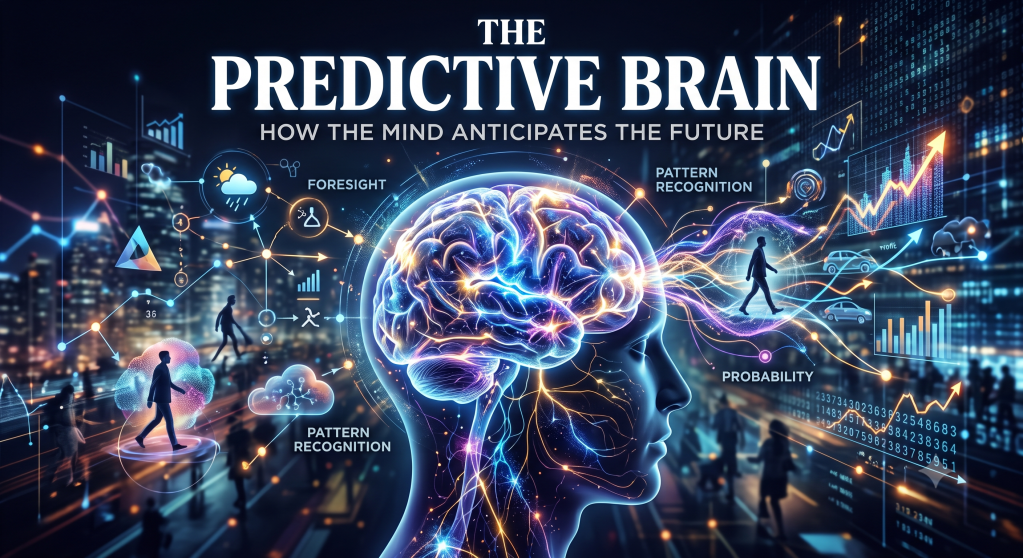
How a wave of influential papers around 2012 reshaped neuroscience’s understanding of perception, framing the brain as a prediction machine rather than a passive observer.
In the early 2010s, neuroscience was quietly rewriting one of its oldest assumptions. For more than a century, the dominant story of perception had gone something like this: light hits the eye, sound waves hit the ear, and the brain builds a picture of the world from that incoming information, piece by piece, like a detective assembling clues. It was a comforting model because it matched intuition. We feel like we simply see what’s in front of us.
But by 2012, a different picture was gaining serious traction among neuroscientists, psychologists, and philosophers of mind. The brain, according to this view, is not a passive receiver of sensory data. It is a prediction machine. Long before your eyes register the coffee cup on your desk, your brain has already guessed it will be there, in roughly that shape, at roughly that distance. What your senses provide isn’t a fresh picture of reality; it’s a correction, a small update to a story your brain was already telling itself.
This idea, often called predictive coding or predictive processing, didn’t appear out of nowhere in 2012. It had roots stretching back to 19th-century physiologist Hermann von Helmholtz, who described perception as “unconscious inference.” But the years around 2012 marked a turning point, a moment when theoretical papers, computational models, and brain-imaging studies converged to make the predictive brain one of the most talked-about frameworks in cognitive science. This was also a period when the broader culture was becoming newly obsessed with the reliability of memory, the fallibility of eyewitness testimony, and the unsettling gap between what we perceive and what is actually there. The predictive processing framework offered a scientific explanation for why that gap exists.
This article traces how the idea developed, what the key papers actually argued, why the theory reshaped how scientists think about perception, attention, and even mental illness, and what has held up more than a decade later.
The Old Model: Perception as a Camera
To understand why the predictive brain idea mattered, it helps to understand what it was replacing. For most of the 20th century, the working assumption in psychology and neuroscience was a bottom-up model of perception. Sensory organs collect raw data. That data travels up through increasingly sophisticated layers of the brain, getting processed and refined at each stage, like a photograph developing in stages until a finished image appears.
This model made sense of a lot of behavior, and it still underlies plenty of legitimate neuroscience. But it struggled with some stubborn puzzles. Why do people so often see what they expect to see rather than what’s actually in front of them? Why does a garbled sentence become perfectly clear once you know the topic of conversation? Why do optical illusions work at all, if the brain is simply reading off sensory input? Bottom-up models could describe these phenomena, but they had a harder time explaining them from first principles.
Enter the Free-Energy Principle
An important computational precursor came from Rao and Ballard’s influential 1999 model of predictive coding in the visual cortex, which gave Helmholtz’s old idea of “unconscious inference” a concrete neural mechanism, showing mathematically how a layered system of neurons could generate predictions and correct them using error signals. That model laid quiet groundwork for what came next.
The theoretical groundwork for the predictive brain surged forward through the work of British neuroscientist Karl Friston, whose ideas about the “free-energy principle” had been building since the mid-2000s and reached a particularly influential form around 2010. Friston’s proposal was ambitious: he argued that the brain’s fundamental job, at every level from individual neurons to whole cognitive systems, is to minimize the difference between what it predicts and what it actually senses. He called this difference “prediction error,” and he argued that reducing it is essentially what brains are for. Much of this framework draws on Bayesian statistics, in which prior expectations are continually updated as new evidence arrives.
This is a dense idea, so it helps to simplify it. Imagine your brain is constantly running a simulation of the world, a kind of internal movie that anticipates what’s about to happen next. Every time your senses report something that doesn’t match the movie, that mismatch gets flagged. The brain then has two options: update the internal movie to match reality, or, in some cases, act on the world to make reality match the movie. Friston later called this second process active inference: organisms reduce prediction errors not only by updating beliefs but also by acting to make the world conform more closely to those expectations.
Both options serve the same underlying goal of eliminating the mismatch. Friston’s framework tied prediction error minimization to a set of mathematical tools borrowed from statistics and information theory, which made the theory unusually rigorous compared to some looser ideas in psychology at the time. That rigor has its limits, though. The free-energy principle is often criticized, even by sympathetic scientists, as being so broad and mathematically flexible that it can be made to fit almost any observation after the fact. It functions more as an overarching theoretical framework than as a set of specific, falsifiable predictions, and that distinction matters when evaluating how much explanatory weight it can bear.
The Paper That Brought Predictive Processing to a Wider Audience
If Friston’s work laid the mathematical foundation, it was philosopher Andy Clark’s writing that translated the idea for a broader academic audience, and eventually for the public. Clark, working at the University of Edinburgh, had been developing and refining the argument through the early 2010s, and it crystallized in a major target article published in the journal Behavioral and Brain Sciences in 2013, though the paper had circulated in draft form and generated discussion within the field well before that.
Clark’s argument was that brains are essentially prediction machines that support perception and action by constantly attempting to match incoming sensory input with top-down expectations, using what he described as a layered, hierarchical system that works to minimize prediction error through a bidirectional flow of processing across the cortex. In plain terms, Clark was describing a brain organized in layers, with higher layers making broad predictions (“that’s probably a face”) and lower layers checking those predictions against raw sensory detail (“does it have the right edges, shadows, and proportions for a face?”). When the layers agree, perception feels effortless and automatic. When they disagree, that mismatch travels back up the hierarchy as an error signal, prompting either a revised prediction or closer attention to the conflicting detail.
What made Clark’s paper so influential wasn’t just the theory itself but the scope of its ambition. He argued this framework could unify not just perception, but attention, action, and even the emotional coloring of experience, into a single explanatory model. The paper concluded that this hierarchical prediction machine approach offered the best available clue to a unified science of mind and action. That kind of sweeping claim invited plenty of pushback from other researchers, which is exactly what happened; the journal published dozens of critical commentaries alongside the original article, a standard practice for that publication’s format, and the resulting exchange became one of the most cited debates in the field.
Around the same time, philosopher Jakob Hohwy published a related but distinct book-length treatment of the same core idea, and the two works together are often credited with popularizing the phrase “predictive processing” outside of specialist neuroscience circles.
What Prediction Errors Actually Look Like in the Brain
To ground this in something more concrete than abstract information theory: Predictive coding proposes that different frequencies of communication carry different kinds of information in the cortex. Feedback signals, carrying predictions downward from higher-order brain regions to lower-order sensory regions, tend to be associated with slower oscillating brain activity. Feedforward signals, carrying prediction errors upward from sensory regions toward higher-order ones, tend to be associated with faster oscillating activity. Researchers using EEG and other brain-imaging tools found patterns broadly consistent with this division, which gave the theory some genuine empirical traction rather than leaving it purely as a philosophical proposal.
This distinction also offered a tidy explanation for a strange and specific phenomenon: mismatch negativity, a well-documented brain response that occurs when a person hears a sequence of repeated sounds interrupted by an unexpected one. The brain’s electrical response spikes noticeably at the moment of the surprising sound, even when the person isn’t consciously paying attention to the sequence. Under the older bottom-up model, this was a curiosity. Under predictive processing, it made obvious sense: the brain had built a prediction from the repeated pattern, and the interruption generated a large, measurable prediction error.
Attention as a Volume Knob
One of the more intuitive contributions of predictive processing theory was its account of attention. Rather than treating attention as a spotlight that simply illuminates certain sensory information more brightly, the theory proposed that attention works by adjusting how much weight, or “precision,” is given to prediction errors from a particular source.
Think of it like adjusting the sensitivity of a smoke detector. If you’re cooking, you might expect some smoke and effectively turn the detector’s sensitivity down, so it doesn’t overreact to expected smoke drifting from the stove. If you’re not cooking and suddenly smell smoke, that same detector should be highly sensitive, because the input strongly contradicts what should be happening. Predictive processing theory suggested the brain performs something structurally similar. When you expect a certain input to be unreliable or unimportant, you weight its prediction errors low, effectively tuning it out. When you expect an input to matter, you turn up the weighting, making yourself more sensitive to any mismatch. This offered a mechanistic explanation for why attention feels less like a mental spotlight and more like a dynamic recalibration of what counts as noteworthy.
Illusions, Hallucinations, and a New Way to Think About Mental Illness
Perhaps the most striking implication of the predictive brain framework was its application to psychiatric conditions. If perception is a negotiation between prior expectation and incoming sensory evidence, then disorders of perception might reflect an imbalance in that negotiation rather than damage to the sensory organs themselves.
Researchers working in this period proposed that some symptoms of schizophrenia, particularly hallucinations and delusions, might arise when the brain assigns too much weight, or precision, to its own internal predictions relative to actual sensory evidence. Under this account, a hallucination isn’t a broken sensory system; it’s a prediction that has become so confidently held that it overrides the corrective signal that normal perception depends on. This was a genuinely novel way to think about psychiatric symptoms, shifting the conversation away from purely chemical explanations and toward questions about how confidently the brain trusts its own expectations versus the evidence in front of it.
It’s important to be careful about how strong this claim actually was, then and now. This was, and largely remains, a theoretical proposal rather than an established clinical fact. It offered a compelling and mathematically coherent narrative, and it generated useful hypotheses for further research, but it did not amount to a demonstrated mechanism for any specific mental illness. The distinction between an elegant explanatory framework and a proven causal account is one that responsible coverage of this topic has to maintain.
Why This Idea Resonated Beyond the Lab
Part of why predictive processing caught on so widely in the early 2010s had to do with the cultural moment surrounding it. This was an era of growing public skepticism about the reliability of memory and perception, fueled partly by high-profile legal cases involving mistaken eyewitness identifications and partly by a broader psychological literature on cognitive biases that was reaching general audiences through popular books and media coverage. A theory suggesting that perception itself is shaped by expectation, rather than being a neutral window onto reality, fit neatly into that emerging cultural conversation.
There was also a technological backdrop worth noting. The early 2010s saw rapid advances in machine learning, particularly in a family of techniques that would soon be called deep learning. Some of these systems used layered, hierarchical architectures that bore a structural resemblance to what predictive coding proposed for biological brains, with higher layers processing more abstract patterns and lower layers processing raw input. This cross-pollination between artificial intelligence research and theoretical neuroscience made the framework seem especially timely, even though the computational similarities should not be mistaken for evidence that biological brains operate identically to these engineered systems.
What Has Held Up, and What Hasn’t
Looking back from 2026, we can now assess how well the predictive brain framework has aged. The core insight, that the brain actively generates expectations and that perception involves comparing those expectations against incoming sensory data, has held up well and remains broadly accepted across cognitive neuroscience. It successfully explained phenomena that older models struggled with, and it continues to generate productive research questions.
What has proven more contested is the scope of the claim. Critics, including some sympathetic to the general framework, have pointed out that predictive processing theories can be difficult to test in ways that could actually disprove them. A theory flexible enough to explain almost any pattern of brain activity after the fact runs the risk of explaining too much, which is a real scientific liability rather than a strength. Other researchers have questioned whether “prediction” is really doing the explanatory work claimed for it, or whether it’s sometimes a relabeling of processes that were already understood in other terms.
The application of predictive processing to psychiatric conditions has also matured considerably since the early 2010s, generating a substantial body of follow-up research, though it remains one hypothesis among several rather than a settled explanation for conditions like schizophrenia. And the analogy to deep learning systems, while suggestive, has been treated with more caution over time, as neuroscientists have become wary of assuming that computational similarity implies biological equivalence.
Conclusion
The rise of the predictive brain as a serious scientific framework marked a genuine shift in how researchers think about the relationship between mind and world. Rather than treating perception as a straightforward recording of external reality, the theory proposed something more unsettling and, in many ways, more interesting: that what we experience is always partly a construction, a best guess continually checked and corrected against the evidence our senses provide.
This idea mattered well beyond neuroscience departments. It offered a scientific vocabulary for a broader cultural unease about the reliability of memory and perception that was already taking hold in the early 2010s, and it provided psychiatry with a new theoretical lens for thinking about hallucinations and delusions. It also arrived at a moment when artificial intelligence research was independently converging on hierarchical, layered architectures, lending the theory an interdisciplinary relevance that few neuroscience frameworks achieve.
More than a decade later, the predictive brain hasn’t been overturned, but it has been refined, narrowed in places, and subjected to the kind of sustained scrutiny that any influential scientific idea should expect. That combination of durability and continued debate is, in its own way, a sign of a theory that was doing something right from the start: not offering a final answer, but reframing the question in a way that generated genuine scientific progress.









