
What Happens When Your Nervous System Stops Treating Life Like an Emergency
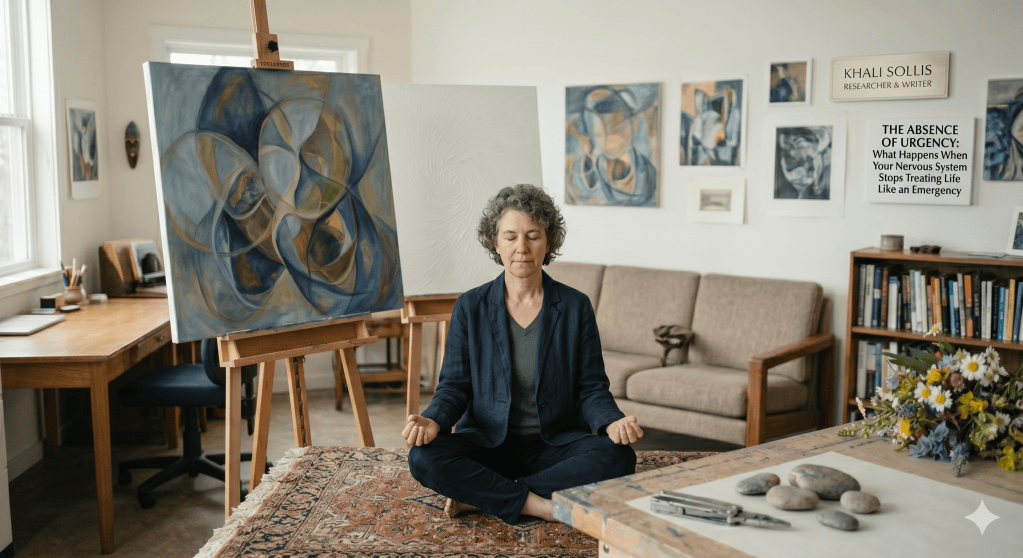
Many people do not miss the pain. They miss the intensity.
For a long time, urgency can feel indistinguishable from aliveness.
The constant anticipation.
The emotional intensity.
The hypervigilance.
The pressure to manage, fix, prepare, respond.
The nervous system becomes so accustomed to operating inside survival activation that stillness starts feeling unfamiliar.
Almost suspicious.
At first, people rarely recognize this consciously.
They simply believe they are:
- highly responsible
- deeply caring
- exceptionally driven
- always prepared
And sometimes they are.
But beneath the functionality, another process is often occurring:
The nervous system has stopped distinguishing between importance and emergency.
Everything feels urgent.
Every conversation.
Every emotional shift.
Every delayed response.
Every uncertainty.
Every possibility of instability.
The body remains partially braced against life itself.
This state becomes so normalized that many people do not realize how much energy constant urgency consumes until the activation finally begins fading.
And when it does, something unexpected often appears first:
Disorientation.
Because peace is quieter than survival.
A regulated nervous system can initially feel emotionally unfamiliar to people conditioned by chronic adaptation.
There is no constant adrenaline.
No emotional emergency to solve.
No endless anticipation of collapse.
And strangely, the absence of urgency can initially feel emotionally empty.
Not because peace is wrong.
But because the body had learned to associate activation with meaning.
This is one of the hidden consequences of prolonged survival states.
The nervous system becomes chemically accustomed to intensity.
Chaos creates stimulation.
Hypervigilance creates focus.
Emotional unpredictability creates heightened alertness.
Over time, the body begins organizing itself around activation as a baseline operating condition.
That is why many people unconsciously recreate stressful dynamics even after leaving difficult environments.
Not because they consciously want suffering.
But because calmness feels neurologically unfamiliar.
The body keeps searching for:
- tension
- urgency
- emotional spikes
- relational instability
- over-responsibility
because survival conditioned the nervous system to expect them continuously.
This creates an important realization:
Healing is not merely escaping painful environments.
It is learning how to emotionally tolerate peace without unconsciously generating new emergencies.
That process can feel surprisingly uncomfortable.
People often expect safety to feel euphoric immediately.
But many times, safety first feels quiet.
Slow.
Spacious.
And for nervous systems conditioned by prolonged urgency, spaciousness can feel deeply disorienting.
There is suddenly:
- time to think
- room to feel
- silence between crises
- emotional energy no longer consumed entirely by survival management
That silence changes things.
Previously suppressed emotions begin surfacing.
Fatigue becomes visible.
Grief becomes accessible.
Desire becomes audible again.
Without constant urgency distracting the system, the person begins noticing how long they lived emotionally compressed.
This is often the phase where people realize they were not actually “bad at resting.”
They were simply unable to rest while their nervous system believed danger was continuous.
The body was never refusing peace.
It was preparing for impact.
That distinction matters profoundly.
Because many survival-conditioned people secretly feel uncomfortable when life becomes emotionally calm.
They may:
- overthink stable relationships
- feel guilty during rest
- create unnecessary pressure
- seek stimulation compulsively
- interpret peaceful periods as “boring”
- distrust situations that lack emotional volatility
Not because calmness lacks value.
Because intensity became familiar.
And familiarity powerfully shapes emotional perception.
Some people spend years confusing emotional activation with passion.
Anxiety with love.
Urgency with purpose.
Hypervigilance with responsibility.
But eventually, the nervous system begins recalibrating.
The body slowly learns:
not every silence predicts abandonment,
not every pause signals danger,
not every peaceful moment requires preparation for collapse.
That learning changes identity profoundly.
Because survival-based identities are often organized around constant management.
The person becomes accustomed to:
- anticipating needs
- preventing instability
- scanning for emotional shifts
- carrying excessive responsibility
- remaining perpetually prepared
So when urgency disappears, identity confusion often appears too.
If I am no longer constantly managing survival,
what do I do with all this emotional space?
That question sits underneath much of early healing.
At first, the nervous system may try filling the silence automatically.
Searching for problems.
Creating unnecessary stress.
Re-entering familiar emotional chaos.
Not because suffering is desired.
Because regulation is still being learned.
A peaceful life requires capacities survival mode never developed fully:
- presence
- receptivity
- patience
- emotional spaciousness
- trust in continuity
- the ability to exist without constant defense
Those states take practice.
Especially after years of nervous system compression.
But slowly, something remarkable begins happening.
The body stops treating every uncertainty as catastrophe.
The mind stops catastrophizing ordinary pauses.
The nervous system stops organizing existence entirely around protection.
And within that shift, another realization quietly emerges:
Peace is not empty.
It is simply less loud than survival.
That realization can feel almost surreal at first.
Because for many people, this may be the first time life has not felt like something that must be constantly outrun, repaired, managed, or endured.
The person begins discovering:
- calm without numbness
- stillness without fear
- connection without hypervigilance
- rest without guilt
- existence without constant emotional emergency
Not perfectly.
But increasingly.
And perhaps that is one of the deepest transformations healing creates:
The nervous system no longer experiences life primarily as a threat requiring perpetual urgency.
Instead, life slowly becomes something else entirely:
A place the self is finally allowed to fully arrive inside.









