
The Strange Mourning That Happens When You Outgrow Survival Identities
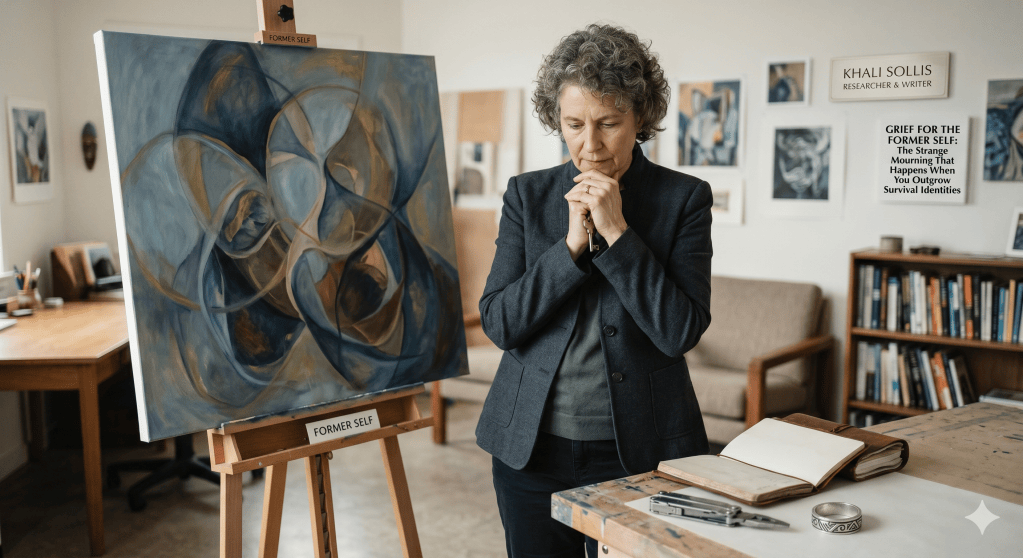
Sometimes healing feels less like becoming someone new and more like mourning the person who learned how to survive without ever fully being allowed to live.
Most people expect healing to feel victorious.
Liberating.
Empowering.
Clear.
What many people do not expect is grief.
Not grief only for relationships, lost years, or missed opportunities.
A stranger kind of grief.
Grief for the former self.
The version of you that adapted so completely to survival that she became difficult to separate from your actual identity.
At first, survival identities do not appear harmful.
In fact, they are often incredibly effective.
They help people:
- endure instability
- remain emotionally functional
- preserve connection
- anticipate danger
- minimize rejection
- survive environments that required adaptation over authenticity
The survival self becomes highly intelligent.
Highly observant.
Highly capable.
And because these adaptations work, they often become deeply integrated into personality itself.
The person stops asking:
“Who did I become to survive?”
Because survival eventually feels normal.
That’s why outgrowing survival identities can feel emotionally disorienting.
The old self was not imaginary.
She protected you.
She knew how to:
- remain useful
- stay emotionally manageable
- suppress overwhelming feelings
- anticipate instability
- function under pressure
- survive disappointment repeatedly
And for many years, those skills were necessary.
That truth matters.
Because healing becomes much more compassionate when people stop treating their former selves as embarrassing mistakes and begin understanding them as intelligent adaptations to difficult emotional realities.
The former self was not weak.
She was overworked.
She carried responsibilities the nervous system was never meant to sustain indefinitely.
But eventually, something changes.
The survival identity that once protected the person begins limiting them instead.
The hyper-independence becomes isolation.
The emotional suppression becomes numbness.
The constant adaptability becomes identity erosion.
The vigilance becomes exhaustion.
And slowly, the person begins realizing:
The version of me that kept me alive cannot fully accompany me into the life I now want to build.
That realization creates grief.
Real grief.
Because healing is not merely gaining new capacities.
It is also losing identities once organized entirely around survival.
People rarely discuss this part openly.
The sadness that appears when old coping structures stop feeling necessary.
Not because the structures were healthy.
But because they were familiar.
The former self knew the rules of survival.
She knew how to function inside limitation.
How to endure emotional scarcity.
How to remain psychologically operational even during prolonged suppression.
Letting go of that identity can feel strangely vulnerable.
Almost like removing armor in unfamiliar territory.
Especially because survival identities often become intertwined with self-worth.
The person may unconsciously admire themselves for:
- how much they tolerated
- how little they needed
- how resilient they became
- how efficiently they carried pain privately
So when healing begins softening those structures, identity confusion appears.
If I am no longer surviving constantly,
who am I now?
That question contains enormous emotional weight.
Because many people spent years becoming experts in endurance while never learning how to exist without crisis organizing the nervous system.
The former self knew how to survive.
But she may never have learned:
- rest without guilt
- love without performance
- safety without vigilance
- authenticity without fear of abandonment
- desire without suppression
That learning process changes identity profoundly.
And every major identity shift contains mourning.
People often assume grief only appears after visible loss.
But humans also grieve internal versions of themselves.
Especially versions that carried them through emotionally difficult seasons.
The grief can appear unexpectedly.
A sudden sadness while remembering how hard you worked to remain emotionally acceptable.
A quiet ache realizing how young you were when you learned to suppress yourself.
A strange tenderness toward the person who normalized exhaustion because survival required it.
This grief is not regression.
It is integration.
The psyche finally slowing down enough to emotionally process what adaptation once forced it to ignore.
That is why healing sometimes feels emotionally heavier before it feels lighter.
The body begins releasing identities it spent years constructing carefully for protection.
And protection, even painful protection, creates attachment.
Especially when the survival identity succeeded externally.
Many former survival selves were admired.
Praised for:
- strength
- reliability
- maturity
- composure
- emotional intelligence
- resilience
Very few people recognized the cost beneath the functionality.
The exhaustion.
The self-erasure.
The chronic nervous system compression.
The emotional labor required to remain “strong.”
Eventually, the person begins seeing the former self more clearly.
Not as broken.
Not as foolish.
But as someone who carried too much for too long.
That reframing changes grief entirely.
Because healing is not about humiliating the past self for surviving imperfectly.
It is about understanding why certain identities formed in the first place.
And perhaps the most beautiful part of this process is what eventually emerges beneath the grief:
Compassion.
Not only for the current self.
For the former self too.
The one who:
- adapted constantly
- stayed too long
- tolerated too much
- minimized her own needs
- believed survival was the same thing as living
She deserves compassion.
Because she built the bridge that allowed the future self to finally arrive somewhere safer.
And perhaps healing reaches a deeper level the moment people stop asking:
“Why was I like that?”
And begin asking:
“What was that version of me trying so hard to protect?”









