
What Happens After Survival Stops Defining You
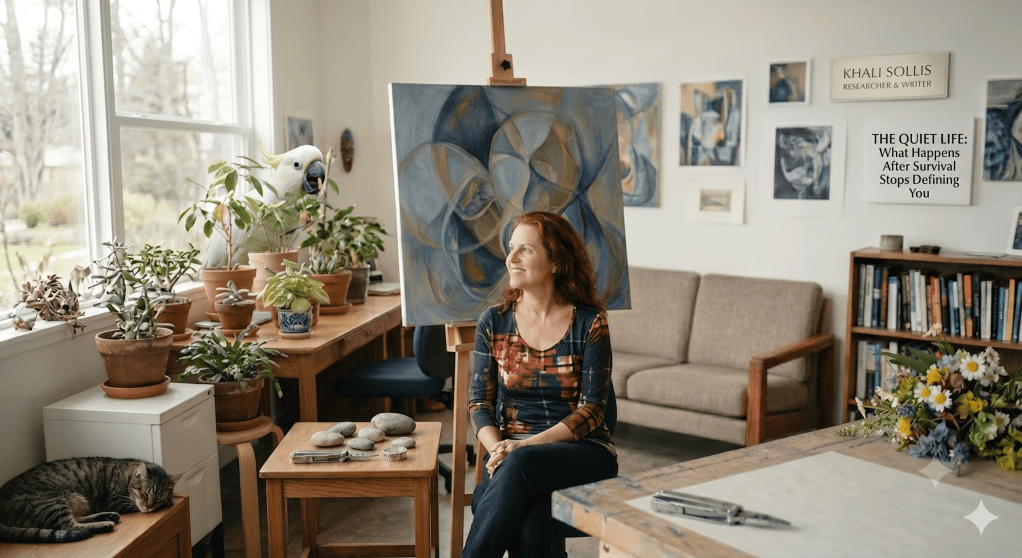
Healing does not always end with reinvention. Sometimes it ends with the nervous system finally understanding that it no longer has to survive every moment of its own existence.
At first, the absence feels unfamiliar.
No constant urgency.
No emotional emergency.
No endless over-analysis.
No perpetual anticipation of collapse.
Just quiet.
Not empty quiet.
Safe quiet.
For people who spent years organized around survival, this kind of stillness can feel almost unreal at first.
Because survival is loud.
It demands constant attention.
Constant adjustment.
Constant emotional movement.
The nervous system becomes highly skilled at:
- anticipating instability
- managing disappointment
- carrying excessive responsibility
- suppressing internal truth for external continuity
- adapting quickly to emotional unpredictability
And eventually, survival stops feeling like a temporary condition.
It becomes identity.
The person no longer asks:
“How do I live?”
They ask:
“How do I prevent collapse?”
That question shapes entire lives.
For years, existence may revolve around:
- endurance
- functionality
- emotional management
- maintaining stability at personal cost
- preserving structures that no longer feel internally alive
And then slowly — sometimes almost imperceptibly — something changes.
The nervous system stops bracing constantly.
The body no longer wakes already preparing for emotional impact.
The mind stops scanning every silence for danger.
The self stops treating peace as suspicious.
And in that shift, life begins feeling different.
Not dramatic.
Not euphoric.
Just… inhabitable.
That word matters.
Because many people survive inside lives they cannot fully inhabit emotionally.
The routines continue.
The obligations continue.
The personality continues.
But internally, the person remains partially absent from their own existence.
The Quiet Life begins when that absence starts dissolving.
Not because life becomes perfect.
But because the nervous system is no longer consumed entirely by protection.
For the first time, energy becomes available for things beyond survival.
Curiosity returns quietly.
Presence returns quietly.
Joy returns quietly.
Not as performance.
Not as forced positivity.
As natural emotional movement.
The person notices small things again:
- sunlight through a window
- laughter that does not feel guarded
- conversations without hypervigilance
- rest without guilt
- silence without panic
- affection without emotional calculation
These moments may appear insignificant externally.
But psychologically, they are enormous.
Because survival-conditioned people often spent years unable to experience life without simultaneously monitoring it.
Even happiness was partially filtered through anticipation:
How long will this last?
What will this cost?
When will it disappear?
The body remained prepared for interruption.
Prepared for withdrawal.
Prepared for instability.
The Quiet Life changes that relationship slowly.
The nervous system begins learning something it may have never fully trusted before:
Goodness does not always require immediate defense.
That realization alters emotional posture profoundly.
The person no longer feels compelled to:
- over-explain themselves constantly
- prove their worth continuously
- earn rest through exhaustion
- shrink emotionally for acceptance
- survive every interaction defensively
Life becomes less performative.
More direct.
The self stops existing primarily as a survival mechanism.
And perhaps one of the strangest parts of healing is realizing how ordinary peace actually feels.
Movies portray transformation as dramatic.
Explosive.
Life-altering.
But often, real healing looks much quieter than people expect.
It looks like:
- sleeping without dread
- eating without emotional negotiation
- existing without constant self-monitoring
- trusting your own perception
- saying “no” without collapse
- receiving care without panic
- no longer romanticizing emotional chaos
It looks like the nervous system finally understanding:
I do not have to remain prepared for suffering at all times.
That realization creates enormous internal spaciousness.
And within that spaciousness, identity changes naturally.
The person no longer organizes life entirely around:
- fear
- adaptation
- scarcity
- hypervigilance
- emotional performance
- survival maintenance
Instead, life begins organizing itself around congruence.
What feels true.
What feels alive.
What feels emotionally sustainable.
What allows the self to remain fully present inside existence.
This does not make the person fearless.
It makes them less divided internally.
And perhaps that is the deepest transformation of all.
Because survival creates fragmentation.
One part of the self protects.
Another suppresses.
Another performs.
Another endures.
The Quiet Life begins when those internal negotiations start softening.
The person no longer feels at war with themselves.
There is less urgency to become someone else.
Less desperation to prove worth.
Less attachment to identities built entirely around endurance.
And slowly, another realization emerges:
Healing was never about becoming extraordinary.
It was about becoming internally free enough to experience ordinary life without chronic emotional defense.
That freedom changes everything.
The person begins understanding:
peace is not boredom,
softness is not weakness,
stability is not emotional imprisonment,
and rest is not something that must constantly be justified.
The body softens.
The mind quiets.
The nervous system stops treating existence itself like an emergency.
And eventually, life becomes something many survival-conditioned people once considered impossible:
Not spectacular.
Not cinematic.
Not endlessly intense.
Just real.
A quiet morning.
A regulated breath.
An honest relationship.
A calm nervous system.
A life that no longer requires self-betrayal to maintain.
And perhaps that is the most profound ending after all:
Not becoming untouchable.
Not becoming perfect.
Simply becoming someone who no longer has to abandon themselves in order to stay alive.









