
What Happens When Your Life Finally Becomes Larger Than Survival
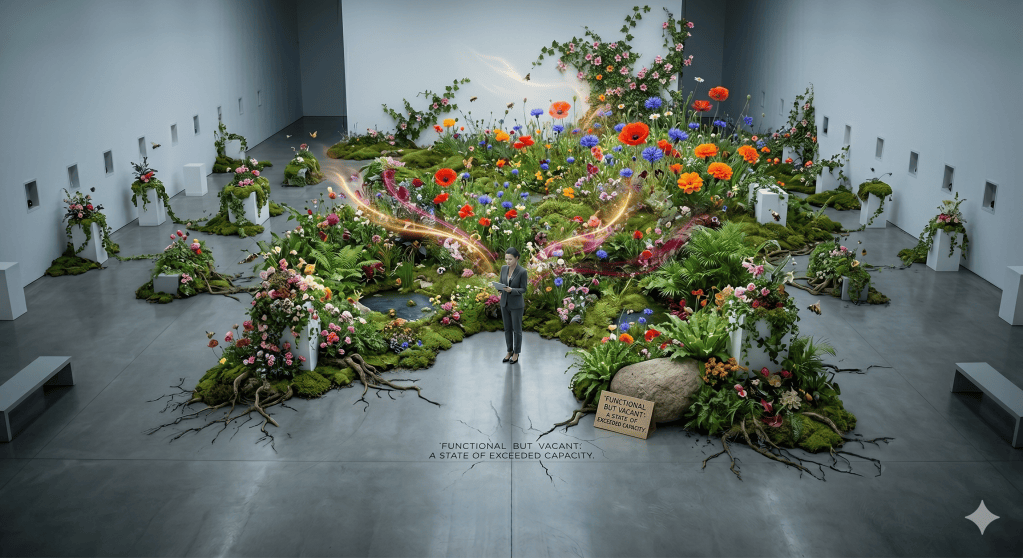
Some people are not afraid of suffering anymore. They are afraid of how unfamiliar freedom feels
For a long time, survival organizes the nervous system.
Not joy.
Not expansion.
Not possibility.
Survival.
The person becomes highly skilled at:
- enduring uncertainty
- minimizing needs
- adapting quickly
- tolerating emotional deprivation
- functioning under pressure
- carrying excessive responsibility
And eventually, these survival adaptations stop feeling temporary.
They become identity.
The nervous system calibrates itself around limitation.
Around vigilance.
Around compression.
That is why many people imagine healing incorrectly.
They assume the moment life becomes safer, healthier, or more aligned, relief arrives automatically.
But often, something much stranger happens first:
Capacity shock.
The nervous system begins encountering realities it was never conditioned to hold comfortably:
- rest without guilt
- support without control
- love without performance
- stability without suppression
- possibility without immediate danger
And instead of immediate peace, the person often experiences disorientation.
Sometimes even anxiety.
Not because the expansion is bad.
But because it is unfamiliar.
After years of survival, the system becomes deeply adapted to constriction.
The body learns how to function inside scarcity, instability, emotional overwork, and constant vigilance.
Freedom requires entirely different internal architecture.
That transition can feel profoundly destabilizing.
Especially for people whose identities were built around endurance.
Because suffering creates structure.
It creates predictability.
It gives the nervous system a familiar role:
Manage.
Protect.
Anticipate.
Survive.
But when life begins expanding beyond survival, those roles become less necessary.
And suddenly, the system no longer knows what to organize itself around.
This is why some people unconsciously sabotage healthy opportunities after long periods of suppression.
Not because they consciously want pain.
But because the nervous system experiences unfamiliar expansion as potential instability.
The person may finally receive:
- healthy love
- emotional safety
- financial improvement
- creative freedom
- spaciousness
- genuine support
And yet internally, panic appears alongside relief.
That contradiction confuses many people.
They think:
“If this is what I wanted, why does it feel uncomfortable?”
Because the nervous system does not immediately distinguish between:
- danger
and - unfamiliarity.
And after years of compression, expansion itself can feel neurologically unsafe.
This often appears in subtle ways.
Difficulty relaxing during peaceful periods.
Anxiety when things are going well.
Suspicion toward ease.
The compulsive urge to prepare for collapse even in stable environments.
The body keeps anticipating deprivation because deprivation was historically reliable.
This creates an important realization:
Healing is not merely obtaining better circumstances.
It is developing the internal capacity to emotionally tolerate better circumstances without unconsciously recreating survival conditions.
That process takes time.
Because survival identities often become emotionally attached to struggle itself.
Not consciously.
Structurally.
The person becomes accustomed to measuring worth through:
- endurance
- sacrifice
- hyper-independence
- emotional labor
- resilience under pressure
So when life becomes softer, slower, or more supportive, identity confusion emerges.
If I am no longer constantly surviving,
who am I now?
That question sits underneath much of capacity shock.
The nervous system has spent years preparing for impact.
Now suddenly it must learn receptivity.
Allowance.
Presence.
Enjoyment.
Those states sound simple conceptually.
But for survival-conditioned systems, they can feel deeply vulnerable.
Because enjoying life requires openness.
And openness once felt dangerous.
That is why many people feel emotionally exposed when they begin experiencing genuine alignment.
The armor that protected them during survival phases starts becoming unnecessary.
And removing armor — even heavy armor — can initially feel unsafe.
There is grief inside this process too.
Grief for how long survival was normalized.
Grief for how foreign peace once felt.
Grief for all the years the nervous system remained too occupied with endurance to fully experience expansion.
But alongside the grief, something else slowly develops:
Capacity.
Not merely the capacity to survive hardship.
The capacity to hold goodness without distrusting it.
That may be one of the most overlooked forms of healing.
Learning how to remain emotionally present when life stops requiring constant defense.
Learning how to receive:
- support
- rest
- softness
- love
- possibility
without immediately preparing for their disappearance.
Because eventually, the nervous system begins realizing something extraordinary:
Safety is not a temporary interruption before the next disaster.
Expansion is not recklessness.
Peace is not weakness.
And slowly, the body stops organizing itself entirely around protection.
Curiosity returns.
Creativity returns.
Playfulness returns.
The future begins feeling open instead of threatening.
Not because life suddenly becomes perfect.
But because the self is no longer exclusively calibrated for survival.
That recalibration changes everything.
The person begins noticing how much energy was previously consumed by:
- hypervigilance
- emotional guarding
- self-minimization
- fear-based adaptation
- anticipating instability
And with that energy no longer fully occupied by survival, something unfamiliar finally becomes possible:
Expansion.
Not performative expansion.
Not forced positivity.
Real expansion.
The slow, nervous-system-level realization that life may contain more than endurance.
And perhaps that is the true meaning of healing:
Not simply escaping pain.
But developing the capacity to remain open when life finally becomes larger than survival.









