
Originally published in December 2013 and comprehensively updated/edited in July 2026.
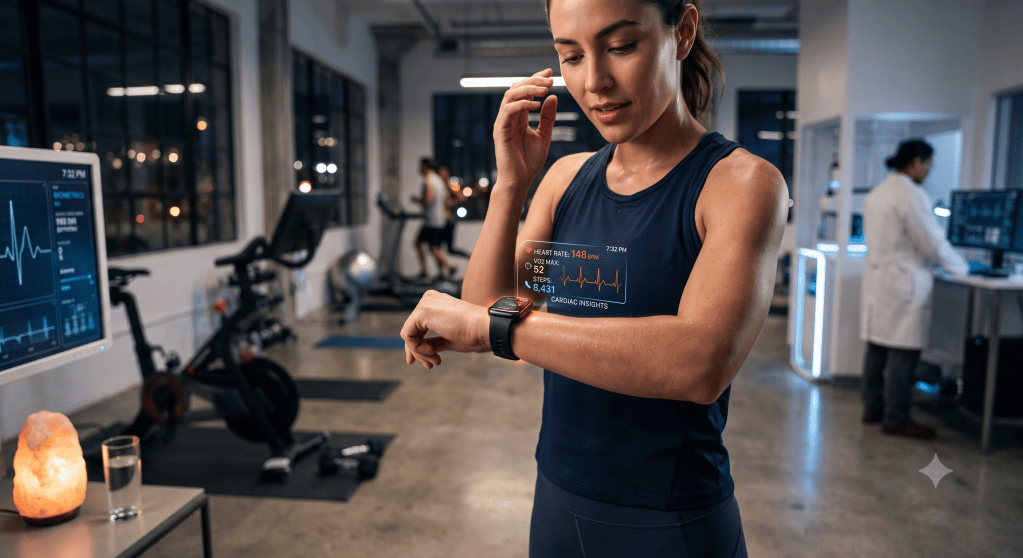
How 2013’s Fitbit, Jawbone, and Nike trackers launched continuous personal health monitoring — and the psychology and science behind why it worked.
In late 2013, a small plastic clip or wristband started showing up on wrists and belt loops across the United States. It didn’t do much by today’s standards. It counted steps, estimated calories burned, and, if you paid a little more, guessed at how well you’d slept. Yet something about it felt different from the pedometers your gym teacher handed out in the 1990s. This device synced with a phone. It built a graph. It nudged you with a small vibration when you’d been sitting too long. For the first time at consumer scale, ordinary people were generating a continuous, personal stream of health data, and they were doing it voluntarily, for fun, often before they’d even mentioned it to a doctor.
That shift, small as it looked at the time, marked the beginning of something larger. The consumer activity tracker boom of 2013 was not just a gadget trend. It was the moment health monitoring stopped being something that happened occasionally, in a clinic, and became something that happened continuously, in daily life. Understanding why that moment mattered requires looking at three things at once: the technology that made it possible, the psychology that made people want it, and the culture that was primed to receive it.
A Culture Ready for Self-Measurement
By 2013, several cultural currents had already been running for years, and they converged on the wearable device almost by accident. The first was the rise of the smartphone. Just six years after the iPhone’s debut, a large and rapidly growing share of Americans carried a device capable of Bluetooth syncing, cloud storage, and constant connectivity. That infrastructure meant a cheap sensor on your wrist could suddenly talk to a powerful computer in your pocket, which could talk to a server somewhere that stored your data indefinitely. None of this was technically new by 2013, but the pieces had only recently become affordable and reliable enough to combine into a consumer product.
The second current was less technological and more philosophical. In 2007, two editors at Wired magazine, Gary Wolf and Kevin Kelly, had started informally gathering people in the San Francisco Bay Area who were experimenting with tracking aspects of their own lives, from sleep to mood to caffeine intake. <cite index=”16-1″>They had noticed a set of new practices taking shape around them, loosely connected by the idea of adding a computational dimension to ordinary existence.</cite> They called the resulting community the Quantified Self, with the tagline “self-knowledge through numbers.” What began as a single meetup grew into an international network, and <cite index=”15-1″>by 2013, media coverage of the concept had grown substantially compared with just a couple of years earlier</cite>, a sign that the idea had moved from a niche hobby toward something closer to a mainstream sensibility.
The third current was economic. Fitness and wellness had been consumer categories for decades, but the years following the 2008 financial crisis produced a broader cultural appetite for optimization and personal control. In a period marked by job insecurity and stagnant wages, technologies promising measurable, incremental self-improvement found a receptive audience — domains like diet, exercise, and sleep offered a sense of governable progress that larger economic conditions did not. This connection is more interpretive than the device-validation research discussed later in this piece, but it fits a broader pattern researchers have long noted: interest in self-improvement tools tends to rise during periods of economic uncertainty.
The Devices Themselves
The activity tracker market in 2013 was dominated by three companies. <cite index=”3-1″>Fitbit, Jawbone, and Nike together accounted for roughly 97 percent of smartphone-enabled activity trackers sold that year</cite>, with <cite index=”3-1″>Fitbit alone responsible for about two-thirds of sales, Jawbone’s UP band for around a fifth, and Nike’s FuelBand for roughly a tenth</cite>. <cite index=”3-1″>Industry analysts estimated the overall digital fitness device market at around $330 million for the year</cite> — a modest figure by today’s standards, but a striking one for a product category that had barely existed five years earlier.
These early devices were mechanically simple. Most relied on an accelerometer, a small chip that detects motion and changes in orientation, the same basic technology found in smartphones to determine screen rotation. From the pattern of movement, the device’s software estimated steps taken, distance traveled, and calories burned. Some models, worn at night, also attempted to infer sleep stages from how much a person tossed and turned.
Simplicity, though, came with limitations, and researchers were quick to test them. A study that fitted 21 healthy adults with seven different consumer trackers alongside two research-grade devices found that <cite index=”2-1″>consumer trackers correlated strongly with the research instruments for step counts and sleep duration, but only moderately for total daily energy expenditure and for time spent in moderate-to-vigorous activity</cite>. A broader review of the scientific literature on Fitbit and Jawbone devices reached a similar conclusion: <cite index=”1-1″>laboratory-based step counting was highly accurate, generally matching accelerometer-based reference measurements closely</cite>, but other metrics were shakier. <cite index=”5-1″>Energy expenditure tended to be underestimated across studies, while total sleep time and sleep efficiency were often overestimated compared with polysomnography, the clinical gold standard for sleep measurement, and time spent awake after falling asleep tended to be underestimated</cite>.
None of this made the devices useless. It did mean that the numbers people were staring at each night — the calories “earned,” the hours of “deep sleep” logged — carried more uncertainty than the clean graphs suggested. This is a pattern that would recur again and again as wearable technology matured: consumer-facing simplicity often concealed a fair amount of measurement noise underneath.
Why People Wanted to Watch Themselves
Scientific interest in wearables in 2013 wasn’t only about accuracy. Behavioral scientists were also asking a more basic question: does simply watching a number change how people act?
This question had a research history that predated Fitbit by decades. Self-monitoring, the practice of deliberately observing and recording one’s own behavior, had long been studied as a behavior-change technique in clinical psychology, used for everything from smoking cessation to weight management. The general finding was that the act of measurement itself tends to nudge behavior, even without any additional coaching or incentive — a phenomenon sometimes described informally as “what gets measured gets managed.” Closely related is goal-setting theory, developed over several decades by psychologists Edwin Locke and Gary Latham, which found that specific, moderately difficult goals tend to produce better performance than vague goals like “do your best.” A tracker that displayed a concrete daily step target, and showed in real time how close you were to it, was essentially goal-setting theory built into a consumer product.
Wearable devices added something self-monitoring on paper never had: continuous, low-effort feedback. Instead of writing in a notebook once a day, the device did the counting automatically and displayed the result instantly, often as a small ring that filled in as you moved. Behavioral researchers studying personal informatics — the broader academic term for tools people use to collect and reflect on data about themselves — had already proposed that people moved through stages when adopting such tools: first collecting data, then reflecting on it, then, ideally, acting on what the reflection revealed. Early industry-sponsored analysis of wearable adoption patterns suggested that many buyers stalled at the first stage, wearing the device enthusiastically for a few months before abandoning it, a pattern that would become one of the more persistent challenges in the field for the next decade.
The Pull of Small Rewards
Part of what kept people engaged, when they did stay engaged, appeared to be a fairly ordinary psychological mechanism: the appeal of small, frequent rewards. Filling a progress ring, hitting a round number of steps, or beating yesterday’s total delivered a modest hit of satisfaction that cost the user almost nothing to obtain. This is the same basic principle that video game designers and app developers were leaning on heavily during the same period, sometimes described under the broad and somewhat overused label of “gamification.” Wearable makers borrowed liberally from that playbook, adding badges, streaks, and social leaderboards where friends could compare step counts.
It’s worth being careful here about what the evidence actually supported at the time. There was reasonable behavioral theory suggesting that frequent feedback and small rewards could sustain short-term engagement, and clear market evidence that people found the devices compelling enough to buy in large numbers. What was much less established in 2013 was whether that engagement translated into lasting changes in health outcomes — reduced disease risk, sustained weight change, or long-term increases in fitness. Most of the research available at the time focused on validating the sensors themselves or on short-term behavioral engagement, not on multi-year health results. That distinction between “people like using this” and “this improves health outcomes” would remain an open, actively studied question for years afterward.
The Social Dimension of Personal Data
Wearable tracking in 2013 was rarely a purely private activity, even though it centered on an intensely personal stream of biological data. Fitbit’s platform, like several competitors, allowed users to connect with friends, compare daily step counts, and post achievements to social feeds. This social layer mattered more than it might first appear.
Human beings are highly attentive to social comparison, a tendency documented since psychologist Leon Festinger’s original social comparison theory in the 1950s: people evaluate their own abilities and opinions partly by comparing themselves with others, especially others they see as similar to themselves. A step count is, among other things, a number that can be ranked. Turning fitness into a comparable, shareable statistic tapped directly into that comparison instinct, for better and for worse. For some users, a friend’s higher step count functioned as gentle motivation. For others, particularly those already prone to anxious or perfectionistic tendencies around health and body image, the same feature could turn a fitness goal into a source of low-grade stress. Researchers and clinicians would spend the following decade working out where that line tended to fall, and the wearable industry itself would eventually add privacy controls and the option to track without comparison, partly in response to concerns raised during this early period.
There was also a quieter cultural shift happening underneath the social features. Health information had traditionally been treated as private, discussed mainly with a doctor or immediate family. The willingness of large numbers of people to display their step counts, sleep patterns, and weight trends to online friends and strangers reflected a broader loosening of boundaries around personal health disclosure, one that ran parallel to the era’s growing comfort with sharing other kinds of personal data on social media.
From Novelty to Infrastructure
What made 2013 a genuine turning point, rather than just another fad year in consumer electronics, is that it established a template that outlived the specific devices themselves. The basic architecture — a wearable sensor, a companion app, a cloud account, a dashboard of personal metrics — became the model that essentially every subsequent health and fitness product would follow, including products that didn’t exist yet in any recognizable form. Smartwatches with heart rate sensors, continuous glucose monitors originally built for people with diabetes but later marketed to general consumers, sleep-tracking mattress pads, and eventually smartphone apps that inferred stress or mood from typing patterns all inherited the same basic premise Fitbit had popularized: that continuous personal data collection was both feasible and desirable. The smartwatch era that followed, including the launch of the Apple Watch in 2015, did not create this behavioral model so much as absorb and expand it, folding step counts and activity rings into a device that also handled messaging, payments, and, eventually, more clinically oriented features like fall detection and heart rhythm alerts.
From Step Counts to Early Warning Signs
The kind of questions these devices answer has also shifted, not just the accuracy of the sensors themselves. The 2013-era question a tracker answered was almost entirely behavioral: how much did I move today, and how well did I sleep? It was a rearview-mirror question, describing what had already happened. The wearables of the mid-2020s increasingly ask a different kind of question, one aimed at anticipation rather than description: does this pattern in my heart rhythm, blood oxygen, or skin temperature suggest something worth checking before I notice any symptoms myself? Continuous glucose monitors, once confined to people managing diabetes, are a clear example of that shift, as are consumer devices that flag irregular heart rhythms for follow-up with a physician. This is a meaningful change in ambition, from fitness tracking toward something closer to preventive medicine, and it raises correspondingly higher stakes around accuracy, false alarms, and the appropriate role of a consumer gadget in decisions that used to belong exclusively to clinicians.
It also established, less happily, a set of unresolved questions that the field would keep returning to. Who owns the data a wearable collects? What happens to it if the company goes out of business or is acquired? Can an employer or insurer request or infer health information from tracker data? These questions barely registered in 2013, when most users were simply delighted that a wristband could count their steps. They would become considerably more pressing as the devices grew more capable and the data they generated grew more medically meaningful.
Scientific Caution Alongside Public Enthusiasm
It’s worth pausing on how researchers, as opposed to marketers, actually talked about these devices at the time. The scientific literature from this period is notably more restrained than the advertising copy. Peer-reviewed validation studies focused narrowly on questions like measurement accuracy and test-retest reliability, and even the more optimistic findings were hedged with caveats about specific movement types, wear positions, and device settings that could shift the results. Public health researchers, for their part, were cautiously interested in wearables as a potential tool for large-scale behavioral research and intervention, since continuous data collection at low cost could, in theory, support studies that would have been prohibitively expensive using older methods like manual activity logs or lab-based testing. But that potential was still largely theoretical in 2013; the infrastructure for using consumer wearable data at genuine research scale was only beginning to be built.
This gap between enthusiastic public adoption and cautious scientific validation is a recurring pattern in the history of consumer health technology, and it’s worth naming plainly rather than glossing over. A device can be popular, engaging, and genuinely useful for building awareness of one’s own habits, while still falling short of the evidentiary standard needed to call it a reliable health measurement tool. Both things were true of activity trackers in 2013, and holding both truths at once is a more accurate picture than either uncritical enthusiasm or dismissive skepticism would offer on its own.
Looking Back From 2026
More than a decade later, the trajectory that began with those early clip-on trackers is easy to trace. Continuous personal health monitoring, which felt novel and slightly eccentric in 2013, is now an unremarkable part of daily life for a large share of the population, embedded in smartwatches, rings, and even clothing. The sensors have improved substantially, with heart rate variability, blood oxygen estimation, and irregular rhythm detection now standard on many devices that would have seemed closer to hospital equipment than consumer electronics back then. Regulatory agencies have developed clearer frameworks for distinguishing wellness features from medical claims. And the research base, while still evolving, is considerably deeper than it was, with large longitudinal studies now able to draw on wearable data at a scale researchers in 2013 could only have imagined.
What hasn’t fundamentally changed is the underlying psychological bargain the technology offers: the promise that watching yourself closely enough, in enough detail, will help you become the version of yourself you’re aiming for. That promise is neither fully true nor entirely false. It rests on real behavioral science, particularly around feedback and goal-setting, while also carrying real risks around obsessive self-monitoring, data privacy, and the temptation to mistake a number on a screen for the full picture of one’s health. The self-tracking revolution did not begin with a medical breakthrough or a scientific discovery. It began with a wristband, a step count, and a simple but consequential idea — that health might be something you could watch happen, day by day, rather than something you only checked on once a year.
Scientific Reference
Evenson, K. R., Goto, M. M., & Furberg, R. D. (2015). Systematic review of the validity and reliability of consumer-wearable activity trackers. International Journal of Behavioral Nutrition and Physical Activity, 12, 159.
Case, M. A., Burwick, H. A., Volpp, K. G., & Patel, M. S. (2015). Accuracy of smartphone applications and wearable devices for tracking physical activity data. JAMA, 313(6), 625–626. (Related free-living validity work summarized in: International Journal of Behavioral Nutrition and Physical Activity, 12, 42.)
Wolf, G. (2010, April 28). The data-driven life. The New York Times Magazine.
Wolf, G., & Kelly, K. (2007). Founding of the Quantified Self movement and community, quantifiedself.com.
Festinger, L. (1954). A theory of social comparison processes. Human Relations, 7(2), 117–140.
Locke, E. A., & Latham, G. P. (2002). Building a practically useful theory of goal setting and task motivation: A 35-year odyssey. American Psychologist, 57(9), 705–717.
Li, I., Dey, A., & Forlizzi, J. (2010). A stage-based model of personal informatics systems. Proceedings of CHI 2010, 557–566.
Ledger, D., & McCaffrey, D. (2014). How the science of human behavior change offers the secret to long-term engagement. Inside Wearables, Endeavour Partners.
NPD Group. (2013–2014). Retail sales data on U.S. activity tracker market, cited in MobiHealthNews.









