
Originally published in December 2015 and comprehensively updated and edited in July 2026.
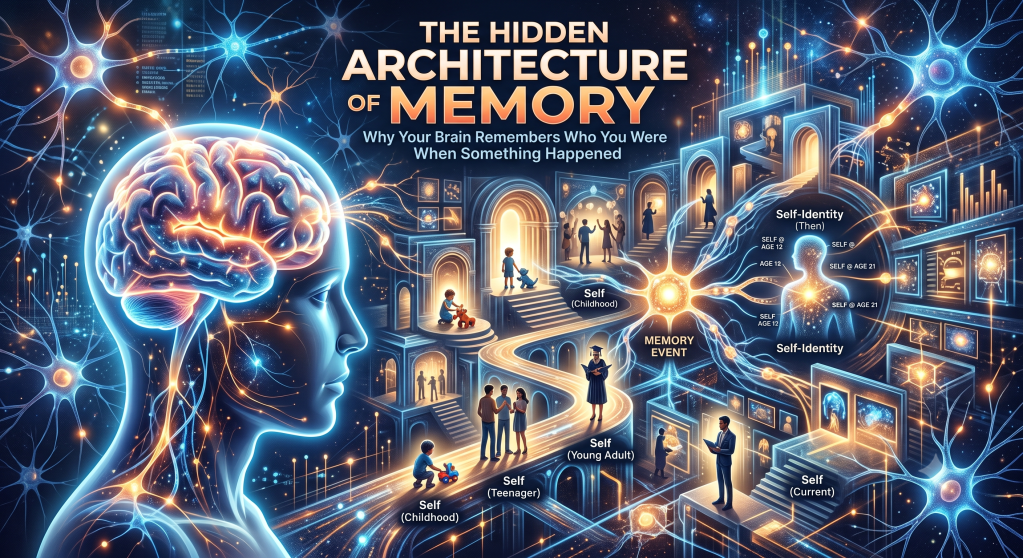
Neuroscience shows memory stores more than events—it preserves the attentional states behind them, reshaping how we see habits, focus, and identity.
In the autumn of 2015, cognitive neuroscience was in the middle of a quiet but significant shift. For decades, memory research had focused mostly on the “what” of experience — the faces, places, words, and events that get filed away in the brain and later retrieved. But a smaller, more curious line of research had started asking a different question: does the brain also remember the state you were in while something happened? Not just what you saw, but how you were paying attention, how focused or scattered your mind was, how tightly you were controlling your thoughts in that moment?
It was a subtle question, and answering it required equally subtle tools. In November 2015, researchers Jiuyang (Julie) Jiang, Nadia Brashier, and Tobias Egner published a study in the Journal of Neuroscience that provided some of the first direct neural evidence that the brain can bind attentional control states to memories of external events. Using brain imaging, they showed that two structures long associated with very different jobs — the hippocampus, famous for building memories of places and events, and the putamen, part of the striatum and better known for habit and motor learning — both carry information about a person’s internal attentional state at the moment a memory is formed. In plain terms: your brain doesn’t just file away what happened. It quietly tags the memory with a record of who you were being while it happened. Not a complete record of identity, of course, but a trace of the cognitive state, attentional stance, and behavioral mode present during that moment.
This finding matters far beyond the walls of a brain-imaging lab. It offers a scientific foothold for something many people sense intuitively but rarely have language for: that certain memories seem to carry an entire mood or mental posture along with them, and that revisiting those cues can pull the old state of mind back into the present. It also has quiet implications for how we think about identity, habit change, and why becoming a different version of yourself is so much harder than simply deciding to.
The Problem With Thinking of Memory as a Filing Cabinet
For most of the twentieth century, memory was often described using a filing-cabinet metaphor. Experiences went in as folders, each one containing a tidy record of the facts: this face, that room, this conversation. Retrieval meant pulling the right folder back out. It’s an appealing image because it’s simple, but it never quite captured how messy and context-sensitive real memory actually is.
Cognitive psychologists had already chipped away at the filing-cabinet idea well before 2015. A classic line of research on context-dependent memory, going back to experiments with divers who learned word lists underwater and recalled them better underwater than on land, showed that the physical environment during learning becomes woven into the memory itself. Mood-dependent memory research found something similar for emotional states: material learned while sad is often recalled more easily when sad again. These findings hinted that memories are not stored as pure content. They’re stored as content plus context.
The 2015 hippocampal-striatal study pushed this idea one step further and into more abstract territory. It wasn’t just asking whether your physical surroundings or your general mood gets bound into a memory. It was asking whether something far more internal and cognitive — your moment-to-moment attentional control state, meaning how tightly or loosely you were regulating your focus — gets bound in too.
What Researchers Mean by “Event Files”
To understand the study, it helps to know about a concept cognitive scientists call the “event file.” The idea, developed earlier by researchers such as Bernhard Hommel, is that when the brain processes an experience, it doesn’t store the stimulus and the response to it as separate items. It binds them together into a single integrated unit, a kind of temporary memory packet. If you later encounter something that overlaps with part of that old event file — say, the same object appears again — the whole file can be reactivated, response and all. This is part of why familiar cues can trigger habitual reactions almost automatically: the brain isn’t reasoning its way to the response, it’s retrieving a bundle it already built.
Earlier behavioral research had suggested that these event files might contain more than just concrete stimuli and responses. They might also contain something more abstract: the attentional control state a person was in, meaning whether they were in a focused, “stay on task” mode or a more flexible, exploratory mode of processing. The 2015 study set out to find the neural evidence for this claim, and to identify where in the brain this binding of internal state to external event actually happens.
Inside the Study: Watching the Brain Bind Mind to Moment
Jiang, Brashier, and Egner’s research design was carefully built to separate several things that usually get tangled together in real life: the actual object a person saw, the physical response they made to it, the broader category that object belonged to, and the mental mode of attention they were in while responding. Using functional magnetic resonance imaging, or fMRI, which tracks blood flow changes associated with neural activity, the researchers scanned participants while they completed a task designed to shift between different attentional demands. Afterward, they used a technique called multivariate pattern analysis, which looks for consistent patterns of activity across many brain regions at once rather than just measuring whether one area lights up more or less.
What they found was that the hippocampus and the putamen both carried decodable information about the attentional control state a person had been in during a given event, and this information was tightly linked to memory-driven priming, the tendency to respond faster or differently to something because of how it was previously encountered. In other words, these brain regions weren’t just representing the “content” of the moment. They were storing something more like the internal cognitive posture behind it, and that stored posture could measurably shape future behavior when a related cue turned up again.
This was a meaningful finding because the hippocampus and the putamen are usually cast as rivals rather than collaborators in memory research. The hippocampus is central to what’s often called declarative or episodic memory: the flexible, contextual, “I remember when” kind of memory tied to specific events and places. The putamen, part of the dorsal striatum, is more associated with procedural and habit-based learning: the gradual, often unconscious tuning of behavior through repetition, the kind of learning behind muscle memory or automatic routines. Researchers have generally treated these as separate systems that can even compete for control of behavior, with stress and arousal sometimes tipping the balance toward the more rigid, habit-driven striatal system and away from the more flexible hippocampal one. Finding that both systems encode the same abstract attentional information suggested a kind of collaboration that hadn’t been well documented before: two normally distinct memory circuits jointly tagging an event with the mental state behind it.
It’s worth being precise about what this study did and did not show. It was a controlled laboratory task using simple visual stimuli, not a study of complex real-world memories like childhood experiences or emotionally rich autobiographical events. The attentional states involved were relatively narrow experimental categories, not the full range of moods, identities, or self-concepts people experience in daily life. And like any single neuroimaging study, its findings needed replication and extension, which follow-up research provided. A related line of work, examining memory for these abstract control states over time, found that such memories did not fade the way ordinary content memories often do across increasing retrieval delays, suggesting that whatever gets encoded about internal state may be unusually durable. Still, the original finding stands as a piece of evidence, not a settled fact about all of human memory. Its value lies in offering a mechanism, however narrow, for something that had mostly been an observation from behavioral experiments and personal experience.
From the Lab Bench to Real Life: State-Dependent Selves
Even with those caveats in place, the implications are worth sitting with. If attentional and cognitive states can become bound into memory traces, then encountering an old cue doesn’t just bring back facts. It may partially reawaken the mental mode you were in — how focused you were, how much control you were exerting over your own thoughts, how you were relating to the task or situation in front of you.
Anyone who has walked back into a childhood home, an old workplace, or even opened an old notebook has likely felt something like this: not just recalling facts about the past, but briefly slipping into an older way of thinking. Psychologists have documented related effects for decades under labels like state-dependent learning and context reinstatement, but the hippocampal-striatal work adds a neural layer to the story, hinting at where and how the brain might be doing this binding at the level of attentional control rather than just mood or environment.
This has a practical edge, particularly for anyone trying to change a habit or shift into a new way of operating. If the environments and cues associated with an old behavior are also bound to the mental state that produced that behavior, then simply resolving to “think differently” while sitting in the same chair, at the same desk, doing the same routine, may be working against the very memory architecture the brain uses to guide behavior. This lines up with well-established, more general findings in habit research: cues in the environment are powerful triggers for automatic behavior, and changing a habit is often easier when the surrounding context changes too, not just the intention behind the behavior.
Attention as a Trainable Skill With a Memory Trace
There’s a second implication worth drawing out, one connected to the broader science of neuroplasticity, the brain’s capacity to reorganize itself with experience. If attentional control states can be bound into memory and later reactivated by cues, it suggests attention itself functions less like a fixed spotlight and more like a skill with its own memory trace. Practicing focused attention repeatedly in a particular setting may not just improve concentration in the moment. It may build an association between that setting and that attentional mode, one the brain can later draw on more easily.
This is consistent with research on cognitive training and meditation practice, which has generally found modest but real improvements in sustained attention with consistent practice, alongside changes in brain networks associated with attentional control. It would be an overstatement to claim that a single 2015 fMRI study proves attention is trained through cue-based memory binding in the way described here; that would stretch a narrow laboratory finding further than the data allow. But the finding does offer a plausible neural ingredient that fits comfortably alongside a much larger and better-established body of work on attention training, habit formation, and context-dependent behavior.
Why 2015 Was the Right Moment for This Question
It’s worth pausing on the era in which this research appeared. By November 2015, smartphones had been mainstream for roughly eight years, and the always-on, notification-driven digital environment was becoming a defining feature of daily attention. Researchers and the public alike were increasingly preoccupied with questions about fractured focus, task-switching costs, and what constant partial attention might be doing to the mind. Concepts like “continuous partial attention” and early conversations about digital distraction were already circulating well before terms like “brain rot” or “popcorn brain” entered popular use years later.
Although the researchers were not studying smartphones or digital distraction directly, the finding arrived at a culturally interesting moment. It offered a scientific vocabulary for something people were beginning to intuit: that how we pay attention isn’t just a fleeting mental weather pattern. It leaves a trace. It can be reactivated. And by extension, the habitual attentional postures we practice, whether focused or fragmented, may become woven into the memories and cues of daily life in ways that are not easily undone by willpower alone.
The Broader Scientific Landscape: Where This Study Fits
To appreciate the 2015 findings properly, it helps to place them next to other developments from the same general period. Around the same years, researchers were making progress on memory reconsolidation, the discovery that recalling a memory can temporarily make it flexible again before it re-stabilizes, and on the default mode network’s surprising role in memory retrieval and imagining the future. These were different research programs, but they pointed in a common direction: memory science was moving away from viewing memory as a passive storage system and toward viewing it as an active, integrative process, one that weaves together external experiences and internal states rather than storing them as separate pieces of information.
What This Means for Identity and Change
Perhaps the most human-scale implication of this research concerns identity, specifically the sense many people have of being a “different person” in different contexts or at different points in life. If attentional and cognitive states really do get bound into memories alongside external content, then the versions of ourselves we associate with certain places, routines, or relationships may be more literally encoded in the brain than the phrase usually implies. Returning to an old context doesn’t just prompt nostalgic recollection. It may partially cue an older cognitive mode, complete with its habitual patterns of focus and control — a trace of the cognitive stance you brought to that moment, reawakened by a familiar cue.
This has a hopeful flip side. If cognitive states can be bound to context and later reactivated, deliberately building new contexts, new cues, and repeated practice of a desired attentional or emotional mode may gradually create new bindings of its own. This lines up with well-supported findings on neuroplasticity showing that repeated, deliberate practice can reshape neural patterns over time, though such change tends to be gradual and effortful rather than immediate. The science does not support the idea that a single insight or resolution can instantly rewrite deep-seated cue-behavior associations. It does support the more modest, and arguably more useful, idea that consistent practice in consistent contexts is how such rewiring tends to happen.
This perspective also changes how we might think about personal transformation more broadly. A person does not become different only by adopting new beliefs. The brain gradually associates new environments, routines, and attentional patterns with new ways of responding. Identity change, in this light, is not simply a psychological decision made once and held onto by willpower; it is also a slower process of building new memory structures through repeated experience.
Conclusion: Memory as a Record of Mind, Not Just Moment
The 2015 study by Jiang, Brashier, and Egner offered a precise, technical answer to a fairly abstract question: does the brain bind internal attentional states into the memories it forms of external events? The evidence, drawn from hippocampal and striatal activity patterns, suggested that it does. That finding, modest in scope but rich in implication, adds a small but important piece to a much larger picture of memory as an integrative, state-sensitive process rather than a simple archive of facts.
Looking back from 2026, this line of research reads as an early signal of where memory science was headed: toward a more unified view in which attention, memory, habit, and context are not separate systems operating in isolation, but deeply interwoven processes that shape and are shaped by one another. In the years since, work on memory reconsolidation, predictive processing, and the neuroscience of habit change has continued to reinforce the idea that memory is less like a filing cabinet and more like a living record of who we were being, moment to moment, as our lives unfolded. Understanding that architecture doesn’t just satisfy curiosity about how the brain works. It offers a genuinely useful lens for anyone trying to understand why certain places and routines pull old versions of themselves back to the surface, and what it might actually take, cue by cue and context by context, to build something new.
Scientific References
Jiang, J., Brashier, N. M., & Egner, T. (2015). Memory Meets Control in Hippocampal and Striatal Binding of Stimuli, Responses, and Attentional Control States. Journal of Neuroscience, 35(44), 14885–14895.
Hommel, B. (2004). Event files: Feature binding in and across perception and action. Trends in Cognitive Sciences, 8(11), 494–500.
Godden, D. R., & Baddeley, A. D. (1975). Context-dependent memory in two natural environments: On land and underwater. British Journal of Psychology, 66(3), 325–331.
Kafkas, A., & Montaldi, D. (2015). Striatal and midbrain connectivity with the hippocampus selectively boosts memory for contextual novelty. Hippocampus, 25(11), 1262–1273.
Horner, A. J., Bisby, J. A., Bush, D., Lin, W. J., & Burgess, N. (2015). Evidence for holistic episodic recollection via hippocampal pattern completion. Nature Communications, 6, 7462.









