
Originally published in May 2016 and comprehensively updated and edited in June 2026.
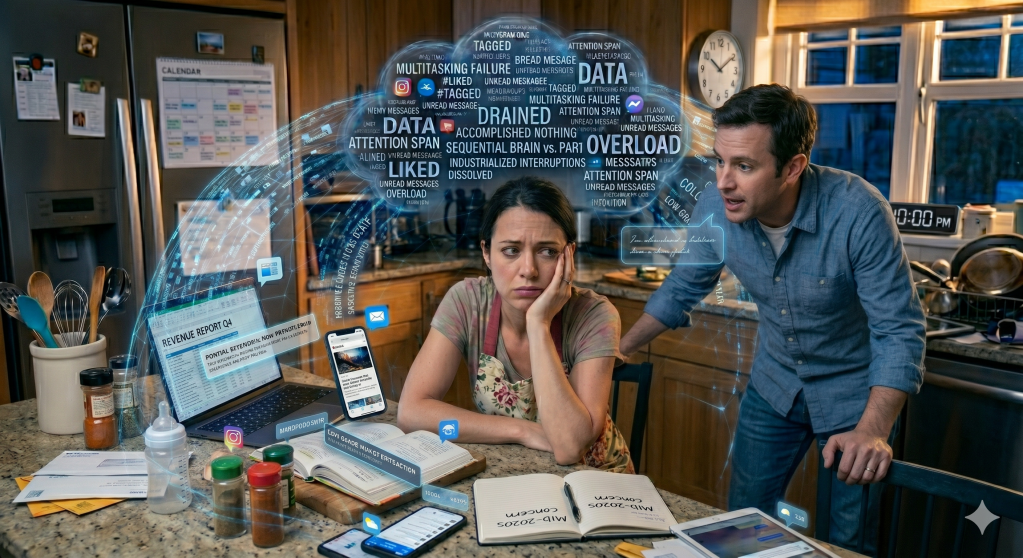
There is a particular feeling that became familiar sometime in the early 2010s — a low-grade hum of distraction that follows you through conversations, meals, and quiet moments alike.
You are present, but not entirely. You are listening, but one part of your mind is elsewhere, grazing on the possibility of a notification, a message, a headline. You are doing one thing while half-prepared to do another.
Picture a table of four friends at dinner, somewhere around 2013 or 2014. The food has arrived. The conversation is real — laughter, catching up, the comfortable rhythm of people who know each other well. And yet the phones are on the table, face up, like a fifth presence. Nobody has made a decision to be distracted. But every few minutes, one person’s gaze drops to their screen. Another follows. The thread of conversation holds, technically, but something in its texture has changed. There is a slightly provisional quality to everyone’s attention — a readiness to redirect that hums beneath the surface even when no one acts on it. This is not rudeness. It is not even particularly unusual. By the mid-2010s, it was simply how dinner worked.
Researchers and technology critics gave this experience a name: continuous partial attention. The term was coined by former Apple and Microsoft executive Linda Stone back in 1998, when she noticed something changing in how people engaged with digital tools. But the concept she identified would take another decade and a half to fully colonize everyday life. By 2016, partial attention was no longer just a habit of early adopters and Silicon Valley professionals. It had become, for hundreds of millions of people, the baseline condition of waking life.
This essay examines how that happened — the technological, psychological, and cultural forces that converged to make divided attention feel normal, even necessary. But it also wants to make a stronger claim than the standard distraction narrative. Attention is not merely a productivity resource that technology wastes. It is the mechanism by which experience becomes meaningful at all. Partial attention is not just an efficiency problem. It may represent a subtle change in the structure of consciousness itself.
What Continuous Partial Attention Actually Means
It is worth distinguishing partial attention from two related concepts that often get conflated with it: multitasking and distraction.
Multitasking implies a deliberate strategy — the attempt to perform two or more tasks simultaneously, with full engagement on each. Distraction implies something external pulling focus away from a primary activity, temporarily and against one’s will. Partial attention is subtler than either. It describes a state in which a person is never fully absorbed in any single activity because they are perpetually scanning for something else — not because they have been interrupted, but because the scanning has become the default mode of engagement.
Stone described it as being motivated by a desire to be connected, to be a live node on the network. Unlike simple multitasking, which people generally recognize as cognitively costly, partial attention can feel almost like heightened awareness. You are monitoring more, staying current, keeping options open. The problem is that this vigilance comes at a cost the brain does not always advertise upfront.
By the time the concept entered broader cultural discussion in the mid-2010s, the smartphone had provided the ideal hardware for sustaining this state. The device went everywhere, announced itself constantly, and trained users to check it reflexively. Research published around this period found that the average American checked their phone somewhere between 46 and 80 times per day, depending on the study. For younger users, estimates ran considerably higher.
The Architecture of Interruption
To understand why partial attention became so entrenched, it helps to understand something about how the technology that produced it was designed.
The notification was the primary mechanism. On its face, a notification is simply a signal — an alert that something has happened somewhere that you might want to know about. But the notification systems built into smartphones and social platforms in the late 2000s and early 2010s were calibrated with considerable sophistication to maximize what engineers sometimes called “engagement” — which, in practice, often meant frequency of checking.
Variable reward schedules played a central role in this. Psychologist B.F. Skinner’s mid-twentieth century research on operant conditioning had demonstrated that animals — and people — respond most persistently to rewards that are unpredictable. A lever that sometimes delivers food, rather than always or never delivering it, produces the most compulsive lever-pressing. Social media feeds, email inboxes, and messaging apps were, in structural terms, variable reward machines. You checked not because you knew something good was there, but because something good might be. The uncertainty was the hook.
The mechanism is easy to observe in daily life. Someone picks up their phone to check the weather. A text message banner appears at the top of the screen. They open the message, and while composing a reply, a social media notification arrives. They check it, scroll briefly, and set the phone down two or three minutes later — having never looked at the weather. The original task dissolved somewhere in the chain of micro-redirections, each one feeling reasonable in the moment. This is not a failure of willpower. It is the system working exactly as designed.
Nir Eyal’s 2014 book Hooked brought this design logic into the mainstream business conversation, describing what he called the “Hook Model” — a cycle of trigger, action, variable reward, and investment that technology products could use to build habitual behavior in users. The book was written as a guide for product designers, and it was widely read as one. Whether or not individual apps were deliberately engineered to exploit psychological vulnerabilities (a question that remains contested), the cumulative effect of the ecosystem they created was a near-constant low-level pull on user attention.
The Role of Social Pressure
Technology design alone does not fully explain the phenomenon. Social dynamics completed the picture.
As smartphones became ubiquitous and communication migrated to digital channels, norms around response time shifted rapidly. Where a returned phone call within 24 hours had once been perfectly acceptable, text messages and social media messages began carrying an expectation of near-immediate response. Not answering quickly came to carry social cost — it signaled disinterest, unavailability, or disrespect, depending on context.
This is not simply a matter of people being impatient. It reflects a genuine change in the communicative contract. When a medium allows real-time communication and both parties know it, delayed response becomes a communicative act in itself. People began checking their phones not just from habit or curiosity but out of a felt obligation to remain available. The monitoring was, in part, a form of social maintenance.
The result was a reciprocal loop: technology made partial attention easy to sustain; social norms made it difficult to abandon; and the difficulty of abandoning it reinforced the sense that it was simply the natural way of being connected.
The Mind That Learned to Interrupt Itself
The psychological and neuroscientific research on attention and interruption accumulated steadily through the 2000s and 2010s, and its findings were not encouraging for anyone hoping that the human brain would simply adapt to the new environment.
The core finding, replicated across dozens of studies, was that the brain does not actually multitask in the way people commonly believe. When people think they are doing two cognitively demanding things at once, they are almost always rapidly switching between them — a process researchers call task-switching. Each switch carries a small cost: a brief period during which the mind is neither fully engaged with the old task nor fully settled on the new one. Psychologists call this cost “switching time” or “cognitive residue.”
Gloria Mark, a professor at the University of California Irvine who spent years studying workplace interruptions, found that after an interruption, it takes an average of over 20 minutes to return to a task with the same level of focus. When interruptions are frequent enough, sustained deep engagement with any single task becomes structurally impossible — not because any individual interruption is too severe, but because the recovery periods never have enough time to complete before the next interruption arrives.
But her later work contained the more troubling finding: people who were frequently interrupted began to self-interrupt even when no external prompt was present. They had internalized the rhythm of distraction. The pull of the phone did not have to come from the phone.
This is, when you sit with it, a remarkable observation. It suggests that the deepest effect of an interruption system is not the interruptions themselves. It is that the system eventually becomes unnecessary. The external trigger trains an internal reflex. The mind, having been taught to disengage at regular intervals, begins disengaging on its own — mid-sentence, mid-thought, mid-conversation — not because anything demanded its attention elsewhere, but because interruption had become its natural rhythm. The ultimate achievement of an attention-capture system is that it no longer needs to capture anything. The capture has already happened, at the level of habit.
Consider what this means in practice. A person sitting quietly with a book finds their eyes drifting from the page — not to a notification, but to nothing in particular, to the mental posture of checking. A couple at dinner fall into silence not because they reach for their phones, but because the part of the mind that would have sustained the conversation has quietly slipped away. The restlessness is no longer a response to stimulation. It has become the baseline condition.
Psychologist Daniel Kahneman’s work on fast and slow thinking offers a useful frame here. Deliberate, analytical reasoning — the kind required for complex judgment and careful argument — is metabolically expensive and demands sustained attention. Automatic, associative processing can run on whatever attentional resources remain. A mind in continuous partial attention defaults toward the latter not by choice but by necessity. The conditions for slower, deeper thinking simply never fully arrive. What was once a distraction became a disposition.
Attention Is the Mechanism of Meaning
Most discussions of distraction frame it as a productivity problem. You get less done. Your work is shallower. Your response time suffers. These are real costs, but they may be the smaller ones.
William James, writing in 1890, observed that “my experience is what I agree to attend to.” This formulation is easy to read past, but it contains something radical. James was not saying that attention helps us process experience more efficiently. He was saying that attention constitutes experience — that without it, the world does not become less vivid or less useful. It does not become anything at all, not for us. The things we do not attend to do not register as experience in any meaningful sense. They pass through without leaving traces.
If that is right — and the neuroscience increasingly suggests it is — then continuous partial attention is not primarily a productivity problem. It is a problem of what counts as lived experience. A conversation held in partial attention is, in significant ways, a diminished one. A meal eaten while scrolling is a meal experienced at a fraction of its potential depth.
This may explain something that many people noticed during this period but found hard to articulate: that the years were becoming blurry. Not in retrospect, the way all past time softens, but in something closer to real time — a feeling that the days were not quite sticking, that experiences were slipping through without fully landing.
The neuroscience offers a partial account of why. Memory consolidation — the process by which experiences are encoded into long-term memory — requires attention at the time of the experience. Not perfect, total attention; but sufficient, sustained engagement. Fragmented attention tends to produce fragmented encoding. The experience enters working memory but may not transfer cleanly into the kind of durable, retrievable memory that makes a life feel like it is actually accumulating.
This is different from simply forgetting things. Forgetting implies that something was recorded and then lost. What partial attention may produce is something closer to the event being only partially recorded in the first place. The decade blurs not only because memory fades but because, for many experiences, durable memories may never have been fully formed. People were present for their lives in a technical sense while being only partially there in the sense that matters for memory, meaning, and the feeling of having lived.
A Shift in Cultural Expectations Around Focus
What made the mid-2010s a particularly significant moment was not just that these changes were happening, but that people were beginning to notice them — and to feel ambivalent.
A wave of books and public conversations emerged around 2010 to 2016 attempting to name the transformation. Nicholas Carr argued that internet use was physically reshaping the brain’s attentional circuits. Sherry Turkle documented how digital connectivity was eroding the capacity for the kind of sustained conversation that emotional intimacy requires. Cal Newport popularized “deep work” — focused, undistracted effort — as a skill that was simultaneously becoming more valuable and more rare. These were not fringe concerns. They resonated because millions of people recognized what was being described. The discomfort was real: people could feel that something was different about how they read, how they conversed, how they sat with their own thoughts.
The Productivity Paradox
There was also an economic dimension to the story that received somewhat less attention in popular accounts but mattered enormously in shaping behavior.
The digital tools that promoted partial attention were, in many contexts, the same tools people needed to do their jobs. Email, messaging platforms, project management software, real-time collaboration tools — these were not optional add-ons but central infrastructure. Staying responsive was not merely a social preference; it was, for many knowledge workers, an explicit professional expectation.
This created a genuine bind. The research said sustained focus produced better work. The professional environment required constant availability. The two demands were in direct structural conflict, and the demands of the environment, being immediate and socially enforced, generally won.
Children, Adolescents, and the Developing Attention System
The effect on younger users raised particular concerns among developmental psychologists, partly because the adolescent brain is still in the process of developing the prefrontal systems responsible for impulse control, sustained attention, and the ability to defer gratification.
The first generation to grow up with smartphones from early adolescence was coming of age precisely during this period, and one of the more consequential changes — less discussed than screen time debates but arguably more significant — was the disappearance of unstructured boredom.
Boredom has a function. It is the mental state that arises when external stimulation drops below a certain threshold, and it is precisely in that gap that the mind tends to do some of its most generative work: daydreaming, self-reflection, the slow assembly of ideas without an immediate goal. A teenager waiting for a bus in 2005 had no choice but to be bored. A teenager in 2015 had a device in their pocket that could fill every such gap instantly. The gaps closed. What had previously been unavoidable now had to be chosen — and boredom, reframed as inefficiency rather than incubation, was not something most people chose.
It is important to be careful here. The causal picture is complicated, and research from this period was often preliminary. Correlations between screen time and various outcomes in young people were documented, but causation was harder to establish, and the effect sizes in many studies were modest. Some researchers pushed back against what they saw as a moral panic insufficiently grounded in evidence. The truth was that this was a genuine empirical debate, not a settled one — and the children who were its subjects were still, in 2016, in the middle of the experiment.
What was clear, regardless of the outcome for individuals, was that the social environment of adolescence had changed substantially. The peer group was now always present, always accessible, and always potentially watching — which placed new pressures on the developing self that had no real precedent in the experience of earlier generations.
Why It Felt Normal — and Why That Mattered
One of the more unsettling aspects of partial attention as a new default state was precisely its quality of normalcy. Experiences that are pervasive and continuous tend to become invisible. The fish does not notice the water.
People adapted. They developed new reading strategies suited to skimming rather than sustained engagement. They calibrated their communication to the channel’s rhythm, writing shorter messages with faster expected response times. They learned to hold conversations while checking phones without necessarily experiencing this as rude, because everyone was doing it, and the norm had shifted accordingly.
This adaptation was not purely negative — human beings are remarkably flexible, and some of the adjustments were genuine improvements in efficiency and accessibility. But adaptation to a condition is not the same as that condition being optimal. The fact that something feels normal tells us relatively little about whether it serves human flourishing.
What the adaptation concealed, for a time, was an emotional cost that was harder to name than lost productivity. A mind in continuous partial attention rarely experiences what psychologists sometimes call closure — the satisfying sense that a task or interaction is complete and can be set aside. When the next message, update, or request is always potentially seconds away, the mind does not fully disengage from monitoring mode even in quiet moments. People described this during the period as a vague but persistent restlessness — the feeling of not quite being able to settle, of sitting with something unfinished even when nothing in particular was pending. It resembled low-level anxiety, and for some it crossed into it. The emotional register of partial attention was not distress so much as a kind of chronic low-grade vigilance that made genuine rest harder to reach.
What was perhaps most significant about the mid-2010s moment was the emergence of explicit cultural resistance — people deliberately seeking out solitude, silence, and single-tasking not because technology had failed them, but precisely because it had succeeded. The popularity of mindfulness practices during this period was not coincidental. Meditation, which at its core is a discipline of sustained present-moment attention, offered something that the ambient media environment conspicuously did not: a structured practice of doing one thing at a time. That millions of people found this practice difficult — found themselves unable to remain with a single breath without the mind sliding sideways — was itself a kind of cultural diagnostic.
Looking Forward: Attention as a Resource
The decade following 2016 brought these tensions into even sharper relief. Smartphones became more capable, social platforms more immersive, and the information environment more fragmented. The widespread adoption of short-form video — platforms built around sub-minute clips algorithmically surfaced for maximum engagement — extended the partial attention economy into new registers of human experience.
At the same time, awareness of the issue matured. “Attention economy” entered common vocabulary. Former technology insiders published accounts of how platforms were designed to capture and hold user attention as their primary business model. Regulatory conversations began, tentatively, in multiple countries. And a significant minority of users began experimenting with intentional limits on their digital engagement — screen time tracking, notification discipline, device-free periods and spaces.
What the science consistently suggested, and what many people were discovering through direct experience, was that attention is not simply a fixed cognitive resource that technology either uses or wastes. It is more dynamic than that — something that can be trained, degraded, recovered, and cultivated. The habits of mind formed over years of partial attention did not undo themselves quickly or easily, but neither were they permanent. People who practiced sustained focus found that the capacity for it returned, sometimes gradually, sometimes with surprising speed. What had been trained could be untrained. What had been internalized could be examined and, eventually, released.
Conclusion: What We Were Learning to Notice
Partial attention as a new default state was not, in the end, simply a story about smartphones or social media or any particular technology. It was a story about what happens when the designed environment gets significantly ahead of cultural and individual adaptation — when systems optimized for one set of goals (engagement, connectivity, information flow) produce conditions that complicate another set of goals (depth, presence, meaningful relationship).
But it was also a story about something more fundamental: what it means to be present for your own life. Attention is not a tool we use to get things done. It is the condition under which experience becomes experience — under which a conversation becomes a conversation, a meal becomes a meal, a year becomes something more than a blur of undifferentiated days. When attention is permanently divided, something more than productivity is lost. What is at stake is the sense of having actually been there. Partial attention is not just an efficiency problem. It is a change in the structure of consciousness itself.
The partial attention era was neither a catastrophe nor a trivial adjustment. It was a significant reorganization of the basic conditions of human mental life, one that is still working itself out — in individual habits, in institutional norms, and in the ongoing argument about what technology is for and who it should serve.
Understanding that moment requires holding two things simultaneously: genuine appreciation for what networked digital life made possible, and clear-eyed acknowledgment of what it cost. Not in hours, or output, or efficiency metrics. But in the texture of experience itself — in the quality of presence that makes a life feel, from the inside, like it is actually being lived.









