
Originally published in July 2016 and comprehensively updated and edited in June 2026.
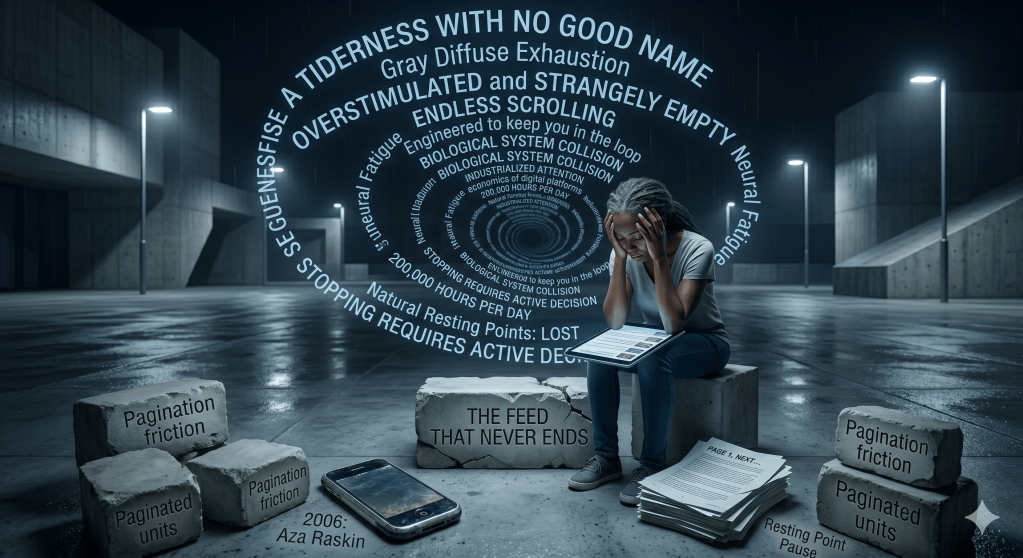
Why the infinite feed exhausts the mind — not just because it’s addictive, but because it’s the first information environment designed without a natural ending.
There is a specific kind of tiredness that has no good name yet. It is not the tiredness of physical labor, or of staying up too late, or even of a long and difficult conversation. It is the tiredness that settles in after an hour of scrolling — a gray, diffuse exhaustion that leaves you feeling both overstimulated and strangely empty at the same time. You put down your phone, and for a moment you are not quite sure what just happened to you.
Most people alive today know this feeling intimately. What fewer people understand is what, exactly, produces it.
The easy answer is addiction — that these platforms are engineered to exploit dopamine systems, the same way slot machines are, and that the resulting compulsion is what leaves us depleted. That explanation is not wrong. But it is incomplete. Human beings have always encountered compelling experiences: stories, games, conversations, rituals. What makes the infinite feed different is not merely that it is compelling. What makes it different is that it has no built-in ending.
For virtually all of human history, nearly every experience arrived with its own conclusion embedded in it. Conversations wound down. Meals ran out. Stories reached their final page. The experience of completion — of a thing having run its course — was so fundamental to daily life that it barely registered as a feature. It was simply how experience worked.
The infinite feed broke that. Not accidentally, and not incidentally, but as a deliberate design choice. And understanding what that means — for the brain, for attention, for the ordinary texture of daily life — turns out to be more interesting than the dopamine story alone.
The Feed That Never Ends
To understand how we got here, it helps to remember what the internet looked like before the infinite scroll existed.
In the early days of the web, information was paginated. You read a page, you clicked “Next,” and you waited for a new page to load. That pause — that small friction — was not a flaw. It was, in retrospect, a natural resting point. It gave your brain a moment to register that a unit of information had ended. You could decide, consciously, whether to keep going.
Aza Raskin changed that in 2006 when he designed the infinite scroll while working at a startup called Humanized. The idea was simple: instead of pagination, content would load automatically as the user reached the bottom of the page. No interruption, no waiting, no decision point. The feed would just keep going.
Raskin later estimated that infinite scroll costs the world roughly 200,000 hours of human attention every day. He has since become one of the more prominent voices calling for redesigns of the attention economy — a notable pivot for someone who helped build one of its foundational mechanics. The technology itself is now so deeply embedded in how social media platforms function that imagining its removal requires reimagining the platforms themselves.
Twitter, Instagram, Facebook, TikTok, Reddit, LinkedIn — all of them use variations of the infinite feed. The specific content changes, but the structural logic is the same: there is always more, it loads before you run out, and stopping requires an active decision rather than a natural pause.
That last point is the one worth dwelling on. Stopping requires a decision. In every prior information environment — the book, the newspaper, the television broadcast — stopping was the default. The book ended. The broadcast signed off. You had to make an active decision to continue, not to stop. The infinite feed reverses that polarity entirely.
What the Brain Is Doing While You Scroll
The brain is not a passive receiver of information. It is constantly filtering, evaluating, and responding to stimuli — a process that requires energy and involves a complex web of neural systems working in concert.
One of those systems is the dopaminergic reward pathway. This system does not simply respond to rewards. It responds, more precisely, to the anticipation of rewards — and most powerfully to unpredictable ones. When something pleasurable might appear, but you are not sure exactly when, the brain enters a sustained state of seeking. Psychologists call this a variable ratio reinforcement schedule, and it is one of the most powerful behavioral conditioning patterns known to science. It is also, famously, the mechanism underlying slot machine gambling: not the win itself that keeps you pulling the lever, but the possibility of a win on the very next pull.
A social media feed is, structurally, a variable ratio reinforcement machine. Most posts are unremarkable. But occasionally something funny, or touching, or surprising, or enraging appears — and you cannot predict when. Because the reward is intermittent and unpredictable, the behavior of scrolling becomes self-sustaining. You keep going not because the last post was good, but because the next one might be.
What amplifies this is the speed of the loop. A slot machine delivers its outcome in seconds, with a mechanical pause between pulls. A social media feed delivers new stimuli continuously, with no imposed gap at all. The cycle restarts before the previous one has had time to conclude.
This is real and worth understanding. But it is also, as explanations go, familiar — a story that has been told many times over the past decade. The more underexplored question is not why the brain keeps scrolling, but why stopping feels so hard. And that question leads somewhere different.
The Cost of Continuous Evaluation
“Neural fatigue” is a term that gets used loosely in popular writing, sometimes to mean almost anything negative that technology does to the brain. It is worth being more precise.
Researchers use the term in a few different ways. At the cellular level, sustained neural activity consumes energy and gradually reduces the responsiveness of the neurons doing the work. At the psychological level, people experience something closer to attentional exhaustion: concentration becomes harder, decisions become more effortful, and distractions become more difficult to resist. Both are real; the second is what most people actually encounter.
The relevant framework here is what Rachel and Stephen Kaplan at the University of Michigan called directed attention fatigue — a concept developed in the 1990s as part of their Attention Restoration Theory. The Kaplans proposed two fundamentally different kinds of attention: directed attention, which is effortful and goal-driven, and involuntary attention, which is effortless and drawn naturally by things that are inherently interesting. Directed attention requires active inhibition — suppressing distracting thoughts, competing impulses, and irrelevant stimuli in order to stay focused. That inhibition is metabolically expensive. Sustain it long enough without rest, and the system begins to fail: concentration slips, errors increase, decisions become harder, irritability rises.
Scrolling is not directed attention in the classic sense. But it is not rest, either. It sits in an ambiguous middle ground where each new piece of content demands a rapid micro-evaluation: Is this interesting? Should I stop here? Should I share this? Does this require a response? These decisions feel trivial individually. Over an hour, you may have made several hundred of them. The cognitive load accumulates even when it does not feel like effort.
There is a second drain running in parallel: the emotional one. A typical scrolling session moves through humor, outrage, tenderness, anxiety, and amusement in quick succession, often within minutes. These are not neutral states for the nervous system. Each produces a small physiological response. None is given time to process or resolve before the next one arrives. The result is a kind of affective overload — not quite any particular emotion, but a dispersed depletion that registers as the gray flatness many people describe after a long session.
The Design Logic Behind Engagement
It would be inaccurate to say that every attention-capturing feature of social media was the product of cynical manipulation. The history is more complicated than that.
The engineers who built these systems were, in many cases, genuinely trying to solve product problems: How do you keep users engaged? How do you surface relevant content? The answers, refined through A/B testing and behavioral analytics at massive scale, gradually converged on a set of patterns — infinite scroll, push notifications, algorithmic feeds, variable reinforcement — that proved maximally effective at capturing and holding attention.
The business logic behind this is simple. Advertising-supported platforms generate revenue in proportion to the time users spend on them. More time means more ads, which means more revenue. This creates a structural incentive to optimize for engagement above almost everything else. It does not require bad intentions. It requires only that the optimization target be engagement, and that whatever increases engagement gets reinforced. Over years of iteration, the result was a class of platforms refined through billions of user interactions into extraordinarily effective attention-capture systems.
What those systems optimized for, it turned out, was not the quality or character of engagement — only its volume. Former employees of major social platforms have described internal cultures in which engagement metrics were celebrated without much scrutiny of what kind of engagement was being measured. A post that enraged users and generated angry comments registered the same, algorithmically, as one that made people laugh or feel genuinely connected. The signal was time-on-platform and interaction rate. The emotional valence was, at least initially, beside the point.
Attention as a Scarce Resource
The psychologist and Nobel laureate Herbert Simon wrote, in 1971, that “a wealth of information creates a poverty of attention.” He was describing a problem that would not reach its full expression for another forty years, but the logic was already clear: information and attention exist in a relationship of inverse scarcity. The more information there is, the less any single piece of it receives.
By 2016 — when this essay was first drafted — the information environment had reached a density no previous generation had experienced. News, entertainment, personal communication, advertising, political argument: all of it arriving through the same small screen, in the same format, at the same relentless pace. The phone in your pocket was a portal to essentially unlimited content, available at any moment, at no incremental cost.
What had not changed was the brain. The neural architecture we bring to this environment evolved to maintain social relationships in small groups, track threats in the immediate physical world, and process information at the pace the physical world naturally delivers. Evolution operates on timescales of thousands of generations. The smartphone is about twenty years old.
Humans are adaptable, and the brain’s plasticity allows it to adjust in ways that go well beyond what evolution alone could explain. But adaptation is not cost-free, and it takes time. What has shifted, for many people, is the capacity for sustained, linear attention — the kind of reading or thinking that requires holding a complex idea in mind across an extended period without interruption. Whether this represents a genuine neurological change or primarily a behavioral one is a question the research has not definitively resolved. The pattern, however, is consistent enough to take seriously.
The 2016 Moment and What Followed
The year this essay was first written was an inflection point for public awareness of these issues. Research from psychologists like Jean Twenge was documenting correlations between heavy smartphone use and rising rates of anxiety and depression in teenagers. Questions about algorithmic filter bubbles — the tendency of feeds to show users content that confirms their existing beliefs — were entering the mainstream. The role of social platforms in shaping the information diet of entire populations was becoming harder to ignore.
In the decade since, the technology has grown more sophisticated and the research has deepened, though not always in the clean directions the early alarm bells implied. Machine learning systems now predict, with considerable accuracy, which content a given user will engage with, and serve it accordingly. The feed has become less random and more targeted — which makes it, from an engagement standpoint, more effective still. The picture that has emerged is more nuanced than the loudest early warnings suggested, but also more complex than the platforms’ defenders have claimed.
What the Research Actually Shows
It is worth being precise about what the science does and does not say, because this is an area where both exaggeration and dismissal are common.
The evidence that heavy social media use is associated with poorer mental health outcomes — particularly for adolescents — has become fairly robust. Multiple large-scale studies, including longitudinal work that follows participants over time, have found correlations with increased rates of anxiety, depression, loneliness, and sleep disruption. Effect sizes are generally modest, meaning social media is one factor among many rather than a dominant cause on its own. But modest effect sizes, across populations of billions, still represent meaningful real-world impact.
The mechanisms are not always what popular accounts suggest. Passive scrolling — consumption without interaction — appears to be more strongly associated with negative outcomes than active participation, such as direct messaging or creating content. Watching others’ curated highlight reels while passively consuming rather than connecting seems to be particularly corrosive to wellbeing. This distinction matters for understanding what specifically is causing harm, as opposed to what is simply novel or unfamiliar.
Sleep disruption is perhaps the most clearly established pathway. Screen use in the hour before bed suppresses melatonin production through blue light exposure, delaying sleep onset and reducing quality. Adolescents, whose circadian rhythms are already shifted toward later sleep times, are particularly vulnerable. The downstream effects on mood, attention, and cognitive function are well-documented and compound over time.
The cognitive effects of habitual scrolling are less studied and harder to isolate, but the early evidence is suggestive. Gloria Mark at the University of California, Irvine has found that recovery from a single interruption can take upward of twenty minutes. In an environment where interruptions are not occasional but continuous and self-generated, the implication is that deep, sustained attention becomes increasingly rare — not because the capacity has disappeared, but because the conditions for it almost never arise.
The Question of Agency and Design
One of the more contentious questions in this space is where responsibility lies — with individual users, who can choose to limit their use, or with the platforms, which engineered dynamics that make healthy use difficult.
Both things can be true simultaneously, and for the most part they are. People do have genuine capacity to change their habits. There is real evidence that screen-time limits, notification management, and deliberate phone-free periods produce measurable improvements in focus and mood. Individual behavior change is available and meaningful.
At the same time, framing this purely as a matter of personal responsibility ignores the degree to which these platforms were specifically designed to make stopping hard. Variable reinforcement schedules, infinite scroll, algorithmic optimization, notification timing — these are not neutral choices. They are the product of intentional engineering, refined through massive behavioral datasets, aimed at maximizing engagement. Asking individuals to exercise more willpower against systems explicitly designed to circumvent willpower is, at minimum, an incomplete answer.
The design community has spent the past decade producing alternatives under the banner of “humane technology” — interfaces that respect rather than exploit cognitive limits. Some proposals are simple: restore pagination, add friction to certain actions, give users real transparency about how their feeds are curated. Others are structural: decouple platform revenue from raw time-on-platform. Progress has been uneven, but the conversation has moved from the fringes toward actual policy.
Where Things Stand in 2026
A decade after this essay was first written, the landscape has shifted considerably.
The mental health dimension of social media use has become one of the most active areas of regulatory debate in multiple countries. Age verification requirements, restrictions on certain design features for minors, and requirements for algorithmic transparency have moved from advocacy papers to law in some jurisdictions. Whether these measures address the right problems remains to be seen.
Perhaps more significant is a broader cultural shift in how people understand their relationship with their devices. “Digital wellness” — barely a phrase in 2016 — is now a mainstream concept with its own product category. The number of people deliberately managing their social media use, taking periodic breaks, or maintaining phone-free spaces in their homes has grown substantially. Awareness, if not always action, has increased.
What has not changed is the underlying architecture: a biological system with real limits, embedded in an information environment designed to have none.
An Incomplete World
Earlier environments that resisted natural endings do exist. Gambling halls were built to be timeless — no windows, no clocks. Serialized Victorian fiction was designed to leave readers suspended between installments. The 24-hour news cycle collapsed the natural rhythm of the morning paper and the evening broadcast into something continuous and unresolved. These precedents matter, and they complicate any claim that the infinite feed is entirely without historical parallel.
What is different about the digital feed is scale, speed, and algorithmic precision. A gambling hall required a physical visit. A serialized novel arrived once a week. Even 24-hour cable news had anchors, segments, and commercial breaks — structure that imposed a kind of rhythm even if the underlying content never stopped. The infinite feed is available at any moment, tailors itself in real time to individual psychology, and has been optimized through billions of interactions to eliminate every natural exit point. The phenomenon is not new in kind, but the degree to which it has been engineered, and the scale at which it operates, represents something genuinely different.
And there is a specific mechanism that sets the digital feed apart from its predecessors: it depletes the very resource needed to stop it. Directed attention — the effortful, inhibitory capacity that allows you to say enough and put the phone down — is exactly what sustained scrolling gradually exhausts. A gambling hall does not sap your willpower as a direct function of staying inside it. The feed, through the continuous accumulation of micro-decisions and emotional stimuli, does. It is a loop that makes its own exit harder the longer you remain in it.
The tiredness at the beginning of this article — that gray, flat exhaustion — is the felt experience of that loop. You were not simply entertained for an hour. You were continuously asked to evaluate, decide, and respond, without the natural resting points that prior environments provided automatically, and without ever arriving anywhere that felt finished.
Human beings are, among other things, creatures of completion. We remember interrupted tasks more vividly than finished ones — a phenomenon psychologists call the Zeigarnik effect. We find unresolved narratives and unfinished melodies difficult to ignore. The sense of closure, of a thing having properly ended, is not a trivial aesthetic preference. It is, in some sense, how experience gets consolidated and put away.
The infinite feed offers no such consolidation. It is experience without closure — or more precisely, it is an environment that has been deliberately designed to defer closure indefinitely, because closure is where attention goes elsewhere.
Whether the platforms of the next decade find ways to restore that structure — through design, through regulation, through cultural norm — remains genuinely open. But the nature of the problem is now clearer than it was when this essay was first written. It is not only that the feed is compelling. It is that the feed is, by design, incomplete. And incompleteness, for a mind that evolved expecting the world to provide its own endings, turns out to be quietly, persistently exhausting.









