
Originally published in January 2018 and comprehensively updated and edited in June 2026.
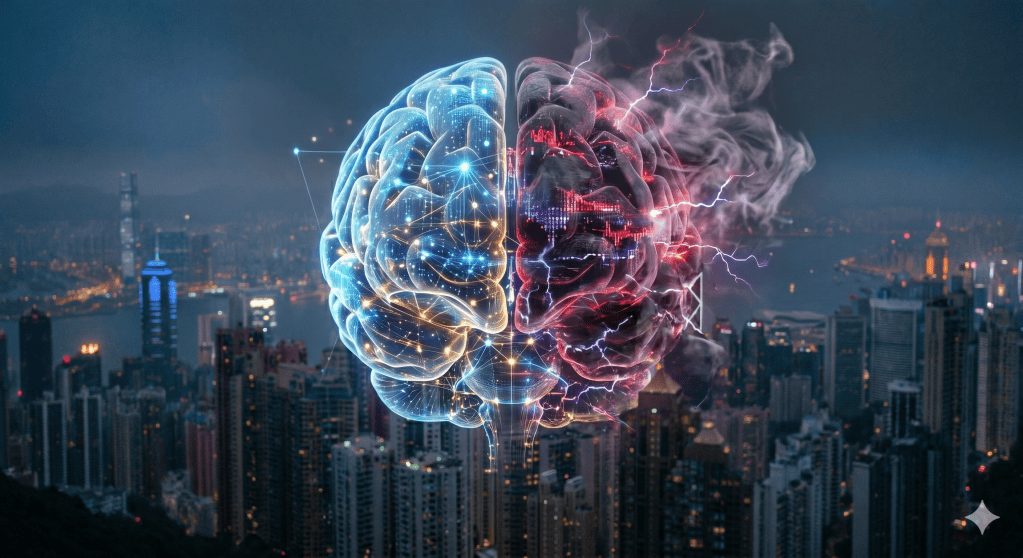
Chronic uncertainty physically alters the brain — changing memory, decision-making, and emotional regulation. Here’s what the neuroscience actually says about why.
There is a particular kind of exhaustion that has become familiar to a lot of people in recent years. It is not the tiredness that comes from working too hard or sleeping too little, though those things might be present too. It is something closer to a low hum of unease — a background tension that never quite goes away, even on the good days. People describe scrolling through news feeds at midnight without really knowing why. They describe the difficulty of making simple decisions. They feel on edge but cannot always say what they are on edge about.
This is not weakness. It is not simply a matter of managing stress better or developing a more optimistic attitude. What many people are experiencing is a measurable, physiological response to a specific kind of stress — the stress of not knowing what comes next, and of living in an environment where the uncertainty seems to never resolve.
For most of human history, uncertainty was temporary. A drought ended. A conflict settled. The unknown became known, one way or another, and the nervous system could return to something resembling calm. What has changed in the modern era is the character of uncertainty itself. Today’s most pressing uncertainties — economic instability, geopolitical tension, climate disruption, technological upheaval — are not the kind that resolve cleanly. They are open-ended, frequently contradictory, and delivered in real time through devices that people carry in their pockets. The result is something neuroscientists and psychologists have begun studying in earnest: what happens to the human brain when uncertainty is not a passing condition but a permanent feature of daily life.
The short answer is that chronic uncertainty can produce measurable changes in brain structure and function — changes that affect memory, decision-making, and emotional regulation in ways that show up on brain scans. The longer answer involves stress hormones, neural architecture, the ancient wiring of fear, and a feedback loop between the media environment and the nervous system that few people fully understand.
What the Brain Is Actually Doing When It Faces the Unknown
To understand how chronic uncertainty damages the brain, it helps to understand what the brain is trying to do in the first place. The brain is fundamentally a prediction machine. At every waking moment, it is using past experience and incoming sensory information to build a working model of the world and to anticipate what comes next. When those predictions are accurate and things unfold as expected, the brain hums along efficiently. When predictions fail — when something unexpected happens, or when the future cannot be anticipated at all — the brain treats this as a potential threat and activates a response accordingly.
That response originates in a region called the amygdala, an almond-shaped structure located deep in the brain that processes emotional meaning, especially threat. When the amygdala detects danger or unpredictability, it sends signals that trigger the release of stress hormones, primarily cortisol and adrenaline, through a system called the hypothalamic-pituitary-adrenal axis, or HPA axis. This is the biological machinery of the fight-or-flight response: heart rate increases, attention narrows, the body mobilizes energy to respond to the perceived threat.
For short-term, well-defined threats, this system works beautifully. But uncertainty presents a particular problem. Uncertainty is not a lion in the clearing. It is the suspicion that there might be a lion, somewhere, possibly approaching, though it is hard to say when or from which direction. The brain cannot resolve this kind of threat by fighting or fleeing. Instead, the amygdala remains active, the HPA axis keeps firing, and the stress hormone cortisol continues circulating in the body and bloodstream.
Uncertainty means the brain must expend effort not only in trying to predict what will happen, but in preparing to deal with all the different possible outcomes simultaneously, according to Aoife O’Donovan, a professor of psychiatry at the UCSF Weill Institute for Neurosciences who studies the relationship between psychological stress and mental disorders. The stress of uncertainty, she notes, especially when prolonged, is among the most insidious stressors people experience.
Research published in 2025 found that uncertainty consistently activates a network of brain regions involved in emotional processing and bodily awareness, with the anterior insula emerging as one of the most reliably engaged. This region helps integrate emotional experience with physical sensation — it is part of the same neural tissue that registers pain and disgust. Its prominence in uncertainty processing suggests that the discomfort of not knowing is not merely psychological. It is experienced physically, in brain systems that monitor the body’s internal state. The feeling of dread that accompanies uncertainty is, in a meaningful sense, a bodily event.
How Cortisol Reshapes the Brain Over Time
Here is where the story becomes more alarming. A brief surge of cortisol is not damaging. The body is built to handle it. What the body is not built to handle is the continuous, low-level elevation of cortisol that results from chronic, unresolved stress — the kind of stress that living under sustained uncertainty produces.
MRI scans of people experiencing chronic stress reveal measurable reductions in the volume of both the hippocampus and the prefrontal cortex — regions critical for memory, decision-making, and emotional regulation. In parallel, areas like the amygdala, which processes fear, can become hyperactive, increasing sensitivity to stress and amplifying emotional reactions.
The hippocampus is particularly vulnerable. It is the brain region most responsible for forming new memories and integrating past experience into present understanding, and it is also dense with receptors for cortisol. When cortisol runs chronically high, the effects on hippocampal tissue become structural: the brain’s ability to generate new neurons — a process that happens in the hippocampus throughout adult life — is suppressed, and the connections between existing neurons weaken. The brain gradually loses some of its capacity to adapt, to learn from experience, and to regulate its own emotional responses.
The prefrontal cortex — the region responsible for rational decision-making, impulse control, and long-term planning — also takes on a diminished role when cortisol runs persistently high. Chronic stress effectively turns down the volume on the most sophisticated part of the human brain while turning up the volume on the most reactive.
This is not metaphor. It is a measurable shift in the distribution of neural resources, and it has predictable consequences for behavior.
The Amygdala Takes Control
When the prefrontal cortex is impaired and the amygdala is hyperactive, the balance of power in the brain shifts. Rational deliberation gives way to threat-scanning. Nuance becomes harder to process. The brain starts to see ambiguity as danger, and it starts scanning the environment not for information, but for confirmation that something bad is coming.
Psychologists call the trait associated with this pattern “intolerance of uncertainty,” and it has become one of the more studied constructs in anxiety research over the past decade. Intolerance of uncertainty does not mean being averse to risk in the everyday sense. It refers specifically to a difficulty tolerating the absence of information about outcomes — a hyperreactivity to not-knowing. Research using functional brain imaging has found that people with higher intolerance of uncertainty show attenuated amygdala habituation — meaning their amygdala does not calm down after repeated exposure to ambiguous stimuli the way it would in people with lower uncertainty sensitivity. This sustained activation appears to be a core mechanism linking uncertainty sensitivity to broader anxiety vulnerability.
The practical consequences of a chronically activated amygdala are far-reaching. Amygdala hyperactivity results in increased vigilance, biased attention toward perceived threats, and difficulties with associative learning — the process by which the brain updates its models of how the world works based on new information. In other words, a brain under chronic uncertainty becomes both more alarmed and less able to update its alarm system when circumstances change. It is hardwired for danger and resistant to reassurance.
Research has found that people with high intolerance of uncertainty disproportionately generalize threat during times of uncertainty, and this compromises their ability to learn that a feared outcome is no longer likely — a process known as fear extinction learning. This is significant because it suggests that sustained uncertainty does not just make people feel anxious in the moment. It makes it harder for them to stop feeling anxious even after the situation has improved.
A 2025 systematic review of the neurobiology of intolerance of uncertainty found that poor top-down regulation and reduced activity in the prefrontal cortex appear to be central to the neurobiological mechanism underlying high uncertainty sensitivity, with hyperactivity in limbic regions, particularly the amygdala, accompanying this shift.
The Information Environment as Chronic Stressor
What distinguishes the current era from previous periods of social upheaval is not simply that stressful events are happening. Stressful events have always happened. What is different is the delivery mechanism. For the first time in history, potentially threatening information is available continuously, in unlimited quantity, refreshed constantly, and personalized by algorithms designed not to inform but to engage.
The term “doomscrolling” — the compulsive consumption of negative news on digital platforms — entered common usage during the COVID-19 pandemic and has not gone away, because the conditions that produce it have not gone away. During times of crisis, whether a pandemic, a natural disaster, or political unrest, the brain’s natural drive to seek information grows stronger. The goal is to make sense of what is happening and to feel less helpless. But many people scroll to feel more in control and find that it backfires: endless negative news only increases anxiety and keeps the brain locked in a worry cycle.
The irony is structurally built into the experience. The brain seeks information to resolve uncertainty, but the information environment is designed to generate more uncertainty — more things to worry about, more contested claims, more potential threats that cannot be confirmed or dismissed. Social media algorithms prioritize content with high emotional engagement, often sensational or polarizing, which further accelerates doomscrolling behavior. Infinite scrolling and autoplay features are specifically designed to remove the natural stopping cues that would otherwise interrupt the behavior.
The result is a feedback loop. Chronic uncertainty activates the amygdala. The amygdala drives threat-scanning behavior. The media environment provides a nearly infinite supply of threat cues. Scanning the environment for threats produces more exposure to negative content. More negative content increases uncertainty. And around it goes.
Recent studies across multiple countries have found that heavy doomscrolling predicts higher levels of anxiety, depression, and stress. One study found that just a few minutes of exposure to negative pandemic updates reduced optimism and mood compared to participants who read no news at all. A 2024 study of 800 adults found that doomscrolling evokes existential anxiety — a feeling of dread or panic that arises when people confront the fundamental limits of control over their circumstances.
This is worth sitting with. The problem is not that people are weak or neurotic for reacting this way. The problem is that human neurobiology was shaped in an environment where threats were concrete and local, and where social information helped coordinate responses to those threats. The modern information environment exploits those same neural tendencies and floods them with threats that are global, abstract, unresolvable, and delivered without pause.
Uncertainty as a Feature of Modern Life
It would be easier if the solution were simply to put down the phone. And while reducing exposure to the news cycle certainly helps, the deeper issue is that many of the uncertainties driving the anxiety are real. Economic precarity for a large portion of the workforce is real. Climate disruption is a genuine and measurable phenomenon. Rapid technological change — particularly the rise of artificial intelligence — is reshaping labor markets, social relationships, and information ecosystems in ways that no one fully understands yet. Political institutions that once provided a sense of stable governance have become contested in many countries.
These are not threats invented by anxious minds. They are structural features of early 21st-century life. And that matters for how we understand the neurological effects of chronic uncertainty, because the stress is not irrational. The brain is not malfunctioning. It is responding appropriately to a genuinely uncertain environment. The problem is that the biological stress response was built for short-term threats, not for long-term ones, and there is no switch that tells the nervous system to stand down because the danger is diffuse and slow-moving rather than immediate and physical.
Research on the concept of “background stress” — low-level, chronic social and environmental stressors that never reach the acute threshold but also never fully resolve — has accumulated substantially over the past decade. The stress of uncertainty, when prolonged, can have toxic effects on both the brain and the broader body, increasing risk for psychiatric disorders and chronic physical diseases. This includes cardiovascular disease, immune system dysregulation, metabolic disorders, and accelerated cellular aging — a range of effects that extend well beyond the psychological.
There is also an important social dimension. Chronic uncertainty does not just affect individuals in isolation. When large populations experience sustained uncertainty simultaneously, the psychological effects aggregate into social behavior. Trust in institutions declines. Conspiratorial thinking becomes more appealing as a way of imposing meaning on ambiguous events. Polarization increases because the brain under threat is more likely to sort the world into clear in-group and out-group categories — a cognitive simplification that reduces uncertainty even as it increases conflict. Empathy for those perceived as outside the group decreases. These are not moral failures. They are predictable outputs of nervous systems that have been chronically stressed.
What the Brain Can Still Do
None of this is a counsel of despair. The same science that documents how chronic uncertainty harms the brain also reveals that the brain retains a remarkable capacity to change, heal, and adapt. This property is called neuroplasticity, and it operates throughout life.
Neuroplasticity is the brain’s ability to reorganize itself by forming new neural connections throughout life. It underlies the capacity to learn new skills, recover from injuries, and adapt to new experiences. For people under chronic stress, neuroplasticity provides the possibility of intentionally rewiring stress-response pathways for healthier outcomes.
The evidence for specific interventions is meaningful. Mindfulness-based practices have been shown to induce neuroplasticity in ways that increase cortical thickness, reduce amygdala reactivity, and improve brain connectivity and neurotransmitter levels, leading to measurable improvements in emotional regulation, cognitive function, and stress resilience. This is not a vague claim about positive thinking. Structural changes in the brain, visible on MRI, have been associated with consistent mindfulness practice. The prefrontal cortex — the reasoning center that chronic stress works to diminish — shows increased gray matter density in experienced meditators.
Physical exercise has a similarly well-documented effect. Exercise promotes the release of a protein called brain-derived neurotrophic factor, or BDNF, which supports the growth and survival of neurons and has been described as something like fertilizer for the brain. It counteracts some of the neurogenic suppression that cortisol produces and improves hippocampal function specifically.
Research on recovery from chronic stress using brain imaging has found plastic changes in specific neural networks following recovery periods, demonstrating that some of the functional disruptions produced by chronic stress are reversible, though certain structural and functional changes may endure after the recovery period. This is an important nuance. The brain is not a simple machine that returns to factory settings once the stress is removed. Recovery takes time, effort, and often professional support. But it is possible, and the evidence points to it.
Cognitive-behavioral therapy, social connection, adequate sleep, and the deliberate creation of predictable structure in daily life all appear to offer the nervous system what chronic uncertainty takes away: a sense that some things can be anticipated, controlled, and trusted. These are not cures for the underlying social and political conditions that generate the uncertainty. They are adaptations — ways of protecting the brain from a stressor that the individual cannot resolve at the systemic level.
A Closing Thought
The relationship between chronic uncertainty and the brain is one of the more important stories in contemporary neuroscience, and it is also one of the more underappreciated. People who feel persistently anxious, cognitively foggy, or emotionally reactive are frequently told to manage their stress better, as if the stress were a personal problem arising from personal deficiency. But the neuroscience suggests a different framing: that chronic uncertainty is a structural condition of modern life, that the brain responds to it in predictable and measurable ways, and that the resulting changes in mood, cognition, and behavior are not signs of weakness but of a nervous system doing exactly what it evolved to do in an environment it was never built for.
Understanding this does not eliminate the uncertainty. But it changes how we interpret our own experience of it. The difficulty concentrating, the irritability, the sense of doom that arrives without a clear cause, the compulsive checking of news feeds — these are not character flaws. They are the brain’s response to a genuinely unprecedented informational and social environment, playing out in neural tissue shaped over hundreds of thousands of years for a very different world.
The human brain evolved to survive uncertain seasons. It was not built to live inside one permanently.









