
Originally published in January 2019 and comprehensively updated and edited in June 2026.
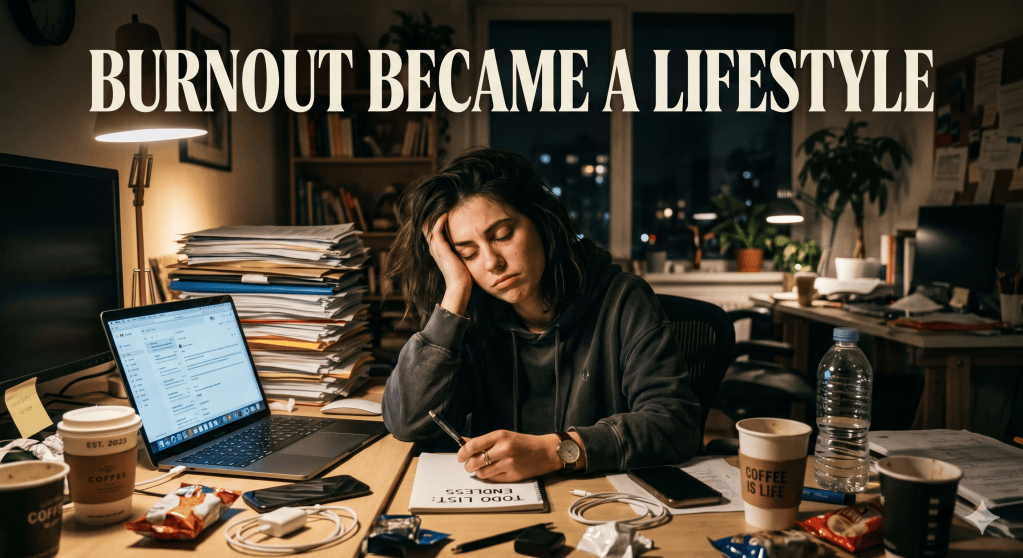
Burnout became a lifestyle in the late 2010s. This deep dive explores the psychology, neuroscience, economics, and cultural forces that turned exhaustion into a norm.
There was a specific kind of exhaustion that settled over a large portion of the workforce sometime around the mid-2010s. It wasn’t the ordinary tiredness that sleep could fix. It was something heavier — a persistent depletion that people started describing less as a symptom and more as a state of being. Hustle culture was ascendant. Side projects were social currency. The phrase “I’ve been so busy” had quietly transformed from a complaint into a status marker.
By January 2019, when this essay was first written, burnout had stopped being a condition that happened to unlucky individuals and had become something closer to a cultural norm. That month, BuzzFeed published Anne Helen Petersen’s essay “How Millennials Became the Burnout Generation,” which spread widely almost overnight. The piece resonated not because it introduced a new idea but because it finally named something millions of people had been living inside without a clear vocabulary for it.
This article examines how burnout stopped being a clinical term on the fringe of occupational medicine and became the defining psychological condition of a generation — and how the social forces, economic pressures, neurological realities, and technological developments of the late 2010s converged to make exhaustion feel like the only honest answer to the world as it existed.
What Burnout Actually Is
The word “burnout” was introduced into psychological literature by Herbert Freudenberger in 1974, though he described it primarily in relation to workers in high-stress caregiving professions — nurses, social workers, people who gave so much of themselves in service roles that they eventually ran dry. For the next few decades, the term remained largely in that clinical lane.
It was the psychologist Christina Maslach who gave the concept its most durable scientific framework. Her Maslach Burnout Inventory, developed in the late 1970s and revised repeatedly over the decades since, defined burnout across three dimensions: emotional exhaustion, depersonalization (a growing cynicism or detachment from one’s work), and a reduced sense of personal accomplishment. This wasn’t just tiredness. It was a specific erosion of a person’s relationship with their work — and, by extension, with their own sense of meaning and competence.
Later in 2019, the World Health Organization would formally classify burnout in its International Classification of Diseases, describing it as “a syndrome conceptualized as resulting from chronic workplace stress that has not been successfully managed.” Critically, the WHO framed burnout as an occupational phenomenon, not a medical disorder — a distinction that matters because it places the origin of the condition in structural and environmental factors rather than in individual psychology. You don’t develop burnout because something is wrong with you. You develop it because the conditions surrounding you create chronic, unresolvable demands.
The Brain Under Chronic Stress
To understand why burnout is so difficult to simply recover from, it helps to understand what sustained stress does to the human brain. The nervous system is designed to handle acute stress efficiently — the fight-or-flight response floods the body with cortisol and adrenaline, the threat is addressed or avoided, and the system returns to baseline. Chronic stress, however, disrupts that recovery loop.
Research in neuroscience over the past two decades has documented several ways this disruption plays out. The prefrontal cortex — the part of the brain most involved in decision-making, planning, and emotional regulation — is particularly vulnerable to prolonged stress. Studies using neuroimaging have shown that chronic stress is associated with reduced gray matter density in the prefrontal cortex and an overactivated amygdala, the brain’s threat-detection center. In plain terms: under sustained pressure, the parts of the brain responsible for calm, considered thinking become less effective, while the parts responsible for anxiety and reactivity become more dominant.
This has a practical consequence that anyone who has experienced severe burnout will recognize. In the middle of it, simple decisions feel impossibly hard. Emails go unanswered not because the person doesn’t care, but because the cognitive resources required to compose a response feel genuinely unavailable. The brain isn’t being lazy. It’s running on depleted reserves.
The HPA axis — the hormonal system that regulates the stress response — also becomes dysregulated under chronic pressure. Cortisol, normally a useful short-term mobilization tool, can become chronically elevated, which research has linked to sleep disruption, immune suppression, impaired memory, and a general flattening of the emotional range that makes work feel not just exhausting but meaningless.
The Economic Architecture of Burnout
Understanding burnout as a neurological event only gets you so far. What made it a mass phenomenon rather than an individual misfortune was the economic architecture of the era in which it escalated.
The financial crisis of 2008 was formative for an entire generation of workers in ways that took years to fully manifest. Millennials, roughly defined as those born between 1981 and 1996, entered the workforce into an economy in acute crisis. College debt had grown substantially across the 2000s, driven by stagnating state funding for public universities and an increasingly credentialized job market. The jobs that were supposed to justify that debt either didn’t materialize or arrived later than expected and paid less than projected.
The response to this economic uncertainty, for many people, was to work more — to treat relentless productivity as a form of self-protection. If you were always doing more, proving more, optimizing your time and building your personal brand and networking and taking on freelance projects on top of a full-time job, you were building a kind of buffer against precarity. The logic was understandable. But it was also, over time, a logic that systematically dismantled the psychological barriers between rest and work.
Sociologist Arlie Hochschild’s earlier concept of the “second shift” — the unpaid domestic labor that falls disproportionately on women after the paid workday ends — now had a generational equivalent that applied across genders: a second economic shift in which the boundary between work and personal life became functionally meaningless. The gig economy accelerated this by reframing this boundlessness as freedom. You weren’t an overworked employee with no time to yourself. You were an entrepreneur. You were flexible. You were building something.
The Role of Social Comparison
Economics don’t operate in a vacuum. They operate inside social environments that shape how people interpret their circumstances. And in the mid-2010s, the social environment was being fundamentally reshaped by platforms that made the performances of productivity and success not just visible but algorithmically amplified.
Social comparison theory, first articulated by psychologist Leon Festinger in the 1950s, holds that humans naturally evaluate their own opinions, abilities, and circumstances by comparing them to others. In ordinary social life, comparison is inherently local — you compare yourself to people you actually know, whose circumstances you have some realistic understanding of. Social media, particularly Instagram and LinkedIn as they existed in the late 2010s, radically disrupted that constraint.
On Instagram, you saw the highlight reels of people’s lives, curated and filtered into idealized presentations. On LinkedIn, you saw their professional achievements announced with earnest enthusiasm: promotions, company launches, speaking engagements, published articles. What you didn’t see was the anxiety, the debt, the failed projects, the jobs held by people who hated them. You were comparing your interior experience to other people’s exterior performances, and the gap was always going to make you feel inadequate.
Research on social comparison and social media use has consistently found links between passive consumption of social media and decreased wellbeing. A 2018 study published in the Journal of Social and Clinical Psychology found that limiting social media use to thirty minutes per day led to significant reductions in depression and loneliness. The key mechanism wasn’t the time spent, but the comparison behavior the platforms reliably triggered.
How Hustle Culture Sold Burnout as Aspiration
It would be a mistake to describe the burnout epidemic of the late 2010s as something that simply happened to people. It was also something that was actively sold to them.
Hustle culture — the ecosystem of productivity influencers, entrepreneurship podcasts, morning routine content, and motivational messaging that dominated much of the decade’s media landscape — performed an ideological function. It reframed the symptoms of economic precarity and chronic overwork as evidence of virtue. Waking up at 5 a.m. wasn’t a sign that you couldn’t afford to wind down at a reasonable hour; it was a sign of discipline. Working weekends wasn’t a sign that your workload was unsustainable; it was a sign of passion. The phrase “I’ll sleep when I’m dead,” often attributed to various celebrities and entrepreneurs, captured the spirit precisely: rest was something you earned, and until you’d earned it, you kept moving.
Gary Vaynerchuk, one of the most prominent figures in this space, built an enormous audience in part by exhorting his followers to work harder, hustle longer, and sacrifice sleep and leisure in pursuit of their entrepreneurial goals. His messaging was effective precisely because it was emotionally compelling — it offered people a framework in which their suffering was meaningful, their exhaustion proof of their seriousness. The alternative interpretation — that you were exhausted because you were being systematically exploited in an economy that demanded more and more while offering less and less stability in return — was less flattering and less actionable, at least on an individual level.
The hustle culture framework placed the burden of economic uncertainty entirely on the individual. If you weren’t successful, you hadn’t worked hard enough. If you were burned out, you needed better systems, better habits, better discipline. It was a tidy ideology — and it was largely wrong.
Presenteeism and the Always-On Workplace
Technology, specifically the smartphone and the workplace communication tools that proliferated alongside it, dissolved the last practical barriers between work and non-work time. Email had already begun this erosion in the 1990s and early 2000s. Slack, introduced in 2013 and widely adopted by 2016, accelerated it. Being “always available” stopped being a choice and became an ambient professional expectation in many industries.
Occupational health researchers have a term for the phenomenon of being physically present at work while cognitively or emotionally impaired: presenteeism. It’s the counterpart to absenteeism, and some research suggests it’s actually more economically costly — people who come to work exhausted, sick, or burned out make more errors, think less creatively, and accomplish less than people who simply take the time off they need. A 2004 study published in the Journal of Occupational and Environmental Medicine estimated that presenteeism costs U.S. employers more than $150 billion per year in lost productivity, a figure cited frequently in subsequent years as evidence that the “always-on” model was economically irrational even on its own terms.
Yet the always-on model persisted because the incentives didn’t align with the research. Individual employees feared appearing uncommitted if they set boundaries around their availability. Managers valued visible effort over measured output. And the culture of many organizations — particularly in high-growth tech companies, finance, and consulting — actively celebrated overwork as a marker of seriousness.
The Fragmented Workday
The always-on workplace didn’t just extend the workday. It shredded it.
By the mid-2010s, the average knowledge worker wasn’t simply working more hours — they were working in an environment of near-constant interruption. A 2016 study by researchers at the University of California, Irvine found that it takes an average of about 23 minutes to fully return to a task after an interruption. In a workplace where Slack notifications, email alerts, and calendar reminders arrive at a steady pace throughout the day, sustained focus on a single task becomes the exception rather than the rule.
Cognitive scientists describe this as the cost of context switching — each time the brain has to disengage from one task and reorient toward another, it expends mental energy. The task-switching overhead isn’t large for any single interruption, but across dozens of them per day it accumulates into something researchers call “attention residue”: the lingering cognitive trace of an unfinished task that follows you into the next one, degrading performance on both. Gloria Mark, one of the leading researchers in this field, found that workers who were frequently interrupted reported not only lower productivity but significantly higher levels of stress, frustration, and fatigue — even when the total hours worked were held constant.
This matters for understanding burnout because it reveals a mechanism that works independently of workload. A person could work a reasonable number of hours and still end the day feeling hollowed out — not because they did too much, but because the cognitive environment in which they worked prevented any genuine absorption in a single thing. The exhaustion of constant interruption isn’t the same as the exhaustion of hard work. It’s more corrosive, because it deprives work of the sense of completion that makes effort feel worthwhile.
Smartphone notifications amplified this dynamic beyond the office. The same device that made workers reachable at all hours also ensured that personal and professional demands arrived in the same stream, competing for the same fragmented attention. Research from Apple and Android usage data studies in the late 2010s consistently showed average users checking their phones somewhere between 80 and 150 times per day — a behavioral pattern that, at its upper range, represents an interruption roughly every six minutes of waking life.
The Millennial Focus and Its Limits
Anne Helen Petersen’s 2019 essay framed burnout primarily as a millennial phenomenon, and the generational framing resonated with millions of readers who felt it described their experience precisely. But the generational lens, while useful for identifying certain patterns, was also somewhat narrow.
The conditions that produced the millennial burnout experience — wage stagnation, credentialization, precarious employment, the dissolution of work-life separation through technology — were not exclusive to one generation. Workers across age groups reported similar symptoms under similar pressures, and those conditions affected people unevenly across lines of class, race, and gender. Research has consistently found that workers in low-wage service and care jobs experience burnout at rates comparable to or higher than those in the professional knowledge economy, often without the vocabulary or institutional recognition to name it as such. The burnout conversation of the late 2010s was largely conducted in, and about, the professional middle class — which meant it captured real suffering while leaving other forms of work-related depletion underexamined.
Gender, Care Work, and Compounding Exhaustion
The experience of burnout was also not gender-neutral. Women in the workforce during this period were navigating not only the professional pressures that affected everyone but also persistent inequities in domestic labor allocation, the emotional labor expectations that fall disproportionately on women in workplace settings, and the particular strain of managing career ambitions in professional cultures that often rewarded the behaviors — long hours, high geographic mobility, the absence of caregiving responsibilities — that were structurally easier for men to perform.
Research on emotional labor, building on Hochschild’s foundational work, has documented the toll of managing emotions as part of professional performance — the flight attendant who must remain calm and pleasant regardless of her actual emotional state, the nurse who must modulate her distress to maintain patient trust, the woman in a meeting who smiles to soften the impact of a direct point. This work is invisible in ways that physical labor is not, which means its costs are also largely invisible and largely uncompensated. Adding these demands to the general conditions of the burnout era compounded the load in ways that standard productivity analyses rarely captured.
The Pandemic and the Breaking Point
By 2020, the conditions described in the 2019 version of this essay became simultaneously more severe and more visible. The COVID-19 pandemic collapsed the remaining conceptual boundary between work and home for the substantial portion of the workforce that shifted to remote work. The kitchen table became the office. The bedroom became the conference room. Children and caregiving and professional responsibilities occupied the same physical and temporal space simultaneously.
For some workers, the initial months of the pandemic produced what researchers would later describe as a kind of enforced pause — a disruption of the routines that had sustained unsustainable levels of busyness. The commute disappeared. Social obligations contracted. For a brief window, some people reported feeling paradoxically less rushed, even as everything else was terrifying.
That reprieve, where it existed, didn’t last. By the end of 2020 and into 2021, burnout rates measured by organizational surveys had reached levels researchers described as crisis-level. Microsoft’s 2021 Work Trend Index reported that 54 percent of respondents felt overworked, and 39 percent felt exhausted. A study published in the Annals of Internal Medicine documented substantial increases in physician burnout during the pandemic, a finding that was replicated across healthcare settings globally. The term “Great Resignation” entered the popular vocabulary as a descriptor for the record numbers of workers who quit their jobs in 2021, with many citing burnout explicitly as a primary motivation.
The pandemic had functioned as a kind of pressure test for the structures that the late 2010s had built — and in many cases, those structures had failed.
What Changed, and What Didn’t
The years between 2022 and 2026 produced some genuine shifts in how organizations and individuals talked about burnout. The vocabulary became more mainstream. Corporate wellness programs expanded. Mental health benefits became a more common feature of employment packages in competitive labor markets. Conversations about the four-day workweek — once considered a fringe proposal — moved into serious policy discussions in multiple countries, with pilot programs in the UK, Iceland, Japan, and Germany producing results that generally showed maintained or improved productivity alongside improved employee wellbeing.
At the same time, the underlying conditions that produce burnout have not fundamentally changed. Wage growth in many sectors has not kept pace with productivity gains or cost of living increases. The gig economy has expanded rather than contracted. And just as smartphones dissolved the boundary between work and personal life in the 2010s, generative AI began reshaping expectations around productivity in the mid-2020s. AI tools, introduced broadly into workplaces from 2023 onward, were framed initially as productivity enhancers — tools that would free workers from repetitive tasks and give them more time for meaningful work. Whether they produced that outcome in practice, or instead raised the productivity ceiling without reducing the workload beneath it, remains a genuinely contested question.
Research published in 2024 and 2025 began documenting what some called “AI anxiety” — the specific stress of working alongside systems whose capabilities are rapidly evolving and whose long-term implications for employment are uncertain. Adapting to new tools while managing existing workloads while wondering whether the tools would eventually replace the work itself proved to be its own distinct category of cognitive and emotional drain — different in character from the hustle-culture exhaustion of the late 2010s, but recognizable in its basic structure.
The Persistence of the Condition
What the burnout epidemic of the late 2010s revealed, and what subsequent years have only reinforced, is that human attention, energy, and emotional capacity are genuinely finite — and that the conditions modern work creates are structured, often deliberately, to push against those limits.
The neuroscience is unambiguous on this point. The human brain requires periods of genuine rest to consolidate learning, regulate emotion, maintain executive function, and sustain the kind of creative cognition that knowledge work actually demands. Rest isn’t a reward you earn after sufficient productivity. It is a biological prerequisite for the productivity itself. Organizations that treat rest as an inefficiency to be minimized are not optimizing for performance — they are consuming the resource that performance requires.
The psychological literature has also become clearer about what recovery actually looks like. Studies consistently point to the same elements: genuine disengagement from work during non-work time, social connection, physical activity, sleep, and a sense of autonomy and meaning in the work itself. None of this is surprising. But these findings require structural support — adequate paid leave, manageable workloads, genuinely responsive management — rather than individual willpower and better morning routines.
Where This Leaves Us
Burnout became a lifestyle not because millions of people made a series of bad personal choices. It became a lifestyle because the economic, technological, and cultural conditions of the period actively rewarded the behaviors that produce burnout while withholding the conditions that prevent it. The hustle gospel told people their exhaustion was proof of virtue. The always-on workplace made genuine rest structurally difficult. A fragmented cognitive environment made deep work increasingly rare. Social media made visible the gap between what you were accomplishing and what everyone else appeared to be accomplishing. And an economic system that had transferred risk from institutions to individuals gave people a rational reason to keep running even after they’d hit the wall.
What’s changed since 2019 is primarily awareness. The language of burnout has become genuinely common — used in everyday conversation, acknowledged by employers, addressed (with varying degrees of seriousness) in organizational policy. Whether that awareness translates into the changes the research suggests are necessary is a question that is still being answered.
The emergence of AI as a defining feature of the work environment from the mid-2020s onward has added new complexity to a problem that was already unresolved. Technological shifts have historically created and destroyed categories of work in roughly equal measure, and they’ve historically been accompanied by adjustment costs that fall most heavily on those with the least institutional power. How this particular transition plays out will shape the burnout story of the next decade in ways that remain genuinely uncertain.
What the past decade has demonstrated, with some clarity, is that burnout is not primarily an individual problem. The experience is personal. The causes are not









