
Originally published in March 2019 and comprehensively updated/edited in June 2026.
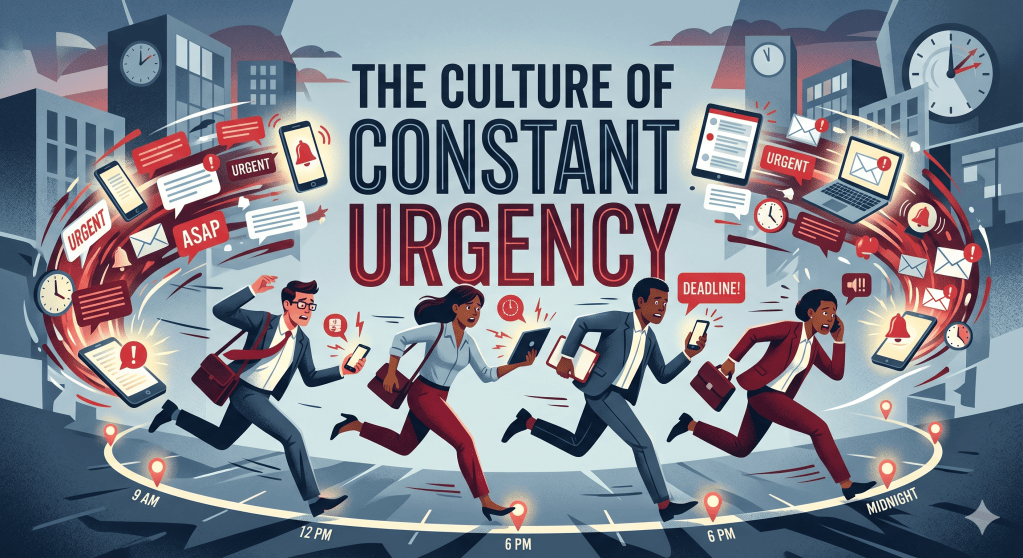
The culture of constant urgency — how smartphones, labor anxiety, and platform design created a psychological state of permanent alertness, and what science reveals about its costs.
There is a particular kind of exhaustion that doesn’t come from doing too much. It comes from feeling like you always should be doing more.
By the late 2010s, that feeling had become a defining feature of everyday life for a significant portion of the developed world — and in the years since, it hasn’t faded. If anything, it’s hardened into something structural. The culture of constant urgency isn’t simply the product of busy schedules or economic pressure. It’s a psychological and social condition shaped by technology, labor economics, communication norms, and a shift in how people understand their own worth.
Picture a few ordinary scenes from that period. A worker answering Slack messages while standing in a grocery line. A parent checking email after putting children to bed. A student waking up and reaching for a phone before their eyes had fully focused. By the end of the decade, these behaviors had become so ordinary they barely registered as unusual. They weren’t signs of crisis. They were just Tuesday.
Understanding how that happened requires looking at several things at once: how smartphones and social media rewired attention and time perception, how economic insecurity pushed people toward productivity as a survival strategy, how the boundaries between work and rest dissolved, and what neuroscience and psychology tell us about what happens when urgency becomes the default operating condition of a human mind. None of these forces worked alone. Together, they produced something new — a background hum of obligation and alertness that many people came to mistake for normal life.
The Disappearing Boundary Between Work and Life
For most of the 20th century, the boundary between work time and personal time was enforced partly by physical limits. When you left the office, the office couldn’t follow you home. The workday had edges. The smartphone erased those edges so gradually that most people barely noticed until they were gone. One widely cited 2019 survey suggested that Americans checked their phones roughly 96 times per day — once every ten minutes during waking hours. But raw frequency only captures part of the story. What mattered more was the psychological shift: the constant awareness that a message might be waiting, that something might need attention, that silence didn’t necessarily mean nothing was happening.
This is what researchers call anticipatory stress — anxiety not about a present demand but about a potential one. A 2016 study published in Computers in Human Behavior found that simply having a smartphone on a desk, even face-down and silenced, reduced available cognitive capacity on tasks requiring concentration. The phone didn’t need to ring. Its presence alone was enough to split attention. The mind, trained to expect interruption, kept part of itself on alert.
That state of readiness carried a biological cost. The human stress response evolved for acute, episodic threats — a burst of cortisol to handle a genuine emergency, then recovery. It wasn’t designed for continuous, low-level activation. When stress hormones remain chronically elevated, the downstream effects are well documented: disrupted sleep, impaired memory consolidation, and the narrowing of the broad, associative thinking that produces creativity and clear judgment. The culture of constant urgency wasn’t just unpleasant. It was physiologically expensive.
Always On, Always Available
The professional world formalized this condition through shifting expectations around response time. Email turnaround that might have allowed a day or two in the 1990s compressed to hours, then to minutes in some workplaces. The shift was rarely announced as policy. It emerged through practice — someone responded quickly, and that speed became the implicit standard. Slower responses began to read as disengagement or incompetence.
Sociologist Arlie Hochschild had described the early version of this problem in her 1997 book The Time Bind, showing how professional life was already colonizing domestic time before smartphones existed. What the smartphone era did was accelerate and extend that dynamic across nearly every corner of working life. Studies of salaried workers in the mid-2010s found that the average professional was engaging with work communications for roughly eleven hours per day — not because employers demanded it contractually, but because the infrastructure of always-on availability made withdrawal feel costly.
The result was what might be called a responsiveness ratchet: expectations tightened periodically, rarely loosened, and each new standard normalized before anyone had consciously agreed to it.
A Brief Historical Note
It helps to place this in longer perspective. Industrialization accelerated the physical demands of labor. The information economy of the late 20th century extended that acceleration to cognitive work. What the smartphone era may have added, for the first time, was the acceleration of interruption itself. Previous generations of workers faced sustained demands on their attention. What became distinctive about the 2010s was that the very capacity to direct and maintain focus — to give one thing your full mind — became the primary site of structural disruption. The demand wasn’t just to work more. It was to remain perpetually interruptible while doing so.
Productivity as Identity
The psychological dimension of constant urgency isn’t purely about workload. It’s also about meaning. In a culture that increasingly equated busyness with virtue, being productive became a way of demonstrating worth — not just to employers, but to oneself.
The sociologist Max Weber traced the roots of this value system to Protestant theology — specifically the Calvinist idea that disciplined labor and worldly success were signs of divine favor. Weber argued this ethic had permanently shaped capitalist culture even as explicit religious belief faded. What the 21st century added was a technology layer that made the performance of productivity continuous and visible. LinkedIn culture, hustle discourse, and the popularity of concepts like “deep work” and “life hacking” created a framework in which personal time became something to optimize. Rest was recovery for the sake of future output. Hobbies were potential side businesses. Free time was wasted unless it was improving something.
The economics reinforced this ideology. The aftermath of the 2008 financial crisis left many workers feeling that job security was fragile and that only those who demonstrated exceptional dedication would survive the next restructuring. That fear reflected real conditions: stagnant middle-class wages, the growth of gig and contract work, and the accelerating automation of routine cognitive tasks. The hustle ethic wasn’t irrational — it was a response to genuine precarity. But it colonized far more of daily life than economic necessity actually required.
The Attention Economy and the Hijacking of Now
The platforms that restructured professional life were simultaneously, and by design, restructuring personal time in ways that deepened the urgency. Social media algorithms rewarded content that provoked strong emotional responses — anxiety, outrage, and anticipation among the most reliable. Tristan Harris, a former design ethicist at Google, described how platforms used variable reward schedules, the same mechanism behind slot machines, to make compulsive checking nearly automatic. The possibility of something new and rewarding was the hook, not the certainty of it. Humans are wired to pay attention to novelty and social signals; these platforms exploited both with considerable precision.
Researcher Gloria Mark at UC Irvine found in repeated studies that once a worker’s attention was disrupted, it took an average of about 23 minutes to return to the original task. In an environment of constant notification, that recovery time had nowhere to accumulate. But organizational psychologist Sophie Leroy identified something even more specific: attention residue. When people switch between tasks, part of their attention doesn’t fully transfer. It lingers on the task just left — still processing, still half-engaged — even as they try to move forward. In a workday structured around near-constant switching between apps, messages, and meetings, residue accumulates. The mind is never quite anywhere, because parts of it are always somewhere else. The culture of constant urgency didn’t just demand more from people. It fragmented the cognitive resource they needed to meet those demands.
Sleep, Stress, and the Narrowing of Thought
One of the most direct effects of the culture of constant urgency was on sleep. By 2016, the CDC was describing sleep deprivation as a public health epidemic, with adults averaging less than seven hours per night. Blue light from screens suppresses melatonin production. But the psychological mechanism may have been more powerful: falling asleep requires releasing the sense that something might need attention, and that release had become genuinely difficult. Many people reported checking their phones immediately before sleep and immediately upon waking, effectively extending the pressure loop into the body’s only recovery period.
Neuroscientist Matthew Walker documented in Why We Sleep how even modest sleep restriction impairs the prefrontal cortex — the brain region responsible for judgment, planning, and emotional regulation. The irony he identified was pointed: people sacrificing sleep in the name of productivity were undermining the very capacities that made productive work possible.
Psychologist Barbara Fredrickson’s research on positive emotions adds a further dimension. Her “broaden-and-build” theory holds that states like calm and curiosity expand the scope of thought, enabling creativity and complex problem-solving. States of anxiety and pressure, by contrast, narrow attention to immediate demands. A mind running in constant urgency mode is, by this account, a mind stuck in a perpetual narrow aperture — capable of managing immediate tasks but poorly equipped for the open-ended thinking that generates new ideas or genuine insight. This may partly explain why many people in this period reported feeling reactive rather than generative, even as they were technically more connected and informed than any previous generation.
Sociologist Hartmut Rosa framed this at the structural level through his concept of “social acceleration.” Modern societies, Rosa argued, were caught in a feedback loop: technological speed increased the pace of social change, which pressured individuals to keep up, which drove demand for more technology, which accelerated everything further. The individual experience of urgency wasn’t just a personal failing or a time management problem. It was the felt experience of living inside a system that had no internal mechanism for slowing down.
The Paradox of Connection and Isolation
One of the more counterintuitive features of this period was that constant urgency coexisted with widespread loneliness. Despite being more measurably connected — more messages sent, more profiles followed, more interactions logged — people in the mid-2010s reported higher rates of loneliness than previous generations. Former U.S. Surgeon General Vivek Murthy described loneliness as a growing health crisis in 2017, noting that its physical health effects were comparable to smoking fifteen cigarettes a day.
The connection between urgency and loneliness was real, and it operated through several related mechanisms.
The most direct was the compression of available time. Deep relationships are not efficient. They require aimless conversation, unhurried presence, and the willingness to show up without an agenda. When every hour carries a sense of productive obligation, that kind of time gets systematically crowded out. What sociologist Ray Oldenburg called “third places” — the informal gathering spaces, separate from home and work, where people have historically built community — were in measurable decline across much of the United States by this period. Neighborhood bars, diners, barbershops, and parks had been replaced not by better alternatives but largely by nothing, or by digital spaces that simulated togetherness while delivering something quite different.
The data on friendship reflected this. A 2021 Survey Center on American Life report found that the share of Americans with no close friends had roughly quintupled since 1990. Spontaneous socializing — the unplanned kind that actually builds closeness — requires slack in a schedule. When schedules are fully allocated, spontaneity disappears. What remains is planned socializing: friendship managed like a project, penciled into calendars weeks out, often canceled when work expands. That kind of socializing keeps relationships at a maintenance level. It rarely deepens them.
Social media offered a substitute: the performance of connection through likes, comments, and follower counts. But research consistently found that passive scrolling through curated feeds was associated with lower wellbeing, not higher. The platforms that promised connection tended to deliver comparison instead. And comparison, as social psychologist Leon Festinger’s foundational work showed, is not neutral — upward comparisons, measuring oneself against those who appear to be doing better, reliably depress mood and self-worth. A platform structurally designed to surface others’ highlights creates an environment of nearly inescapable upward comparison.
What makes this dynamic worth dwelling on is how urgency and loneliness reinforced each other. People were too pressed for the slow, irreplaceable work of genuine connection. The available substitute left many feeling worse about themselves. Feeling worse about themselves often drove them back toward productivity and achievement — toward demonstrating worth through output rather than relationship. Urgency and loneliness weren’t separate problems running in parallel. They fed each other in a loop that was difficult to interrupt from the inside.
How We Got Here, and Where It Has Led
Looking back from 2026, the culture of constant urgency that crystallized in the late 2010s appears less like a cultural moment than a structural transition point. The forces that produced it didn’t recede. Several intensified.
The COVID-19 pandemic initially appeared to some as a possible reset. Lockdowns paused commuting and social obligations. Some people reported an unexpected slowdown. But for knowledge workers, remote work dissolved whatever remained of the office-home boundary. Work expanded to fill domestic space and around-the-clock availability in ways that were new. The urgency didn’t pause — it relocated.
The rapid deployment of AI tools from the early 2020s onward added a dimension that few had fully anticipated. The standard narrative was that automation would reduce pressure by handling routine tasks, freeing human workers for higher-order thinking. What happened instead followed a different logic: each new capability raised the baseline of what was expected. If a tool could now produce a first draft in seconds, the expectation shifted to what a human could do with a first draft — faster revision, higher volume, more ambitious scope. Economists sometimes call this the productivity paradox, the recurring pattern in which efficiency gains don’t reduce workloads but instead expand the definition of adequate output. In the context of AI, this dynamic had a particular quality: the ceiling kept moving upward in near real-time, making it structurally difficult to feel that one had ever fully caught up. The tools didn’t deliver slack. They delivered new standards.
Rethinking Urgency
None of this argues that modern life should be slower for the sake of slowness, or that ambition and engagement are inherently costly. The problem was never urgency itself — urgency is a legitimate and useful state. It focuses attention, motivates action, and sharpens response to genuine demands. The problem was the normalization of urgency as a permanent condition rather than a situational response.
When everything is urgent, the category loses meaning. When the body is chronically primed for demands that may or may not arrive, it loses the capacity to accurately assess which ones matter. When busyness becomes an identity, rest becomes threatening rather than restorative.
The research consistently points toward a straightforward structural insight: human cognition requires oscillation. It needs periods of focus and periods of diffuse rest, of engagement and genuine disengagement. The culture of constant urgency was a sustained mismatch between the demands placed on human minds and the actual requirements of those minds. The mind needs downtime not as a luxury but as a functional necessity — for memory consolidation, for creative association, for the recovery of judgment and emotional range.
What has changed since 2019 is largely a matter of wider awareness. Concepts like attention residue, cognitive load, and the attention economy have moved from academic literature into mainstream conversation. That shift is real, even if structural change has been slower to follow.
The broader significance of this period may ultimately be this: it marks a moment when the gap between the pace of technological change and the pace of human adaptation became too wide to ignore. The technologies arrived faster than the norms, and the norms arrived faster than the institutions capable of managing them, and individuals were left navigating conditions that no amount of personal optimization could fully resolve. That gap hasn’t closed. It remains the defining challenge — not just for productivity or individual wellbeing, but for what it means to live a coherent human life inside systems that have no natural incentive to slow down.









