
Originally published in July 2019 and comprehensively updated/edited in June 2026.
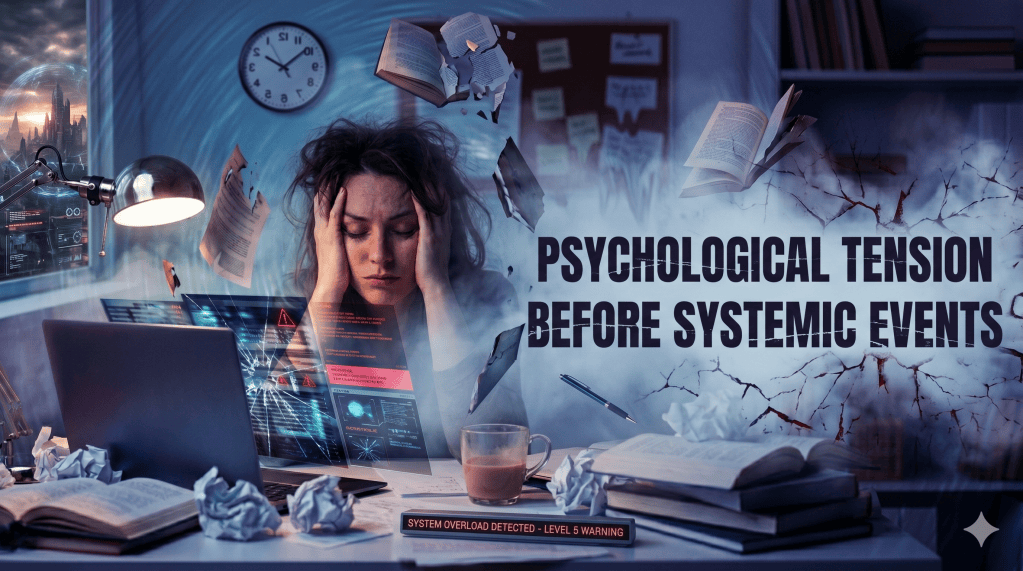
How psychological tension builds before major systemic events — and what neuroscience, psychology, and sociology reveal about the human experience of living through them.
In late 2019, many people described feeling exhausted, anxious, distracted, and unusually reactive. Sleep felt harder to come by. Political conversations turned corrosive faster than they used to. A general sense of unease had settled over daily life that was difficult to explain and even harder to shake. At the time, those experiences were usually interpreted as personal problems — symptoms of individual stress or character weakness. In retrospect, they may also have been something else: symptoms of a society under accumulating strain, in the months before a sequence of systemic disruptions that would reshape the decade.
There are moments in history when the air seems to change before anything visible breaks. Institutions hold their shape on paper. Leaders go through their routines. Markets open and close. And yet something has shifted in the way ordinary people carry themselves through the day — a low-grade alertness, a collective unease that is hard to name but impossible to fully ignore. What historians and social scientists sometimes describe as a period of mounting systemic strain — what might be called pre-systemic tension — is the phase that precedes large-scale social disruption, economic upheaval, or political transformation.
What makes this phenomenon worth studying isn’t just that it happens. It’s that people living inside it rarely recognize it for what it is. The tension manifests as personal anxiety, relationship stress, political irritability, and a vague sense that the ground isn’t quite as solid as it used to be. Only in retrospect — once the systemic event arrives and reshapes the landscape — does the preceding period get reframed as an obvious prelude.
This essay examines how psychological tension builds before major systemic events, drawing on research from psychology, neuroscience, sociology, and behavioral economics. It looks at the individual experience of living under that tension, the collective dynamics that amplify it, and what science has learned about the human nervous system’s response to prolonged uncertainty. The goal isn’t to predict the future — that’s not what this kind of analysis does — but to better understand the emotional and cognitive texture of living through a period when the system is straining before it changes.
What a “Systemic Event” Actually Means
Before getting into the psychology, it’s worth being precise about what we mean by a systemic event. The term gets used loosely, so a definition is helpful here. A systemic event is a disruption that doesn’t just affect individual people or isolated sectors, but restructures the broader rules of the game — the economic, political, social, or institutional frameworks that most people navigate without consciously thinking about them.
The 2008 financial crisis was a systemic event. So was the political realignment that began accelerating across Western democracies through the 2010s. So, in different ways, were the civil rights movement of the 1950s and 60s, the collapse of the Soviet Union, and the COVID-19 pandemic. These weren’t just large news stories. They reorganized expectations, redistributed power and resources, and forced both institutions and individuals to renegotiate their place in the world.
What distinguishes systemic events from ordinary crises is their depth. An ordinary crisis is a severe disruption within the existing framework — a company fails, a hurricane hits a city, a government changes hands. A systemic event bends or breaks the framework itself. And because the framework is what most people rely on to make sense of their lives, a systemic event tends to produce a far more disorienting psychological aftermath than even a severe conventional crisis.
The psychological tension that builds before such events is partly a response to warning signs that something is wrong — even when those signs haven’t yet been processed into a coherent narrative. The system is sending signals, but the cognitive and emotional infrastructure most people rely on to interpret those signals was built for a more stable environment.
Historians frequently identify similar patterns in hindsight. Accounts from the final years of the Soviet Union describe a widespread sense that institutions were stagnating long before the formal collapse arrived — a population that felt something was wrong but lacked the framework to articulate what. Likewise, many retrospective analyses of the years preceding the 2008 financial crisis note that signs of instability were visible but fragmented, making them difficult for most people to assemble into a coherent picture until after the system had already broken. In both cases, the perception of strain was real, even when its meaning remained unclear. What arrived later was not the feeling itself, but the framework for understanding what had been causing it.
Although the dynamics discussed here appear repeatedly throughout history, the years leading up to 2020 provide a useful contemporary case study — one close enough that many readers will recognize its texture from their own experience.
The Neuroscience of Living with Prolonged Uncertainty
To understand how this tension operates at the individual level, it helps to look at what neuroscience has established about how the brain handles uncertainty. The short answer is: not well, and not indefinitely.
The brain is fundamentally a prediction machine. This is one of the more durable insights to emerge from neuroscience over the past two decades. Rather than passively receiving information from the environment and reacting to it, the brain is constantly generating predictions about what should happen next, comparing those predictions against what actually arrives, and updating its models accordingly. This process — sometimes described in terms of “predictive processing” — is efficient and largely unconscious. It’s how we navigate familiar environments without burning cognitive fuel on every small decision.
The problem is that this system is calibrated for relatively stable environments. When uncertainty rises — when the future becomes harder to predict, when familiar patterns stop working, when the gap between expectation and reality widens — the predictive system begins generating a continuous low-level alarm. This is the neurological foundation of anxiety. It’s not a malfunction. It’s the brain signaling that its models may be unreliable, and that extra cognitive resources should be allocated to monitoring the environment.
Under short-term stress, this is adaptive. The extra vigilance helps people respond more effectively to genuine threats. But under prolonged uncertainty — the kind that accumulates across months or years of social and economic instability — the continuous alarm becomes pathological. Research by neuroscientist Martin Paulus and his colleagues has documented how chronic uncertainty dysregulates the body’s stress-response systems, raising baseline cortisol levels, disrupting sleep architecture, and impairing the prefrontal cortex’s capacity for complex reasoning and emotional regulation.
What this means in practice is that people living through extended periods of pre-systemic tension are simultaneously more anxious, more cognitively impaired in exactly the ways that would help them think clearly about their situation, and less able to regulate their emotional responses to perceived threats. This isn’t a failure of character or intelligence. It is a predictable outcome of exposing a biological system adapted for short-term danger to conditions of indefinite ambiguity.
How Collective Anxiety Takes Shape
Individual anxiety is one thing. But pre-systemic tension isn’t just a private experience — it’s a social one. And social anxiety follows different dynamics than individual anxiety, often amplifying in ways that produce collective behaviors that seem irrational when viewed in isolation.
Sociologist Émile Durkheim’s concept of anomie — the condition that arises when social norms break down or no longer provide adequate guidance — captures part of what happens at the collective level during periods of systemic strain. Put simply, people become anxious when they can no longer reliably predict which social rules still apply. When the shared rules that govern behavior become uncertain or contested, people lose a critical source of psychological stability. Norms don’t just tell us how to act; they tell us what to expect from others. When norms erode, the social world becomes less predictable, and the baseline anxiety described above ratchets upward across entire populations.
Contemporary research has added granularity to this picture. Social psychologist Jonathan Haidt’s work on moral foundations theory shows how political polarization tends to intensify during periods of perceived threat, as people cluster more tightly around in-groups defined by shared moral frameworks. The out-group doesn’t just represent a political difference; it comes to represent existential danger. This isn’t rhetorical excess on the part of those who feel it — the emotional reality of threat is genuine. But the cognitive interpretation of that threat is being shaped by the anxious brain’s tendency toward pattern-matching, categorization, and worst-case-scenario modeling.
The sociologist Randall Collins described something similar in his concept of interaction ritual chains — the idea that emotional energy is transmitted through social interaction, and that collective emotional states can self-reinforce across networks of people. In the digital age, this dynamic has been dramatically accelerated. Social media platforms are, in effect, emotional contagion machines. Research by psychologists including James Fowler and Nicholas Christakis has shown that emotional states spread through social networks with measurable statistical regularity. Anxiety, like happiness or depression, is partially contagious.
This means that during a period of genuine systemic strain, the already-elevated individual anxiety gets amplified through social channels — and that amplification happens faster and more broadly than at any previous point in history. The result can be a collective psychological state that is significantly more agitated than the objective circumstances might strictly warrant. Or, alternatively, a state that has appropriately calibrated the danger but lacks the institutional frameworks to channel that calibration into constructive response.
The Role of Economic Precarity
No analysis of pre-systemic psychological tension is complete without addressing the role of economic insecurity. Material conditions and mental states are not separate variables. They are deeply entangled, and the research is unambiguous that prolonged financial insecurity has direct, measurable effects on cognitive function, emotional regulation, and social behavior.
Economists Sendhil Mullainathan and Eldar Shafir developed a powerful framework for understanding this relationship in their work on scarcity. Their research demonstrated that cognitive bandwidth — the mental capacity available for complex thinking, planning, and self-regulation — is a limited resource. When people are preoccupied with immediate financial problems, that preoccupation consumes cognitive bandwidth that would otherwise be available for longer-term planning, relationship maintenance, and the kind of deliberate reasoning that helps people make good decisions under uncertainty.
The political implications of this are significant. During periods of economic precarity — especially the kind of diffuse, long-term precarity that characterized large sections of Western middle and working classes through the 2010s — the population is not just materially stressed. It is cognitively and emotionally compromised in ways that affect political behavior, social trust, and susceptibility to simple narratives that promise to restore order.
This is not a condescending observation about people’s rationality. It’s a structural observation about what happens when a large enough share of a population is operating under conditions of resource scarcity and chronic uncertainty. The research shows that under these conditions, people’s cognitive and emotional responses shift in predictable directions: short-term thinking predominates over long-term planning; threat perception intensifies; and the appeal of clear, decisive authority — even at the cost of individual complexity — increases.
Trust, Institutions, and the Gradual Erosion of Legitimacy
A critical but often underappreciated element of pre-systemic tension is what happens to institutional trust. Trust in institutions — governments, financial systems, media, scientific bodies, judicial systems — is not just a civic virtue. It’s a cognitive load-bearing structure. When people can reasonably trust that the institutions governing their lives are operating with some degree of competence and good faith, they can afford to direct mental energy elsewhere. Institutional trust functions as a kind of psychological infrastructure.
When that trust erodes, the cognitive and emotional burden on individuals increases substantially. Every interaction with a system now requires vigilance that wasn’t necessary before. Every announcement from an authority requires independent evaluation rather than reasonable deference. This is exhausting in ways that accumulate over time, and the exhaustion has its own psychological effects — increasing irritability, reducing capacity for nuanced thinking, and making people more susceptible to simpler explanatory frameworks.
Research by political scientists Pippa Norris and Ronald Inglehart tracked declining institutional trust across advanced democracies over several decades and identified the consequences: increased political volatility, rising support for anti-establishment movements, and growing public receptiveness to narratives that frame the existing order as fundamentally corrupt rather than merely imperfect.
The psychology here is interesting. Declining institutional trust doesn’t simply make people more cynical and disengaged. It often makes them more emotionally engaged with politics — just in ways that are adversarial toward existing institutions rather than supportive of them. The emotional energy that was previously channeled into diffuse civic participation gets redirected into intense, polarized political identification. This is a symptom of a system under strain, not a cause of it — though the feedback loops between the two are tight.
Technology, Fractured Attention, and the Inability to Look Away
Any contemporary account of psychological tension before systemic events must reckon with the role of technology — specifically, the transformation of the information environment that occurred through the 2000s and 2010s. This transformation didn’t create the social and economic pressures that produce systemic strain, but it substantially altered the cognitive and emotional context in which those pressures were experienced. And it introduced several dynamics with no real historical precedent.
The most underappreciated of these is the collapse of shared attention. Before digital media fragmented the information landscape, even a divided society still consumed something resembling a common set of facts and reference points — the same evening news broadcast, the same front pages. That shared attention wasn’t politically neutral, but it provided a minimal common ground for disagreement. When it collapsed, something more fundamental than media preference changed: the basic ability to disagree within a shared reality eroded along with it.
A second dynamic is what researchers call the permanent exposure to distant crises. For most of human history, people were psychologically exposed to roughly the number of crises they could directly observe and influence — those within their community, their household, their immediate social world. Digital media dissolved that boundary. By the mid-2010s, a person checking their phone in the morning was simultaneously exposed to political emergencies on multiple continents, climate data, local crime statistics, and the intimate emotional states of hundreds of acquaintances. The human stress-response system was not designed for this scope of exposure. It responds to distant crises with the same neurological alarm it triggers for local ones, which means the system runs hot in ways it was never calibrated to sustain.
Cognitive psychologist Herbert Simon identified the structural problem decades before the internet: information abundance creates attention scarcity. In an environment of attention scarcity, what gets through is disproportionately what triggers strong emotional responses. Platforms optimized for engagement effectively optimized for emotional arousal, because arousal drives behavior. This is not a conspiracy theory about platform intent — it’s a description of how optimization processes work when engagement is the feedback signal. The consequence was a sustained elevation in average emotional intensity, occurring precisely when structural stressors were already pushing baseline anxiety upward.
The result was something that had no clean parallel in earlier history: a population that could not psychologically leave the public sphere. Every moment of downtime was a potential entry point for the next alarm. Chronic low-level hypervigilance — the neurological state described earlier as costly and dysregulating — became the ambient condition of ordinary life for a large share of the population, not because of any single crisis, but because the information environment made it structurally unavoidable.
Individual Coping Strategies and Their Collective Consequences
One of the more counterintuitive findings in the research on pre-systemic tension is that many of the coping strategies individuals adopt to manage their anxiety have collectively destabilizing effects. This isn’t a moral judgment — it’s an observation about the mismatch between what helps one person feel better and what helps a society navigate uncertainty effectively.
Certainty-seeking is a good example. When uncertainty generates anxiety, one of the most reliable ways to relieve that anxiety in the short term is to adopt a framework that provides clear answers — a political ideology, a conspiratorial narrative, a religious absolutism, or any other system that converts the ambiguous landscape of actual reality into a more manageable binary. This works, to a degree. Research in psychology has repeatedly confirmed that people who hold their beliefs with greater certainty report lower anxiety, at least initially. The problem is that certainty-seeking at the population level tends to fragment shared reality — which is the opposite of the shared epistemic common ground that functional institutions and political negotiations require.
Similarly, social withdrawal — retreating from civic participation, news consumption, and political engagement — is an individually rational response to an overwhelming information environment and a political landscape that feels threatening or hopeless. But withdrawal accelerates the democratic deficit that political scientists identify as a precondition for institutional collapse.
These dynamics don’t mean ordinary people are behaving irrationally or bear responsibility for systemic dysfunction. They mean that the aggregate of individually understandable responses to a stressful environment can produce collective outcomes that none of those individuals wanted or chose.
Looking Back and Looking Forward
The period roughly spanning 2015 to 2020 — the years just before this essay was first drafted — now reads, in retrospect, as a recognizable example of mounting systemic strain. Not because everything that was feared came true, but because the psychological and social conditions described above were clearly present and measurable, and they were followed by a sequence of systemic disruptions — political realignments, the pandemic, acute polarization, and accelerating technological disruption — that forced a broad renegotiation of how institutions, economies, and social norms operate.
This pattern has precedents. Historians studying the years preceding the Soviet Union’s collapse frequently describe a population that sensed institutional exhaustion and stagnation long before the formal political break occurred — a widespread feeling that the system wasn’t working, even when official indicators suggested stability. Accounts from the years immediately preceding the 2008 financial crisis tell a similar story: persistent unease among ordinary people about debt, housing, and economic sustainability, even as market indices climbed and official reassurances continued. In both cases, the aggregate sense of unease preceded the systemic event by years. The unease was real; what was missing was a framework for interpreting its causes.
What the research on psychological tension before systemic events ultimately tells us is something both humbling and clarifying. It tells us that human beings, despite all the cognitive sophistication that makes civilization possible, are still running on biological hardware that doesn’t handle prolonged uncertainty well. That the social dynamics of anxiety amplification can make collective situations more dangerous than objective conditions alone would warrant. And that the solutions to pre-systemic strain are rarely discovered by individuals operating in isolation from the anxious systems around them.
What the research also tells us — and this is the forward-looking piece that matters — is that awareness helps. Not perfectly, and not automatically. But communities and individuals who understand why they feel what they feel during periods of systemic strain are better positioned to distinguish between the signal and the noise, to choose responses that are constructive rather than merely soothing, and to build the kind of local trust networks that research consistently identifies as the most durable buffer against systemic disruption.
None of this is comfortable knowledge. The picture painted by psychology, neuroscience, and sociology is of creatures who are ill-equipped for the conditions they’ve created, navigating systems more complex than their nervous systems were designed to handle, doing their best under constraints they largely don’t see. But it is honest knowledge. And in a period when the gap between complexity and comprehension keeps widening, honesty about the human condition seems like a reasonable place to start.









