
Originally published in February 2024 and comprehensively updated/edited in June 2026.
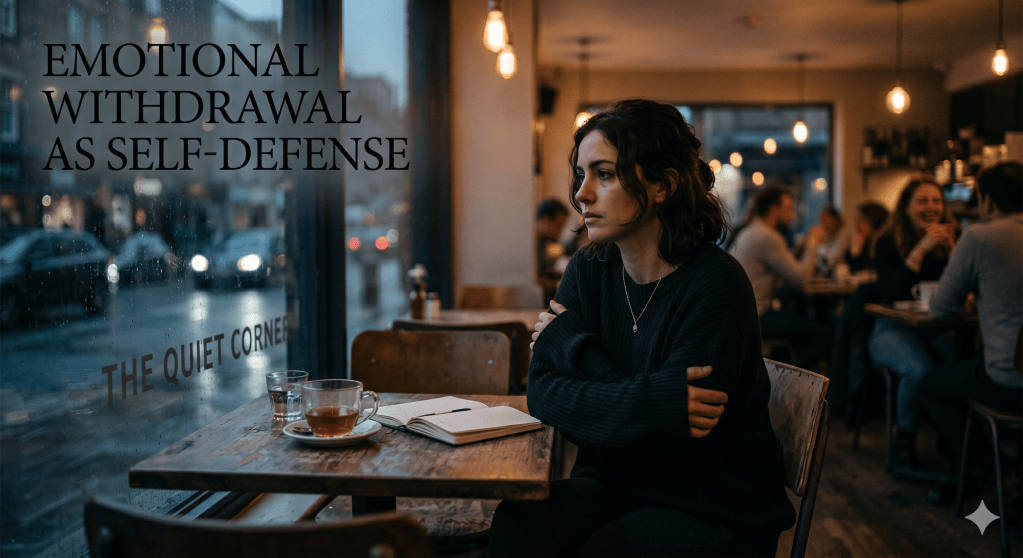
Emotional withdrawal as self-defense became a defining social pattern of the 2020s. This essay examines the psychology, neuroscience, and cultural conditions behind it.
By the early 2020s, a significant portion of the population had developed what might be called a new emotional reflex: the instinct to pull back, to limit exposure, to protect the interior self from a world that had become relentlessly demanding and frequently hostile. This wasn’t depression, exactly, though it could look like it from the outside. It wasn’t antisocial personality, though critics sometimes labeled it that way. It was something more deliberate — emotional withdrawal as a form of self-defense.
Understanding this pattern requires looking at the social, technological, and psychological conditions that made it feel not just reasonable, but necessary. The years surrounding the COVID-19 pandemic, the algorithmic transformation of public discourse, rising economic anxiety, and the accelerating pace of information exposure combined to create an environment in which many individuals began quietly restructuring how much of themselves they were willing to put into the world. This essay examines what that withdrawal looks like, why it happens, what science tells us about its costs and benefits, and what it signals about the broader arc of modern social life.
What Emotional Withdrawal Actually Means
The phrase “emotional withdrawal” can sound clinical, or even dramatic. In practice, it describes something most people will recognize immediately: the gradual narrowing of emotional investment in situations, relationships, or institutions that feel too risky, too exhausting, or too unreliable to be worth the vulnerability.
This is not the same as being cold, or unfriendly, or incapable of connection. People who withdraw emotionally as a coping strategy often maintain warm, genuine relationships within a tightly controlled circle. What they reduce or eliminate is the broader social exposure — the willingness to share opinions in public, to invest emotionally in institutions, to extend trust to strangers, or to participate openly in communities that feel unpredictable.
Psychologists sometimes refer to this as a form of “self-protective disengagement.” The logic is not complicated. If a person has repeatedly experienced emotional harm from a particular kind of interaction — public shaming, relationship betrayal, institutional disappointment — the brain begins treating that category of interaction as a threat. The response is withdrawal, and from a purely neurological standpoint, it makes sense.
The Neurological Foundation: Why the Brain Chooses Retreat
To understand emotional withdrawal as self-defense, it helps to understand what happens in the brain when social threat is perceived. Research in social neuroscience has demonstrated that social pain — the pain of rejection, humiliation, or exclusion — activates many of the same neural regions as physical pain. A landmark study by Naomi Eisenberger and Matthew Lieberman at UCLA, published in the journal Science in 2003, used functional MRI imaging to show that social exclusion activated the dorsal anterior cingulate cortex, the same area that processes the distress component of physical pain.
This finding has been replicated and extended many times since. The brain appears to process social and physical pain through partially overlapping neural systems, suggesting that social rejection is experienced as a genuinely significant threat rather than a purely abstract concern — one that activates many of the same defensive responses that protect against physical danger.
When those defensive systems are triggered repeatedly, the nervous system begins to anticipate threat before it arrives. This is the basis of what’s often called hypervigilance in clinical settings, but the same mechanism operates at a subclinical level in people who have simply been burned enough times to become cautious. The amygdala — the brain’s threat-detection center — learns patterns. If emotional openness has repeatedly resulted in pain, the amygdala begins flagging emotional openness itself as a danger signal.
The prefrontal cortex, the seat of rational deliberation and long-term planning, can sometimes override these responses. But under conditions of chronic stress or sustained social overwhelm, the capacity for that kind of top-down regulation tends to diminish. What’s left is a nervous system that has learned, at a fairly deep level, that openness costs more than it returns.
The Social Environment That Normalized Withdrawal
Neuroscience explains the mechanism. Social history explains why so many people arrived at the same point at roughly the same time.
The Pandemic’s Structural Disruption
The COVID-19 pandemic did not create emotional withdrawal, but it provided a remarkable accelerant. For roughly two years — in some places more — ordinary social interaction became physically dangerous. Isolation was not just a preference but a public health directive. The structures that had previously scaffolded social engagement — offices, schools, religious communities, recreational leagues, casual public spaces — were either shut down or radically altered.
What this period did, beyond its obvious immediate costs, was give an enormous number of people an extended experience of reduced social exposure. Many discovered, often with some surprise, that the relief they felt during lockdown was not purely situational. Some portion of what they had experienced as ordinary social life had apparently been a source of low-grade stress they hadn’t consciously recognized. The silence had been, in some cases, welcome.
When the world reopened, many people found that they didn’t automatically spring back to previous patterns. They returned to social participation selectively, cautiously, and with a different calculus about what was worth the effort. Relationships and communities that had felt obligatory before the pandemic were re-evaluated. Some were quietly dropped. Others were maintained with less emotional investment than before.
The Algorithm Problem
Alongside the pandemic, the architecture of social media had been shifting in ways that made emotional engagement increasingly costly. By the early 2020s, most major platforms had optimized their content algorithms not for connection or satisfaction, but for engagement — and research had made clear, including internal findings at Facebook that became public through whistleblower Frances Haugen in 2021, that outrage and emotional distress tended to generate more engagement than contentment or calm.
The result was an information environment that systematically rewarded emotional reactivity and punished nuance. Sharing a considered opinion in public had become, for many people, an exercise in managing unpredictable hostility from strangers. The risk-reward calculation for public emotional expression had shifted sharply in the direction of risk. Public discourse came to feel less like a conversation and more like a minefield — and the rational response to a minefield is to find a different path.
Research in communication studies and social psychology supports what many people had already figured out experientially. A 2021 Pew Research study found that a majority of Americans reported self-censoring their own views online out of fear of negative reactions. This wasn’t cowardice, or at least it wasn’t only cowardice. It was a reasonable response to an environment in which the costs of expression had become difficult to predict and often severe.
Economic Anxiety as Emotional Depletion
A third current running through this period was economic. The years between 2020 and 2026 brought a sequence of financial disruptions — pandemic-era unemployment, supply chain inflation, rising housing costs in most major markets, and widespread uncertainty about career stability in sectors facing automation pressure. Economic anxiety is not merely a practical problem. It depletes the emotional resources that sustain social engagement.
Psychologists Roy Baumeister and Mark Muraven developed what became known as ego depletion theory — the idea that self-regulation and social effort draw on a limited cognitive resource that can be exhausted. While later research complicated some aspects of this model, the basic intuition holds: people under sustained stress have less capacity for the kind of emotional labor that social connection requires. When a person is chronically worried about their financial stability, the bandwidth available for maintaining peripheral relationships or engaging in emotionally demanding public participation narrows considerably.
The Spectrum of Withdrawal Behaviors
Emotional withdrawal as self-defense does not look the same across all individuals or all domains of life. It operates on a spectrum, and its expression varies considerably depending on temperament, social context, and the specific sources of perceived threat.
Relationship Pruning
At the interpersonal level, withdrawal often manifests as what might be called relationship pruning — a conscious or semi-conscious reduction in the number of relationships a person actively invests in. Social networks that had expanded during more optimistic periods contract. Acquaintances are allowed to drift. Invitations are declined more frequently. The social circle tightens around a smaller number of relationships that feel reliable and low-risk.
This pattern has been documented across age groups, but it became particularly notable among adults in their thirties and forties during the post-pandemic period. Sociologist Claude Fischer, whose decades of research on American social networks produced the influential 1982 study To Dwell Among Friends, documented how social ties in the United States have long been more voluntary and loosely maintained than in many other societies — a pattern that makes American networks both flexible and fragile. His work showed that Americans’ average number of close confidants had been declining well before the pandemic; the disruptions of the early 2020s appear to have accelerated a contraction that was already underway.
Institutional Disengagement
Beyond personal relationships, many people during this period reduced their emotional investment in institutions — civic organizations, religious communities, political parties, employers, and professional associations. Trust in institutions had been declining across most Western democracies for decades, but the early 2020s saw particularly sharp drops. Gallup polling in the United States showed confidence in major institutions — Congress, the media, organized religion, the medical system — at or near historic lows by 2022 and 2023.
Institutional disengagement is a form of emotional withdrawal too, even if it’s rarely described that way. Institutions make emotional demands on their members — requiring loyalty, participation, shared identity, and a degree of vulnerability to collective disappointment. When the perceived risk of that investment exceeds the perceived return, withdrawal is the logical result.
Information Avoidance
A closely related behavior is information avoidance — the deliberate decision to limit exposure to news, social media, or other information streams that produce emotional distress without providing proportionate benefit. Surveys conducted in the early 2020s across multiple countries found that significant numbers of people were reducing their news consumption, taking deliberate breaks from social media, or entirely avoiding certain categories of content.
Psychologists have a name for this: “protective buffering.” The research on its effects is genuinely mixed. On one hand, limiting exposure to distressing information can reduce anxiety and preserve cognitive resources for more immediate concerns. On the other hand, sustained avoidance of threatening information can create gaps in understanding that make people more vulnerable, not less, to the consequences of events they haven’t followed.
The Costs That Don’t Announce Themselves
Emotional withdrawal as self-defense carries real costs, and one of its features is that those costs often accumulate slowly, below the threshold of conscious attention.
The most significant is the erosion of what sociologists call social capital — the network of relationships, reciprocal obligations, and shared norms that allow communities and individuals to navigate difficulty. Social capital is built through consistent, low-stakes social investment: showing up, extending small trusts, maintaining contact even when it’s inconvenient. When many people withdraw simultaneously, the infrastructure of community weakens in ways that are hard to reverse quickly.
Loneliness research had been raising alarms on this front well before the pandemic. Vivek Murthy, the U.S. Surgeon General, issued an advisory in 2023 declaring loneliness and social isolation a public health epidemic, noting that the health consequences of insufficient social connection were comparable to those of smoking 15 cigarettes a day. This is not merely metaphor — the physiological links between social isolation and negative health outcomes, including elevated cortisol, disrupted sleep, increased inflammation, and accelerated cognitive decline, are well established in the literature.
The protective logic of withdrawal, in other words, can become its own trap. The same mechanism that guards against the pain of social risk gradually reduces the capacity for the kind of connection that supports mental and physical health. The nervous system that learned to treat openness as a threat eventually makes genuine vulnerability harder to access even when the environment has become safer.
Distinguishing Healthy Limits from Harmful Isolation
Not all withdrawal is created equal, and an honest account of this phenomenon requires distinguishing between responses that are genuinely adaptive and those that represent a slide toward something more concerning.
Setting limits on emotional exposure can be healthy and even necessary. There are social environments — abusive relationships, toxic workplaces, online spaces designed to provoke outrage — from which withdrawal is not just defensible but clearly the right response. The clinical concept of boundaries exists precisely because not all emotional demands are legitimate, and protecting one’s psychological integrity from genuinely harmful situations is a sign of health, not weakness.
What becomes problematic is when the protective response generalizes beyond the specific threats that prompted it, expanding until it encompasses low-risk connections and opportunities as well as high-risk ones. The person who stops engaging with a genuinely toxic online community is making a healthy choice. The person who, over time, stops engaging with neighbors, old friends, or any situation involving uncertainty has drifted into a different territory.
Clinical psychologist Jonathan Haidt, in his research on what he and colleague Greg Lukianoff have described as “safetyism,” has raised concerns about cultural trends that pathologize normal levels of risk and discomfort. The argument is not that vulnerability should be unlimited, but that a psychology organized entirely around avoiding discomfort tends to produce fragility rather than resilience over time. While researchers continue to debate the scope and implications of these trends, the broader question of how much discomfort is necessary for resilience remains an active area of inquiry. Some degree of exposure to social uncertainty — and even to social pain — appears to be part of how humans develop the emotional flexibility needed to sustain meaningful relationships.
The Quiet Renegotiation of Social Contracts
One of the more significant aspects of the withdrawal phenomenon is what it implies about the implicit social contracts that govern how people relate to one another and to their communities.
Social contracts — the unwritten agreements about mutual obligation, appropriate behavior, and shared commitment — depend on participants believing that the other parties will honor them. The erosion of trust that characterized the early 2020s was, in part, a crisis of these contracts. People who had been told that institutions were trustworthy found that trust violated. People who had expected that public discourse would operate according to norms of basic good faith found those norms ignored.
When social contracts break down repeatedly, it is rational to renegotiate the terms. The willingness to invest emotionally in public life, in civic institutions, in large social networks, was quietly being repriced — placed on conditional terms rather than assumed as a baseline. Social contracts, once renegotiated downward, are difficult to restore. Whether the generation that came of age during the hyperconnected 2010s, and then lived through the disruptions of the early 2020s, can find reasons to revise those terms upward remains one of the more consequential open questions of the period.
What Recovery Might Look Like
The conversation about emotional withdrawal is not complete without addressing what, if anything, might draw people back toward greater openness. Research in psychology and neuroscience offers some tentative guidance, though none of it amounts to a simple prescription.
Trust, when it has been damaged, tends to rebuild through what researchers call “behavioral confirmation” — repeated experiences in which the thing that was distrusted behaves differently than expected. For individuals, this often means small, low-stakes experiments with vulnerability in contexts that feel relatively safe, followed by the experience of not being punished for having been open. For institutions, it means demonstrating reliability and accountability over time, not through rhetoric but through consistent behavior.
The role of what psychologists call “psychological safety” — first described by organizational researcher Amy Edmondson at Harvard — is worth noting here. Psychological safety doesn’t mean absence of challenge or difficulty. It means an environment in which people feel they can speak, engage, and even make mistakes without facing disproportionate consequences. Research consistently shows that psychological safety is a precondition for creative engagement, genuine connection, and productive participation. Its erosion — in workplaces, in online spaces, in civic institutions — is directly correlated with the kind of withdrawal this essay has been examining.
This is perhaps the most useful reframe for thinking about emotional withdrawal as self-defense: it is less a symptom of individual pathology than a diagnostic signal about the safety of the social environments people inhabit. The goal, then, is not simply to convince people to stop withdrawing. It is to understand what made withdrawal feel necessary, and to ask whether those conditions can change.
Looking Forward
By 2026, the contours of this social landscape were still being mapped. Some trends pointed toward continued contraction — political polarization remained high in most Western democracies, trust in institutions had not meaningfully recovered, and the algorithmic architecture of social media had evolved in ways that continued to reward emotional reactivity over considered engagement. The rapid expansion of AI-generated content added a new layer of uncertainty to public discourse, as the question of what was real and who was trustworthy became harder to answer.
Other trends offered something more cautiously optimistic. There was growing recognition, at cultural and institutional levels, of the damage done by environments that demanded constant emotional exposure without offering adequate safety in return. Mental health literacy had increased substantially across demographic groups, particularly among younger adults, who were less likely than previous generations to treat emotional exhaustion as something that simply had to be endured. The very act of naming emotional withdrawal as a rational response to specific conditions — rather than as a personal failure — represented a kind of progress in collective self-understanding.
The deeper question this phenomenon raises is not really about withdrawal at all. It is about what kind of social environment humans need to thrive, and whether the one they have built — with its algorithms optimized for outrage, its public discourse structured around conflict, and its economic pressures relentlessly narrowing the margin for emotional risk — is capable of supporting the connection that psychological and physical health require. Emotional withdrawal as self-defense is, at its core, an answer to a question that the environment has been asking. The more important question is what it would take to ask a different one.









