
Originally published in December 2024 and comprehensively updated/edited in June 2026.
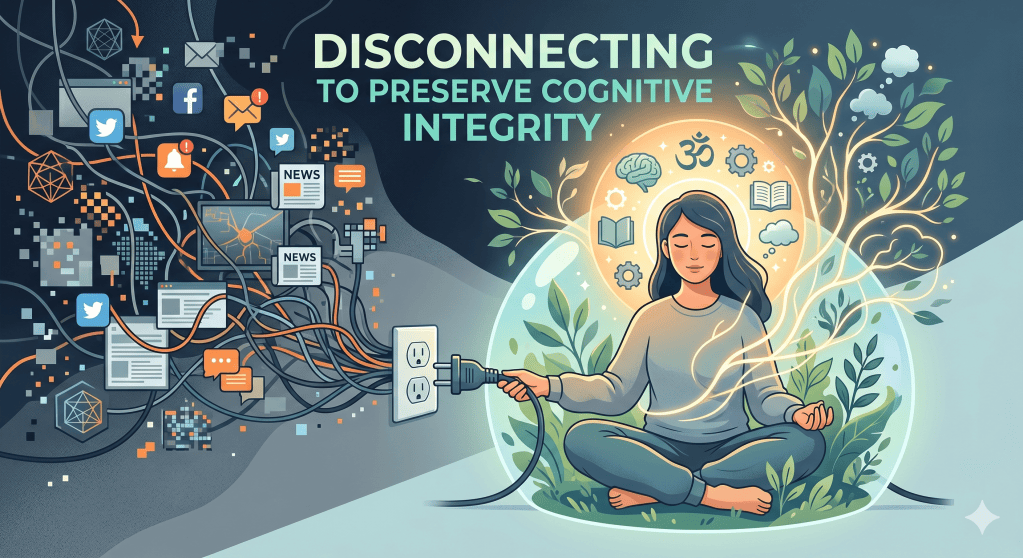
How chronic digital connectivity fragments attention, distorts belief formation, and undermines cognitive integrity — and what the science says about disconnecting.
There is something quietly disorienting about living through an era when the tools designed to keep you informed are also, by design, engineered to keep you agitated. The years surrounding the mid-2020s produced a particular kind of social atmosphere — one shaped by the convergence of hyper-connected digital platforms, algorithmically amplified outrage, and a growing body of science suggesting that constant connectivity was doing measurable harm to the human mind.
This is not a story about phones being bad. It is a story about cognition, identity, and the slow erosion of something researchers call cognitive integrity — the capacity to think clearly, form stable beliefs, and act in alignment with your own values rather than the values being pushed at you by a feed. It is also a story about what happens when people start to push back, and what the science says about why that pushback might matter.
The concept of disconnecting to preserve cognitive integrity sits at the intersection of neuroscience, psychology, and cultural history. Understanding it requires looking at how the digital environment developed, what it does to the brain at a biological level, and what it means — socially and individually — to try to reclaim mental space in an age when attention has become the world’s most aggressively harvested resource.
The Architecture of Distraction
To understand what we’re up against, it helps to understand how modern digital platforms were built. The social media ecosystem that matured through the 2010s and into the 2020s was not designed primarily around what was good for users. It was designed around engagement — the metric that determines advertising revenue. Engagement, it turned out, was most reliably produced not by content that was pleasant or edifying but by content that was emotionally activating. Anger, fear, outrage, and tribal conflict kept people scrolling longer than contentment or curiosity did.
This was not accidental. Platform designers and behavioral scientists worked together to implement what became known as “variable reward schedules” — a term borrowed directly from behavioral psychology, specifically from the work of B.F. Skinner on operant conditioning. Slot machines use the same principle: the unpredictability of the reward is precisely what makes the behavior compulsive. Pulling down to refresh a social media feed resembles a slot machine pull in an important respect: both rely on unpredictable rewards that keep the brain anticipating the possibility of something interesting appearing next.
Neuroscientist Kent Berridge’s research on the brain’s dopaminergic system helps explain why this is so effective. Berridge identified a distinction between “wanting” and “liking” in the brain — two systems that can function independently of each other. Dopamine, it turns out, is less about pleasure than it is about anticipation and craving. You can want something intensely without particularly enjoying it once you have it. Social media platforms are unusually well suited to exploiting this gap: the compulsive urge to check is driven by wanting, while the actual experience of scrolling often produces something closer to dissatisfaction, envy, or low-grade anxiety.
What Constant Stimulation Does to the Brain
By the early 2020s, researchers were accumulating a more complete picture of what sustained digital overstimulation does to cognitive function. The news was not encouraging.
Attention, it turns out, is not a fixed resource that simply gets tired and recovers with sleep. It is more dynamic than that — shaped by habits, environment, and the neural pathways that get reinforced by repeated behavior. A landmark body of work by cognitive psychologist Gloria Mark at the University of California, Irvine demonstrated that the average time a person spends on a single screen before switching had dropped dramatically over the preceding decades, falling to well under a minute by the 2020s. More worrying than the shortening of focus spans was the finding that switching between tasks — what we call multitasking, but what researchers more accurately describe as “task switching” — carries a cognitive cost. Every switch requires mental effort to reorient, and that effort accumulates throughout the day in what researchers call “attention residue”: fragments of the previous task that continue to occupy cognitive bandwidth even after you’ve moved on.
This matters for something called working memory, which is the brain’s mental scratchpad — the system that holds information in mind while you use it to think, reason, or plan. Working memory is finite, and it is the seat of much of what we think of as intelligence in practical terms. When it is chronically fragmented by interruption, the downstream effects are significant: reduced reading comprehension, impaired decision-making, and a diminished capacity for the kind of slow, sustained thinking that produces original ideas.
What gets less attention is how fragmented focus affects the deeper process of memory formation itself. Encoding — the stage at which an experience or piece of information moves from immediate awareness into longer-term storage — requires a certain quality of attention. When you’re only partially present for something, absorbed in only the first few lines of an article before switching to something else, or skimming a conversation while a notification pulls at the edge of your vision, what gets encoded tends to be shallow and poorly organized. You retain the emotional texture of an experience more readily than its content. You remember that you read something about a topic without being able to reconstruct what it actually said. Over time, a mind that has spent years in this mode of partial engagement accumulates a vast catalog of impressions without the deeper structure of real knowledge — a felt sense of being informed that doesn’t quite survive scrutiny.
There is also a more structural concern. Research using neuroimaging technology found associations between heavy social media use and differences in brain regions involved in attention, impulse regulation, and emotional processing. Interpreting these findings remains challenging because much of the evidence is correlational rather than causal — it is difficult to determine whether certain patterns of use reshape the brain or whether people with certain neurological profiles are simply more drawn to heavy use. What can be said with more confidence is that the brain changes in response to repeated experience throughout life. Neuroplasticity — the brain’s capacity to reorganize itself based on experience — is a lifelong process, and the habits built by years of fragmented attention are unlikely to leave no trace at all. In adolescents, whose brains are still actively developing, researchers have expressed particular concern about this dynamic.
The Social Dimension: When Information Becomes Identity
The cognitive effects of constant connectivity do not exist in isolation. They unfold in a social context, and that social context has its own dynamics that compound the psychological pressure.
By the mid-2020s, researchers in sociology and social psychology were drawing attention to a phenomenon that had been building for years: the fusion of identity with information consumption. What you read, what you shared, and what you claimed to believe had become powerful signals of tribal belonging. This is not new in human terms — people have always defined themselves in part through group affiliation — but the speed and scale at which digital platforms enabled this process was historically unprecedented.
Among the frameworks researchers have used to understand these dynamics is moral foundations theory, developed by Jonathan Haidt and colleagues, which holds that moral intuitions are fast, automatic, and often emotion-driven rather than reasoned. Whether or not one accepts that framework in full, the underlying observation it points to is hard to dispute: when information arrives at high volume through a platform optimized to maximize emotional activation, the result tends to be a population that becomes increasingly reactive rather than reflective. Beliefs that should be held tentatively, updated in the face of evidence, and examined for internal consistency instead become identity markers, defended the way territory gets defended.
This has a name in psychology: myside bias, sometimes called my-side bias. It refers to the tendency to evaluate evidence not for its accuracy but for how well it supports what you already believe — or more precisely, what your group believes. Research by philosopher and psychologist Keith Stanovich found that higher general intelligence does not reduce this bias; if anything, more cognitively capable people are better at generating rationalizations for positions they hold for non-rational reasons. This is a sobering finding for anyone who believes that more education is the automatic antidote to motivated reasoning.
The Emotional Cost of Always Being On
Alongside the cognitive effects, researchers were documenting something more immediately felt: the emotional toll of continuous engagement with a high-intensity information environment.
Studies examining social media use and psychological wellbeing consistently found associations between heavy platform use and elevated rates of anxiety, depression, and what psychologists called “ambient anxiety” — a persistent, low-level sense of threat and unease that doesn’t attach itself to any single cause. The mechanism appears to involve what researcher Naomi Eisenberger and others identified as the brain’s threat-detection system, which does not reliably distinguish between physical threats and social ones. Being publicly criticized, watching political conflict unfold, absorbing news of disasters and moral failures — the brain processes these in ways that activate stress responses not entirely different from the ones triggered by physical danger.
Cortisol, the hormone most associated with the stress response, has well-documented effects on cognition when it is chronically elevated. It impairs memory consolidation, disrupts sleep, and — in a particularly cruel irony — makes the prefrontal cortex less effective, which is precisely the brain region needed to think critically about the information causing the stress in the first place.
The phrase “doom scrolling” entered common usage during this period because it captured something real about the subjective experience: the sensation of being unable to stop consuming distressing information even when doing so felt awful. This is not a failure of willpower in any simple sense. It is, at least in part, a feature of how the threat-detection system works — bad news is treated as immediately relevant in a way that good news is not, a phenomenon researchers call negativity bias. Platforms that surfaced alarming content were, in effect, hijacking an ancient survival mechanism and using it to sell advertising.
The Emerging Case for Strategic Disconnection
Against this backdrop, a countermovement was taking shape. It drew from a diverse set of intellectual traditions — digital minimalism as articulated by computer scientist and author Cal Newport, contemplative practices rooted in mindfulness traditions, philosophical arguments about autonomy and attention from writers like Matthew Crawford — and it increasingly had the support of empirical research.
The basic claim was this: if cognitive integrity — the capacity to think clearly, form independent beliefs, and live deliberately — is undermined by constant digital immersion, then strategic disconnection is not a retreat from the world but an act of cognitive self-defense.
The word “strategic” matters here. This is not a movement that generally argues for hermit-like withdrawal from technology. It argues for intentionality: choosing when, how, and for what purposes to engage with digital environments, rather than having those choices made by default — which, in practice, means having them made by the engagement-optimization algorithms of platform companies.
What the Research Says About Disconnecting
By the mid-2020s, the evidence for the benefits of reduced screen engagement had grown considerably. Several findings stand out as particularly robust.
Research on attentional restoration, drawing on the theoretical work of Rachel and Stephen Kaplan, found that exposure to natural environments — or simply to environments low in what the Kaplans called “directed attention demands” — allowed the brain’s attentional systems to recover. Time spent in spaces that don’t demand constant vigilance and rapid response appears to restore the capacity for sustained focus. This is sometimes called the “restorative experience” literature, and it has practical implications: even brief periods of genuine disengagement appear to confer measurable cognitive benefits.
Experimental work on the effects of smartphone absence has produced striking results. A study by Adrian Ward and colleagues at the University of Texas at Austin found that the mere presence of a smartphone on a desk — face down, silenced — reduced participants’ available cognitive capacity compared to those whose phones were in another room. The device didn’t need to be active; the habitual awareness of its availability was enough to consume working memory resources. This finding, if it holds up across replications, suggests that the cognitive cost of digital connectivity is not limited to the moments of active use.
Sleep research adds another dimension. Research on sleep and memory has highlighted the importance of sleep not just for rest but for memory consolidation — the process by which the brain sorts, stores, and integrates the day’s experiences into long-term memory. Blue light from screens disrupts melatonin production and delays sleep onset, and the stimulating content typical of social media feeds keeps the nervous system in a state of arousal poorly suited to the kind of pre-sleep wind-down that supports quality rest. The downstream effects on cognition, mood, and decision-making are substantial.
Studies examining social media “detox” periods — typically ranging from a few days to several weeks — have found improvements in self-reported wellbeing, reductions in anxiety, and in some cases improvements in measurable cognitive performance. The effects are not always dramatic, and some of the research has methodological limitations worth acknowledging. But the directional consistency across studies is notable.
Cognitive Integrity as a Cultural Concept
The idea of cognitive integrity has both a personal dimension and a social one, and it is worth spending time on the latter.
Think about what it takes, in practice, for a society to reason well collectively: people need to be able to change their minds when evidence warrants it, hold disagreements without treating them as moral emergencies, and distinguish between what they actually know and what they’ve simply absorbed from the people around them. These aren’t exotic demands. They describe the kind of thinking most people aspire to most of the time. But they require cognitive conditions — a baseline of attentional stability, emotional regulation, and tolerance for uncertainty — that chronic overstimulation actively undermines.
When people are chronically stressed, sleep-deprived, and operating under the influence of systems that reward emotional reactivity over careful thought, those capacities degrade in ways that show up in behavior: in the impulse to share before verifying, to dismiss rather than engage, to feel certain about things that deserve more scrutiny. The social effects compound the individual ones. A culture of people whose attention has been systematically fragmented will produce a public discourse shaped by that fragmentation.
This is not a counsel of despair. It is a diagnosis that points toward a remedy. Understanding the mechanisms by which the digital environment degrades cognitive function makes it possible to think clearly about interventions — both individual and collective.
Technology’s Role in Its Own Reckoning
One of the more interesting developments in the mid-to-late 2020s was the degree to which technology itself became a vehicle for addressing the harms of technology. Attention-management tools, app usage trackers, notification filters, and “digital wellness” features built into operating systems represented the industry’s recognition — however self-interested — that the old model of frictionless, unlimited engagement was facing both regulatory scrutiny and user backlash.
More consequential, perhaps, were a series of regulatory efforts in the European Union and several U.S. jurisdictions that sought to address concerns ranging from addictive design patterns to algorithmic transparency and protections for minor users. These efforts reflected a growing consensus that the attention economy’s consequences — fragmented focus, strained mental health, a public discourse shaped more by provocation than deliberation — were not simply matters of individual choice but had acquired the character of a shared social problem.
Within the research community, the conversation shifted as well. The question was increasingly shifting from whether certain forms of digital engagement could be harmful to understanding the mechanisms involved well enough to design effective countermeasures. Researchers began distinguishing more carefully between different types of digital engagement: passive consumption versus active communication, algorithmically-driven content versus self-directed information-seeking. Not all digital engagement appears equally harmful. Evidence increasingly suggests that passive consumption of algorithmically selected content produces different outcomes than intentional communication, learning, or creation. These distinctions matter because the harms are not uniformly distributed across all forms of digital activity — a finding that complicates any blanket case either for or against technology use.
What Reclaiming Attention Actually Looks Like
For most people, the practical project of preserving cognitive integrity is not about dramatic renunciation. It is about restructuring the relationship with technology in ways that change the default from reactive to intentional.
Some of what the research supports is unglamorous and familiar: putting the phone in another room during focused work, establishing phone-free periods before sleep, being deliberate about when and how you consume news rather than letting the feed dictate it. The consistency of these recommendations across diverse sources — neuroscientists, cognitive psychologists, contemplative traditions — suggests they’re pointing at something real about the conditions under which human cognition functions well.
The more interesting territory involves what replaces the time and attention that gets reclaimed. Researchers studying boredom — long treated as a problem to be solved by stimulation — have found that it plays a functional role in creativity and self-reflection. States of low external stimulation appear to activate what neuroscientists call the default mode network, a set of brain regions associated with introspection, imaginative thinking, and the integration of past experience. The incubation periods during which people report their best ideas often involve precisely this kind of unstructured mental wandering. Filling every available moment with external input forecloses this process.
There is also the matter of what sustained reading — long-form articles, books, extended essays — does for the mind that fragmented reading does not. Literary scholar Maryanne Wolf, in her research on the reading brain, argued that deep reading is cognitively distinctive: it activates inferential reasoning, empathy, and critical analysis in ways that skimming and scrolling do not. The habits of mind cultivated by serious reading are, arguably, exactly the habits that the attention economy erodes.
Looking Forward
The period we are living through is one of negotiation — between the genuine capabilities that digital technology provides and the costs that unrestricted engagement with that technology imposes on human cognition and culture. The negotiation is happening at multiple levels: in regulatory bodies, in research laboratories, in design studios, and in the daily choices of individuals deciding how to structure their relationship with their devices.
What seems clear, surveying the evidence, is that those choices are not trivial. Attention is not simply a medium through which life passes. It is constitutive of what life feels like and what kind of thinking becomes possible. The philosopher and psychologist William James made this point more than a century ago, in terms that have lost none of their force: “The faculty of voluntarily bringing back a wandering attention, over and over again, is the very root of judgment, character, and will.”
The current era has made that faculty harder to maintain and more important to cultivate. Disconnecting — not as a permanent posture but as a regular and intentional practice — is one of the more empirically grounded ways of doing so. It is less a rejection of technology than a reclamation of the cognitive conditions under which human beings think well, form genuine beliefs, and live with some degree of deliberateness.
That seems worth some effort.









