
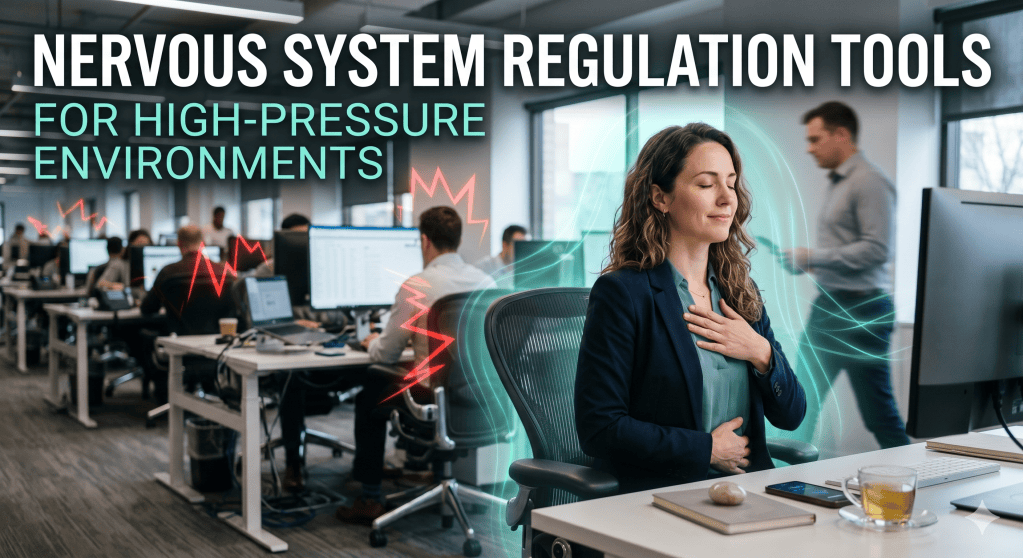
A field guide to burnout prevention — with stress management protocols you can deploy in the middle of a chaotic day, without leaving your desk, your meeting, or your commute.
The Problem Nobody Is Solving at the Right Stage
I started experimenting with these tools after noticing that the most exhausting days weren’t the busiest ones. They were the days when small stressors accumulated without interruption — when the fight-or-flight response kept activating in low doses, never fully resolving, until by evening I was running on empty without anything dramatic having happened. What changed my experience wasn’t adding more recovery time. It was learning how to regulate while the pressure was still happening.
Most nervous system advice arrives too late.
It finds you at the end of the day, when you are already depleted. It suggests a bath. A walk. A meditation session. And those things have value — but they are recovery tools, not prevention tools. They address the damage after it has been done.
The new frontier is earlier intervention: building emotional regulation into the high-pressure environment itself, not reserving it for the quiet space that comes after.
This is the shift from reactive wellness to what researchers increasingly call allostatic management — keeping the body’s chronic stress load from accumulating in the first place. Not managing the crisis. Managing the conditions that create it.
If you work in a fast-moving environment, lead a team, handle unpredictable inputs, or simply navigate a day that does not slow down for you to process it — this guide is built for you. Every protocol here is designed to be deployed in real time, with zero performance overhead.
Quick Start: The Five Tools in This Guide If you’re short on time, start here: ✓ The Macro-Filter Protocol ✓ The Five-Minute Morning Stack ✓ The Input Audit ✓ The Three-Breath Neutral ✓ The End-of-Day Discharge Protocol
Together, these practices support nervous system regulation, emotional resilience, and burnout prevention before chronic stress takes hold.
Note: These tools are not therapy, medical treatment, or a replacement for professional support. They are practical nervous system maintenance practices designed for everyday stress management.
Common Signs Your Baseline Is Already Elevated
Before diving into the tools, a quick check-in.
Many people living with chronically elevated stress don’t recognize it as such — because elevated has become their normal. Burnout prevention requires catching the drift early, and your physiology gives clear signals when its baseline has shifted upward.
You may be operating with an elevated baseline if:
- You feel “on” or wired even when nothing urgent is happening
- Minor interruptions feel disproportionately frustrating
- You struggle to genuinely relax after work, even when you have time
- Your sleep feels light, restless, or unrefreshing
- You constantly seek stimulation — scrolling, noise, busyness — during any moment of stillness
- Decision-making feels harder than it used to, even for small things
- You experience a vague sense of dread or unease that is difficult to name
None of these are character flaws. They are physiological data. They tell you that your internal state is running in a higher-activation mode than is sustainable — and that the tools in this guide are not optional extras, but active maintenance your system needs.
Understanding Your Baseline: The State You’re Defending
Before you can regulate toward something, you need to know what you are regulating toward.
Your stress response system has a resting state — a default level of arousal that reflects how much accumulated stress it is currently carrying. Researchers sometimes refer to this as allostatic load: the cumulative cost of adapting to demands over time. When that load stays chronically high, your baseline shifts upward. Your default becomes activated. Your threshold for reactivity drops.
This is how workplace stress and burnout actually build — not in a single event, but in an upward drift of baseline arousal that eventually leaves no buffer between you and the next trigger.
The goal of nervous system regulation in high-pressure environments is not to avoid stimulation. It is to keep your baseline low enough that stimulation does not push you past your threshold.
Think of it as defending a perimeter — not with walls, but with maintenance. Something running quietly in the background, keeping conditions stable regardless of what is coming in.
Burnout rarely begins with exhaustion. It begins when stress stops being an event and becomes a baseline.
The Macro-Filter Protocol: Your Automated Background Field
The most important concept in this guide is this: regulation does not have to be a discrete event.
The highest-functioning people in high-pressure environments are not those who find time to regulate. They are those who have built self-regulation into the background of how they move through their day — a kind of automated filter that processes incoming stimulation before it overwhelms the system.
Here is how to build that filter.
Step 1 — Set the field before you enter the environment.
Before you walk into a high-input space — an office floor, a difficult meeting, a crowded commute, a packed conference — take sixty seconds to do the following:
Stand or sit upright. Take one slow breath in (four counts) and a longer exhale out (six to eight counts). As you exhale, consciously soften your jaw, drop your shoulders, and release the muscles around your eyes. Then set a quiet internal intention: I am present here, but I am not owned by this.
This is not an affirmation. It is a physiological re-anchor. You are entering the environment from a chosen baseline rather than a reactive one. That distinction compounds across a full day.
Step 2 — Run passive somatic monitoring.
Once you are in the environment, activate a background thread: a low-level, continuous awareness of your body’s state that runs underneath your engagement with the room.
Check-in points: jaw tension, shoulder elevation, breath depth, belly softness. You do not stop what you are doing. You simply note the data, the way a system monitors its own resource usage. If any of those readings spike — jaw clenched, breath held, shoulders up around your ears — you have a signal that the filter is being overloaded.
That signal is not a problem — it means the system is working. It tells you to act before the load peaks.
Step 3 — Deploy micro-resets without leaving the interaction.
When the somatic signal comes in, you do not leave the room or pause the meeting. You run a micro-reset — a sub-thirty-second internal intervention that does not require external performance.
The three most field-tested micro-resets:
- The elongated exhale: Breathe out for twice as long as you breathe in. Do this once. Many people notice a calming effect after even one extended exhale — this works through the vagus nerve, which connects the brain to the body’s calming response.
- The jaw-drop release: Slightly open your mouth, let your tongue rest behind your lower teeth, and release all tension in the jaw. Releasing jaw tension can help reduce one of the body’s most common physical stress patterns — the kind that builds invisibly through a demanding day.
- The peripheral gaze shift: Instead of narrow, focused vision — the visual mode associated with threat response — soften your gaze and allow your peripheral field to expand. This practice, sometimes called panoramic vision or diffuse gaze, has been associated with reductions in perceived stress and threat-focused attention. You can do it in the middle of a conversation without anyone noticing.
These three micro-resets, deployed early, are maintenance — the kind that prevents the larger failure from forming.
Pre-Loading: The Morning Architecture for Burnout Prevention
The state of your nervous system at 9:00 AM shapes your reactivity ceiling for the next several hours.
Most people enter high-pressure environments without deliberately setting their starting conditions. They move from alarm to phone to commute to meeting without a single moment of intentional calibration. By the time a genuine stressor arrives — and in high-pressure environments, it always does — they are already running close to threshold.
The five-minute morning stack is not a meditation practice. It is a calibration protocol.
Minute one — Breath priming: Two rounds of box breathing (four counts in, four hold, four out, four hold). Heart rate variability research has linked greater autonomic flexibility — the nervous system’s ability to shift between activation and recovery — with improved stress resilience and emotional regulation. Box breathing is one of the most accessible ways to train that flexibility daily.
Minute two — Somatic inventory: Scan from feet to crown. Where is there tension? Where is there ease? You are not trying to fix anything. You are reading your starting state so you know what you are working with.
Minute three — Temperature exposure (optional, high-yield): Thirty seconds of cold water on the face or wrists. Cold exposure activates the body’s calming reflex and has been associated with norepinephrine release, improved alertness, and a more resilient stress response over time. This single habit, practiced consistently, may help shift your baseline reactivity.
Minutes four and five — Intentional framing: Not visualization. Not affirmations. Simply asking two questions: What is the most important thing I will do today? and What is the thing I refuse to let disrupt me? You are pre-loading your priority hierarchy before the day installs its own. This reduces cognitive fragmentation — the scattered, reactive thinking pattern that drains executive function in high-input environments.
The Input Audit: Managing What Enters Before It Processes
Your stress response system does not cleanly differentiate between informational stress and physical stress. A thread of difficult messages, a stream of urgent notifications, a news cycle running in the background — all of it registers as activation. All of it contributes to allostatic load.
In high-pressure environments, input management is a stress management tool as much as any breathing technique.
The threshold question: Before consuming any input — reading the group chat, checking the news, scrolling before a meeting — ask: Is this necessary right now, or am I checking it out of habit? Habitual input consumption in high-pressure environments is one of the quieter drivers of baseline arousal elevation. Your system does not need more to process. It needs space to process what it already has.
The notification architecture audit: Most people have never consciously designed their notification environment. They inherited the defaults. Each notification triggers a small orienting response — a micro-activation of the fight-or-flight pathway — that takes meaningful cognitive recovery time to resolve. Batching notifications into two or three intentional windows per day is commonly framed as productivity advice. At the nervous system level, it is something more basic than that — it is simply reducing unnecessary activation.
The transition buffer: Between high-demand activities, build a sixty-to-ninety second buffer — even if it is just walking to the water cooler slowly. Do not move directly from one intense input environment to the next. The transition buffer is when incomplete stress cycles have a chance to process rather than compound.
Real-Time Regulation in Public and Social Environments
Crowded environments — open offices, commutes, conferences, client-facing roles — carry a specific stress signature: shared activation. Research in affective neuroscience suggests that humans unconsciously entrain to the emotional states of those around them through emotional contagion. In a stressed room, your physiology can begin to mirror that stress before you consciously register it.
This is why high-performers in high-exposure roles often feel inexplicably drained after social environments — not from introversion, but from unmanaged permeability to the room’s collective state.
The ownership check, deployed in real time: Before entering any charged social environment, ask: What belongs to me, and what belongs to the room? Then, while inside it, periodically run the same check. If you notice your heart rate elevating, your jaw clenching, or your thoughts accelerating — pause and ask: Is this mine? Often it is not. The body picked it up from the environment. Naming that distinction can interrupt the automatic absorption.
Grounding under social pressure: When you feel the environment pulling your system upward — a tense negotiation, a loud room, a conflict-heavy meeting — place both feet flat on the floor and press them gently but deliberately into the ground. Proprioceptive input, your body’s awareness of its physical position in space, can help interrupt escalating activation patterns. You can do it in a boardroom, on a train platform, or standing at a reception desk.
The three-breath neutral: In any moment where you feel yourself about to react from an elevated state — before sending a tense message, before responding to a provocative comment, before making a high-stakes call — take three breaths in which the exhale is noticeably longer than the inhale. Not dramatic. Not visible. Just three breaths. This is not a pause for composure. It is a brief physiological intervention that encourages a shift toward a calmer state.
The End-of-Day Discharge Protocol: Preventing Accumulation
Stress that is not discharged at the end of the day tends to be stored — in residual muscle tension, in background cognitive activation, in a physiology that cannot fully downshift. Over time, this accumulation raises your resting baseline and narrows your buffer. What used to feel manageable starts to feel like a lot. Burnout follows.
The discharge protocol does not require an hour. It requires ten minutes and a decision to close the cycle rather than carry it forward.
The body-first discharge: Stress hormones are designed to be metabolized through movement. A ten-minute walk — deliberately slow, without headphones, without destination urgency — allows the stress response system to complete the physiological arc that high-pressure work opens but rarely closes. If walking is not available, five minutes of deliberate gentle shaking or slow, intentional stretching can serve a similar purpose.
The cognitive offload: Before closing your work context, write three sentences: what you handled today, what remains open, and what can wait until tomorrow. This is not a to-do list. Research on the Zeigarnik effect — the tendency for unfinished tasks to create persistent cognitive activation — suggests that simply externalizing open loops can reduce the mental rehearsal that disrupts sleep and recovery. The written offload closes the loop without requiring resolution.
The sensory transition: Change at least one sensory input before entering your personal time — change clothes, step outside briefly, brew something warm, dim the lights. The body uses sensory context as a cue for state. A deliberate sensory shift signals: that context is complete. This one is different.
The Compound Effect: Why Consistency Beats Intensity
None of these protocols require significant time. None of them require a quiet room or a perfect moment. They are designed to run inside the day, not around it.
But they only work through repetition — practiced not because you feel stressed, but as maintenance, the way you would maintain any system that matters.
The autonomic nervous system is adaptable. Its baseline is not fixed. Through consistent, low-intensity regulation practices, the resting state can shift over time — lower baseline arousal, faster recovery, more room between you and reactivity. That capacity to handle pressure is something you build incrementally, not something you either have or you don’t.
Most people think burnout begins when they feel exhausted.
In reality, it begins much earlier — when elevated stress becomes the body’s default setting, and the nervous system stops returning to baseline between demands.
The goal isn’t to eliminate pressure. It’s to prevent pressure from becoming your baseline.
The tools in this guide are small by design. Their power comes from repetition.
A single breath won’t change your nervous system. Hundreds of them will.









