
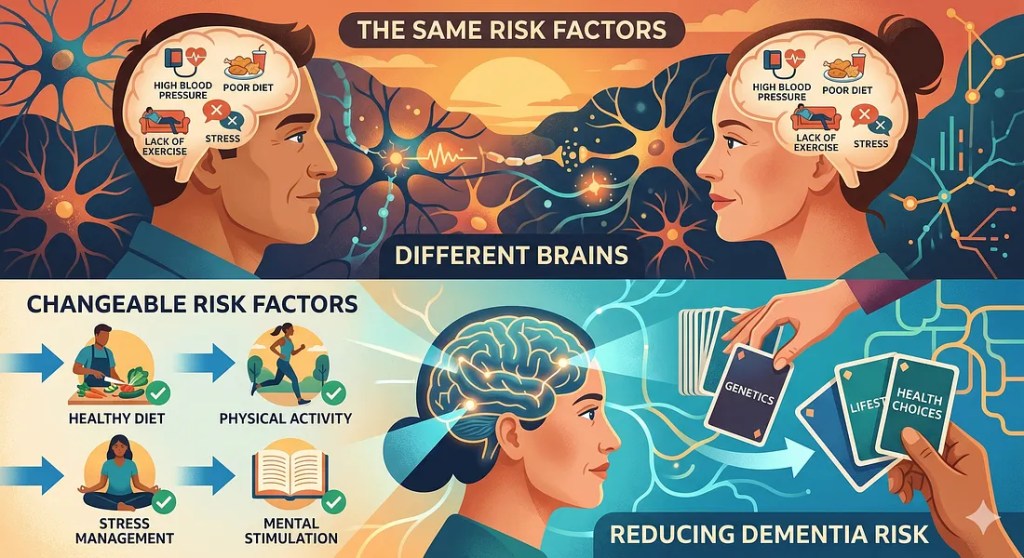
New research reveals that the deck may be quietly stacked against women — but the good news is that most of the risk factors are changeable.
Nearly two-thirds of Americans living with Alzheimer’s disease are women. That imbalance has often been explained as a simple consequence of longevity. Women live longer, so more women survive long enough to develop dementia. But new research suggests longevity may be only part of the story. Several of the health conditions linked to dementia may be exerting a stronger cognitive toll on women than on men.
A newly published study from the University of California, San Diego adds important evidence to that possibility. Women don’t just live longer than men. They also appear to experience a greater burden from several modifiable dementia risk factors.
What the Research Actually Found
The study, published in the peer-reviewed journal Biology of Sex Differences, analyzed data from 17,182 participants in the Health and Retirement Study — a nationally representative, long-running look at how older Americans age physically, mentally, and financially. The average participant was 69 years old; nearly 60 percent were women.
Researchers examined 13 modifiable dementia risk factors, including hearing loss, depression, diabetes, hypertension, obesity, physical inactivity, smoking, sleep quality, vision problems, alcohol use, and educational attainment. The goal was to understand not just whether these factors mattered, but whether they mattered differently depending on sex.
Of the 13 risk factors examined, 10 showed meaningful differences based on sex. Women were more likely to experience elevated cholesterol, depression, physical inactivity, smoking, poor vision, and poor sleep. They also, on average, had fewer years of formal education — a factor strongly associated with cognitive reserve across the lifespan.
Men, meanwhile, had higher rates of hearing loss, diabetes, and excessive alcohol use.
Yet the most important finding wasn’t simply who experienced which conditions. For women, certain conditions hit harder cognitively than they did for men. Cardiovascular and metabolic conditions — including hypertension and obesity — showed steeper negative associations with cognition in women. Notably, hearing loss and diabetes, though more common in men, were also linked to worse cognitive performance in women than in men.
One area worked in women’s favor: education. Women with higher educational attainment showed stronger cognitive performance overall — a finding consistent with the well-established role of education in building cognitive reserve across the lifespan.
Why This Matters Beyond the Headlines
It would be easy to read this and feel a kind of resignation. Great — another thing working against women. But that’s precisely the wrong takeaway.
Every single factor identified in this study is modifiable. That word matters enormously. These aren’t genetic destinies written before birth. They’re patterns — shaped by healthcare access, lifestyle habits, social structures, and the kind of medical attention people receive across their lifetimes.
The researchers noted that interventions in midlife and early older adulthood could make a meaningful difference. Treating hearing loss. Managing hypertension. Addressing insomnia. Maintaining a healthy weight. Getting regular movement into daily life. These aren’t radical prescriptions. They’re the kind of changes that compound quietly over years — and according to this research, the payoff for women may be especially significant.
The Bigger Problem This Study Is Pointing To
There’s a less comfortable truth embedded in these findings, and it’s worth sitting with: previous dementia research has frequently failed to account for sex differences at all.
For much of modern medical history, researchers often treated sex as a variable to control for rather than a question worth investigating. Studies asked whether a risk factor affected cognition — but not whether it affected women and men differently. Research like this suggests that distinction may matter more than previously assumed.
This study is part of a corrective shift. By explicitly examining how sex interacts with age and risk factors, the researchers are building a more accurate map of who is most vulnerable and why. That’s not just academically useful. It’s the foundation for interventions that actually work.
What You Can Do With This
If you’re a woman — or you love one — the most actionable thing this research offers is a sense of where to direct attention, particularly in middle age and the early years of older adulthood.
Get your hearing checked, and take the results seriously. Talk to your doctor about blood pressure and blood sugar, even if you feel fine. Treat sleep problems as a health issue, not a personality quirk. Move your body regularly. And if there are opportunities to keep learning — formally or informally — take them. The cognitive reserves you build now are drawing interest for decades.
The researchers are clear that more work is needed. The full picture of sex differences in dementia is still coming into focus. But the core message is already legible: women may face a steeper path, and they also hold more of the tools to change the terrain than previously understood.
Nearly two-thirds of Alzheimer’s patients are women. If studies like this continue to hold up, longevity may explain only part of that disparity. The most important lesson isn’t that women face higher risk. It’s that risk is not destiny. The more precisely science understands who is vulnerable and why, the more opportunities there are to intervene before decline begins.
Sources: Fitzhugh & Pa, “Sex differences in modifiable risk factors of dementia and their associations with cognition,” Biology of Sex Differences (2026); UC San Diego news release; Health and Retirement Study, University of Michigan.









