
What Happens When You Stop Carrying Feelings That Don’t Belong to You
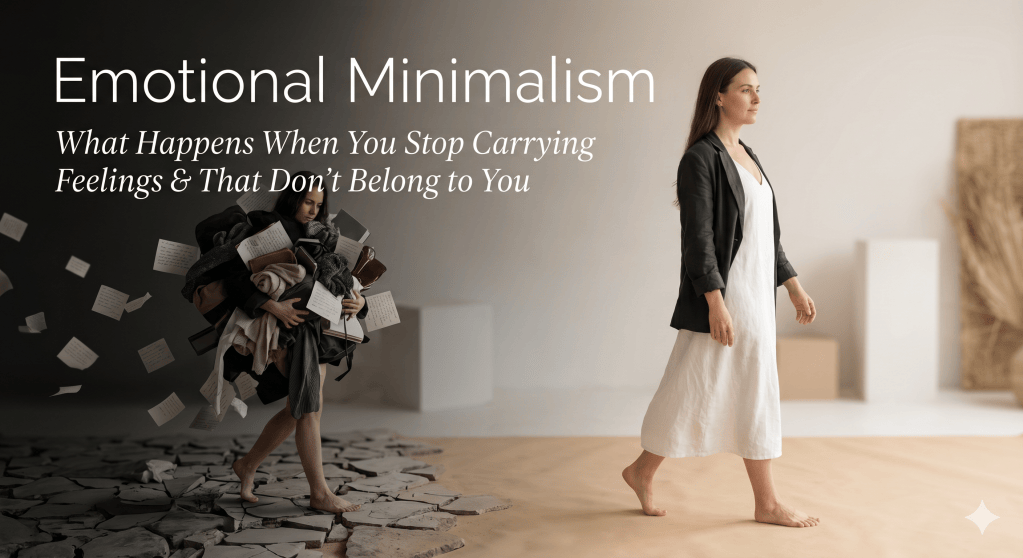
Peace is expensive when your identity was built around emotional excess.
For a long time, I believed emotional depth meant emotional volume.
Intense conversations.
Constant processing.
Endless availability.
Heavy emotional exchanges mistaken for intimacy.
I thought being emotionally connected meant being emotionally saturated.
But eventually, I became tired in a way rest couldn’t fix.
Not because life was exceptionally chaotic —
but because I had normalized emotional overcrowding.
Too many conversations I didn’t need.
Too many explanations.
Too many emotional responsibilities crossing invisible boundaries and settling inside me as if they belonged there.
I was emotionally overfurnished.
Every relationship carried layers of unspoken management:
- monitoring tone
- anticipating reactions
- preventing misunderstandings
- softening truths
- cushioning boundaries
- emotionally translating myself so other people would remain comfortable
And because I had done it for so long, I mistook emotional complexity for emotional maturity.
Then something changed.
Not suddenly.
Quietly.
I stopped responding to every emotional invitation.
Not every feeling required my participation.
Not every conflict required my intervention.
Not every disappointment required my repair.
At first, this felt unnatural.
Almost cold.
Because when you are conditioned to emotionally over-function, simplicity can feel emotionally vacant.
But over time, I began noticing something surprising:
My internal world became quieter.
Not emptier.
Clearer.
There is a difference.
For years, I had been carrying emotional noise that was never entirely mine:
- projections
- expectations
- unresolved tension
- other people’s discomfort
- relational ambiguity
- invisible emotional labor
And slowly, I started putting things down.
Not dramatically.
One small refusal at a time.
I stopped over-explaining simple boundaries.
Stopped rehearsing conversations that hadn’t happened.
Stopped managing imagined emotional reactions before they even existed.
Stopped treating every shift in someone’s tone as a problem requiring immediate emotional investigation.
That last one changed my life more than I expected.
Because hypervigilance disguises itself as empathy.
But they are not the same thing.
Empathy allows people to feel with others.
Hypervigilance forces people to constantly scan others for emotional instability.
One creates connection.
The other creates exhaustion.
And exhaustion had quietly become my emotional baseline.
I didn’t realize how much psychological energy I was spending maintaining emotional equilibrium for everyone around me until I stopped doing it.
That’s the strange thing about emotional minimalism:
At first, it can feel like loss.
You respond less.
Engage less.
Explain less.
The emotional intensity decreases.
And for a while, part of you wonders:
Am I becoming disconnected?
But eventually you realize:
You are not becoming disconnected.
You are becoming intentional.
Minimalism is not absence.
It is removal of excess.
And emotionally, excess can take many forms:
- unnecessary guilt
- prolonged emotional processing
- one-sided relationships
- performative accessibility
- conflict maintenance
- compulsive reassurance
- emotional responsibility that extends beyond your actual role
Not everything deserves permanent residence inside your nervous system.
That realization changed the way I moved through relationships.
I became slower to internalize other people’s moods.
Slower to assume responsibility for emotional tension.
Slower to abandon my own peace simply because someone else was uncomfortable.
And something unexpected happened:
My relationships became more honest.
Because once you stop over-managing emotional dynamics, people reveal who they are without your constant compensation altering the environment.
Some connections deepened.
Others dissolved without the emotional scaffolding I had unknowingly been providing for years.
That used to frighten me.
Now it feels clarifying.
Emotional minimalism is not about becoming detached.
It’s about becoming discerning.
Understanding that:
- not every message requires immediate access to your emotional state
- not every relationship deserves unlimited psychological space
- not every feeling deserves permanence
- not every person deserves uninterrupted proximity to your nervous system
And perhaps most importantly:
You realize peace is not something you find after managing everyone successfully.
Peace is what appears when you stop managing what was never fully yours to carry.
The quiet that follows can feel unfamiliar at first.
Especially if your identity was built around emotional intensity.
But eventually, the silence stops feeling empty.
It starts feeling safe.
You begin noticing small things again:
- your own thoughts
- your own preferences
- your own timing
- your own emotional rhythms without constant external interference
And maybe that’s the real shift.
You stop organizing your inner world around the emotional weather of other people.
Not because you no longer care.
But because you finally understand something essential:
Caring for others should not require abandoning yourself internally.
Some people will interpret your emotional minimalism as distance.
Others will call it change.
But the right people will recognize it for what it actually is:
A nervous system no longer willing to live in permanent emotional overcrowding.









