
How Financial Comfort Quietly Extends Emotional Misalignment
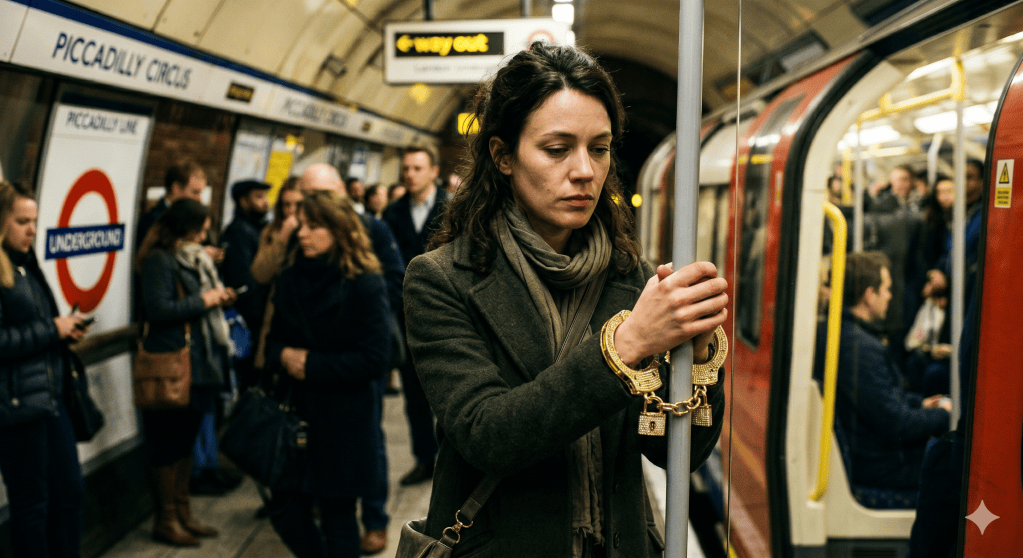
Some environments do not keep people through love, purpose, or fulfillment. They keep them through predictability.
Not every form of captivity looks painful from the outside.
Some look successful.
Stable.
Well-furnished.
Financially secure.
The routines function smoothly.
The bills are paid.
The lifestyle appears intact.
And yet beneath that external stability, something quieter is happening:
A slow negotiation between authenticity and comfort.
Over the years, I’ve noticed a pattern that appears across relationships, careers, social environments, and even entire identities.
People often do not remain in emotionally misaligned environments because they are happy.
They remain because the environment has become psychologically expensive to leave.
Not only financially expensive.
Neurologically expensive.
Emotionally expensive.
Existentially expensive.
The nervous system values predictability more than most people realize.
Even painful predictability can feel safer than uncertain freedom.
That is why people can remain inside environments that quietly diminish them for years while still appearing “fine” externally.
Because survival and aliveness are not the same thing.
At first, the compromise is usually small.
A relationship that no longer feels emotionally nourishing — but feels stable.
A career that drains vitality — but provides status and financial certainty.
A lifestyle that no longer reflects the self — but would be difficult to dismantle publicly.
None of these situations appear catastrophic enough to justify immediate departure.
That’s part of what makes them psychologically powerful.
Extreme pain often creates movement.
Moderate comfort creates endurance.
And endurance can become dangerous when prolonged long enough.
Because humans adapt remarkably well to low-grade emotional dissatisfaction.
Especially when comfort softens the edges.
The environment becomes familiar.
The routines become automatic.
The nervous system stops evaluating fulfillment and begins prioritizing continuity.
This is where emotional economics quietly enters the equation.
Every system has perceived costs.
Leaving may require:
- financial instability
- rebuilding identity
- social judgment
- reduced lifestyle comfort
- uncertainty
- loneliness
- temporary regression
And for many people, those perceived losses feel more threatening than the quiet erosion happening internally.
So the mind begins rationalizing the misalignment.
“It’s not that bad.”
“Everyone compromises.”
“Stability matters.”
“At least it’s secure.”
And sometimes those statements are partially true.
Stability does matter.
Financial safety matters.
Security matters.
But there is an important distinction many people never fully examine:
Comfort is not always peace.
Peace expands the nervous system.
Comfort can sedate it.
That distinction changes the entire conversation.
Because prolonged comfort can become a psychological sedative powerful enough to override authenticity.
Not dramatically.
Gradually.
The person slowly stops asking:
“Does this still feel alive?”
And starts asking:
“Can I maintain this safely?”
That shift is subtle.
But enormous.
Eventually, emotional misalignment becomes normalized through repetition.
The nervous system adapts to emotional deadness the same way eyes adjust to dim lighting.
After enough exposure, the absence of vitality stops feeling unusual.
It simply becomes “life.”
And modern society often reinforces this adaptation.
People are rewarded for maintaining appearances.
For preserving structures.
For staying functional.
Very few environments encourage individuals to dismantle financially comfortable systems simply because they no longer feel emotionally true.
Especially when the external optics still look successful.
That’s why some people remain in:
- emotionally empty relationships
- psychologically exhausting careers
- identity structures that no longer fit
- environments that quietly suppress their vitality
long after they internally recognize the misalignment.
Not because they are weak.
And not because they are choosing money over happiness in some shallow, simplistic way.
The situation is far more psychologically complex than that.
Human beings form attachments not only to people —
but to predictability.
To routine.
To environmental certainty.
To identities that have become economically integrated into survival.
Leaving often requires more than courage.
It requires nervous system tolerance for uncertainty.
And many people were never taught how to survive emotionally without guarantees.
So they remain.
Not fully alive.
Not fully disconnected.
Suspended somewhere between functionality and quiet resignation.
What makes this dynamic especially difficult to recognize is that external comfort can successfully disguise internal deterioration for long periods of time.
A person may still:
- perform well
- appear composed
- maintain status
- function socially
while internally experiencing chronic emotional disconnection from their own life.
And because nothing is visibly “falling apart,” the urgency to change weakens.
This is the hidden influence of golden handcuffs.
The environment rewards continuation just enough to delay confrontation.
Not all suffering is chaotic.
Some suffering is upholstered.
That may be why certain people seem strangely disconnected from themselves despite having achieved everything they once believed would make them feel secure.
Because security without alignment eventually becomes psychological confinement.
And confinement does not always announce itself through pain.
Sometimes it announces itself through numbness.
Through emotional flatness.
Through the gradual disappearance of curiosity, vitality, spontaneity, and internal movement.
The tragedy is not always that people stay too long.
Sometimes the tragedy is that they stop recognizing they are staying at all.
Because once adaptation fully settles in, emotional compromise starts feeling reasonable.
Normal.
Mature.
But there is a profound difference between building a stable life and constructing a psychologically tolerable cage.
One expands you.
The other merely protects you from uncertainty while slowly reducing your aliveness.
And perhaps the most difficult realization of all is this:
There are moments when the life someone has built becomes so optimized for security that it no longer leaves room for truth.
Not dramatic truth.
Quiet truth.
The internal voice that asks:









