
Originally published in August 2010 and comprehensively updated/edited in June 2026.
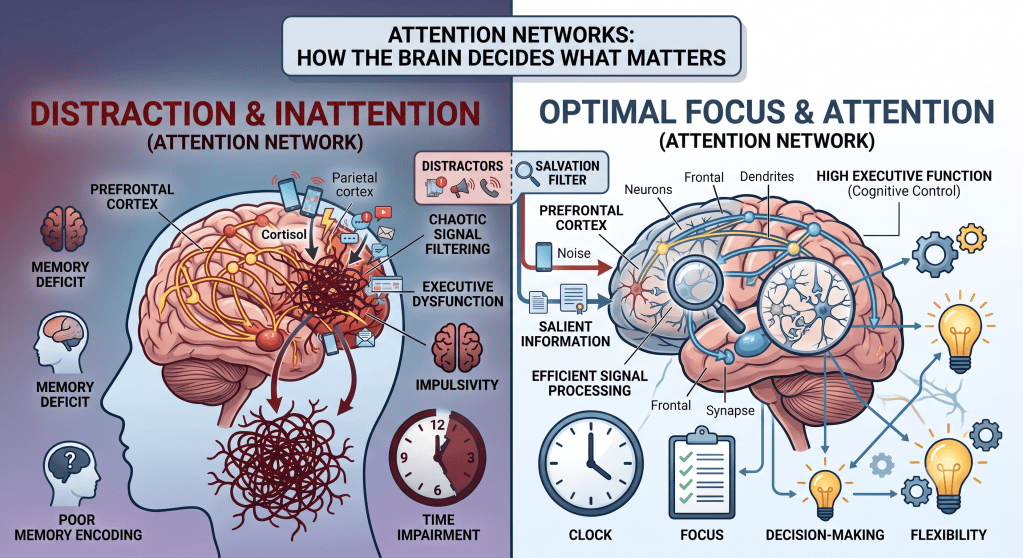
How the brain’s attention networks work, from Posner and Petersen’s landmark model to why focus feels harder in a distraction-filled world.
When this piece was first written, in the late summer of 2010, the iPhone was three years old, Instagram did not yet exist, and the idea of “digital distraction” was still mostly confined to warnings about texting while driving. And yet the scientific model at the center of this article was already two decades old by then. In 1990, the psychologist Michael Posner and the neuroscientist Steven Petersen published a paper that would quietly reshape how researchers think about one of the mind’s most basic capacities: the ability to pay attention. Their work did not arrive with the kind of cultural fanfare that greets a new gadget or diagnosis. It arrived in a scientific journal, built on brain-imaging data and careful behavioral experiments, and it proposed something that sounds almost too simple to be revolutionary — that attention is not one thing, but several.
That distinction matters more now than it did in 2010, and it mattered more in 2010 than it did in 1990. We live in an environment engineered, in large part by accident and in some part by design, to test the limits of human attention. Notifications compete with conversations. Open browser tabs compete with open documents. The average adult now checks a phone dozens of times a day, and workplaces have normalized a kind of continuous partial attention that would have seemed exhausting to previous generations. Understanding what attention actually is — not as a vague willpower-like resource, but as a set of specific, measurable brain systems — gives us a much better vocabulary for talking about why focus feels so hard to come by, and what, realistically, can be done about it.
This article traces the history and substance of the Posner-Petersen model, explains what each of the three attention networks does, and connects the science to the everyday experience of trying to concentrate in a world that rarely makes it easy.
Why Attention Became a Scientific Problem
For much of the twentieth century, psychologists studied attention indirectly, through behavior. Early researchers like Donald Broadbent, working in Britain in the 1950s, were interested in a very practical question: how do people manage to follow one conversation at a crowded party while a dozen others are happening around them? Broadbent proposed that the mind acts like a filter, letting through only the information a person needs and screening out the rest. This idea, often called early selection theory, was a useful starting point, but it treated attention as a single gate rather than a collection of distinct processes.
The tools available at the time limited how far this line of research could go. Psychologists could measure reaction times and error rates, but they had no way to look inside the brain while someone was paying attention. That began to change in the 1980s, as positron emission tomography, or PET, scanning made it possible to observe blood flow in the brain during simple cognitive tasks. This was the technological opening that allowed Posner, Petersen, and their collaborators to ask a more ambitious question. Rather than treating attention as a unified faculty, they wanted to know whether different components of attention lived in different, identifiable regions of the brain.
Their 1990 paper, published in the Annual Review of Neuroscience and titled “The Attention System of the Human Brain,” proposed exactly that. Drawing on imaging studies and decades of behavioral research, Posner and Petersen argued that attention was best understood as three separate but interacting networks, each with its own job and its own approximate location in the brain. This was a genuinely new way of framing an old problem, and it gave researchers something they had lacked before: a testable map.
The Three Networks: Alerting, Orienting, and Executive Control
The Alerting Network: Staying Ready
The first network Posner and Petersen described is responsible for what they called alerting, which is essentially the brain’s capacity to achieve and maintain a state of readiness to respond. Think of the difference between waiting for a starting gun at the beginning of a race and daydreaming on a slow afternoon. In both cases you are conscious and capable of acting, but your nervous system is in very different states of preparedness. The alerting network, which relies heavily on a brain chemical called norepinephrine and involves regions in the brainstem and right frontal and parietal cortex, governs that shift.
This network fluctuates naturally over the course of a day. It dips in the mid-afternoon for most people, which is one reason concentration often feels harder after lunch than it did at nine in the morning. It also responds to external cues. A sudden loud noise, an unexpected email marked urgent, or even a strong cup of coffee can push the alerting system into a higher gear, at least temporarily. Caffeine, in fact, works partly by influencing the same neurochemical pathways this network depends on, which is a tidy example of how a piece of everyday behavior — reaching for coffee before a meeting — connects to a specific, identifiable brain process rather than a vague sense of tiredness.
The Orienting Network: Choosing Where to Look
The second network handles orienting, the process of selecting information from among the many things competing for attention at any given moment. This is the network at work when your eyes are drawn to a flash of movement at the edge of your vision, or when you scan a crowded parking lot for your own car. Posner’s earlier research, which predates the 1990 paper and helped inspire it, had already shown that orienting involves distinct sub-processes: disengaging attention from what you are currently focused on, moving attention to a new target, and then engaging with that new target. The orienting network draws on regions in the parietal lobe and areas around the frontal eye fields, and it appears to rely more on a different neurochemical system, involving acetylcholine, than the alerting network does.
Orienting can happen in two rather different ways, and the distinction is worth pausing on because it shows up constantly in daily life. Sometimes attention is pulled toward something automatically, a phenomenon researchers call exogenous or stimulus-driven orienting. A phone buzzing on a table pulls attention this way almost every time, regardless of whether a person intends to look at it. Other times, attention is directed deliberately, based on a person’s own goals, which is called endogenous orienting. Reading a dense paragraph of a contract, deciding to scan specifically for the payment terms, is an example of the latter. Much of what makes modern environments taxing is that they generate a constant stream of exogenous cues — buzzes, banners, badges with unread counts — that compete against a person’s endogenous intentions to focus on something else.
The Executive Network: Managing Conflict
The third network is the one most closely associated with what people colloquially call willpower or self-control, though Posner and Petersen described its function more precisely as conflict monitoring and resolution. This network becomes active whenever there are competing responses available and the brain needs to select the correct one while suppressing the others. A classic laboratory example is the Stroop task, in which a person is shown the word “red” printed in blue ink and asked to name the ink color rather than read the word. The automatic impulse to read the word conflicts with the instructed task of naming the color, and resolving that conflict draws on a region called the anterior cingulate cortex, along with parts of the prefrontal cortex, which together make up the executive network.
This network is doing the same kind of work, on a larger scale, whenever someone tries to keep writing an email while a much more entertaining conversation is happening at the next desk, or tries to stay on a diet while walking past a bakery. It is the network responsible for holding a goal in mind and inhibiting the more immediately appealing alternative. Unlike the alerting network, which is largely governed by norepinephrine, the executive network is influenced by dopaminergic signaling within prefrontal circuits, which connects it to the brain’s broader reward and motivation circuitry. This is part of why executive attention tends to be harder to sustain when a task feels unrewarding, and easier when a person finds the work itself engaging.
Building a Way to Measure the Model
A theory like this one is only as useful as the tools available to test it, and one of the more significant developments to follow the original 1990 paper was the creation of a behavioral test designed to measure all three networks in a single task. In 2002, a research team led by Jin Fan, working with Posner and others, published the Attention Network Test, often abbreviated ANT. The test asks participants to identify the direction of a central arrow flanked by other arrows, some pointing the same way and some pointing the opposite way, while occasionally providing a warning cue beforehand. By systematically varying warning cues and the congruence of surrounding arrows, researchers could calculate separate scores for alerting, orienting, and executive control from a single, fairly simple task.
This mattered because it moved the three-network model out of the realm of brain imaging alone and into something researchers could use more cheaply and more widely, including with children, older adults, and clinical populations. Studies using the ANT and related tasks have since explored how these networks change across the lifespan, generally suggesting that orienting and alerting develop relatively early in childhood while executive control continues maturing well into adolescence and early adulthood, a pattern that lines up with what is known more broadly about the prefrontal cortex being one of the last brain regions to fully mature.
Attention Networks in Ordinary Life
It’s worth stepping back from the laboratory to notice how naturally these three systems show up in situations that have nothing to do with a research setting. Consider a parent cooking dinner while a child recounts a long story about the school day. The alerting network keeps the parent generally responsive rather than zoned out. The orienting network shifts attention between the pot on the stove, the knife on the cutting board, and the child’s face at different moments, prioritizing whichever demands it most urgently. The executive network is what allows the parent to keep listening and responding warmly to the story even while a competing impulse, the urge to check whether the pasta is boiling over, is temporarily set aside.
Or consider a very different scene: a surgeon in an operating room, a driver merging onto a busy highway, or a musician sight-reading an unfamiliar piece in front of an audience. In each case, all three networks are working simultaneously, and a breakdown in any one of them produces a recognizable kind of failure. Poor alerting looks like sluggishness or missed cues. Poor orienting looks like tunnel vision, failing to notice something important happening just outside the current focus. Poor executive control looks like impulsivity, acting on the wrong response even when the right one is known.
This framework also offers a more precise way of thinking about conditions like attention-deficit/hyperactivity disorder. Rather than describing ADHD as simply “trouble paying attention,” researchers using the three-network model have investigated whether the condition reflects difficulties concentrated in one network more than the others. The evidence here should be treated with some caution, since findings across studies have not always agreed, but there is a reasonable body of work suggesting that executive attention and alerting are more consistently affected in ADHD than orienting is. This kind of specificity has practical value. It suggests, tentatively, that interventions might eventually be tailored to the particular network most affected in a given individual, rather than treating attention difficulties as a single undifferentiated problem.
What Brain Training and Meditation Research Suggests
Because the three-network model provides a way to measure attention with some precision, it has also become a common tool for evaluating whether various practices actually improve attention, rather than simply feeling like they do. Meditation research offers one of the more interesting examples. Several studies, including work associated with Posner himself in later years, have examined whether short periods of mindfulness training produce measurable changes in attention network performance. Some of this research has reported improvements, particularly in the alerting and executive networks, after relatively brief training periods of a few weeks.
It is important to be careful about how much weight this evidence can bear. Sample sizes in many of these studies have been modest, and meditation research as a field has faced legitimate criticism over the years for inconsistent methods and, in some cases, overstated claims in popular reporting. The more measured conclusion is that there is preliminary but genuine evidence that sustained attention practices can influence these networks, not that meditation has been definitively proven to rewire the brain’s attention systems in a permanent or dramatic way. The gap between a promising early finding and an established scientific fact is one that popular science writing does not always respect, and it is worth respecting here.
A similar caution applies to commercial “brain training” programs that became popular in the years following the original publication of this article. Early enthusiasm for the idea that specific computer games could sharpen general attention and memory has cooled considerably as more rigorous, large-scale studies have generally failed to find that gains on a trained task transfer very far beyond that specific task. The three-network model itself remains well supported, but claims about easily and dramatically upgrading one’s attention through a game or app deserve considerably more skepticism than they are usually given.
The Digital Environment and the Orienting Network
Setting attention research within the fifteen years separating the two versions of this article, the most obvious change has been the built environment competing for the orienting network in particular. Smartphones, social platforms, and workplace messaging tools are, in a fairly literal sense, engineered to generate exogenous cues, the kind of stimulus-driven pulls on attention that Posner’s research described decades before any of these products existed. A notification badge is a small, deliberately designed trigger for the orienting network to disengage from whatever it is currently doing.
This does not mean, as some popular commentary has suggested, that human attention itself has been fundamentally rewired or damaged by these technologies. That is a much stronger claim than the current evidence supports, and researchers in this area tend to be considerably more cautious about it than headlines often are. What does seem reasonably well supported is that an environment rich in exogenous cues makes sustained endogenous attention, the kind directed by a person’s own goals, harder to maintain, simply because the orienting network keeps getting pulled away and the executive network has to keep doing the work of redirecting it back. Over the course of a workday, that repeated redirection is effortful in a way that is easy to underestimate, because each individual glance at a phone feels brief and inconsequential even as the cumulative cost adds up.
Understanding this in terms of the three-network model offers something more useful than a simple diagnosis. If the primary problem in a distracting environment is an overload of exogenous cues on the orienting network, then the most direct remedies are the ones that reduce those cues, rather than approaches that assume the issue is simply a lack of discipline or focus. Turning off notifications, closing unnecessary tabs, and creating physical separation from a phone are not clever tricks so much as fairly direct interventions on the specific network being taxed.
What the Model Gets Right, and Where It Is Still Being Refined
No scientific model survives thirty-five years without revision, and the three-network framework is no exception. Later research using more advanced imaging techniques than were available in 1990 has refined the picture considerably, identifying more specific sub-regions within each network and exploring how the networks interact with each other rather than operating in isolation. Some researchers have proposed additional networks or reorganized the boundaries between the original three, and there remains genuine, ongoing scientific debate about exactly how independent these systems truly are versus how much they overlap and share resources.
Modern imaging studies have further divided aspects of the orienting system into dorsal and ventral attention networks, with the dorsal system supporting goal-directed attention and the ventral system responding to unexpected but behaviorally important events. These refinements build upon rather than replace the original Posner-Petersen framework, sharpening the boundaries of what the earlier model described in broader strokes. Other models have emphasized networks such as the salience network, which appears to help determine which incoming information deserves attention before interacting with executive systems. None of this later work has displaced the original three-network model so much as filled in its architecture with finer detail, which is a fairly normal trajectory for an influential theory in an active field.
What has held up remarkably well is the core insight: that attention is not a single dial that turns from low to high, but a set of related, partially separable systems, each with a distinct neurochemical basis and a distinct behavioral signature. That insight has proven durable enough to shape research not just in cognitive neuroscience but in clinical psychology, education, and even the design of technology, for better and occasionally for worse.
Conclusion: Attention as a System, Not a Trait
The value of the Posner-Petersen model is not that it makes attention easy to fix, but that it makes attention easier to understand. Describing someone as having “bad attention” or telling them to simply “focus harder” treats a complex, multi-part system as if it were a single switch. The three-network model offers a more accurate, and ultimately more useful, picture: readiness, selection, and conflict resolution, each drawing on different brain chemistry, each capable of being strengthened to some degree, temporarily strained, or studied independently.
Looking back from 2026 at an essay first drafted in 2010, what stands out is how little the underlying science needed to change and how much the surrounding world did. The core alerting, orienting, and executive systems described in 1990 are still recognizable in the brain reading this sentence today, even as later research has refined how scientists understand their organization and interaction. What has changed is the density and design of the cues competing for those systems, and the growing cultural recognition that attention is a limited, biologically grounded resource rather than an unlimited expression of character or willpower. As new technologies continue to be built, often quite deliberately, around the vulnerabilities of the orienting network, the research legacy of Posner and Petersen offers something valuable: not a solution, but a vocabulary precise enough to describe the problem honestly, which is usually the necessary first step toward addressing it well.
Scientific Reference
Posner, M. I., & Petersen, S. E. (1990). The attention system of the human brain. Annual Review of Neuroscience, 13, 25–42.









