
Originally published in July 2010 and comprehensively updated/edited in June 2026.
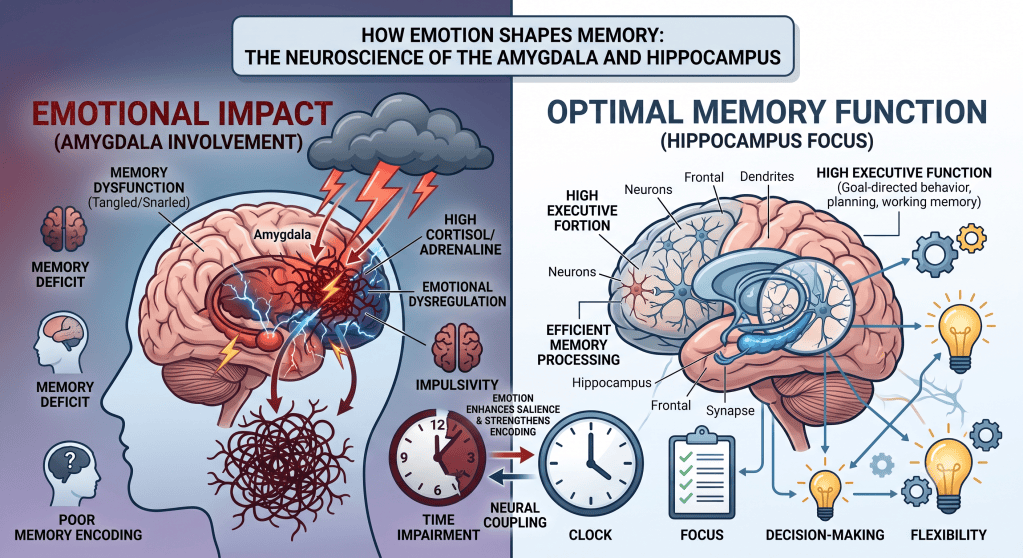
How emotional arousal, stress hormones, the amygdala, and the hippocampus work together to make some memories last a lifetime while others fade.
Most people can recall exactly where they were when they heard a piece of shocking news, yet they cannot remember what they ate for lunch three Tuesdays ago. This isn’t a personal failing or a quirk of an untrained mind. It reflects one of the more consistent findings in psychology and neuroscience. The brain does not treat all experiences equally when it comes to what gets kept and what gets discarded. Emotion acts like a stamp of importance, and the brain treats those experiences as higher priority for consolidation.
This idea moved from folk wisdom to hard science over the final decades of the twentieth century, as brain imaging technology matured and researchers began mapping which structures activate during learning and recall. Among the most influential figures in this area was James L. McGaugh, a psychobiologist at the University of California, Irvine, whose decades of work on the amygdala and hippocampus reshaped how scientists think about memory formation. His research, along with contributions from colleagues such as Larry Cahill, helped explain a pattern nearly everyone recognizes intuitively: emotionally charged moments tend to leave a deeper, more durable mark than emotionally flat ones.
Understanding why this happens matters well beyond the laboratory. It touches on how eyewitnesses recall crimes, why trauma can dominate a person’s inner life years after an event has passed, how students retain information best, and why some experiences from childhood remain sharp while entire years otherwise blur together. This article walks through the science behind emotional memory, the specific brain structures involved, the experiments that tested these ideas directly, and what the research has come to mean for fields ranging from mental health treatment to education.
The Puzzle of Selective Remembering
Human memory has never worked like a video recorder that captures everything with equal fidelity. Forgetting is, in fact, the default outcome for most of what a person experiences. Attention drifts, sleep consolidates only a fraction of the day’s input, and unimportant details simply fail to reach long-term storage. Given how much information the brain must filter through, some kind of triage system makes evolutionary sense. An organism that remembered every ordinary meal with the same fidelity as a life-threatening encounter would waste valuable cognitive resources on information with little survival value.
Researchers in the 1980s and 1990s began to ask a more precise question than “why do we forget most things.” They asked why the exceptions to forgetting are so consistently emotional in nature. Studies of autobiographical memory found that people could recall arguments, accidents, first kisses, and public tragedies in far greater detail than routine days, even when those routine days occurred more recently. This pattern held up across cultures and age groups, suggesting something biological was at work rather than something purely social or cultural.
The explanation that eventually took shape centers on the idea that emotional arousal does not just make an experience feel more vivid in the moment. It actually changes what happens biologically in the minutes and hours after the experience, during the period when a new memory is still fragile and being written into more permanent storage. This process is called memory consolidation, and it turns out to be remarkably sensitive to the body’s stress response. Sleep, particularly slow-wave and REM sleep, also plays an important role in stabilizing newly formed memories, interacting with many of the same consolidation processes influenced by emotional arousal.
The Amygdala’s Role as an Emotional Alarm
Deep in the temporal lobes sits a small, almond-shaped cluster of neurons called the amygdala. For a long time, the amygdala was associated mainly with fear and threat detection, largely because early animal research showed that damage to this structure blunted an animal’s fear responses. But subsequent decades of work, much of it led by McGaugh’s laboratory, revealed that the amygdala’s job is broader than simple fear processing. It functions more like a modulator that adjusts how strongly other brain regions encode an experience, based on how emotionally significant that experience seems to be. Strong positive experiences, such as weddings, the birth of a child, or winning an important competition, can engage many of these same memory-enhancing mechanisms, which is why emotional memory research is not simply a study of fear and trauma.
When something arousing happens, whether it is frightening, thrilling, or emotionally overwhelming in a positive sense, the body releases stress hormones, primarily epinephrine (also known as adrenaline) and cortisol. These hormones don’t just prepare the body for action by raising heart rate and redirecting blood flow. They also signal the brain that whatever just happened deserves extra attention during the memory-formation process. Although epinephrine itself crosses the blood-brain barrier only minimally, it triggers neural pathways that increase norepinephrine release within the brain, and norepinephrine is one of the primary neurotransmitters through which this signal actually reaches the amygdala. The basolateral region of the amygdala appears to be especially important in picking up this hormonal signal and translating it into changes in nearby memory-related circuits.
<cite index=”7-1″>A substantial body of research indicates that emotional arousal enhances the storage of memories, which appears to serve the function of selectively preserving an organism’s more significant experiences, and the adrenal stress hormones epinephrine and corticosterone released during emotional arousal help regulate how long-term memories are consolidated.</cite> In simpler terms, being emotionally shaken up sends a chemical message to the brain that essentially says, “this one matters, hold onto it.”
Why the Amygdala Doesn’t Work Alone
It would be a mistake to think of the amygdala as the place where emotional memories are actually stored. That job belongs largely to other structures, particularly the hippocampus. The amygdala’s contribution is closer to that of an editor than an author. It doesn’t write the memory itself; it influences how strongly the memory gets written elsewhere in the brain.
<cite index=”9-1″>Research summarized by McGaugh describes how activation of the basolateral amygdala modulates memory consolidation through its connections to a number of brain regions involved in building lasting memories, including the hippocampus, the caudate nucleus, a region called the nucleus basalis, and areas of the cortex.</cite> This wide reach helps explain why emotional arousal can affect many different kinds of memory at once, not just memories tied narrowly to fear.
The Hippocampus: Assembling the Details
If the amygdala functions as an alarm system, the hippocampus functions more like an assembly line for the kind of memory people usually mean when they talk about “remembering something”: specific facts, places, sequences of events, and personal experiences. This category is often called declarative or episodic memory, and it depends heavily on the hippocampus to bind together scattered pieces of sensory information, such as sights, sounds, and context, into a coherent memory that can later be retrieved as a whole.
Damage to the hippocampus, whether from injury, certain kinds of surgery, or disease, has long been associated with a striking inability to form new long-term memories, even when older memories and general intelligence remain intact. This tells researchers that the hippocampus isn’t simply one storage bin among many. It plays a more foundational role in organizing new experiences so they can eventually be stored and later recalled.
The connection between the amygdala and the hippocampus turns out to be where the real story of emotional memory takes shape. <cite index=”1-1″>Research on amygdala-hippocampal interactions has found that emotional arousal influences memory consolidation by activating the basolateral amygdala, which in turn modulates activity and the strengthening of connections in several downstream brain regions, including the hippocampus.</cite> In practice, this means the hippocampus doesn’t consolidate every memory with the same intensity. When the amygdala signals that an experience was emotionally significant, the hippocampus appears to lay down a stronger, more durable version of that memory than it would for something emotionally neutral.
A Two-Structure Partnership
It helps to picture this system as a kind of collaboration rather than a chain of command. The amygdala detects emotional significance and releases a modulating signal. The hippocampus does the heavy lifting of organizing the actual content of the memory. Neither structure produces a rich, retrievable memory entirely on its own, but together they explain why an emotionally charged event, such as a car accident, a wedding, or a sudden loss, so often comes with memories that feel unusually sharp and enduring years later.
This doesn’t mean emotional memories are perfect recordings. As later sections will explain, vividness and accuracy are not the same thing, and one of the more sobering discoveries in this field is that people can feel extremely confident about details that are, in fact, wrong.
Testing the Theory: What Happens When You Block the Stress Response
Ideas about brain chemistry and memory could easily remain speculative without a way to test them directly in living, thinking people. This is where a now-classic line of experiments, led by Larry Cahill working closely with McGaugh, became so influential.
In one particularly well-known study from the mid-1990s, researchers had participants view a series of slides accompanied by a narrated story. Part of the story was emotionally neutral, and part of it was more disturbing and emotionally arousing. Before the session, some participants received a drug called propranolol, a beta-blocker that interferes with the body’s normal response to epinephrine, while others received a placebo. <cite index=”17-1″>The results showed that the impairing effect of propranolol on memory for the emotional portion of the story could not be explained by reduced emotional responsiveness or by general sedation or attention problems, and instead supported the idea that the memory-enhancing effect of emotional experiences depends on activation of the brain’s beta-adrenergic system.</cite>
Put more plainly, when researchers chemically blocked the stress hormone pathway, the usual memory boost from emotional content disappeared, while memory for the neutral material stayed roughly the same either way. This was a meaningful piece of evidence because it showed a cause-and-effect relationship rather than just a correlation. It wasn’t simply that emotional memories happened to be recalled better; interfering with the underlying hormonal signal directly reduced that advantage.
Follow-up studies by other research teams reinforced this finding using different doses, delivery methods, and testing conditions, and the basic pattern held up reasonably well across this body of work, even as some studies produced more mixed results depending on timing and dosage. Taken together, this research strengthened the case that stress hormones acting through the amygdala are a key ingredient in why some memories become unusually durable, rather than emotional memories simply being remembered better because they are rehearsed or thought about more often afterward.
Flashbulb Memories: Vivid, Confident, and Sometimes Wrong
One of the more culturally recognizable expressions of emotional memory research is the concept of the “flashbulb memory,” a term introduced by psychologists Roger Brown and James Kulik in the late 1970s to describe the unusually vivid, seemingly photographic memories people often report for the moment they learned about a major public event. People who lived through events like the assassination of a prominent public figure or a large-scale disaster often describe remembering exactly where they were standing, who they were with, and what the room looked like when they heard the news.
The amygdala-hippocampus research offers a plausible biological explanation for why these memories feel so vivid: the emotional shock of the moment likely triggers the same stress-hormone cascade described above, prompting a stronger-than-usual consolidation process. However, later research introduced an important complication. Several studies that followed people over months and years found that flashbulb memories, while remembered with high confidence, were not necessarily remembered with high accuracy. Details shifted, sometimes substantially, even as the person’s certainty in their memory stayed just as strong or grew stronger over time.
This distinction between vividness and accuracy is one of the more important nuances in this entire field, and it’s worth stating carefully rather than glossing over. Emotional arousal appears to strengthen certain aspects of a memory, often the emotional tone and some central details, while other peripheral details can still be reconstructed inaccurately during later recall. A memory can feel completely reliable to the person experiencing it and still contain errors. This has real consequences in situations like eyewitness testimony, where confidence and accuracy don’t always move together.
From the Lab to the Clinic: Trauma and Treatment
The practical stakes of this research become clearer once trauma enters the picture. Post-traumatic stress disorder involves, among other things, intrusive and unusually persistent memories of a traumatic event, often accompanied by strong physiological reactions when those memories resurface. If stress hormones play a central role in making emotional memories unusually durable, then it follows that the same biological mechanism responsible for helping someone remember a meaningful but non-traumatic event might also be involved in why traumatic memories can become so persistent and distressing.
This line of reasoning led some researchers to explore whether beta-blockers like propranolol, given shortly after a traumatic event, might reduce the intensity of the memory that eventually forms, potentially lowering the risk of developing severe PTSD symptoms later. Results from this area of research have been mixed and are best described as suggestive rather than conclusive. Some studies found modest reductions in later symptom severity, while others found smaller or inconsistent effects, and questions remain about optimal timing, dosage, and which individuals might benefit most. This is an active and still-evolving area of clinical research rather than a settled matter, and it would be an overstatement to describe propranolol as a proven treatment for preventing PTSD.
A related and more recent area of interest involves memory reconsolidation, the idea that recalling an old memory can temporarily make it unstable again, open to modification before it gets “re-stored.” Some researchers have explored whether interventions delivered during this reconsolidation window, sometimes combined with beta-blockers, might soften the emotional intensity of an already-formed traumatic memory rather than only preventing new ones from forming so strongly in the first place. This research raises interesting scientific questions, but it also raises ethical ones about how much we should try to edit human memory, even with good intentions.
What Has Changed Since the Original Research
When this line of research first gained wide attention, much of the evidence came from animal studies using rodent models, supplemented by a growing but still limited number of human studies using drugs like propranolol. In the years since, brain imaging technology has allowed researchers to observe amygdala and hippocampal activity directly in living human subjects while they view emotional material, rather than inferring brain involvement only from drug effects or from patients with brain damage. These imaging studies have generally supported the earlier conclusions, showing that amygdala activity at the time an emotional memory is formed correlates with how well that memory is later recalled.
Research has also become more attentive to individual variation. Not everyone shows the same strength of relationship between stress hormones and memory enhancement, and factors such as the type of emotion involved, a person’s baseline stress levels, and even genetic differences in hormone receptor sensitivity appear to shape how strongly this system operates in any given individual. This has pushed the field away from treating “emotional memory enhancement” as a single, uniform effect and toward a more nuanced understanding that accounts for meaningful differences between people.
The reconsolidation research mentioned earlier also represents a genuine shift from the original consolidation-focused model. Early work on emotional memory largely asked how memories get strengthened at the moment of formation. More recent work asks a related but distinct question: what happens biologically when an already-formed memory is retrieved, and can that reactivation process itself be influenced. This has opened new lines of both basic research and, cautiously, clinical exploration, though much of it remains at earlier stages than the original consolidation findings.
Why This Research Still Matters
The relationship between emotion and memory touches far more of daily life than laboratory experiments or PTSD treatment alone. It helps explain why certain teaching methods that engage emotion, whether through storytelling, personal relevance, or dramatic demonstration, tend to produce better long-term retention than dry repetition of facts. It offers a partial explanation for why grief, love, and fear so often anchor some of the most detailed memories a person carries through life, even decades later. It also serves as a useful caution in legal and investigative contexts, where an eyewitness’s vivid certainty about a traumatic event should not automatically be equated with factual precision.
At a broader level, this research reflects something worth sitting with: the brain is not a neutral recording device. It is constantly making judgments, largely outside of conscious awareness, about what deserves to be remembered and what can be safely let go. Emotion, mediated through stress hormones and interacting brain networks, is one of the primary signals it uses to make that judgment. The amygdala flags significance, the hippocampus does the work of construction, and together they shape which parts of a life become the moments a person carries forward and which parts quietly disappear.
As research continues into memory reconsolidation, individual variation in stress hormone sensitivity, and more targeted approaches to trauma treatment, our understanding of this system will likely keep sharpening. What began largely as animal research and a handful of pioneering human experiments in the late twentieth century has grown into a substantial, still-active field that connects neuroscience directly to some of the most personal and consequential aspects of human experience: what we remember, why we remember it, and how reliable those memories really are.
References
- McGaugh, J. L. (2004). The amygdala modulates the consolidation of memories of emotionally arousing experiences. Annual Review of Neuroscience, 27, 1–28.
- McGaugh, J. L. (2002). Memory consolidation and the amygdala: a systems perspective. Trends in Neurosciences, 25(9), 456–461.
- McGaugh, J. L. (2013). Making lasting memories: Remembering the significant. Proceedings of the National Academy of Sciences, 110(Supplement 2), 10402–10407.
- Cahill, L., Prins, B., Weber, M., & McGaugh, J. L. (1994). β-Adrenergic activation and memory for emotional events. Nature, 371(6499), 702–704.
- Cahill, L., Babinsky, R., Markowitsch, H. J., & McGaugh, J. L. (1995). The amygdala and emotional memory. Nature, 377, 295–296.
- Brown, R., & Kulik, J. (1977). Flashbulb memories. Cognition, 5(1), 73–99.
- Roesler, R., Parent, M. B., LaLumiere, R. T., & McIntyre, C. K. (2021). Amygdala-hippocampal interactions in synaptic plasticity and memory formation. Neurobiology of Learning and Memory.
- Roozendaal, B., & McGaugh, J. L. (2011). Memory modulation. Behavioral Neuroscience, 125(6), 797–824.









