
Originally published in October 2010 and comprehensively updated/edited in June 2026.
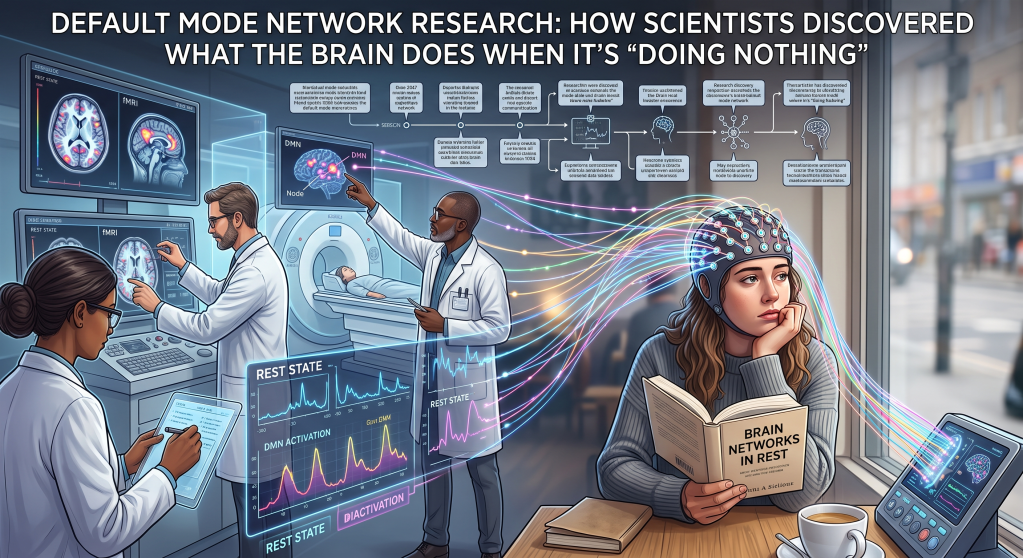
Discover how the 2001 discovery of the Default Mode Network transformed neuroscience’s understanding of rest, daydreaming, memory, and the wandering mind.
In the early 2000s, brain imaging was still a young science chasing an old assumption. For decades, researchers had built their careers around a simple idea: the brain is a reactive organ. Show it a picture, ask it to solve a math problem, have it recall a childhood memory, and specific regions light up to handle the job. When the task ends, the thinking goes, the brain settles back into a kind of idle hum, waiting for the next demand. This was the working model of cognitive neuroscience for most of the twentieth century, and it shaped how thousands of experiments were designed. Researchers needed a “resting” baseline to subtract from an “active” state, and nobody thought too hard about what that baseline actually represented. It was treated as neural white noise, a placeholder rather than a phenomenon worth studying in its own right.
That assumption started to crack in 2001, when neurologist Marcus E. Raichle and a team of colleagues at Washington University in St. Louis published a paper that would eventually be cited more than twelve thousand times. Their study, titled “A Default Mode of Brain Function,” proposed something that seemed almost backward: the resting brain isn’t idling at all. It’s running a coherent, organized pattern of activity that consumes a surprising share of the brain’s total energy budget, and that pattern actually switches off, rather than on, when a person begins a demanding task. What looked like background noise turned out to be one of the most consistent and important patterns in all of human neuroscience. Researchers eventually named this pattern the Default Mode Network, or DMN, and it has since been linked to memory, imagination, self-reflection, social understanding, and even the early biology of conditions like Alzheimer’s disease and depression.
This article traces how that discovery came about, what the original research actually showed, and why a paper about oxygen levels in a scanner would end up reshaping how psychologists and neuroscientists think about the wandering mind. Along the way, it’s worth keeping in mind the difference between what the data demonstrated at the time and what later research has built on top of it. Much of the popular understanding of the Default Mode Network has grown well beyond the modest, careful claims of the original 2001 paper, and separating the two is part of what makes this story interesting.
The Scientific Climate Before the Discovery
A Brain Built Around Tasks
To understand why the default mode network came as a surprise, it helps to picture how brain research was actually conducted at the turn of the millennium. Positron emission tomography, or PET, and the newer functional MRI technique had given scientists an unprecedented window into the living brain. For the first time, researchers could watch blood flow shift toward brain regions as a person performed a task, using that shift as a proxy for neural activity. This was a genuine revolution, and it produced a flood of exciting findings: distinct visual areas for processing faces, motor regions that fired reliably in sequence, memory circuits that could be traced with some precision.
But the method required a comparison point. To say that a brain region was “active” during, say, a language task, scientists needed to compare it against a moment when the person wasn’t doing that task. That comparison state was almost always a passive condition, something like lying still with eyes closed or staring at a fixation cross. It was assumed, more or less by default, that this passive condition represented something close to a true neural baseline. If activity dropped in a region when a task began, it seemed reasonable to conclude that the resting condition was simply a state of lower, less organized brain activity.
The Puzzle of the Deactivations
The trouble was that a curious pattern kept showing up in study after study, and it was often treated as a nuisance to be corrected rather than a phenomenon to be explained. Certain brain regions, mostly located along the midline of the brain and in areas of the parietal and prefrontal cortex, consistently showed decreased activity during tasks compared to rest. This happened across an enormous range of experiments involving completely different kinds of mental work, from visual attention to language comprehension to memory retrieval. Researchers sometimes noted these “deactivations” in their results sections, occasionally speculated about them in passing, but rarely made them the central focus of an investigation. The dominant framework simply didn’t have a good place to put this finding.
Marcus Raichle had been involved in brain imaging research since its earliest days, having helped pioneer the use of PET scanning to study human cognition in the 1980s. By the late 1990s, he and his colleagues at Washington University, including Gordon Shulman, Debra Gusnard, and others, had accumulated years of imaging data and had started to notice that these deactivation patterns were remarkably consistent in their location from one study to the next, regardless of what specific task was being performed. That consistency raised a pointed question: if the same regions reliably dropped in activity across wildly different tasks, maybe those regions weren’t simply falling into disorganized quiet. Maybe they were doing something specific during rest, something organized enough to be consistently interrupted by focused mental effort.
The 2001 Study: Measuring a Baseline That Wasn’t Supposed to Exist
A Different Way of Looking at Brain Energy
<cite index=”9-1″>Raichle and his co-authors, Ann Mary MacLeod, Abraham Z. Snyder, William J. Powers, Debra A. Gusnard, and Gordon L. Shulman, published their findings in the Proceedings of the National Academy of Sciences in January 2001.</cite> Rather than relying purely on the blood-flow measurements that had become standard in fMRI research, the team took an approach rooted in older PET methodology, examining how efficiently the brain was using the oxygen delivered to it. This measure, called the oxygen extraction fraction, essentially tracks the ratio between how much oxygen the brain pulls out of the blood and how much oxygen is actually flowing past it. In simple terms, it’s a way of gauging how hard different parts of the brain are working relative to their fuel supply.
What the researchers found was striking in its uniformity. Across the resting brain, this oxygen extraction ratio held remarkably steady from one region to another, suggesting that the brain, even while a person lay quietly with eyes closed, was operating according to some kind of stable, organized plan rather than firing unpredictably. That stability was itself an important finding, because it undercut the old assumption that an unconstrained, resting brain would show chaotic or arbitrary patterns of activity. Instead, the data pointed toward what the researchers called an “organized, baseline default mode” of brain function, one that appeared to be actively suspended, rather than simply outcompeted, whenever a person turned attention outward to a specific task.
Why This Mattered More Than a Technical Detail
It would be easy to read this as a narrow methodological point about how oxygen is used in brain tissue, and in a sense, that’s exactly what it was. But the implications reached much further. If the resting brain has its own coherent operating mode, then the entire logic of subtracting a “rest” condition from a “task” condition needed to be reconsidered. Researchers weren’t just comparing an active state to an inactive one. They were comparing two different active states, one turned toward the outside world and one turned toward something else entirely. The paper didn’t claim to know exactly what that “something else” was, and to its credit, it was fairly restrained in its speculation. But it opened a door that had been effectively locked for the better part of a scientific generation.
It’s worth pausing here on a point of scientific accuracy that sometimes gets blurred in popular writing on this topic. The original 2001 paper did not itself introduce the term “Default Mode Network” as a fully mapped, named brain circuit in the way it’s often discussed today. The paper proposed the existence of a default mode of brain function and identified regions consistently involved in it. The more specific network mapping, along with much of the terminology now used casually in psychology writing, developed over the following several years as other researchers, including some of Raichle’s own collaborators, built on and refined the initial observation.
From a Single Paper to a Field of Study
The Regions Involved
The brain areas that showed up again and again in this default pattern included the medial prefrontal cortex, located toward the front and middle of the brain, along with the posterior cingulate cortex and adjacent precuneus, situated toward the back. Portions of the parietal cortex and the hippocampal formation, important for memory, were also frequently implicated. These regions don’t sit next to each other anatomically, which is part of what made the discovery interesting. They form a network that spans considerable physical distance across the brain, connected not by proximity but by the fact that they tend to rise and fall in activity together.
Follow-up research in the years after 2001 helped clarify what these regions seemed to be doing when a person wasn’t focused on an external task. Evidence began to accumulate linking default mode activity to self-referential thinking, the kind of mental activity involved in reflecting on one’s own traits, feelings, or life story. Other research connected it to imagining the future, recalling autobiographical memories, and thinking about the mental states of other people. None of these connections were established by the original 2001 paper itself, and it’s important to be careful about that distinction. The initial study identified a consistent physiological pattern. It was later work, conducted by many different labs over the following decade, that gradually built the case for what psychological processes might correspond to that pattern.
A Cautious Word About What the Evidence Actually Shows
This is a good place to slow down and note something that often gets lost in casual discussions of the default mode network, especially online. There’s a tendency in popular psychology writing to describe the network almost as if it were the physical seat of the wandering mind, the daydream circuit, or even something like the neural home of the self. Some of that language captures a real pattern in the data, but it also runs ahead of what neuroimaging studies can actually demonstrate. Functional imaging shows correlations between blood flow changes and mental states that researchers infer from what a person reports doing or what a task requires them to do. It doesn’t directly prove that a network causes a particular subjective experience, and it can’t fully rule out that some of these regions are involved in several different, only loosely related processes.
The honest scientific picture, then as now, is one of a strong and repeatedly replicated pattern whose exact function remains genuinely debated. Some researchers have emphasized its role in mental simulation, essentially treating it as a kind of internal rehearsal system for imagining scenarios that aren’t currently happening. Others have focused on its apparent involvement in social cognition, the mental work of understanding other people’s perspectives and intentions. Still others caution that treating the network as having one unified “purpose” may be an oversimplification of a system that likely coordinates several related but distinct cognitive processes. All of these are reasonable positions supported by real evidence, and none of them should be presented as settled fact.
How the Discovery Reshaped Everyday Understanding of the Mind
Rest as an Active Process
One of the most significant, and most quietly radical, consequences of this line of research is how it changed the cultural conversation about rest itself. Before this body of work took hold, it was common, even among some psychologists, to treat idle mental time, staring out a car window, waiting in a line, lying awake before sleep, as essentially wasted time, a gap between the moments that actually mattered. The default mode network research offered scientific grounding for a different way of thinking about those gaps. If a consistent, energy-intensive brain network activates specifically during those unstructured moments, then something meaningful may well be happening during them, even if it isn’t visible from the outside.
This idea resonates with ordinary experience in ways that go well beyond the laboratory. A commuter staring blankly out a train window might suddenly land on the solution to a problem that had stumped her at her desk all afternoon. A retired teacher, walking his dog along the same familiar route each morning, finds that his best memories and reflections tend to surface not during structured conversation but during those quiet, repetitive stretches. A student who has been cramming for hours reports that insights about how ideas connect tend to arrive later, in the shower or on the walk home, rather than while staring directly at the textbook. None of these anecdotes prove anything about the default mode network specifically, since so many mental processes overlap and interact, but they illustrate why the scientific finding struck such a public chord. It gave a plausible biological anchor to something people had already sensed about their own minds.
Mind-Wandering and Its Two Faces
Subsequent research, building carefully on the 2001 findings, explored how default mode activity relates to what psychologists call mind-wandering, the experience of attention drifting away from an ongoing task toward internally generated thoughts. Some of this research suggested that mind-wandering, often treated as a lapse or a failure of discipline, might actually serve constructive purposes some of the time, including creative problem-solving and long-range planning. Other studies pointed to a less flattering side of the same coin, showing that excessive or poorly regulated mind-wandering correlates with lower performance on tasks that demand sustained attention, and that certain patterns of default mode activity appear more pronounced in people experiencing persistent low mood or rumination.
Taken together, the picture that has emerged over roughly two decades of follow-up work suggests that the same underlying network can support both valuable, generative thought and less helpful, repetitive dwelling on worries or regrets.
Which one shows up seems to depend heavily on context, on how well a person can shift between internally directed and externally directed attention, and likely on other assessments of mental health, and this is an area where researchers are still working out the details rather than one where firm conclusions have been reached.
How the Discovery Expanded Beyond Basic Research
The Network and Disorders of Thought
As imaging technology and analytic methods matured through the 2000s and 2010s, researchers began investigating whether disruptions to default mode network activity might relate to specific psychiatric and neurological conditions. Some studies found altered patterns of connectivity within this network in people diagnosed with depression, schizophrenia, and Alzheimer’s disease, among other conditions. In Alzheimer’s research specifically, a number of studies observed that some of the same brain regions involved in the default mode network are also among the earliest areas to show the buildup of amyloid plaques associated with the disease, a finding that generated considerable scientific interest in whether the network’s high baseline activity level might make it more vulnerable to certain kinds of degeneration over time.
These are genuinely important lines of inquiry, but they remain areas of active investigation rather than settled clinical fact. Altered default mode connectivity has been observed in people with a range of different conditions, which itself suggests that changes in this network are not a specific fingerprint for any one disorder. Researchers have been careful, for the most part, to describe these findings as associations worth exploring further rather than as diagnostic tools ready for clinical use, and readers encountering bold claims about the default mode network “explaining” a particular mental health condition should treat such claims with a healthy degree of skepticism.
A Network That Develops Over Time
Developmental research has also added an interesting layer to the story. Studies using brain imaging in children and adolescents have suggested that the default mode network isn’t fully mature at birth or even in early childhood. Instead, it appears to become more integrated and more distinctly organized gradually, over the course of childhood and into early adulthood. This developmental trajectory has led some researchers to speculate about connections between the network’s maturation and the emergence of more sophisticated self-reflective thinking and social understanding as children grow older, although this remains an area where causal relationships are difficult to establish with confidence.
The Broader Scientific Legacy
A Shift in How Neuroscience Treats “Nothing”
Perhaps the most lasting contribution of the 2001 paper isn’t any single finding but the shift in perspective it helped trigger. Before this research, the resting state of the brain was, scientifically speaking, an afterthought, a necessary evil for experimental design rather than a subject in its own right. Afterward, an entire subfield of what’s now called resting-state functional connectivity research grew up around the idea that the brain’s organization during unstructured moments deserves the same rigorous attention as its organization during tasks. This shift proved useful well beyond questions about the default mode network specifically. Techniques originally developed to study this one network have since been applied to map dozens of other functional brain networks, transforming how neuroscientists think about the brain’s overall architecture.
Caution Amid the Enthusiasm
Given how influential this line of research became, it’s worth closing this section with a reminder about scientific humility. The original 2001 paper was a careful, methodologically grounded piece of work that made a fairly narrow claim: that the resting brain shows a consistent, organized pattern of oxygen use that gets interrupted during goal-directed tasks. Everything that followed, the naming of the network, the psychological interpretations, the clinical associations, the popular narratives about daydreaming and creativity, represents the accumulated work of hundreds of subsequent studies, many of which point in complementary but not always fully consistent directions. Good science writing on this topic distinguishes between the solid, well-replicated core finding and the more tentative, evolving interpretations layered on top of it. The default mode network is real and well-documented as a physiological phenomenon. Exactly what it means for human psychology remains an active and, in places, genuinely unsettled area of research.
Conclusion
The story of the default mode network is, in some ways, a story about how science handles overlooked details. For years, the pattern that would eventually reshape thinking about rest and reflection sat quietly in the background of countless brain-imaging studies, dismissed as noise or an inconvenient side effect of experimental design. It took a research team willing to ask why that pattern kept appearing, and a methodological approach borrowed from an older imaging technique, to reveal that the resting brain was doing something far more organized and purposeful than anyone had assumed.
The broader significance of this discovery extends well past neuroscience laboratories. It offered a scientific vocabulary for something many people had already intuited: that unstructured time, daydreaming, quiet walks, moments of drifting attention, plays some meaningful role in how people process their experiences, imagine their futures, and understand themselves and others. At the same time, the honest scientific record urges caution against overstating what a single, if foundational, paper actually proved. Two decades of careful follow-up work have expanded, complicated, and occasionally challenged the initial findings, which is exactly how good science is supposed to proceed.
Looking forward, the default mode network continues to sit at the center of active research into memory, mental health, and the basic architecture of human thought. As brain imaging techniques grow more precise and as researchers develop better tools for connecting large-scale brain activity to specific subjective experiences, the picture first sketched out in that 2001 paper will likely continue to be refined, revised, and in some places rewritten. What began as a curious footnote in decades of task-based brain research has become one of the more durable reminders that, even in a field built on careful measurement, some of the most important discoveries come from paying attention to what was happening the whole time in the background.
Scientific Reference:
Raichle, M. E., MacLeod, A. M., Snyder, A. Z., Powers, W. J., Gusnard, D. A., & Shulman, G. L. (2001). A default mode of brain function. Proceedings of the National Academy of Sciences, 98(2), 676–682. https://doi.org/10.1073/pnas.98.2.676
The Brain’s Default Network. Annual Review of Neuroscience, 31, 433–447.









