
Originally published in November 2010 and comprehensively updated/edited in June 2026.
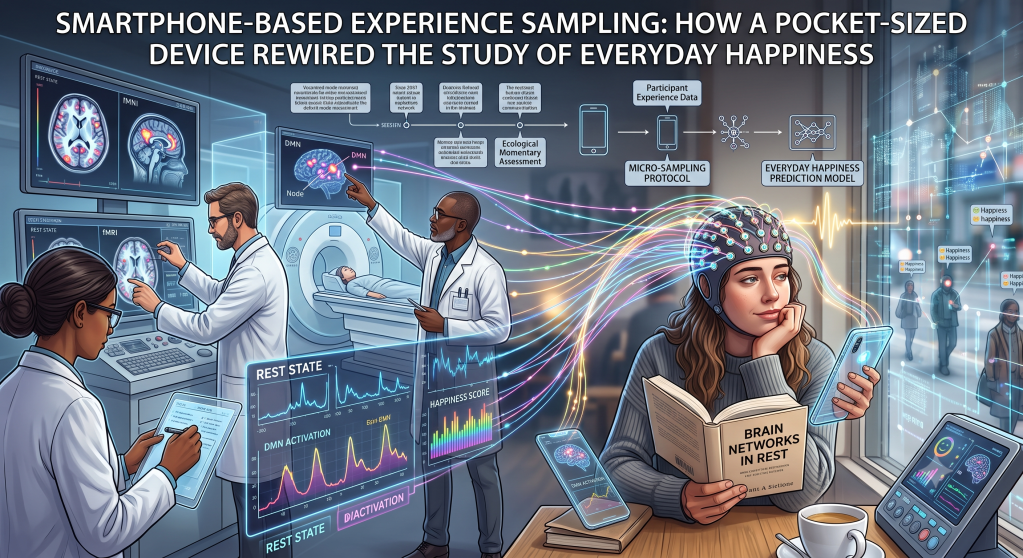
How a 2010 iPhone app turned smartphones into scientific tools, revealing that a wandering mind predicts unhappiness more than daily activities do.
In the fall of 2010, the iPhone was only three years old, but it had already changed the texture of daily life in ways few people fully appreciated at the time. People checked email standing in grocery store lines. They looked up directions instead of asking strangers. They filled small gaps in the day, the sixty seconds waiting for a bus or a coffee order, with a glowing screen rather than a wandering gaze out the window. Smartphones were becoming something closer to a limb than a tool, always within reach, always on.
What almost no one anticipated was that this same device, so often blamed for distracting people from their own lives, would become one of the most powerful scientific instruments ever built for understanding what those lives actually feel like from the inside. That is exactly what happened when a Harvard graduate student named Matthew Killingsworth, working with Harvard psychologist Daniel Gilbert, built a simple iPhone web application called Track Your Happiness. The app did something deceptively modest: at random points during the day, it pinged volunteers and asked them what they were doing, what they were thinking about, and how happy they felt in that exact moment.
Published in Science in November 2010, the results offered one of the largest and most detailed pictures yet assembled of people’s real-time emotional lives. It also introduced a research method, smartphone-based experience sampling, that would go on to reshape how psychologists study mood, attention, and mental health. This article traces how that method came to be, what it revealed about the human mind, and why it mattered that the tool measuring our inner lives was the same tool we carried everywhere we went.
The Problem With Asking People How They Feel
For most of the twentieth century, psychologists who wanted to understand happiness faced an awkward limitation. They could not climb inside someone’s head and observe emotion directly, so they relied on surveys. A researcher would ask a person to think back over the past week, or month, or year, and rate their overall life satisfaction on a numbered scale. This approach produced useful data, but it rested on a shaky assumption: that people can accurately reconstruct how they felt across long stretches of time.
Memory research had already cast doubt on that assumption. People do not store their emotional history the way a video camera stores footage. Instead, they reconstruct it, often relying heavily on how they felt at the end of an experience or how they feel right now as they try to remember. A single dramatic afternoon can color someone’s memory of an entire month. A person’s current mood while filling out a survey can quietly bias their recollection of the more distant past. Researchers had a name for the gap this created between lived experience and remembered experience, and it was a persistent thorn in the side of happiness research.
There was an older solution to this problem, developed decades before smartphones existed. Psychologists Mihaly Csikszentmihalyi and Reed Larson pioneered what they called the Experience Sampling Method in the 1970s, equipping study participants with pagers that beeped at random intervals throughout the day, prompting them to fill out a paper questionnaire about their current activity and mood. It was a clever workaround, and it produced genuinely valuable insights, but it was slow, expensive, and difficult to scale. Recruiting a few dozen participants and keeping them compliant with paper diaries for even a week or two was a significant undertaking. Reaching thousands of people, across many countries and walks of life, was simply not realistic with pagers and paper.
A New Instrument Arrives
By 2009, Killingsworth recognized that the device already sitting in millions of pockets could solve the scalability problem that had limited experience sampling for thirty years. An iPhone could deliver a survey prompt anywhere a person happened to be, at any hour, without requiring them to carry a separate pager or fill out a paper form later. It could also collect responses instantly and store them in a central database, turning what used to be a labor-intensive research project into something closer to a self-running data collection engine.
The Track Your Happiness app, which launched in 2009 and became the basis of the 2010 Science paper, worked on a simple principle. Anyone with an iPhone could download it and sign up to participate. At random moments during their waking hours, the app would send a signal asking them to briefly stop and answer a short set of questions: What are you doing right now? Are you thinking about something other than what you’re currently doing? How are you feeling, on a scale of very bad to very good? The whole process took less than a minute, which mattered enormously, because a survey that intrudes too much on daily life will not get honest, in-the-moment answers.
Because the app was public and free, it attracted an extraordinary number of participants with almost none of the recruitment costs that had constrained earlier research. Over time, more than fifteen thousand people across roughly eighty countries contributed data, and the original Science paper alone drew on responses from 2,250 adults, producing about 250,000 individual snapshots of thought and feeling. No paper-and-pager study could have approached that scale. The sheer size of the dataset let Killingsworth and Gilbert look for patterns that would have been statistically invisible in a smaller sample, and it let them do something researchers had rarely managed before: compare how people felt across an enormous range of ordinary activities, from commuting to cooking to lying in bed.
What the Data Showed About the Wandering Mind
The finding that made the study famous was almost incidental to its original purpose. Killingsworth and Gilbert were not just interested in what people were doing when they were sampled. They were interested in where people’s minds were, regardless of what their hands and bodies were occupied with. So alongside questions about activity and mood, the app asked a deceptively simple question: was the person thinking about something other than what they were currently doing?
The answer, aggregated across all those hundreds of thousands of samples, was striking. People reported that their minds had wandered away from their current activity 46.9 percent of the time, essentially independent of what that activity was. This held true whether someone was working, exercising, having a conversation, or watching television. Only when people were having intimate relations did the mind stay anchored to the present at a notably higher rate. Otherwise, wandering thoughts, about the past, the future, or things that were not happening at all, occupied close to half of people’s waking mental life.
That statistic alone was a notable discovery about the basic architecture of human consciousness. But the more consequential finding concerned how mind-wandering related to happiness. Across the dataset, people reported feeling happy about 66 percent of the time when their attention was on their current activity, compared with about 56 percent of the time when their mind had drifted elsewhere. This gap persisted almost no matter what the person happened to be doing at the time, including activities that people generally enjoy. In other words, an unpleasant task performed with full attention tended to leave people in a better mood than a pleasant task performed with a wandering mind.
Killingsworth and Gilbert went further and tried to estimate how much of the variation in people’s happiness could be explained by what they were doing versus where their minds were. In their statistical models, variation in attention explained substantially more of the variation in reported happiness than the activity itself, with the specific task a person was engaged in accounting for something in the range of five percent, and the state of a person’s attention, whether it was anchored to the present or drifting, accounting for roughly twice that share. This did not mean that activities do not matter at all to happiness. It meant that, within this dataset, the wandering or focus of attention was a stronger statistical predictor of a person’s mood than the specific task in front of them.
Untangling Cause From Consequence
A natural objection to this finding is that the arrow of causation might run the other way. Perhaps unhappy people are simply more prone to let their minds drift, meaning the wandering is a symptom of unhappiness rather than a cause of it. This is a reasonable concern, and it is one that Killingsworth and Gilbert anticipated.
Because their app sampled the same individuals repeatedly throughout the day, the researchers could look at the order in which mind-wandering and unhappiness tended to appear. They examined whether a person’s mind-wandering at one moment predicted their unhappiness at the next sampling point, and separately, whether a person’s unhappiness at one moment predicted their mind-wandering at the next. The pattern that emerged favored the idea that mind-wandering was doing causal work. A person’s mood after mind-wandering tended to dip relative to what would be expected from their mood beforehand, while unhappiness on its own did not reliably predict a shift toward more mind-wandering afterward.
It is worth being careful about how strong a claim this supports. Time-lag analyses of this kind are suggestive rather than definitive; they are not the same as a controlled experiment in which mind-wandering is deliberately induced or prevented. Later researchers, using different methods including brief in-lab manipulations, have generally reinforced the idea that unconstrained mind-wandering carries an emotional cost, but the picture has also grown more nuanced. Subsequent work has shown that the content of a wandering thought matters a great deal. Drifting toward a pleasant memory or an appealing future plan does not carry the same emotional penalty as drifting toward a worry or a regret, and some research has questioned how universal the pattern is across cultures and personality types. The original finding held up reasonably well under scrutiny, but like most single studies, it described a strong tendency rather than an iron law of the mind.
Why This Fit the Cultural Moment
It is worth pausing on why this particular finding resonated so widely with the public, beyond its scientific merits. The early 2010s were a period of rising unease about attention itself. Smartphones had normalized a kind of constant partial presence, where people were physically in one place while their attention flickered toward emails, notifications, and social feeds elsewhere. Commentators and researchers were beginning to describe multitasking not as a skill but as a liability, and popular interest in mindfulness and meditation, practices explicitly built around training attention to stay anchored in the present, was climbing.
Killingsworth and Gilbert’s paper landed in the middle of that conversation with a memorable, almost aphoristic conclusion: a wandering mind is an unhappy mind. That phrase was easy to repeat and easy to misapply, and it is worth noting that plenty of subsequent commentary flattened a nuanced statistical finding into a blanket claim that daydreaming is bad for you. The actual data told a more measured story, one about tendencies and averages rather than a universal rule for every person and every wandering thought. Still, the timing mattered. A rigorous, large-scale scientific study appeared to confirm something that a technologically anxious culture already suspected about itself, that the habit of being elsewhere, mentally, was quietly costing people something.
The Method Becomes the Message
There is a layer of irony worth sitting with here. The instrument that made this discovery possible was the very device that critics were beginning to blame for fragmenting attention in the first place. The smartphone was not just the messenger reporting on distraction; it was also the tool that let scientists measure distraction at a scale and precision that had never before been possible. That dual role, distraction machine and scientific instrument, foreshadowed much of the next decade and a half of debate about technology’s effect on the mind.
From a Single App to a Research Field
The years after 2010 saw smartphone-based experience sampling move from a novel technique used by one research group into a standard tool across psychology, psychiatry, and public health. Researchers studying depression, anxiety, and stress adopted similar app-based methods to track mood fluctuations in near-real time, rather than relying solely on a patient’s recollection during a monthly clinic visit. This mattered clinically because mood disorders often involve exactly the kind of memory distortion that undermines retrospective surveys; a person in the grip of depression may recall the past week as uniformly bleak even if their actual everyday experience included some genuine variation.
The general approach also acquired a more formal name in the scientific literature: ecological momentary assessment, often used as a broader umbrella term, with the original Experience Sampling Method treated as one particular implementation within it. The core idea across these labels is the same, capturing a person’s state as they actually live it, in their normal environment, rather than asking them to reconstruct it afterward in a lab or a waiting room. Smartphones simply made this approach cheap enough and frictionless enough to use at a scale that would have been unimaginable with pagers and paper diaries.
By the middle of the 2010s, wearable sensors and passive smartphone data, things like step counts, screen time, and location patterns, began to be layered on top of self-reported mood, giving researchers an even richer picture of how behavior and emotion move together throughout the day. Large consortia of researchers built shared platforms so that smaller labs without the resources to build their own app could still run sophisticated sampling studies. What began as one graduate student’s clever repurposing of a new gadget had become standard infrastructure for behavioral science.
What the Method Could and Could Not Tell Us
It is important not to overstate what any single experience-sampling study, including the original Track Your Happiness paper, can prove. The participants who downloaded the app voluntarily were not a perfectly representative sample of humanity; people willing to install a happiness-tracking app on their iPhone in 2009 skewed toward those with the means to own a fairly new and expensive piece of technology, and likely toward those with some pre-existing interest in self-reflection or psychology. The findings describe correlations observed within this particular group, and while the pattern has been echoed in later, more demographically varied studies, healthy scientific caution suggests treating the original numbers as an informative estimate rather than a precise universal constant.
There is also a difference between statistical significance and practical importance. A correlation between mind-wandering and lower immediate happiness, however well documented, does not mean that all daydreaming is harmful or that constant present-moment focus is achievable or even desirable. Human cognition depends on the capacity to plan, remember, and imagine, all of which require stepping mentally outside the current moment. The research is best read as identifying a statistical tendency worth understanding, not as a prescription demanding that people suppress an entire mode of thought that likely serves other important functions.
Conclusion
The Track Your Happiness project offers a useful case study in how a shift in measurement technology can open an entirely new window onto an old question. Philosophers and psychologists had wondered for centuries about the relationship between attention, thought, and well-being, but the tools available for most of that history could only capture crude, retrospective snapshots of emotional life. The arrival of a device that most people already carried everywhere turned continuous, in-the-moment measurement from a logistical fantasy into an achievable research method, and in doing so it surfaced a finding, the emotional cost of a wandering mind, that might have gone undetected by less granular methods.
The broader significance extends well past this one study. Smartphone-based experience sampling demonstrated that the tools reshaping everyday behavior could simultaneously become the tools scientists use to understand that behavior’s psychological consequences. That same logic has only expanded since 2010. The sensors embedded in phones and watches now feed into research on sleep, exercise, social connection, and mental health at a scale the pager-and-clipboard researchers of the 1970s could scarcely have imagined. As smartphones continue to evolve, and as newer technologies like wearable biosensors and passive digital tracking mature alongside them, the basic insight behind Track Your Happiness endures: to understand how people actually feel, it helps enormously to ask them in the middle of their real, ordinary lives, rather than relying solely on memory.
Scientific Reference: Killingsworth, M. A., & Gilbert, D. T. (2010). A wandering mind is an unhappy mind. Science, 330(6006), 932. https://doi.org/10.1126/science.1192439









