
Originally published in April 2011. Comprehensively updated and edited July 2026.
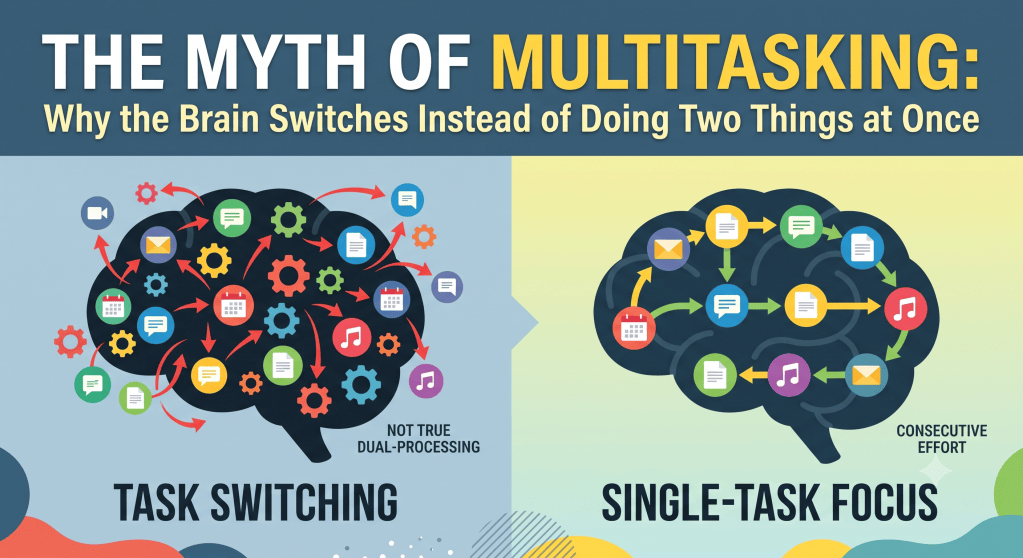
Multitasking feels efficient, but decades of research show your brain is rapidly switching tasks, not doing them at once — at a real cognitive cost.
In 2011, “multitasking” was still a badge of honor. Job postings asked for it by name. Parents watched their teenagers do homework with a television on, a phone buzzing, and three browser tabs open, and worried aloud that this generation was simply wired differently — built for a faster world. The smartphone, only a few years old at the time, was rapidly becoming the object through which people managed their entire lives: calendars, conversations, news, entertainment, and work, all funneled into a single glowing rectangle that never stopped asking for attention.
Fifteen years later, the device has only tightened its grip, but the story we tell about what it’s doing to us has changed considerably. The idea that some people — or even most people — can successfully juggle several demanding tasks at once has been tested extensively by psychologists and neuroscientists, and it has not held up well. What actually happens when you write an email while a group chat is going and a podcast is playing in the background is not parallel processing. It’s rapid switching, and it comes with a cost that is often invisible to the person paying it.
This piece revisits that research, much of which was pioneered by Stanford communication professor Clifford Nass in the years before smartphones became truly ubiquitous, and follows it forward into an era where smartphones invite frequent checking throughout the day. Along the way, it looks at why multitasking feels productive even when it isn’t, what switching actually costs the brain in time and accuracy, and how the culture of constant availability reshaped what we expect from our own attention.
The Cultural Moment That Made Multitasking a Virtue
To understand why multitasking became so celebrated, it helps to remember what was happening technologically and economically in the years leading up to the smartphone era. The rise of email in the workplace during the 1990s, followed by instant messaging, mobile phones, and eventually app-based smartphones in the late 2000s, created a world where communication no longer waited for a convenient moment. A worker in 2008 might reasonably be expected to answer a client email, take a phone call, and update a spreadsheet within the same ten minutes.
Economic pressures reinforced this. As companies sought efficiency gains after the 2008 financial crisis, doing more with less became a widespread expectation, and the ability to “multitask” was often treated as a proxy for how much output a single employee could produce. Being able to say you juggled several responsibilities at once suggested resourcefulness and stamina. Few people paused to ask whether the juggling itself might be quietly undermining the quality of the work being juggled.
At the same time, the smartphone was reshaping personal life in a parallel way. Text messages, social media notifications, and app alerts introduced a steady rhythm of small interruptions into daily routines that had never existed before. Attention became something that had to be actively defended rather than something that simply belonged to whatever task was in front of you. It’s within this cultural backdrop — a workplace that prized simultaneous output and a personal life increasingly organized around notifications — that the scientific study of multitasking became urgently relevant.
What the Brain Is Actually Doing When You “Multitask”
The term multitasking is borrowed from computing, where it originally described a single processor executing pieces of multiple programs so quickly that the switching itself is invisible to the user. Applied to human cognition, the term is misleading in an important way. Computers with multiple cores can genuinely run separate processes at the same time. Human attention does not work that way for tasks that require conscious thought.
Two Kinds of Tasks
Researchers generally separate what looks like multitasking into two categories. The first involves pairing a task that demands conscious attention with one that has become largely automatic through repetition, such as folding laundry while listening to a podcast, or walking while having a casual conversation. Because one of the two activities requires little deliberate mental effort, this kind of pairing usually works reasonably well.
The second category is different: pairing two or more tasks that each require active, conscious attention, such as writing a report while responding to messages, or reading an article while following a conversation. This is where the brain runs into a genuine bottleneck. Rather than processing both simultaneously, it toggles back and forth, dropping and picking up context each time. Cognitive scientists refer to this as task-switching, and it’s the process actually taking place during most of what people casually call multitasking.
The Switching Cost
Every time attention moves from one task to another, the brain has to disengage from the mental model of the first task and reconstruct the mental model of the second — remembering what you were doing, why, and what step comes next. This transition is not instantaneous. Research on task-switching dating back to work by psychologists Joshua Rubinstein, David Meyer, and Jeffrey Evans in the early 2000s found that switching between tasks introduces measurable delays and increases the likelihood of errors, particularly when the tasks are complex or unfamiliar. The more demanding the tasks, and the more frequently a person switches between them, the larger this accumulated cost becomes.
It’s worth being precise about what this research does and does not show. It doesn’t mean the brain is incapable of handling more than one responsibility in a day, or that all interruptions are equally damaging. It means that when two tasks each require deliberate thought, doing them in overlapping bursts tends to take longer in total and produce more mistakes than doing them one after another. The appearance of simultaneity is largely an illusion produced by how quickly the brain can switch its focus, not evidence that it is genuinely doing two things at once.
The Nass Studies: Heavy Multitaskers Under the Microscope
The most influential and, at the time, most surprising body of research on this subject came from Clifford Nass and his colleagues at Stanford University. In the years leading up to 2010, Nass’s team set out to test a fairly intuitive hypothesis: that people who multitask frequently — jumping between screens, messages, and media throughout the day — would become better at it. Practice, after all, tends to build skill in most domains.
To test this, the researchers separated a group of college students into “heavy” and “light” media multitaskers based on self-reported habits, then ran them through a series of cognitive tasks designed to measure specific mental abilities. One task tested how well participants could ignore irrelevant information while focusing on a relevant target. Another tested how efficiently they could switch between different categories of judgment. A third looked at working memory, the capacity to hold and manipulate several pieces of information in mind at once.
The results, published in the Proceedings of the National Academy of Sciences, surprised the researchers themselves: heavy multitaskers performed worse across the cognitive measures tested. They were more easily distracted by irrelevant information, slower and less accurate at switching between tasks, and less effective at organizing information in working memory than their light-multitasking peers. Nass summarized the finding in interviews at the time by noting that the people who multitasked the most were, somewhat paradoxically, the worst at the individual cognitive skills multitasking is supposed to require. Rather than sharpening their ability to divide attention efficiently, frequent multitasking appeared to be associated with greater difficulty filtering out distraction, whether or not multitasking was actually underway.
It’s important to note that this early research was correlational rather than experimental in the strictest sense — the study compared existing habits rather than randomly assigning people to multitask heavily or lightly over time, so it couldn’t fully establish that multitasking causes these cognitive differences rather than simply being more common among people who were already more distractible. Nass and his collaborators were candid about this limitation, and subsequent research has continued to probe the direction of the relationship. Still, the consistency of the pattern across several distinct cognitive tests made it one of the more talked-about findings in cognitive psychology of that decade, and it reframed multitasking from a skill worth cultivating into a habit worth questioning.
From Desktop Distraction to Pocket-Sized Interruption
The Nass studies were conducted primarily around computer use — instant messaging, multiple browser windows, television paired with homework. The smartphone changed the shape of the problem considerably. Where a desktop computer’s distractions were at least somewhat contained to moments when a person chose to sit down at it, a phone travels everywhere, and its notifications arrive without regard for what the owner happens to be doing.
Researchers studying attention in the years since have paid close attention to two related but distinct phenomena. The first is the cost of an actual interruption — a text message that arrives and gets answered in the middle of a task. The second, arguably more pervasive, is the cost of a phone’s mere presence, even when it isn’t used at all. A frequently cited study led by Adrian Ward and colleagues, published in 2017, found that participants performed worse on tests of available cognitive capacity when their phone was resting on the desk in front of them, compared to when it was in another room, even though the phone was silent and unused throughout the testing. The researchers described this as a “brain drain” effect, suggesting that part of the mind remains occupied by the effort of not checking the phone, quietly consuming attention that would otherwise be available for the task at hand.
Later work has continued to investigate the size and reliability of this effect, with researchers debating how large the everyday impact may be, while the broader finding that distraction consumes cognitive resources remains well supported. Around the same period, neuroscientist Adam Gazzaley and psychologist Larry Rosen brought this line of research together in The Distracted Mind, arguing that the brain’s limited capacity to filter interference, not a lack of willpower, is what makes constant technological interruption so difficult to manage.
This finding matters for the multitasking conversation because it suggests the cost of a phone-saturated environment isn’t limited to the moments a person is actively switching between the phone and something else. Simply knowing the phone is nearby, and available, appears to place a small but measurable draw on attention throughout the day.
The Myth of “20 Minutes to Refocus”
A statistic that has circulated widely in the years since — that it takes over twenty minutes to fully refocus after an interruption — is often traced to research by Gloria Mark, a professor who has spent much of her career studying attention and interruption in workplace settings through direct observation of office workers. It’s worth being careful with this figure, because it is frequently repeated in a way that overstates what the underlying research shows. Mark’s studies measured how long it took workers to return to an original task after being pulled away by something else, not how long it takes to recover full concentration on the same activity a person was already doing. In practice, people often bounce between several intervening tasks before returning to the first one, and the resumption itself doesn’t necessarily mean lost focus for the entire intervening period.
What her broader body of research does support more directly is that knowledge workers are interrupted extremely frequently over the course of a day, that self-interruptions — checking a phone or a new tab without any external prompt — are at least as common as externally triggered ones, and that this fragmented rhythm of attention has become a defining feature of digital-era work, whatever the precise recovery time turns out to be for any given task.
Why It Feels Productive Anyway
If task-switching carries real costs, an obvious question follows: why does it so often feel efficient? Part of the answer lies in how the brain evaluates effort versus output. Switching between short tasks produces a steady stream of small completions — an email sent, a message answered, a line of a document written — each of which delivers a modest sense of accomplishment. Working on one demanding task for an extended, uninterrupted stretch can feel slower by comparison, even when it produces more useful work overall, because the feedback of progress is less frequent.
There’s also a role for the brain’s reward circuitry here. Notifications and novelty can engage reward-learning systems involving dopamine, reinforcing the habit of checking for new information. This doesn’t mean phones are addictive in the strict clinical sense that term is sometimes used, but the underlying mechanism — a habit loop reinforced by unpredictable, bite-sized rewards — bears a structural resemblance to other behaviors that keep people checking back. Over time, this can make sustained, single-task focus feel effortful by comparison, simply because it lacks the frequent small hits of novelty that switching provides.
Finally, people are often poor judges of their own multitasking performance. Several studies have found that individuals who multitask heavily tend to rate their own ability to do so favorably, even when objective testing shows their performance suffers. This gap between subjective confidence and measured ability helps explain why the belief in effective multitasking has persisted culturally even as the evidence against it has accumulated.
Individual Differences and the Limits of the Research
None of this means multitasking ability is identical across all people, or that switching costs are fixed and unavoidable. Some individuals do perform better than others at managing interruptions and shifting between tasks, and factors such as task familiarity, how similar the tasks are to one another, and how well-rested a person is all appear to influence how large the switching cost turns out to be in a given moment. Rehearsed, well-practiced tasks — such as an experienced driver adjusting the radio — impose smaller costs than switching between two unfamiliar or complex demands.
It’s also worth distinguishing between the laboratory tasks used in much of this research and the messier, less time-pressured multitasking of everyday life. A controlled experiment measuring reaction time in milliseconds captures something real about how attention works, but it doesn’t fully translate into a statement about, say, how much a person’s overall workday output suffers from checking messages periodically. The scientific consensus supports the existence of a real, measurable cost to switching between attention-demanding tasks; it is more cautious about precisely how large that cost is in any particular real-world setting, and researchers continue to refine those estimates.
Living With an Attention-Fragmenting Technology
By the mid-2020s, the conversation around smartphones and attention had matured considerably from the early “digital detox” framing of the previous decade. Rather than treating phones as something to be eliminated, much of the more recent research and public discussion has focused on designing environments and habits that reduce unnecessary switching: separating notification settings by urgency, batching message-checking into set windows rather than responding continuously, and physically distancing the phone during tasks that require sustained focus, in keeping with the “brain drain” findings described earlier.
Workplaces, too, have increasingly acknowledged what the research suggests: that an employee who focuses on one task at a time for a defined stretch is often more productive, not less, than one who appears constantly responsive. This represents a meaningful shift from the atmosphere of the early smartphone era, when visible busyness and rapid responsiveness were often read as signs of diligence. The underlying tension hasn’t disappeared — the same economic and social pressures toward constant availability that existed in 2011 are, if anything, more deeply embedded in daily life now — but the scientific case against multitasking as an efficient strategy is better established and more widely understood than it once was.
Conclusion
The evidence accumulated over the past two decades points in a consistent direction: what people call multitasking is, for any pair of tasks that require conscious thought, actually rapid task-switching, and that switching carries a real cost in time, accuracy, and mental energy. Clifford Nass’s early research on heavy media multitaskers offered one of the first clear signals that frequent switching doesn’t build a special skill for managing distraction — if anything, it was associated with greater difficulty filtering out irrelevant information. Subsequent research into smartphone use, from the cognitive drain of a phone’s mere presence to the fragmented rhythms of interrupted office work, extended those findings into the pocket-sized, always-on environment most people now live within.
None of this suggests attention is fixed or that modern life is uniquely doomed to distraction; humans have always had to manage competing demands on their focus, and the tools for doing so more deliberately — batching tasks, limiting notifications, protecting blocks of uninterrupted time — have become more widely understood alongside the science. What has changed most since 2011 is not the underlying mechanics of attention, which appear to be fairly stable features of human cognition, but the sheer density of the environment competing for it. As new technologies, from wearable devices to increasingly capable digital assistants, continue to reshape how information reaches people throughout the day, the core lesson from this body of research is likely to remain relevant: the brain was not built to do two demanding things at once, only to convincingly imitate the experience of doing so.
Scientific Reference
- Ophir, E., Nass, C., & Wagner, A. D. (2009). Cognitive control in media multitaskers. Proceedings of the National Academy of Sciences, 106(37), 15583–15587.
- Rubinstein, J. S., Meyer, D. E., & Evans, J. E. (2001). Executive control of cognitive processes in task switching. Journal of Experimental Psychology: Human Perception and Performance, 27(4), 763–797.
- Ward, A. F., Duke, K., Gneezy, A., & Bos, M. W. (2017). Brain drain: The mere presence of one’s own smartphone reduces available cognitive capacity. Journal of the Association for Consumer Research, 2(2), 140–154.
- Mark, G., Gudith, D., & Klocke, U. (2008). The cost of interrupted work: More speed and stress. Proceedings of the SIGCHI Conference on Human Factors in Computing Systems, 107–110.
- Gazzaley, A., & Rosen, L. D. (2016). The Distracted Mind: Ancient Brains in a High-Tech World. MIT Press.









