
Originally published in March 2011. Comprehensively updated and edited July 2026.
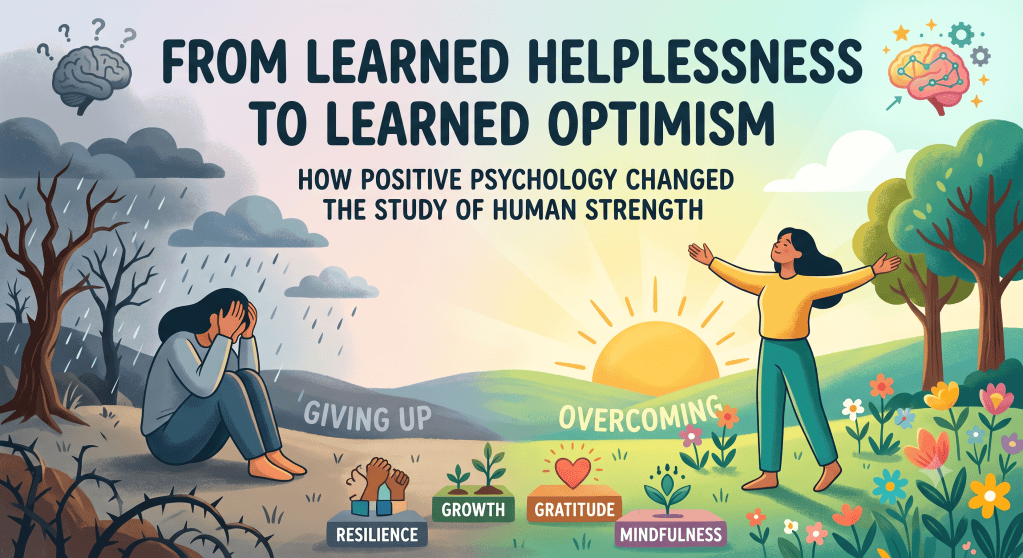
Can optimism be learned? Explore Martin Seligman’s journey from learned helplessness to learned optimism, the science of resilience, and how positive psychology evolved.
In the early 1990s, American psychology was still, by institutional influence and research priorities, largely organized around understanding what goes wrong. Clinics studied depression, anxiety, trauma, and addiction. Graduate programs primarily trained therapists to diagnose and treat disorders, while the systematic study of strengths and flourishing remained a smaller part of the field. This wasn’t an accident or an oversight—it was a reasonable response to real needs, shaped in part by decades of funding priorities that followed World War II, when the profession organized itself around treating psychological injury. But by the time Martin Seligman became president of the American Psychological Association in 1998, a question had started to nag at him and a small circle of colleagues: if psychology had spent a century cataloging what makes people miserable, why had it spent so little time asking what makes them thrive?
That question became the founding premise of positive psychology, a subfield built around the study of well-being, resilience, and human strength rather than pathology alone. It didn’t emerge from nowhere. Seligman had already spent thirty years researching something that seemed, on its surface, to belong to the old paradigm of suffering and dysfunction: a phenomenon he called learned helplessness. The path from that early, rather bleak discovery to the sunnier territory of “learned optimism” and eventually to a broader theory of human flourishing is one of the more interesting turns in the history of modern psychology. It also raises a question that has outlived its original moment and is still being tested today: can optimism, resilience, and a sense of purpose actually be taught, or are they mostly fixed traits that some people are simply born with more of than others?
From Learned Helplessness to Learned Optimism
Seligman’s earliest and most influential research had nothing to do with optimism at all. In the late 1960s, working with dogs in a series of experiments that would become foundational—and controversial—in behavioral psychology, Seligman and his colleagues observed something unexpected. Animals that had previously experienced unavoidable, uncontrollable unpleasant stimuli later failed to escape the same stimuli even when escape became possible. They had, in effect, learned that their actions didn’t matter, and that learned passivity carried over into new situations where it no longer made sense. Seligman called this learned helplessness, and the concept quickly became a touchstone for understanding depression in humans. If people came to believe that bad events were permanent, that they touched every part of their lives, and that they were personally at fault for them, they tended to give up trying, even when circumstances changed. Later research would show that helplessness responses are also shaped by factors such as expectations, prior experiences, biology, and the meaning people assign to adversity.
It took Seligman years of further research to notice the flip side of this pattern. Not everyone who experienced setbacks became helpless. Some people, faced with the same failures and disappointments, kept trying. What separated them wasn’t raw willpower or a sunnier disposition in some vague sense—it was something more specific and more measurable: the explanations they gave themselves for why bad things happened. Seligman termed this explanatory style, and it became the backbone of his 1991 book Learned Optimism, which argued that optimism wasn’t a fixed personality trait but a pattern of thinking that could, in principle, be identified, measured, and changed.
The Three Dimensions of Explanatory Style
Seligman broke explanatory style down into three dimensions, sometimes remembered by the shorthand “the three Ps”: permanence, pervasiveness, and personalization.
Permanence concerns whether people believe the causes of bad events are lasting or temporary. A pessimistic explanatory style treats setbacks as permanent—”I always mess this up”—while an optimistic one treats them as fleeting—”I had an off day.” Pervasiveness concerns how far the person believes the failure bleeds into other areas of life. A pessimistic style generalizes a single failure into a global judgment (“I’m bad at everything”), while an optimistic style keeps the failure contained to its actual domain (“I’m not good at public speaking, but that doesn’t say anything about my other skills”). Personalization concerns who or what gets blamed. Pessimists tend toward internal, self-blaming explanations even in situations shaped heavily by outside forces, while optimists are more likely to weigh external and situational factors appropriately, without simply deflecting all responsibility. The pattern is specific to negative events; for positive events, optimists are more likely to attribute success partly to their own abilities and efforts.
Seligman and his collaborators developed tools like the Attributional Style Questionnaire to measure these patterns, and a body of research through the 1980s and 1990s linked pessimistic explanatory style to higher rates of depressive symptoms, poorer performance under pressure, and even, in some longitudinal studies, worse physical health outcomes later in life. It’s worth being precise about what this research actually showed and what it didn’t. Most of these studies were correlational, meaning they could show a relationship between explanatory style and outcomes like depression, but they couldn’t on their own prove that pessimism caused the depression rather than being an early symptom of it, or that some third factor—genetics, early adversity, chronic stress—was driving both. Seligman was aware of this limitation, and part of what made his subsequent work interesting was the attempt to move from correlation toward something closer to causal evidence, by testing whether deliberately teaching people to shift their explanatory style actually changed downstream outcomes like depression risk.
The ABCDE Model and Cognitive Techniques
To translate explanatory style theory into something teachable, Seligman borrowed heavily from cognitive-behavioral therapy, particularly the work of Aaron Beck and Albert Ellis, who had already shown in clinical settings that changing how people interpreted events could change how they felt and behaved. Seligman adapted these ideas into a model he called ABCDE: Adversity, Belief, Consequence, Disputation, and Energization.
The idea was straightforward, even if the practice of it wasn’t always easy. An adversity occurs—a rejection, a failure, a setback. That adversity triggers a belief, often automatic and unexamined, about why it happened. That belief produces an emotional and behavioral consequence. The intervention comes at the disputation stage: actively questioning the belief the way a lawyer might cross-examine a witness, looking for evidence that contradicts the pessimistic interpretation, alternative explanations that are more accurate, and the actual real-world implications of the setback, which are often smaller than they feel in the moment. The final stage, energization, refers to the renewed motivation that tends to follow once a distorted, overly pessimistic belief has been challenged and replaced with something more accurate.
This is a useful place to flag a distinction that often gets blurred in popular accounts of positive psychology: learned optimism, as Seligman framed it, was not simply “positive thinking” or telling yourself that everything would work out. The disputation step was explicitly about accuracy, not cheerfulness for its own sake. Seligman was often careful to distinguish his approach from naive optimism, arguing that unrealistic positivity could be just as maladaptive as excessive pessimism, since it left people unprepared for real risks and blind to legitimate warning signs. The goal was what he sometimes called “flexible optimism”—the capacity to use pessimistic, realistic thinking when accuracy mattered, such as when planning for genuine risks, while defaulting to optimistic explanatory patterns in situations where resilience and persistence mattered more than caution.
Positive Psychology Becomes a Field
Seligman’s 1998 APA presidency gave these ideas an institutional home. Alongside colleagues including Mihaly Csikszentmihalyi, who had already developed influential work on flow states and engagement, and Christopher Peterson, who would later co-author a widely used classification of character strengths, Seligman helped establish positive psychology as a distinct area of research, complete with its own journals, conferences, and university centers. The Positive Psychology Center at the University of Pennsylvania, which Seligman directed, became one of the field’s central hubs.
The framing mattered as much as the content. Rather than positioning itself as a rejection of clinical psychology’s traditional focus on illness, positive psychology presented itself as a complement: psychology, its founders argued, had spent a century figuring out how to move people from negative ten to zero, and it was time to also study how to move people from zero to positive ten. That distinction—treating dysfunction versus building flourishing—gave the field a clear identity, even as critics later argued it sometimes overstated how novel this focus really was, since humanistic psychologists like Abraham Maslow and Carl Rogers had explored similar territory decades earlier.
From Optimism to Flourishing: The PERMA Model
By the time Seligman published Flourish in 2011, his thinking had expanded well beyond explanatory style into a broader model of well-being, which he summarized with the acronym PERMA: Positive emotion, Engagement, Relationships, Meaning, and Accomplishment. The shift reflected a growing recognition within the field that happiness, understood narrowly as pleasant feeling, was too thin a concept to build a science around. People could report high levels of momentary positive emotion while still describing their lives as empty or unfulfilling, and conversely, people engaged in difficult, meaningful work—raising a child with special needs, caring for a dying parent, training for years toward a distant goal—often reported deep satisfaction alongside real hardship and relatively little moment-to-moment pleasure.
PERMA tried to capture this complexity by treating well-being as multidimensional rather than a single scale running from miserable to happy. Engagement drew on Csikszentmihalyi’s flow research, describing the state of complete absorption people experience during challenging, skill-matched activities. Relationships reflected a large and fairly consistent body of research, including long-running studies like the Harvard Study of Adult Development, linking strong social ties to both psychological and physical health outcomes across the lifespan. Meaning referred to a sense of belonging to and serving something larger than oneself. Accomplishment captured the pursuit of achievement and mastery for its own sake, distinct from any social recognition attached to it.
Resilience Research and Its Applications
Parallel to the theoretical development of positive psychology, Seligman and others pushed to apply these ideas in practical, testable programs, most notably in education and, more controversially, in the military. The Penn Resiliency Program, developed by Seligman’s team, brought cognitive techniques derived from learned optimism theory into school classrooms, teaching adolescents to identify pessimistic thought patterns and practice more accurate, flexible ways of interpreting setbacks. Evaluations of the program through the 2000s and 2010s generally found modest but measurable reductions in depressive symptoms among participants compared to control groups, particularly for students who started with more pessimistic explanatory styles, though effect sizes varied considerably across studies and tended to be larger immediately after the program than at longer follow-up intervals.
A more ambitious and more contested application came in 2009, when the U.S. Army adopted a program called Comprehensive Soldier Fitness, built substantially on Seligman’s resilience training model and rolled out to more than a million soldiers. The program aimed to build psychological resilience before deployment rather than only treating post-traumatic stress after the fact. It drew both enthusiasm and sharp criticism. Supporters pointed to the sheer scale of the undertaking as evidence that resilience science had matured enough for real-world application. Critics, including some psychologists and researchers, questioned whether the evidence base was strong enough to justify a program of that size, and whether resilience training risked functioning as a low-cost substitute for addressing more structural sources of psychological harm in military service, rather than a genuine complement to them.
This tension—between promising early findings and the difficulty of scaling those findings into large, generalizable interventions—became a recurring theme in positive psychology’s growth, and it’s one that later assessments of the field would return to repeatedly.
The Field Confronts Its Own Limits
No account of positive psychology’s development would be complete, or honest, without acknowledging that the field has faced substantial internal and external criticism, some of it overlapping with the broader replication crisis that has affected psychology as a whole since the early 2010s. When large-scale efforts to replicate influential psychological studies produced disappointing results across multiple subfields, positive psychology was not exempt from the scrutiny. Systematic reviews of critiques leveled at the field have pointed to problems including underdeveloped theorizing, weaknesses in measurement and methodology, and claims of poor replicability, alongside broader concerns about whether some applied positive psychology interventions have been oversold relative to the strength of their supporting evidence.
Some of this criticism has been methodological in a narrow sense—concerns about small sample sizes, a reliance on self-report questionnaires that are vulnerable to bias, and publication practices that favored positive results over null ones, all of which affected psychology broadly rather than positive psychology specifically. Other criticism has been more conceptual, questioning whether concepts like “flourishing” or “authentic happiness” were ever defined precisely enough to be tested rigorously in the first place, or whether the field’s optimistic framing made it slower than it should have been to report and reckon with disappointing or null findings.
It would be inaccurate to say that positive psychology’s core findings have collapsed under this scrutiny in the way that some individual famous studies elsewhere in psychology have. The general relationship between explanatory style and depressive symptoms, for instance, has held up reasonably well across many independent studies, even if the size of the effect is often more modest than early popular accounts suggested. But the field has, by most honest assessments, moved into a more cautious and methodologically self-critical phase than it was in during its founding years, and some researchers have framed the broader replication crisis in psychology not simply as a series of methodological failures but as a prompt to reconsider deeper assumptions about how quantitative research methods fit the subject matter of psychology in the first place. That’s a useful caution for readers today: findings from this era of positive psychology research are generally credible as an account of broad tendencies, but should be read as suggestive rather than definitive, particularly at the level of specific effect sizes or claims about individual interventions.
Why the Timing Mattered
It’s worth pausing on why learned optimism and positive psychology found such a receptive audience in the culture of the late 1990s and 2000s, beyond the merits of the research itself. The self-help publishing industry was already enormous and growing, and it offered positive psychology a ready-made audience hungry for research-backed alternatives to the more anecdotal advice that had long dominated the genre. Corporate America, meanwhile, was increasingly interested in employee engagement and workplace wellness, partly for reasons connected to productivity and retention, and positive psychology’s vocabulary of strengths, flow, and flourishing translated easily into training seminars and management consulting.
Education systems, too, were grappling with rising concerns about adolescent mental health and looking for preventive, classroom-based interventions rather than purely clinical ones, which made resilience curricula like the Penn Resiliency Program an appealing fit. And on a more diffuse cultural level, positive psychology arrived at a moment when Western societies, and American culture in particular, were increasingly comfortable talking openly about mental health and psychological well-being as everyday concerns rather than private, stigmatized matters reserved for crisis. The field didn’t create that openness, but it benefited from it, and in turn helped normalize the idea that psychological well-being was something people could actively work on, study, and measure, not simply something they either had or didn’t.
What the Science Actually Supports
Given how far “learned optimism” traveled into popular culture, it’s worth being precise about what the underlying research does and doesn’t support. The evidence is reasonably solid that explanatory style is a measurable, real pattern of thinking, that it correlates meaningfully with risk for depressive symptoms, and that structured cognitive techniques modeled on the ABCDE approach can shift explanatory style and produce modest improvements in mood and resilience for at least some people, particularly in the months immediately following training. The evidence is considerably thinner and more mixed on questions like how durable these changes are over years rather than months, how well they generalize across different cultures and populations, and how much of the benefit in large-scale programs comes from the specific cognitive techniques themselves versus more general factors like structured attention, social support, or simply being part of a program that signals institutional care.
None of this means the underlying idea was wrong. It means the idea was, like most genuinely useful scientific findings, more limited and more conditional than its most enthusiastic popularizers sometimes suggested. Optimism, in the sense Seligman studied it, does appear to be at least partially learnable—not in the sense of flipping a permanent switch in personality, but in the narrower and still meaningful sense that people can be taught to notice and question unhelpful explanatory habits, with real if modest effects on how they respond to setbacks.
What Positive Psychology Got Right—and Wrong
Looking back across three decades of research, it helps to sort the field’s claims into three rough categories: the ideas that have held up well, the ones that were oversold, and the ones that remain genuinely open questions.
What Positive Psychology Got Right
The basic premise that thoughts shape emotional and behavioral responses is well supported, not just by positive psychology but by decades of cognitive-behavioral research it drew from. Explanatory style is a real, measurable pattern that correlates with depression risk and resilience. And the push to study strengths, relationships, and flourishing as legitimate scientific subjects, not just the absence of illness, opened up lines of research that clinical psychology’s older disease model had largely ignored.
What Was Overstated
Popular treatments of the field often implied that happiness could be engineered through simple exercises, that brief interventions produced permanent transformation, and that optimism alone was a reliable predictor of success in work or life. The underlying research rarely supported claims that strong. Most documented effects were modest, often faded over time, and were entangled with other factors like social support and structured attention that had little to do with optimism specifically.
What Remains Unresolved
Several genuine open questions remain unresolved: how durable resilience training is over years rather than months, how much explanatory style and its interventions vary across cultures very different from the American samples most research was built on, and how cognitive habits like explanatory style interact with biology, temperament, and environment rather than operating as an isolated lever.
Conclusion: A Field Still Finding Its Footing
Positive psychology’s trajectory from Seligman’s dog experiments in the 1960s to the PERMA model of the 2010s traces a genuinely interesting arc in the history of the discipline: a field that started by studying passivity and defeat and ended up building an entire research program around the opposite question. Along the way, it produced real, if bounded, insights—explanatory style is a meaningful psychological construct, cognitive techniques can measurably shift it, and well-being is better understood as a multidimensional experience than a single scale from sad to happy.
It also, like the rest of psychology, ran into the limits of what self-report questionnaires, modest sample sizes, and enthusiasm for a promising new idea can support on their own, and the field’s more recent history has been shaped by a necessary, if sometimes uncomfortable, period of methodological reckoning. That reckoning hasn’t discredited the core project so much as matured it, pushing researchers toward larger samples, pre-registered studies, and more cautious claims.
Looking forward from where positive psychology stood in the early 2010s, the questions it raised have only become more pressing, as concerns about adolescent mental health, workplace burnout, and the psychological costs of a hyperconnected, attention-fragmented culture have intensified in the years since. The specific tools Seligman and his colleagues built—explanatory style training, resilience curricula, the PERMA framework—remain part of that ongoing conversation, tested and refined rather than either fully vindicated or discarded. Whether optimism can be taught turned out to be less a yes-or-no question than a matter of degree, context, and honest accounting of what the evidence can and can’t yet show.
Scientific Reference
Beck, A. T. (1976). Cognitive Therapy and the Emotional Disorders. International Universities Press.
Ellis, A. (1962). Reason and Emotion in Psychotherapy. Lyle Stuart.
Seligman, M. E. P. (1975). Helplessness: On Depression, Development, and Death. W. H. Freeman.
Seligman, M. E. P. (1991). Learned Optimism: How to Change Your Mind and Your Life. Knopf.
Seligman, M. E. P., & Csikszentmihalyi, M. (2000). Positive psychology: An introduction. American Psychologist, 55(1), 5–14.
Seligman, M. E. P. (2011). Flourish: A Visionary New Understanding of Happiness and Well-Being. Free Press.
Peterson, C., & Seligman, M. E. P. (2004). Character Strengths and Virtues: A Handbook and Classification. Oxford University Press / American Psychological Association.
Cornum, R., Matthews, M. D., & Seligman, M. E. P. (2011). Comprehensive Soldier Fitness: Building resilience in a challenging institutional context. American Psychologist, 66(1), 4–9.
Lester, P. B., Harms, P. D., Herian, M. N., Krasikova, D. V., & Beal, S. J. (2011). The Comprehensive Soldier Fitness Program Evaluation. Report prepared for the U.S. Army.
Biswas-Diener, R., Dean, B., & Dormann, C. (2020). The replication crisis and applied positive psychology. Journal of Positive Psychology, 15(3), 353–360.
Van Zyl, L. E. (2025). Exploring the potential solutions to the criticisms of positive psychology: But can the bold, idealistic visions of positive psychologists survive real-world scrutiny? Frontiers in Psychology, 16, 1511128.









