
Originally published in June 2011. Comprehensively updated and edited July 2026.
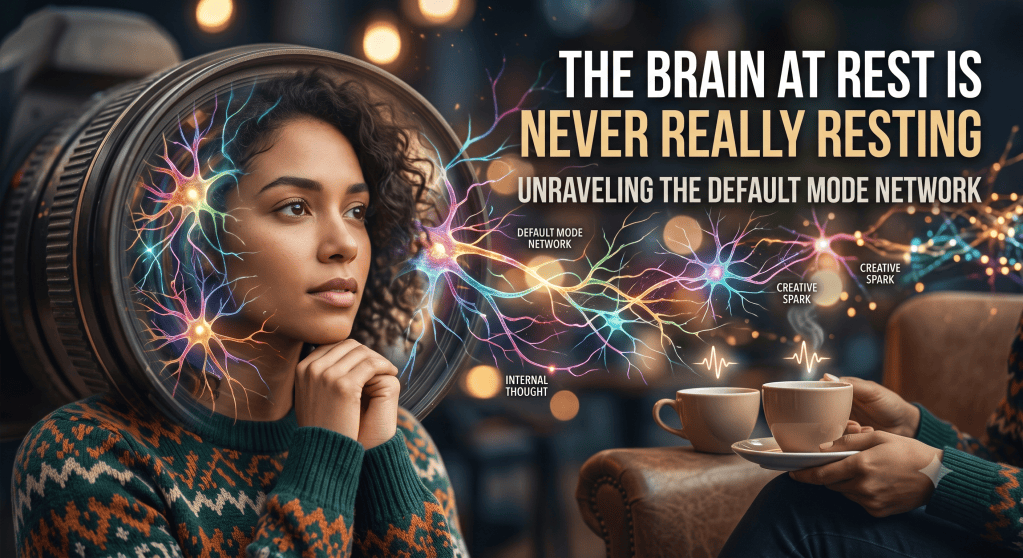
How the discovery of the default mode network revealed the hidden activity of the resting brain, memory, imagination, and mind-wandering.
In the early 2000s, brain imaging labs were operating under a quiet but stubborn assumption. If you wanted to study how the brain worked, you gave a person a task. Show them a word, ask them to name a color, have them solve a puzzle while lying inside a scanner. Whatever lit up while they worked was assumed to be the interesting part. Whatever happened in between tasks, during the gaps and pauses, was treated as background noise, something to be subtracted away so the “real” signal could shine through.
That assumption turned out to be wrong in a way that reshaped an entire field.
Researchers began noticing that a specific set of brain regions consistently became more active when people stopped doing a task, not less. At first this looked like a technical nuisance. Eventually it became one of the more important discoveries in modern neuroscience: a network of brain regions that hums along in the background whenever the mind is not focused on the outside world, a system now known as the default mode network (DMN).
The idea that the brain has a built-in “default” state changed how scientists think about daydreaming, memory, imagination, and even mental health. This article traces how the DMN was discovered, what scientists now understand about what it does, and why a network active mostly when you’re not paying attention to anything in particular turned out to matter so much for who you are.
A Strange Signal Nobody Was Looking For
The Problem With “Rest”
Functional MRI, or fMRI, works by tracking blood flow in the brain. When a brain region becomes more active, it needs more oxygen, and blood rushes in to supply it. Scanners detect that change and researchers use it as a rough proxy for neural activity. Through the 1990s, most fMRI studies followed the same basic design: scan the brain while a person performs some mental task, then scan it again while they rest, then subtract the resting scan from the task scan. Whatever activity remained was assumed to reflect the task itself.
The “resting” scans were supposed to be the boring control condition, a neutral baseline. But a handful of researchers started paying closer attention to what the brain was actually doing during those supposedly blank stretches, and the pattern was too consistent to ignore. A cluster of regions, including the medial prefrontal cortex, the posterior cingulate cortex, and parts of the parietal lobe, reliably showed higher activity during rest than during almost any externally focused task.
Naming the Network
The researcher most closely associated with formalizing this discovery is Marcus Raichle, a neurologist at Washington University in St. Louis. In the early 2000s, Raichle and his colleagues proposed that this collection of regions represented an organized, baseline mode of brain function, one that gets partially suppressed whenever a person turns their attention outward to complete a specific task. In 2001, they gave this baseline state a name that stuck: the default mode network.
The term was a deliberate choice. It implied that this pattern of activity wasn’t an accident or a glitch, but the brain’s default setting, the configuration it returns to whenever it isn’t being asked to do something else. That reframing turned “noise” into one of the most studied systems in neuroscience.
Confirming It Wasn’t a Fluke
Skepticism was reasonable at first. Was this pattern really a coordinated network, or just a handful of regions that happened to drift together by chance? The evidence that settled the question came from a technique called resting-state functional connectivity, which looks at whether different brain regions show correlated patterns of activity over time, even when a person is simply lying still with no task to perform. If two regions consistently rise and fall together, that’s taken as evidence they’re functionally connected, part of the same working system, even if they’re physically far apart in the brain.
Using this method, researchers repeatedly found that the regions associated with the default mode moved together in a tightly synchronized way, distinguishing them clearly from other networks, such as those involved in vision or motor control. This gave scientists confidence that the DMN wasn’t a fluke of the subtraction method. It was a genuine, organized system, one of several large-scale networks that the brain relies on for different kinds of cognitive work. Although researchers often refer to the DMN as a single network for simplicity, it’s more accurate to think of it as a family of interacting subsystems, a point that becomes more relevant later on.
What the Default Mode Network Actually Does
Turning Inward
If focused attention on the outside world quiets the DMN, what turns it on? The short answer is: thinking about anything that isn’t right in front of you.
The default mode network becomes active during autobiographical memory, when you recall a specific moment from your past. It lights up during imagination, when you picture a scenario that hasn’t happened yet, like rehearsing what you’ll say in a difficult conversation tomorrow. It’s engaged during what researchers call theory of mind, the act of imagining what someone else might be thinking or feeling. And it’s central to mind-wandering, the everyday experience of your attention drifting away from a task toward some inner train of thought.
What connects all of these seemingly different mental activities is that none of them require processing the immediate environment. Remembering your last vacation, imagining a future job interview, and wondering what a friend really meant by an offhand comment all pull your attention inward, away from the sensory world and toward some internally constructed scene. Researchers sometimes describe this collectively as internally directed cognition, mental activity generated from stored knowledge and simulation rather than from whatever is happening in front of your eyes.
Building the Self Out of Memory
One of the more striking implications to come out of DMN research involves the sense of self. Autobiographical memory doesn’t just store facts about your past; it’s part of how you maintain a continuous sense of being the same person across time. Studies using resting-state fMRI have found substantial overlap between the brain regions active during autobiographical memory retrieval and those active during self-referential thinking, moments when you’re explicitly considering your own traits, preferences, or history.
This overlap suggests that the default mode network isn’t just a passive memory-retrieval system. It appears to play a role in constructing and maintaining the ongoing narrative people carry about who they are. Every time you drift into a memory of your childhood home or imagine how a decision might play out for your future self, you’re likely engaging some of the same circuitry, stitching together the pieces of an identity that feels continuous even though the underlying brain activity is happening moment to moment.
It’s worth being careful with the strength of this claim. Correlation between brain regions active during memory and self-reflection tasks does not prove that the DMN single-handedly generates the self. What the evidence supports is more modest but still significant: this network appears to be a consistent, necessary participant in the mental processes that let people construct a coherent personal narrative, not the sole author of it.
Mind-Wandering Is Not Wasted Time
For a long time, mind-wandering carried a slightly negative connotation, something close to a lapse in discipline. Cognitive science complicated that picture considerably. Studies tracking DMN activity during undemanding tasks found that periods of mind-wandering were associated with increased activity in default mode regions, and that this internally directed thought often served useful functions, including future planning, problem-solving incubation, and creative idea generation.
There’s an important nuance here that gets lost in popular summaries. Mind-wandering isn’t uniformly beneficial. Research distinguishes between mind-wandering that people are aware of and can redirect, and mind-wandering that happens without the person noticing, which tends to correlate more strongly with poor task performance and lower reported well-being. In other words, the DMN engaging during a lull isn’t automatically good or bad; what seems to matter is whether a person retains some capacity to notice where their attention has gone and steer it, rather than losing track of the task entirely.
The Push and Pull Between Two Networks
Meet the Task-Positive Network
The default mode network rarely operates in isolation. Its counterpart, often called the task-positive network (and overlapping with what many researchers now call the frontoparietal control network), includes regions like the dorsolateral prefrontal cortex and parts of the parietal cortex that activate during externally focused, goal-directed tasks, things like solving a math problem, navigating traffic, or following a conversation closely.
These two networks tend to behave like a seesaw. When the task-positive network ramps up, the default mode network typically quiets down, and vice versa. This anti-correlated relationship isn’t perfectly rigid, and researchers continue to debate exactly how flexible or fixed it is, but the general pattern has been replicated often enough that it’s now treated as a foundational feature of large-scale brain organization.
Why This Matters for Everyday Attention
This seesaw relationship offers a plausible, though still evolving, explanation for something everyone has experienced: the difficulty of staying focused on a boring task. If sustained external attention requires actively suppressing the brain’s internally directed default mode, then tasks that are repetitive, low-stakes, or unengaging may simply provide weaker suppression, making it easier for the DMN to creep back in and for the mind to wander.
This doesn’t mean willpower is irrelevant, and it would be an overstatement to claim that boredom is purely a matter of network suppression failing. Attention involves many interacting systems, and individual differences in working memory capacity, motivation, and sleep quality all shape how well someone can hold task-focused attention over time. But the DMN research does offer a biologically grounded reason why the mind seems to have a built-in pull toward internal thought whenever external demands loosen their grip, rather than treating that pull as a simple character flaw.
The Default Mode Network and Mental Health
A System Worth Watching Closely
Because the DMN is so deeply tied to self-referential thought and autobiographical memory, researchers have investigated whether disruptions to this network relate to psychiatric conditions where those processes go awry. Depression research has drawn particular attention, given how central rumination, a pattern of repetitive, self-focused negative thinking, can be to the condition.
Several studies have reported that people experiencing depression show patterns of heightened or poorly regulated connectivity within default mode regions, particularly involving the subgenual cingulate cortex, an area implicated in mood regulation. The interpretation offered by many researchers is that an overactive or poorly modulated DMN may make it harder to disengage from negative self-referential thought, potentially reinforcing the ruminative cycles common in depression. Findings in this area are not uniform, however, and appear to vary depending on factors such as the subtype of depression being studied, illness severity, and whether participants are taking medication at the time of scanning, all of which make it difficult to generalize across the literature as a whole.
This is an area where caution about overstatement is especially important. Brain imaging findings related to depression have had a mixed replication record, and effect sizes in this kind of research tend to be modest. It would be inaccurate to describe the DMN as “the depression network” or to suggest that abnormal connectivity causes depression in any simple, one-directional sense. What the current evidence supports is an association, one piece of a much larger and still incomplete picture involving genetics, life circumstances, other brain systems, and environmental stress. Scientists studying this connection generally describe it as promising but preliminary, worth continued investigation rather than a settled explanation.
Similar caution applies to research linking DMN function to conditions such as anxiety disorders, PTSD, and some aspects of the autism spectrum. In each case, altered default mode connectivity has been observed in some studies, but the field has been careful not to treat these patterns as diagnostic markers or definitive causal mechanisms.
A Discovery That Arrived at a Telling Moment
The Cultural Backdrop of the 2000s and 2010s
It’s worth pausing on the timing of this discovery, because it says something about the era in which it happened. The DMN was formally named in 2001 and gained substantial traction through the following decade, precisely the years when smartphones, social media, and constant notifications began colonizing every spare moment of attention. Just as researchers were discovering that the brain does important, identity-shaping work when it’s allowed to idle, the culture was making idle moments harder and harder to find. The first iPhone arrived in 2007. Social media platforms scaled from novelty to daily habit over the following several years. Push notifications, infinite scroll feeds, and algorithmically curated content were all designed, whether explicitly or as an emergent effect of competition for engagement, to keep external attention captured as continuously as possible.
Neuroscience was, in effect, discovering the biological value of unstructured mental time at almost the exact moment that consumer technology was becoming extraordinarily effective at eliminating it. Waiting in line, riding a bus, sitting with a cup of coffee before starting the day, these had long been the small pockets of unstructured time in which minds naturally drifted into the kind of internally directed thought the DMN supports. As smartphones filled those pockets with feeds and notifications, that drifting time became scarcer.
Not a Verdict, But a Useful Frame
It would be an overreach to claim that neuroscience proves smartphones are harming a specific brain network, and serious researchers in this space are careful to avoid that framing. The relationship between screen use and default mode activity is an active area of study, not a settled conclusion, and much of the popular commentary linking the two oversimplifies what remains a genuinely open scientific question. What the DMN research does provide is a useful vocabulary for a pattern many people already sense intuitively: that constant external stimulation and constant unstructured daydreaming pull on the brain in different, and possibly competing, ways.
This is less a story about technology being bad and more a story about a tradeoff becoming visible for the first time. Before the DMN was named, there was no biological language for what happens when a person never lets their mind idle. For decades, neuroscientists largely treated the resting brain as a neutral baseline rather than an active cognitive state. The discovery of the default mode network showed that this framing was incomplete: the resting mind is doing something, and understanding what it’s doing offers useful context, not a verdict, for evaluating how modern habits shape everyday cognition.
What Two Decades of Research Have Clarified
From Curiosity to Cornerstone
In the years since Raichle’s initial papers, the default mode network has moved from a curious anomaly to one of the most extensively studied systems in human neuroscience, cited across thousands of papers spanning psychology, psychiatry, developmental science, and even philosophy of mind. Researchers have mapped how the network develops across childhood and adolescence, how its connectivity patterns shift with healthy aging, and how it interacts with other large-scale networks involved in attention and cognitive control.
This body of work has converged on a few reasonably well-supported conclusions. Internally directed thought is not the cognitive equivalent of idling; it draws on organized, identifiable brain circuitry and serves identifiable psychological functions, from maintaining a coherent sense of self to supporting planning and creative problem-solving. The relationship between internal and external attention appears to involve a genuine tradeoff at the network level, rather than being two entirely independent capacities running in parallel. And disruptions to typical default mode functioning show meaningful, if still incompletely understood, associations with several mental health conditions.
What Remains Uncertain
It’s equally important to be honest about the limits of current knowledge. Much of the foundational DMN research relies on correlational data, observing which regions activate together rather than proving what causes what. The precise boundaries of the network are still debated, with some researchers arguing for subdividing it into distinct subsystems rather than treating it as a single unified circuit. And the clinical implications, while promising, have not yet translated into reliable diagnostic tools or targeted treatments, despite considerable interest in that possibility.
Conclusion
The story of the default mode network is, in part, a story about how science sometimes advances by taking its own control conditions seriously. What looked like meaningless background activity turned out to be a coordinated system with important roles in memory, imagination, empathy, and the ongoing construction of personal identity. Two decades of research have transformed “resting state” from an afterthought into one of the most productive areas of brain science.
There’s also a broader significance to this discovery that extends past the laboratory. It offers a scientifically grounded reminder that unstructured mental time, the kind spent staring out a window or letting a memory surface unprompted, is not wasted time in any straightforward sense. Research on meditation has also examined how contemplative practices may influence patterns of default mode activity, particularly the relationship between self-referential thinking and present-moment awareness, although the findings remain an active area of investigation. As technology continues to reshape how much of that time people have available, and as new tools, including AI systems that can occupy even more of the attention once left open for idle thought, become part of daily life, the questions raised by default mode network research seem likely to matter more, not less, in the years ahead. Understanding what the resting brain is doing may turn out to be just as important as understanding what it does when it’s busy.
Scientific Reference
Raichle, M. E., MacLeod, A. M., Snyder, A. Z., Powers, W. J., Gusnard, D. A., & Shulman, G. L. (2001). A default mode of brain function. Proceedings of the National Academy of Sciences, 98(2), 676–682.
Buckner, R. L., Andrews-Hanna, J. R., & Schacter, D. L. (2008). The brain’s default network: Anatomy, function, and relevance to disease. Annals of the New York Academy of Sciences, 1124(1), 1–38.
Fox, M. D., Snyder, A. Z., Vincent, J. L., Corbetta, M., Van Essen, D. C., & Raichle, M. E. (2005). The human brain is intrinsically organized into dynamic, anticorrelated functional networks. Proceedings of the National Academy of Sciences, 102(27), 9673–9678.
Christoff, K., Gordon, A. M., Smallwood, J., Smith, R., & Schooler, J. W. (2009). Experience sampling during fMRI reveals default network and executive system contributions to mind wandering. Proceedings of the National Academy of Sciences, 106(21), 8719–8724.
Andrews-Hanna, J. R., Smallwood, J., & Spreng, R. N. (2014). The default network and self-generated thought: Component processes, dynamic control, and clinical relevance. Annals of the New York Academy of Sciences, 1316(1), 29–52.
Smallwood, J., & Schooler, J. W. (2015). The science of mind wandering: Empirically navigating the stream of consciousness. Annual Review of Psychology, 66, 487–518.
Sheline, Y. I., Price, J. L., Yan, Z., & Mintun, M. A. (2010). Resting-state functional MRI in depression unmasks increased connectivity between networks via the dorsal nexus. Proceedings of the National Academy of Sciences, 107(24), 11020–11025.









