
Originally published in July 2011. Comprehensively updated and edited July 2026.
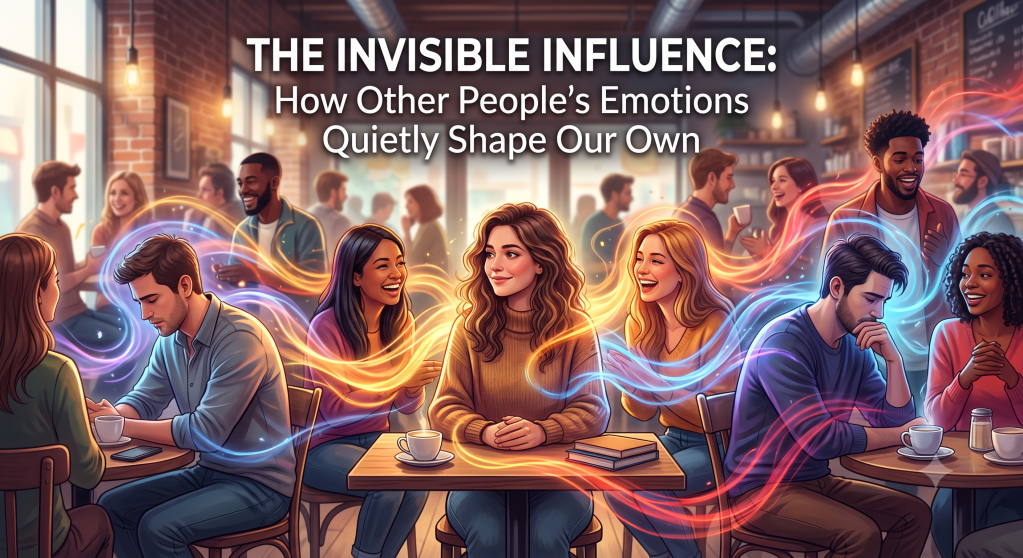
How emotional contagion, mirror neurons, and unconscious mimicry quietly shape our moods—and what the science says about empathy today.
In the summer of 2011, the idea that emotions could spread between people the way a cold spreads through an office was still something of a novelty outside academic psychology. Facebook was only seven years old. The iPhone had just introduced most people to the idea of carrying a camera, a phone, and a social feed in one pocket. Researchers were beginning to ask a question that would only grow more urgent over the following decade and a half: if we can catch a stranger’s yawn across a room, what else might we be catching from the people around us, without ever noticing it happened?
That question sits at the center of one of psychology’s more quietly unsettling findings. More of what we feel in any given day may be shaped by others than we typically realize. It is borrowed, absorbed, and reflected from the people we spend time with — a coworker’s tension before a big meeting, a friend’s contagious laughter, the low hum of anxiety that can spread through a family during a hard week. Researchers call this phenomenon emotional contagion, and it turns out to be one of the most consistent, well-documented patterns in social psychology.
This matters more now than it did in 2011, not because the underlying human wiring has changed, but because the environment that wiring operates in has changed dramatically. We now spend enormous stretches of our day absorbing other people’s emotional states through screens rather than faces, and the science of emotional transfer has had to catch up. This piece walks through where the idea came from, what neuroscience has proposed about the biological pathways involved (including the famous and still-debated mirror neuron system), what solid evidence actually shows about empathy and emotional mimicry, and why so much of this influence operates entirely below the threshold of conscious awareness.
The Old Idea Behind a New Science
Long before anyone put people in brain scanners, philosophers and writers had already noticed that emotion seemed to move between individuals like a current. Adam Smith wrote about “sympathy” as an almost automatic process in the 1700s, describing how watching someone in pain produces a flicker of that same pain in the observer. Charles Darwin, in his 1872 book on the expression of emotion, argued that facial expressions were not simply decorative — they were functional signals, shaped by evolution, that helped social animals coordinate with one another.
What changed in the late twentieth century was the willingness of psychologists to treat this as a testable phenomenon rather than a literary observation. In 1994, psychologists Elaine Hatfield, John Cacioppo, and Richard Rapson published a book simply titled Emotional Contagion, which became the reference point for most of what followed. Their central claim was that people, in ordinary everyday interactions, tend to automatically and continuously fall into step with the facial expressions, voices, postures, and movements of the people around them. The theory proposed something deceptively simple: we do not just observe someone else’s smile or frown. We tend to mimic it, in small and mostly unconscious ways, and that physical mimicry can trigger something like the emotion itself.
The researchers described this as a stream of tiny, moment-to-moment reactions — a process through which people come to “feel themselves into” the emotional experience of the person they’re with, simply through these automatic acts of mimicry. One of the more striking pieces of supporting evidence involved facial muscle activity. In experiments where subjects viewed photographs of happy or angry faces, tiny electrical sensors placed on the skin picked up distinct patterns of muscle activation — the cheek muscles associated with smiling activated when people viewed happy faces, and the brow muscles associated with frowning activated when they viewed angry ones, often before the subject was consciously aware of reacting at all.
Why Mimicry Might Produce Feeling
The theoretical leap from “we mimic expressions” to “we then feel the emotion behind them” rests on something called the facial feedback hypothesis, an idea with roots going back over a century. The basic proposal is that the brain partly reads its own emotional state by monitoring what the face and body are doing. If your face is arranged into the shape of a smile, even if you did not consciously choose it, some part of the nervous system treats that as data suggesting things are going well. Multiply this by dozens of small mimicked expressions across a conversation, and you get a plausible mechanism for how someone else’s mood becomes, in a diluted form, your own.
This does not mean emotional contagion is purely mechanical facial copying. Researchers have identified other channels as well — vocal tone, posture, pace of speech, and even breathing rhythm can synchronize between people who are interacting closely, particularly if one person holds more social influence in the moment, such as a manager speaking to a team or a parent speaking to a child. It’s worth noting that the facial feedback hypothesis itself went through its own replication scrutiny in the 2010s, after a widely cited early demonstration failed to reproduce in a large multi-lab effort. A subsequent meta-analysis pooling well over a hundred studies found the effect was real but modest, which fits the broader pattern in this research: the phenomenon holds up, even if its strength has been recalibrated downward from earlier claims.
Enter the Mirror Neuron
If emotional contagion described what seemed to be happening between people, the discovery of mirror neurons in the early 1990s offered scientists a candidate explanation for how the brain might make it happen — and by 2011, this idea had become one of the most talked-about concepts in popular neuroscience.
In 1992, a team at the University of Parma, Italy, led by Giacomo Rizzolatti discovered a class of brain cells in macaque monkeys that fired both when the monkey performed an action, such as reaching for food, and when the monkey merely watched another individual perform that same action. This was unexpected — neurons involved in movement were assumed to activate only when the animal was actually moving. Follow-up brain imaging research suggested a similar “mirror system” in humans, one that activated even during the perception of meaningless, non-goal-directed movements, leading some researchers to argue it had expanded well beyond simple action recognition to support imitation itself. From there, the idea took on a life of its own in popular science writing, credited at various points with explaining empathy, language evolution, autism, and human culture broadly. Neuroscientist Marco Iacoboni, one of the researchers most associated with human mirror neuron studies, proposed that the same mechanism letting a monkey’s brain represent another monkey’s grasping motion could, in a more elaborate human form, let us represent — and therefore feel a version of — another person’s emotional state.
A Necessary Dose of Caution
This is where the original 2011 version of this essay reflected the scientific consensus of its moment more than where things would eventually settle. The mirror neuron story has since become considerably more contested. Most direct evidence still comes from recordings in monkeys, a method that cannot ethically be used in humans, which means the “human mirror neuron system” is largely inferred rather than confirmed at the level of single cells. Some researchers now argue the mirror system develops through ordinary learning rather than as a specialized, built-in mechanism, and a widely cited 2022 review pushed the field to reconsider what mirror neurons were ever actually shown to explain.
None of this makes mirror neurons a dead end. Later work out of Parma and other labs has continued to refine the concept, and there is broad agreement that some neural overlap between observing and acting exists and plays a role in imitation. What has changed is the confidence with which scientists attribute complex experiences like empathy directly to this one mechanism — the honest current position is that mirror neurons are likely part of a larger, distributed system, not the single “empathy switch” the phrase once implied.
From Mimicry to Empathy
Emotional contagion and empathy are related, but they are not the same thing, and the distinction matters. Emotional contagion is largely automatic and undifferentiated — you catch a flicker of someone’s anxiety without necessarily understanding why they’re anxious, or even fully registering that it happened. Empathy, by contrast, is generally understood by clinical and counseling psychologists as requiring three separate abilities: the capacity to share another person’s feelings, the cognitive ability to correctly infer what they are feeling, and a genuinely compassionate intention to respond to their distress.
In other words, emotional contagion may be one of the raw ingredients that empathy is built from, but empathy also requires perspective-taking and motivation that contagion alone does not provide. This helps explain a pattern many people recognize from experience: it is possible to absorb someone’s bad mood without having any real understanding of, or concern for, what is troubling them. That absorbed mood is contagion. Understanding and caring about the underlying cause is empathy. Healthy social functioning generally depends on both working together — enough automatic emotional resonance to notice something is wrong, paired with enough cognitive and motivational effort to actually understand and respond to it.
Why It Happens Below Awareness
One of the more robust findings across decades of research is that a significant share of emotional contagion occurs without conscious awareness on either side. People do not typically decide to mimic a frown; the mimicry tends to occur in fractions of a second, faster than deliberate thought. Studies using facial electromyography — sensors sensitive enough to detect muscle activity invisible to the naked eye — have repeatedly found these micro-reactions occurring even when subjects report noticing nothing unusual about their own expression.
This matters practically because it means the emotional tone of the people around us functions something like ambient weather. We do not always notice the sky getting cloudier, but we adjust our behavior to it anyway. A chronically tense workplace, a household under financial strain, a friend group that leans toward cynicism — these environments shape the emotional baseline of the people inside them continuously, in ways that rarely announce themselves as a discrete, nameable event.
Emotional Contagion in Groups and Networks
Contagion does not only travel one-to-one. Sociologists and network scientists have spent the past two decades documenting how emotional states appear to ripple outward through larger social networks, sometimes across several degrees of separation. A widely discussed 2008 study using data from the long-running Framingham Heart Study found that reported happiness in one person correlated with happiness in friends, and even friends of friends, suggesting effects that extended well beyond direct contact.
This line of research became considerably more controversial in 2014, when it emerged that researchers had worked with Facebook to manipulate the emotional tone of content shown to hundreds of thousands of users’ news feeds, without informing them, in order to test whether emotional contagion could occur through text alone rather than face-to-face expression. The study defined emotional contagion as the transfer of positive or negative emotion between people through their interactions within a social network. The researchers reported that people shown more positive content in their feeds tended to post more positive updates themselves, and the reverse held for negative content, suggesting that contagion effects were measurable even without facial mimicry, tone of voice, or physical presence. The study became a landmark not just for its findings but for the ethical debate it triggered about experimenting on people’s emotions without their consent — a debate that reshaped how platforms and researchers think about consent in behavioral studies going forward. It’s worth noting that later analyses of the same data generally confirmed the effect was real but quite small in absolute terms — enough to be scientifically meaningful, not enough to suggest a news feed can dramatically sway anyone’s emotional state on its own.
Whatever one concludes about the ethics of that particular experiment, its central finding lines up with a broader body of evidence: emotional tone appears to be genuinely contagious across digital as well as face-to-face channels, even when the usual biological mimicry pathways — facial muscles, vocal tone, posture — are entirely absent. That is a meaningful clue that emotional contagion is not purely a matter of physical imitation. Something about the content and framing of what we read and see seems capable of shifting mood on its own.
Individual Differences: Why Some People Catch More Than Others
Not everyone is equally susceptible. Hatfield and her colleagues developed something called the Emotional Contagion Scale specifically to measure how strongly different people tend to absorb the emotions around them, and research using it has found consistent individual variation. People who score higher on measures of empathic concern, and people in certain caregiving or service roles, tend to show stronger contagion effects — which has an obvious upside in terms of social connection, but also a documented downside. Therapists, nurses, teachers, and other professionals in emotionally demanding roles have to actively manage the fact that they are, in a very literal physiological sense, absorbing some portion of the distress they are exposed to across a working day. This is one of the mechanisms researchers point to when explaining compassion fatigue and burnout in caregiving professions — not simply overwork, but the cumulative cost of sustained, largely automatic emotional absorption.
Personality traits play a role as well. Some research has suggested that extraverts tend to both express emotion more visibly and pick up on others’ emotional expressions more readily, while introverts may show somewhat more restrained contagion effects, though the picture here is less settled and should be treated as a general tendency rather than a fixed rule.
Real-World Implications
The practical consequences of this research extend into places most people would not immediately associate with brain science. Workplace psychology has increasingly incorporated emotional contagion into how organizations think about leadership. A manager’s visible stress or calm tends to spread through a team surprisingly quickly, independent of what is actually being said in meetings, which is one reason leadership training now often includes explicit attention to emotional self-regulation, not as a soft-skills afterthought but as something with measurable downstream effects on team performance and morale.
Family dynamics show similar patterns. Parental stress, particularly chronic stress that shows up in tone of voice, facial tension, and posture rather than explicit words, appears to register with children well before children have the vocabulary to describe what they’re picking up on. This does not mean parents must perform constant cheerfulness — that would be neither realistic nor healthy — but it does help explain why household emotional climate seems to matter as much as, or more than, specific disciplinary approaches in shaping a child’s own emotional regulation over time.
And in an era where a large share of daily social contact happens through text messages, video calls, and social feeds rather than face-to-face conversation, the 2014 Facebook findings and the network research that preceded them raise a genuinely open question: if emotional tone can spread through a screen almost as effectively as it spreads through a room, what does that mean for the aggregate emotional climate of a society that spends several hours a day consuming algorithmically selected content? This is an area where current research is still catching up to the scale of the technology, and firm conclusions remain limited — but the underlying mechanism, contagion without conscious awareness, is well enough established that the question deserves serious attention rather than dismissal.
What the Evidence Does and Does Not Support
It is worth being precise about where the science stands, because the popularity of these ideas has occasionally outpaced the underlying evidence. The core phenomenon of emotional contagion — that people’s expressed emotions correlate with, and often causally influence, the emotions of those around them — rests on a substantial body of experimental and observational evidence built up since the early 1990s. The facial mimicry and physiological components are among the most consistently replicated components of the literature. Notably, emotional contagion itself has remained considerably more robust than several other social psychology phenomena that received widespread attention before psychology’s replication movement took hold in the 2010s, which lends the core finding more durability than many of its contemporaries from the same era.
The mirror neuron explanation for why contagion and empathy occur is considerably less settled than popular science coverage sometimes suggests, particularly the leap from monkey single-cell recordings to sweeping claims about human social cognition. And network-level claims about emotional spread across friends-of-friends, while intriguing, rely heavily on correlational data that is difficult to fully disentangle from the simple fact that people tend to befriend others who are already similar to them in mood and disposition — a phenomenon researchers call homophily, which can produce patterns that look like contagion even when the underlying mechanism is closer to selection than transmission. Good research in this area continues to work at separating those two explanations, and readers should treat strong claims about exact percentages or precise causal pathways with some skepticism.
Conclusion
The central insight of this research has not changed much since 2011, even as the details around it have been refined, contested, and in some cases revised: a meaningful share of what we feel on any given day did not originate entirely within us. It arrived, in small and largely undetected pieces, from the people we spent time with — their expressions, their tone, their posture, and increasingly, the emotional coloring of the words and images they send us through a screen.
This does not diminish the reality or significance of our own emotional lives. If anything, it adds a layer of responsibility and self-awareness worth cultivating. Fortunately, emotional contagion is not destiny. Awareness, emotional regulation, and deliberate choices about our environments allow us to influence how strongly we absorb the emotional climate around us. Recognizing that mood is porous — that it moves between people more easily and more automatically than most of us assume — offers a practical kind of leverage. It means the emotional tone we bring into a room, a conversation, or a comment section is not a purely private matter; it becomes raw material that other nervous systems are, in some small way, going to process and reflect back.
As research on mirror neurons continues to mature past its early, sometimes overstated claims, and as digital contagion research grapples with a media environment that did not exist when Hatfield first proposed the theory, one thing seems likely to remain constant: humans evolved as intensely social animals, and the machinery for reading and absorbing each other’s emotional states runs quietly in the background of nearly every interaction we have, whether we are standing in the same room or scrolling through the same feed.
Scientific Reference
- Hatfield, E., Cacioppo, J. T., & Rapson, R. L. (1994). Emotional Contagion. Cambridge University Press.
- Hatfield, E., Rapson, R. L., & Le, Y. L. Primitive emotional contagion: Recent research. In J. Decety & W. Ickes (Eds.), The Social Neuroscience of Empathy. MIT Press.
- Rizzolatti, G., & Craighero, L. (2004). The mirror-neuron system. Annual Review of Neuroscience, 27, 169–192.
- Iacoboni, M., Woods, R. P., Brass, M., Bekkering, H., Mazziotta, J. C., & Rizzolatti, G. (1999). Cortical mechanisms of human imitation. Science, 286, 2526–2528.
- Heyes, C., & Catmur, C. (2022). What happened to mirror neurons? Perspectives on Psychological Science, 17(1), 153–168.
- Decety, J., & Jackson, P. L. (2004). The functional architecture of human empathy. Behavioral and Cognitive Neuroscience Reviews, 3(2), 71–100.
- Coles, N. A., Larsen, J. T., & Lench, H. C. (2019). A meta-analysis of the facial feedback literature: Effects of facial feedback on emotional experience are small and variable. Psychological Bulletin, 145(6), 610–651.
- Fowler, J. H., & Christakis, N. A. (2008). Dynamic spread of happiness in a large social network. BMJ, 337, a2338.
- Kramer, A. D. I., Guillory, J. E., & Hancock, J. T. (2014). Experimental evidence of massive-scale emotional contagion through social networks. Proceedings of the National Academy of Sciences, 111(24), 8788–8790.









