
Originally published in November 2011. Comprehensively updated and edited July 2026.
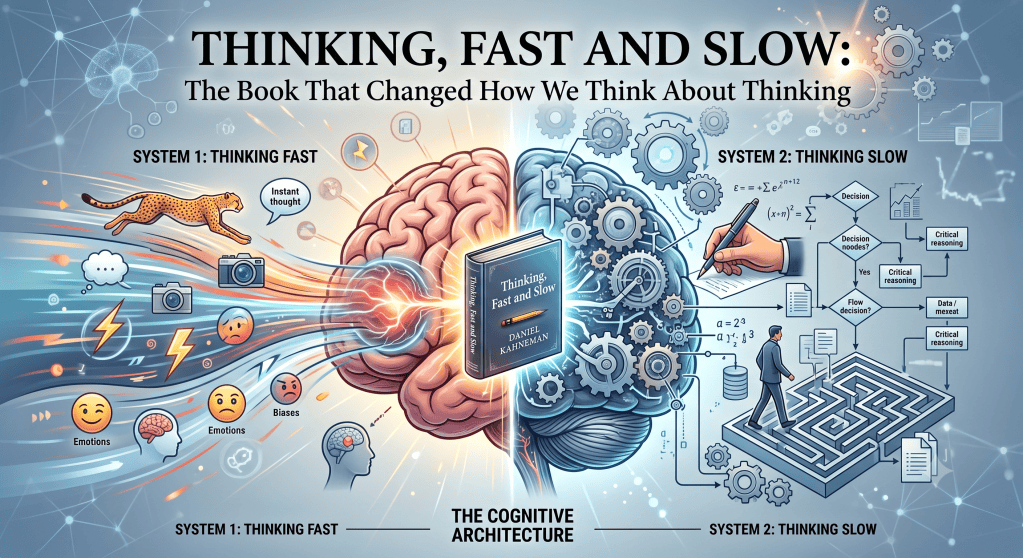
Revisiting Daniel Kahneman’s Thinking, Fast and Slow: how System 1 and System 2 thinking, heuristics, and cognitive bias reshaped modern psychology.
In the autumn of 2011, the world was still sorting through the wreckage of a financial crisis that had exposed serious weaknesses in many of the assumptions underlying conventional economic models. Markets that were supposed to be rational had behaved in ways few models predicted. Homeowners had signed mortgages they didn’t understand, banks had bet fortunes on securities nobody could accurately price, and regulators had missed warning signs that, in hindsight, looked obvious. Into that atmosphere of public doubt came Daniel Kahneman, a then-77-year-old psychologist whose decades of research had already helped transform the study of judgment and decision-making, carrying a book that would do something unusual for an academic work: it would become a genuine cultural phenomenon.
Thinking, Fast and Slow was not a self-help book, though millions read it looking for one. It was not a business manual, though it reshaped how executives think about strategy and risk. It was, at its core, a distillation of roughly four decades of research into how the human mind actually makes decisions, as opposed to how economists and philosophers had long assumed it did. Kahneman, who had already won the Nobel Memorial Prize in Economic Sciences in 2002 for work he conducted largely with his longtime collaborator Amos Tversky, used the book to hand the general public a set of tools his field had been refining since the early 1970s.
The book’s central idea sounds almost too simple to have taken a career to establish: human cognition can be usefully understood in terms of two broad modes of processing. One is fast, intuitive, and largely invisible to us. The other is slow, effortful, and easily exhausted. Most of the time, the fast mode is in charge, and it is very good at its job. But it is also the source of remarkably consistent, predictable errors in judgment — errors that affect everything from how doctors read scans to how investors pick stocks to how ordinary people decide what to eat for dinner. Understanding those errors, Kahneman argued, was not about becoming a perfectly rational machine. It was about knowing when to trust your gut and when to slow down and check your work.
This piece revisits the book, its intellectual origins, and the science underneath its two most famous characters — System 1 and System 2 — along with the reasons it became one of the most influential works of popular psychology and behavioral science in the twenty-first century, and how its legacy has held up under further scrutiny in the years since.
The World Kahneman Was Writing Into
To understand why Thinking, Fast and Slow landed the way it did, it helps to understand the intellectual climate it entered. For most of the twentieth century, mainstream economics rested on a convenient fiction: the idea of Homo economicus, a purely rational actor who calculates costs and benefits with something like a spreadsheet in his head. This assumption made the math of economic models tractable, but it required ignoring a great deal of observable human behavior. People bought lottery tickets and insurance policies at the same time. They panicked in markets. They stuck with bad investments simply because they didn’t want to admit a mistake.
Kahneman and Tversky, working together at Hebrew University in Jerusalem in the early 1970s, began systematically documenting the gap between the rational actor of economic theory and the actual human being making choices under uncertainty. Their early papers on heuristics and biases, published through the 1970s, and their 1979 paper introducing prospect theory, built the intellectual scaffolding that would eventually become behavioral economics. Prospect theory in particular — which described how people evaluate potential losses and gains asymmetrically, feeling the pain of a loss more sharply than the pleasure of an equivalent gain — became one of the most cited papers in economics and a major basis for Kahneman’s Nobel Prize.
By the time Thinking, Fast and Slow was published in 2011, decades of laboratory work had accumulated. Tversky had died in 1996, and the Nobel committee’s rules meant he could not share the prize posthumously, a fact Kahneman referenced with visible grief throughout the book’s early chapters. What made the book different from a typical academic retrospective was Kahneman’s decision to organize an entire career’s worth of findings around a single, teachable metaphor: two systems of thought, competing for control of the mind.
It’s worth pausing on what that means for how the book should be read. Thinking, Fast and Slow is necessarily a solo-authored account of what had been, for most of its intellectual history, a joint project. Kahneman was candid about this asymmetry, describing much of the research in the book as work he and Tversky had built together, thought through together, and in many cases could no longer remember which of them had originated. Their partnership — an unusually close, sustained collaboration between two psychologists with very different temperaments — is generally credited as the foundation on which behavioral economics as a field was built, and readers encountering the book’s ideas as Kahneman’s alone are missing half the story.
The Two Characters: System 1 and System 2
System 1: The Fast, Automatic Mind
System 1 is the part of the mind that operates without effort or a sense of voluntary control. It is the system that lets you know someone is angry from their facial expression before you’ve consciously registered any single feature of their face. It completes the phrase “bread and…” before you’ve decided to think about food. It steers your car through a familiar intersection while your conscious attention is somewhere else entirely.
System 1 is not stupid. In fact, it is often remarkably accurate, and it has to be, because most of daily life would be unmanageable if every decision required deliberate, effortful thought. The catch is that System 1 achieves its speed by using shortcuts, commonly called heuristics, rather than by running a full, careful analysis. These shortcuts work well most of the time. They also produce specific, repeatable errors under specific, predictable conditions — and identifying those conditions was the project of Kahneman and Tversky’s careers.
System 2: The Slow, Deliberate Mind
System 2 is the part of the mind most people associate with “thinking” in the traditional sense. It is the mental effort involved in solving a multiplication problem, filling out a tax form, or comparing two job offers on their actual merits rather than on gut feeling. System 2 is capable of logic, of checking its own work, and of overriding the snap judgments System 1 produces. It is also, critically, lazy. It is effortful and capacity-limited, it consumes real cognitive resources, and it tends to defer to System 1 whenever possible because deferring is cheaper.
This laziness is not a character flaw; it is an efficient design. A mind that scrutinized every decision with full deliberate effort would be exhausted by lunchtime. The problem, as Kahneman documented extensively, is that System 2 often fails to intervene precisely when intervention matters most — during moments of overconfidence, in situations that resemble familiar patterns but actually differ from them in important ways, and whenever a plausible-sounding intuitive answer arrives quickly enough to feel obviously correct.
Distinguishing Evidence From Theory: What the Book Got Right, and Where the Science Has Moved
Before going further into the specific heuristics Kahneman catalogued, it’s worth pausing on how the two-systems framework itself should be understood. It is, by Kahneman’s own account, a simplification. He described System 1 and System 2 not as literal, separate brain regions or mechanisms, but as a useful narrative device for organizing a much messier, more continuous set of cognitive processes. Neuroscience has not identified a clean anatomical boundary between “fast” and “slow” thinking; the distinction is best understood as a description of two different modes of cognitive processing that blend and interact constantly, rather than two discrete systems that switch on and off.
A fair account of the book also has to acknowledge something Kahneman himself became notably candid about in later years: not every finding in it has held up equally well. In the years following publication, psychology went through what researchers now call the replication crisis, a broad reckoning in which many well-known findings, particularly in social psychology, failed to reproduce reliably when other labs tried to repeat the original experiments.
One area affected was social priming, the idea that subtle, incidental cues could unconsciously influence behavior in fairly large ways — for instance, research suggesting that people who read words related to old age afterward walked more slowly down a hallway. Kahneman featured several such priming studies in the book’s early chapters as illustrations of System 1’s automatic, associative operation. When later, larger replication attempts failed to reproduce some of these specific effects with the same strength, Kahneman wrote an open letter to researchers in the field in September 2012, reported at the time by Nature, acknowledging the problem and urging the priming research community to take replication more seriously; in the years that followed, he became more direct in noting that he had placed too much faith in underpowered studies.
This episode is worth flagging here, before the heuristics discussed below, not to undermine the book’s core contributions, but because it illustrates good scientific practice in action: a finding gains credibility through repeated, independent confirmation, not through the prestige of the researcher who first reported it. Many of the phenomena and theoretical contributions underlying the book — including prospect theory, anchoring, availability and representativeness heuristics, and loss-related asymmetries in decision-making — have proved substantially more durable than some of the specific priming demonstrations used to illustrate System 1. Readers benefit from treating the chapters ahead with the same calibrated skepticism Kahneman himself came to model: some claims are well-established experimental regularities, some are compelling theoretical frameworks still being refined, and a few specific examples have not survived closer inspection.
Heuristics: Useful Shortcuts With Predictable Blind Spots
The word heuristic simply means a mental shortcut — a rule of thumb that lets the brain arrive at a workable answer without doing the full calculation. Kahneman and Tversky’s research identified several heuristics that show up again and again across very different contexts.
The Availability Heuristic
People tend to judge how common or likely something is based on how easily examples come to mind, rather than on actual statistics. This is why people often overestimate the danger of dramatic but rare events, like plane crashes or shark attacks, while underestimating the danger of common but unremarkable risks, like heart disease or car accidents on familiar roads. News coverage amplifies this effect, because vivid, emotionally striking stories are more memorable than dry statistics, which means the frequency of media coverage can distort a person’s sense of real-world risk even when they know, intellectually, that the coverage is not representative.
The Representativeness Heuristic
People often judge probability by how much something resembles a mental prototype, rather than by considering the actual base rates involved. Kahneman and Tversky’s famous “Linda problem” illustrated this vividly: given a description of a woman who sounds like a stereotypical social activist, most people judged it more probable that she was “a bank teller who is active in the feminist movement” than simply “a bank teller” — even though the first option is logically a subset of the second and therefore cannot be more probable. The specific, vivid story felt more representative of the person described, even though it was statistically less likely.
Anchoring
When people estimate an unknown quantity, their guess is heavily influenced by whatever number was suggested to them first, even when that number is arbitrary and they know it. In one classic demonstration, participants who watched a spun wheel land on a high number gave systematically higher estimates for an unrelated question — the percentage of African countries in the United Nations — than participants who saw the wheel land on a low number. The initial number, however irrelevant, pulled subsequent judgments toward it like gravity.
Loss Aversion and Framing
Perhaps the most economically consequential of Kahneman’s findings is loss aversion: the tendency to feel the pain of losing something more sharply than the pleasure of gaining an equivalent amount. The exact size of that asymmetry varies with context, stakes, and how it’s measured, but the underlying pattern is one of the more consistently observed findings in the field. This asymmetry explains a huge range of behavior, from why investors hold onto losing stocks too long, hoping to avoid “locking in” a loss, to why a price increase framed as the removal of a discount provokes more anger than the same price framed as a new, higher baseline. How a choice is presented — its framing — can change people’s decisions even when the actual options are mathematically identical.
Real-World Consequences: Why This Matters Beyond the Lab
What made Thinking, Fast and Slow resonate so widely was Kahneman’s insistence on connecting these laboratory findings to consequential, real-world decisions. He discussed how diagnostic judgments can be vulnerable to intuitive errors, and how structured procedures can sometimes provide a useful check against them. He examined how corporate planning committees consistently underestimated the time and cost of major projects, a pattern he called the “planning fallacy,” rooted in a tendency to focus on best-case scenarios for one’s own project while ignoring the base rate of how similar projects had actually gone for everyone else.
He also introduced readers to the idea of an “outside view” as a corrective: instead of asking how long a specific project will take based on its own particular details, ask how long similar projects have taken historically, and use that broader pattern as a starting anchor. The outside view has subsequently influenced approaches to forecasting, project planning, and public policy, precisely because it encourages decision-makers to counter System 1’s optimistic, detail-focused storytelling.
The book’s discussion of financial decision-making proved especially influential outside academia. Kahneman’s account of why investors trade too often, why they feel regret more sharply than they feel satisfaction from an equivalent gain, and why professional stock pickers rarely outperform simple index funds over long periods, gave ordinary readers a vocabulary for behavior they had observed in themselves but never had language to describe.
Why the Book Became So Influential
Several things converged to make Thinking, Fast and Slow more than just a well-reviewed academic summary. First, the timing was right. A public still processing the 2008 financial crisis was primed, in a very literal sense, to be interested in a book explaining why supposedly rational actors — bankers, regulators, homeowners — had made such visibly irrational choices.
Second, Kahneman wrote with unusual clarity and humility for a scientist summarizing his own life’s work. He frequently pointed out his own susceptibility to the very biases he studied, which gave the book a disarming, personal quality rare in popular science writing. Rather than positioning himself as someone who had transcended these mental traps through expertise, he presented himself as a fellow traveler still catching his own System 1 making mistakes.
Third, the book arrived at a moment when behavioral economics was moving from an academic curiosity into mainstream policy and business practice. Governments were beginning to experiment with “nudge” units that applied Kahneman and Tversky’s insights to public policy, from retirement savings defaults to organ donation forms. Corporations were hiring behavioral scientists to redesign everything from checkout pages to performance reviews. Thinking, Fast and Slow gave this growing movement one of its foundational texts, a book that practitioners across very different fields could point to as common ground.
Finally, the book succeeded because its central metaphor was genuinely useful. Unlike many academic frameworks that fade once their novelty wears off, “System 1 versus System 2” gave ordinary people a durable mental tool for catching themselves in the act of a snap judgment. More than a decade after its release, and even after Kahneman’s death in March 2024 at the age of 90, the phrase “System 1 thinking” remains common shorthand in business meetings, classrooms, and everyday conversation — a rare feat for language originating in an academic psychology paper.
The Book’s Lasting Influence
The influence of Thinking, Fast and Slow is visible across an unusually wide range of fields. In medicine, it contributed to broader conversations about diagnostic error and the value of structured decision procedures as a check on pattern-matching under time pressure. In law, it contributed to a growing awareness of how anchoring effects shape jury damage awards and plea bargain negotiations. In technology and product design, the book’s account of cognitive ease — the idea that people trust information more when it is easy to process, including simply because it is presented in a clear, readable font — became a working principle for user interface design.
In finance specifically, the book helped legitimize an entire subfield, behavioral finance, that studies how psychological biases produce market anomalies that pure rational-actor models cannot explain. Investment firms increasingly incorporate behavioral-finance research into their strategy and client communication, and personal finance advice aimed at ordinary investors increasingly incorporates warnings about loss aversion, overconfidence, and the dangers of trading too frequently, all lifted more or less directly from Kahneman’s research.
Perhaps most significantly, the book changed how many people think about the very concept of a “gut feeling.” Rather than treating intuition as either infallible wisdom or unreliable noise to be ignored, Thinking, Fast and Slow offered a more nuanced position: intuition is highly reliable in domains where a person has had extensive practice with fast, clear feedback — a chess grandmaster’s instant read of a board position, an experienced firefighter’s sense that a building is about to collapse — and considerably less reliable in domains involving genuine uncertainty, unfamiliar situations, or slow, ambiguous feedback, such as predicting stock prices or political outcomes.
Conclusion: A Map, Not a Cure
Thinking, Fast and Slow never promised to make its readers rational. That was, in a sense, the entire point. Kahneman was explicit that simply knowing about a cognitive bias does very little to eliminate it; awareness of loss aversion does not make loss aversion disappear, any more than knowing about an optical illusion makes the illusion stop working. What the book offered instead was something more modest and, arguably, more useful: a map of the terrain, showing readers where the mind’s automatic shortcuts are most likely to lead them astray, so they can build in deliberate checks — checklists, second opinions, structured decision processes — at exactly those points.
More than a decade after its publication, the book’s core framework remains one of the most influential organizing ideas in modern psychology and behavioral science, even as some of its specific illustrative studies have been revised or set aside in light of the replication crisis that reshaped the field in the years following its release. That willingness to be corrected, visible in Kahneman’s own later writing, is arguably as important a legacy as the two-systems framework itself: a reminder that good science updates itself, and that a book’s value lies not in being permanently right about every detail, but in giving readers durable, well-tested tools for noticing their own thinking. As behavioral science continues to mature, and as fields from artificial intelligence to public health increasingly grapple with how humans actually make decisions rather than how they theoretically should, Kahneman’s central insight — that cognition operates through two broad modes, one fast and one slow, each with its own strengths and blind spots — remains one of the most widely used lenses for understanding why people do what they do.
Scientific Reference
- Kahneman, D. (2011). Thinking, Fast and Slow. Farrar, Straus and Giroux.
- Kahneman, D., & Tversky, A. (1979). Prospect theory: An analysis of decision under risk. Econometrica, 47(2), 263–291.
- Tversky, A., & Kahneman, D. (1974). Judgment under uncertainty: Heuristics and biases. Science, 185(4157), 1124–1131.
- Kahneman, D., Slovic, P., & Tversky, A. (Eds.). (1982). Judgment Under Uncertainty: Heuristics and Biases. Cambridge University Press.
- Yong, E. (2012). Nobel laureate challenges psychologists to clean up their act. Nature News. (Reports on and reproduces Kahneman’s September 2012 open letter to priming researchers.)
- Nobel Prize Outreach. (2002). The Sveriges Riksbank Prize in Economic Sciences in Memory of Alfred Nobel 2002. NobelPrize.org.
- Open Science Collaboration. (2015). Estimating the reproducibility of psychological science. Science, 349(6251).









