
Originally published in October 2011. Comprehensively updated and edited July 2026.
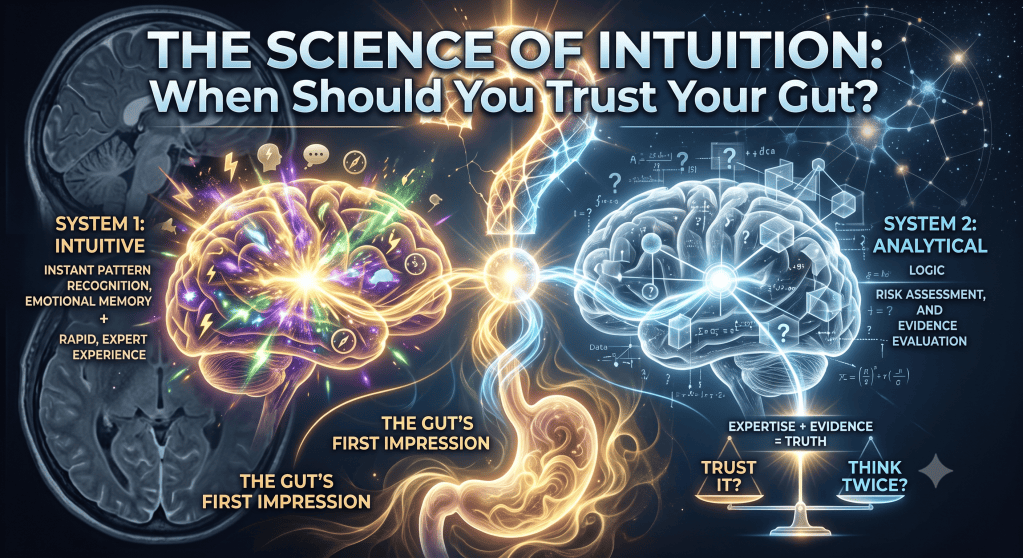
Explore the science of intuition — dual-process theory, expert pattern recognition, and how Kahneman and Klein resolved their famous debate over trusting your gut.
In the fall of 2011, the world was beginning to grapple with a book that would quickly become one of the most influential popular accounts of modern behavioral science: Daniel Kahneman’s Thinking, Fast and Slow. For decades, Kahneman and his late collaborator Amos Tversky had been chipping away at a comfortable assumption most people carried around without examining it — the assumption that human beings, left to their own devices, reason their way to good decisions. Kahneman’s research suggested something messier. Much of what feels like careful thought is actually the output of a fast, automatic system operating below conscious awareness, one that is brilliant in some situations and badly misleading in others. At the same time, a different strand of research, led by the psychologist Gary Klein, had spent years studying firefighters, nurses, and military commanders making split-second calls under real pressure, and had reached a strikingly different conclusion: that gut instinct, far from being a shortcut to be distrusted, was often the distilled product of genuine expertise.
Nearly fifteen years later, the question these two researchers spent a career circling — when should you trust your gut? — has only become more pressing. We now make decisions inside a firehose of information, aided and complicated by algorithms that claim to out-intuit us, in a culture that alternately worships “following your instincts” and warns against the dangers of bias and snap judgment. Understanding what intuition actually is, where it comes from, and when it deserves our confidence has moved from an interesting academic puzzle to something close to a practical necessity.
This article traces that story: the rise of dual-process theories of thinking, the science of unconscious decision-making, the curious case of expert intuition, and the eventual, hard-won meeting of minds between Kahneman and Klein — two researchers who started out on opposite sides of the argument and ended up, in one of psychology’s more graceful episodes, mostly agreeing with each other.
Two Ways of Thinking
Psychologists have long suspected that the mind doesn’t run on a single processing track. The formal version of this idea, known as dual-process theory, holds that human thinking operates through two distinct systems. One is fast, automatic, and effortless — it recognizes a friend’s face in a crowd, senses that a stranger’s tone is off, or catches a typo without any deliberate searching. The other is slow, deliberate, and effortful — it’s what you use to solve a long division problem, compare two mortgage offers, or work through an unfamiliar argument step by step.
Kahneman, building on decades of prior work by researchers including Keith Stanovich and Richard West, popularized this distinction under the now-famous labels System 1 and System 2. System 1 is the mind’s autopilot. It runs constantly, in parallel, and it isn’t something you can switch off — try not seeing the emotion on an angry face, or not knowing that two plus two is four. System 2 is the mind’s manual override, the effortful process you engage when System 1 doesn’t have a ready answer or when the stakes are high enough to warrant close attention. It’s also lazy, in the sense that it prefers to endorse whatever answer System 1 hands it rather than doing independent work, which is precisely why so many everyday errors in judgment sneak through unchallenged.
It’s worth being precise about what “System 1” and “System 2” actually mean, because the labels get used loosely in popular writing. They aren’t separate physical structures in the brain, like two different organs. They’re a useful shorthand for two clusters of mental operations that behave differently — one fast and associative, one slow and rule-based — and most researchers today treat the split as a simplified model of a much more continuous and overlapping set of cognitive processes, rather than a literal architecture.
Why Two Systems Instead of One
The evolutionary logic behind having a fast system is straightforward. An animal that has to consciously deliberate over whether a rustling in the grass is a predator will lose the evolutionary race to one that reacts instantly based on pattern recognition. Speed, in many of the situations our ancestors faced, mattered more than perfect accuracy. The fast system draws on learned patterns and associations, along with perceptual processes, emotions, and other forms of automatic processing. Some of these capacities are shaped by repeated exposure to the world and can be brought to bear almost instantaneously.
The capacities associated with deliberate reasoning depend heavily on executive-control networks, including regions of the prefrontal cortex, and allow us to hold information in mind, suppress impulses, compare alternatives, and follow explicit rules. This slower mode allows for something the fast system can’t do on its own: stepping back from an immediate impulse and asking whether it’s actually right. This is useful, but it’s also expensive. Deliberate thought draws on limited attentional resources, tires quickly, and is the first thing to falter when a person is stressed, distracted, or mentally depleted — a phenomenon researchers have studied under the heading of ego depletion, though later replication efforts have complicated exactly how large and reliable that effect is.
The Unconscious Mind Makes More Decisions Than You Think
One of the more unsettling implications of dual-process research is just how much of daily behavior is steered by processes we have no direct access to. This isn’t a new idea — Freud built an entire theoretical edifice on the unconscious a century earlier — but the modern, empirically grounded version looks quite different from Freud’s model of repressed drives and hidden conflicts. Contemporary cognitive science treats the unconscious less as a seething basement of forbidden impulses and more as an enormous, silent data-processing operation that handles vast amounts of information without conscious awareness.
Consider something as simple as walking down a crowded sidewalk without colliding with anyone. That task requires constant recalculation of trajectories, speeds, and gaps, executed continuously and without any conscious sense of doing math. Or consider the well-documented phenomenon of “thin-slicing,” a term popularized by Malcolm Gladwell in his book Blink, which drew heavily on research by the psychologist Nalini Ambady. Ambady’s studies found that people could form surprisingly consistent judgments about a teacher’s effectiveness, or a professional’s competence, from just a few seconds of silent video — and some judgments from very brief behavioral samples have shown meaningful relationships with later or more extensive evaluations. The unconscious mind, it turns out, is remarkably good at picking up on subtle behavioral cues that never rise to the level of conscious notice.
This same machinery, though, is also the source of every cognitive bias Kahneman spent his career cataloguing. The availability heuristic, in which people judge how likely something is by how easily examples come to mind, is a System 1 shortcut that works well most of the time and fails badly when memorable events are rare but vivid — a plane crash feels more probable than a car accident precisely because it’s rarer and more dramatic, even though the statistics say the opposite. Anchoring, in which an arbitrary number presented early in a decision skews later estimates, is another System 1 artifact: the fast system latches onto whatever reference point is available and adjusts from there, usually not adjusting enough. None of this happens through conscious deliberation. It happens automatically, which is exactly what makes it so hard to correct.
The Body Weighs In: Somatic Markers and Gut Feelings
The phrase “trust your gut” turns out to be more literal than most people realize. In the 1990s, the neuroscientist Antonio Damasio proposed what he called the somatic marker hypothesis, based partly on his work with patients who had damage to the ventromedial prefrontal cortex, a brain region involved in linking emotion to decision-making. These patients often retained normal intelligence and could reason through hypothetical problems just fine, but they struggled badly with real-world decisions — they’d deliberate endlessly over trivial choices and often made disastrous financial and personal decisions despite having no obvious cognitive deficit.
Damasio’s explanation was that healthy decision-making relies on a subtle stream of bodily feedback — changes in heart rate, skin conductance, muscle tension — that gets attached to memories of past outcomes and then resurfaces as a felt sense of “this seems right” or “something’s off” before a person has consciously worked out why. His research team demonstrated this with a card-sorting task known as the Iowa Gambling Task, in which participants drew cards from decks with different, unstated risk profiles. Healthy participants began showing anticipatory stress responses to the risky decks — measurable in their skin — before they could consciously articulate which decks were dangerous. Patients with ventromedial damage never developed that early warning signal and kept drawing from the bad decks even after they could describe, in words, which ones were losing money. Damasio and his colleagues interpreted these anticipatory physiological responses as evidence that bodily signals could guide decision-making before conscious knowledge emerged, although subsequent research has debated exactly what the Iowa Gambling Task demonstrates and how early participants actually come to understand the deck contingencies.
This research gave the vague folk idea of a “gut feeling” a plausible biological mechanism. It doesn’t mean every gut feeling is trustworthy — the same bodily-feedback system that flags real danger can also get hijacked by irrelevant anxiety or superficial resemblance to a past threat — but it does mean that intuition isn’t simply “no information.” It’s information that has been processed and encoded somewhere the conscious mind can’t directly inspect.
The Two Camps: Heuristics and Biases Versus Naturalistic Decision Making
By the early 2000s, two research traditions had grown up studying essentially the same phenomenon — intuitive judgment — from almost opposite starting points, and for years they mostly talked past each other.
Kahneman and Tversky’s tradition, known as the heuristics and biases program, had built its reputation largely through laboratory experiments designed to expose the mind’s failures. Give people a well-constructed problem in a controlled setting, and their intuitions will reliably lead them astray in predictable, describable ways. This research produced an enormous and still-growing catalogue of biases — overconfidence, the conjunction fallacy, loss aversion, hindsight bias — and its overall message, at least in its early framing, was cautionary: don’t trust your instincts, because they’re systematically wired for shortcuts rather than accuracy.
Gary Klein’s tradition, known as naturalistic decision making, grew out of a very different kind of fieldwork. Klein spent years observing people who had to make consequential decisions in real time and under real pressure — fireground commanders deciding whether to pull crews out of a burning building, neonatal intensive care nurses spotting early signs of infant sepsis, military officers assessing threats with incomplete information. What Klein found again and again was that these experts rarely weighed alternatives in any deliberate, textbook fashion. Instead, they seemed to size up a situation, recognize it as similar to one they’d encountered before, and act — often without being able to explain, in the moment, exactly how they knew what to do.
Klein formalized this into what he called the recognition-primed decision model. Rather than generating multiple options and comparing them, as classical decision theory assumes people do, experienced decision-makers under time pressure typically generate a single plausible course of action based on pattern recognition, mentally simulate whether it will work, and either act on it or quickly adjust. It’s a strikingly different picture of skilled judgment than the one the biases-and-heuristics tradition had painted, and for years the two camps read each other’s work as, essentially, a challenge to their own.
Firefighters, Chess Masters, and the Anatomy of Expertise
One of Klein’s most cited findings involved a fire commander who ordered his crew out of a house moments before the floor collapsed, despite the fire looking, by every visible measure, like a routine kitchen fire. When Klein interviewed him afterward, the commander initially said he’d had a premonition — some kind of extrasensory sixth sense. Pressed further, though, a different story emerged. The fire was too quiet and too hot for a kitchen fire of that size, and his ears had been unconsciously unbearably warm given the apparent size of the flames. Those subtle cues, invisible to an untrained observer, had registered in his experienced perceptual system as “something’s wrong here” well before he could consciously name the source of his unease. The fire, it turned out, was actually in the basement beneath his crew’s feet.
This kind of pattern recognition has deep roots in the psychology of expertise more broadly, going back to the work of Adriaan de Groot and later Herbert Simon and William Chase on chess masters. Their research found that expert chess players weren’t fundamentally better than novices at calculating further ahead move by move — their advantage wasn’t primarily explained by calculating dozens of moves ahead. What set them apart was recognition. Shown a real game position for a few seconds, masters could reconstruct the board from memory with remarkable accuracy; shown a board with pieces arranged randomly, their advantage almost disappeared. Their skill lived in an enormous, highly organized library of meaningful board configurations built up through years of practice, not in raw calculating horsepower. Klein’s fireground commanders appeared to be running the same basic process, just with burning buildings instead of chessboards.
When the Two Sides Finally Talked
By the mid-2000s, the two research traditions increasingly came to recognize that they weren’t necessarily describing contradictory phenomena — they were describing the same underlying process operating in very different environments, and reaching very different conclusions about its trustworthiness as a result. In 2009, Kahneman and Klein published a joint paper in American Psychologist titled “Conditions for Intuitive Expertise: A Failure to Disagree,” an unusually candid piece of academic writing in which two researchers with genuinely different starting assumptions worked through their disagreement in public and largely resolved it.
Their shared conclusion centered on a single question: is the environment in which the judgment is being made learnable? Some environments, like a chess game, a fireground, or an operating room, have stable, discoverable regularities. The same cues reliably predict the same outcomes, feedback on whether a judgment was right or wrong tends to arrive quickly, and a person who spends years immersed in that environment has a genuine opportunity to build accurate, fast pattern recognition. Klein’s experts were operating almost entirely in these kinds of environments, which explains why their gut calls were so often reliable.
Other domains lack this structure. Kahneman’s laboratory subjects, and many real-world professionals such as stock pickers or long-range political forecasters, often operate in environments where the relationship between cues and outcomes is weak, inconsistent, or genuinely close to random, and where feedback is delayed, ambiguous, or entirely absent. In these settings, confident intuition isn’t a sign of skill — it’s frequently just familiarity mistaken for accuracy. A trader can feel just as certain about a bad call as a firefighter feels about a good one; the feeling of confidence, on its own, tells you nothing about whether it’s earned.
This distinction gave the field a genuinely useful, testable framework rather than a vague truce. Trustworthy expert intuition, the two researchers argued, requires two things working together: an environment with enough regularity to be learned in the first place, and prolonged practice with fast, clear feedback that allows a person to actually learn it. Remove either ingredient — give someone a chaotic, low-validity environment, or give them a learnable environment but no real feedback loop — and confident intuition becomes a liability rather than an asset. Subjective confidence, Kahneman and Klein were emphatic on this point, is not by itself a reliable indicator of accuracy in either kind of environment; it can be built up through sheer repetition and familiarity even when nothing real is being learned.
Why Some Fields Reward Intuition and Others Punish It
This framework helps explain a pattern that puzzles a lot of people: why do experts in fields such as chess and firefighting — and in some areas of medicine — develop trustworthy instincts, while stock pickers, political pundits, and parole boards frequently don’t, even after decades in the field?
Chess, firefighting, and some areas of medicine share a structure — a large number of repeated cases, reasonably consistent cause-and-effect relationships, and outcomes that become known relatively quickly, allowing the pattern-recognition system to be corrected and refined over time. Medicine is actually a mixed case: some specialties, like reading a straightforward fracture on an X-ray, offer exactly this kind of fast, learnable feedback, while others, involving chronic disease with delayed and probabilistic outcomes, look much more like the noisy, low-feedback environments described below. Financial markets and long-range geopolitical forecasting share a different structure — genuinely high uncertainty, outcomes influenced by countless interacting variables, and feedback so noisy that even a skilled forecaster who is right for the wrong reasons, or wrong for reasons outside their control, may never get a clean signal about which of their judgments to trust. Kahneman’s own earlier research on expert political forecasters, echoing later work by Philip Tetlock, found that supposed experts’ predictions were often barely better than chance, despite their confident, fluent explanations for why they were right.
This isn’t a claim that intuition is worthless in unstable domains — it’s a claim that its reliability there can’t be assumed, and has to be checked against actual track records rather than felt confidence.
Intuition in the Modern World
Fifteen years after this essay was first published, the landscape it describes has shifted in ways worth noting. Algorithmic decision tools, from medical diagnostic aids to hiring software to recommendation engines, now compete directly with human intuition across an increasing number of domains, and a substantial body of research comparing simple statistical models against expert human judgment — often called clinical versus actuarial prediction, a line of research going back to Paul Meehl in the 1950s — has repeatedly found that in low-validity, high-uncertainty environments, straightforward formulas frequently outperform confident human experts. This doesn’t mean algorithms are always superior; it means the same lesson Kahneman and Klein arrived at applies here too. The question isn’t whether to trust intuition or data in the abstract, but whether the specific environment supports the kind of learning that makes either one trustworthy.
There’s also been growing interest in how digital life may be reshaping the conditions under which intuition develops in the first place. Constant task-switching, the fragmented attention encouraged by many digital platforms, and the sheer volume of low-stakes decisions people now make in a given day are all, at least in principle, at odds with the slow, high-feedback, high-repetition conditions that produced Klein’s fireground commanders and chess masters. Researchers are still working out how significant this effect actually is, and it’s an area where firm conclusions remain premature, but it points to a broader truth: expert intuition isn’t a fixed trait some people have and others lack. It’s a byproduct of a specific kind of practice, and the environments that support that practice aren’t guaranteed to exist just because someone spends years doing a job.
Intuition Isn’t the Same as Impulse
Part of what makes “trust your gut” such slippery advice is that popular culture tends to lump together three things that are, psychologically, quite different. The first is expert intuition — a rapid judgment built on years of pattern recognition in a learnable environment, of the kind Klein documented in his fireground commanders. The second is emotion — a felt reaction that may carry genuine information, as Damasio’s research suggests, but that isn’t necessarily grounded in relevant expertise. The third is impulse — an immediate urge or reaction that may have little relationship to accuracy at all, and can be driven by fatigue, mood, or a superficial resemblance to something unrelated.
All three can feel identical from the inside. That’s precisely the problem. Someone who has spent twenty years interviewing job candidates for a specific technical role may have a legitimate intuitive read on a candidate’s competence, built on thousands of prior comparisons with known outcomes. Someone who instantly dislikes a candidate because their mannerisms happen to resemble an unpleasant figure from childhood is also having a “gut feeling,” but that feeling carries none of the same evidentiary weight. The usefulness of the framework Kahneman and Klein developed is that it gives you a way to investigate where these feelings come from, by asking about their origin rather than simply how strongly they’re felt.
Conclusion: A More Precise Way to Trust Yourself
The question this essay opened with — when should you trust your gut? — doesn’t have a single universal answer, but the science built up since 2011 offers something more useful than a simple yes or no: a set of conditions worth checking before deciding how much weight to give an instinct. Has the situation involved enough repetition, in a domain with genuine and discoverable regularities, for a real skill to develop? Has feedback on past judgments been fast and clear enough to correct errors along the way? And is the confidence behind the feeling actually tracking accuracy, or simply familiarity with a situation that resembles competence without being it?
What began as a genuine standoff between two research traditions — one built on exposing the mind’s systematic errors, the other built on documenting its impressive real-world successes — turned out, on close inspection, to be two views of the same underlying machinery, differing mainly in which environments they’d been observed in. That’s a more satisfying resolution than either side offering a full concession, and it’s also a more genuinely useful one. It hands anyone facing a difficult decision a real diagnostic question to ask, rather than a slogan to follow.
As decision-making continues to be reshaped by algorithms, data, and an ever-accelerating information environment, that diagnostic question is likely to matter more, not less. The gut is neither an oracle nor a liability. It’s a record of experience, and like any record, its value depends entirely on what it was trained on.
Scientific Reference
Kahneman, D., & Klein, G. (2009). Conditions for intuitive expertise: A failure to disagree. American Psychologist, 64(6), 515–526.
Kahneman, D. (2011). Thinking, Fast and Slow. Farrar, Straus and Giroux.
Klein, G. (1998). Sources of Power: How People Make Decisions. MIT Press.
Damasio, A. R. (1994). Descartes’ Error: Emotion, Reason, and the Human Brain. Putnam.
Bechara, A., Damasio, H., Tranel, D., & Damasio, A. R. (1997). Deciding advantageously before knowing the advantageous strategy. Science, 275(5304), 1293–1295.
Chase, W. G., & Simon, H. A. (1973). Perception in chess. Cognitive Psychology, 4(1), 55–81.
Stanovich, K. E., & West, R. F. (2000). Individual differences in reasoning: Implications for the rationality debate. Behavioral and Brain Sciences, 23(5), 645–665.
Ambady, N., & Rosenthal, R. (1993). Half a minute: Predicting teacher evaluations from thin slices of nonverbal behavior and physical attractiveness. Journal of Personality and Social Psychology, 64(3), 431–441.
Meehl, P. E. (1954). Clinical Versus Statistical Prediction: A Theoretical Analysis and a Review of the Evidence. University of Minnesota Press.
Tetlock, P. E. (2005). Expert Political Judgment: How Good Is It? How Can We Know? Princeton University Press.
Tetlock, P. E., & Gardner, D. (2015). Superforecasting: The Art and Science of Prediction. Crown.
Evans, J. St. B. T., & Stanovich, K. E. (2013). Dual-process theories of higher cognition: Advancing the debate. Perspectives on Psychological Science, 8(3), 223–241.
Dunn, B. D., Dalgleish, T., & Lawrence, A. D. (2006). The somatic marker hypothesis: A critical evaluation. Neuroscience & Biobehavioral Reviews, 30(2), 239–271.









