
Originally published in February 2012 and comprehensively updated/edited in June 2026.
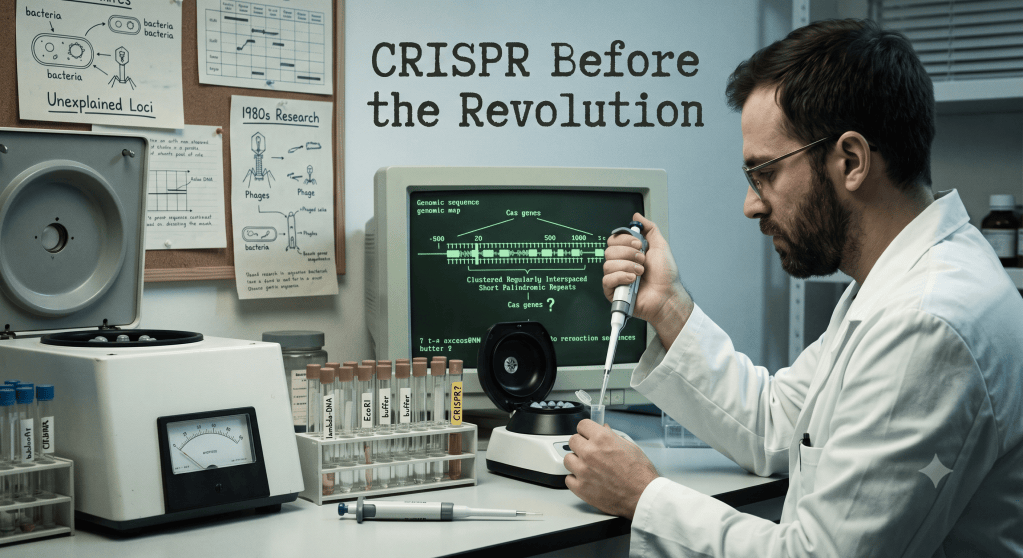
How bacterial immune defenses became CRISPR gene editing — the overlooked science behind Doudna and Charpentier’s 2012 breakthrough.
In the winter of 2012, molecular biology was a field waiting for a tool it didn’t yet know it needed. Genome sequencing had become routine. Scientists could read the entire genetic code of a human being, a rice plant, or a strain of bacteria in a matter of days. But reading was not the same as writing. If a researcher found a mutation that caused a disease, there was no reliable way to go in and simply fix it. The existing methods for editing DNA — zinc finger nucleases and TALENs, if those names mean anything to you — worked, but they were slow, expensive, and required a small army of specialized expertise to build a new tool for every new target. Editing a gene felt less like using a word processor and more like hand-carving a new set of type for every sentence you wanted to print.
That gap between what scientists could see and what they could change produced a particular kind of professional restlessness, the sense that a field had amassed enormous knowledge but not yet found the tool to act on it. Into that atmosphere, a paper published in the summer of 2012 by the biochemists Jennifer Doudna and Emmanuelle Charpentier would arrive.
This article is about what came before that moment and what it reveals about how scientific revolutions actually happen — not as sudden lightning strikes, but as the product of unglamorous, patient research finally converging.
An Immune System Hiding in Plain Sight
The strange thing about CRISPR is that it was not discovered in a lab hunting for a gene-editing tool. It was discovered by accident, repeatedly, by scientists studying something that seemed almost unrelated: how bacteria defend themselves against viruses.
Bacteria, it turns out, get sick too. Viruses called bacteriophages infect bacterial cells constantly, injecting their genetic material and hijacking the cell’s machinery to make copies of themselves. Given how ancient and widespread this arms race is, it should not be surprising that bacteria evolved defenses. What was surprising, when researchers started noticing it in the late 1980s and 1990s, was the peculiar structure some bacteria carried in their DNA: short, repeating sequences of genetic code, interrupted by unique spacer sequences that didn’t match anything else in the bacterium’s own genome.
A Japanese research team led by Yoshizumi Ishino first spotted these repeats in E. coli in 1987, though they had no idea what they meant. Over the following two decades, similar repeated sequences turned up in bacteria and archaea all over the tree of life. In 2002, the Spanish microbiologist Francisco Mojica, who had spent much of the 1990s studying these repeats in salt-loving microbes, proposed the acronym CRISPR — clustered regularly interspaced short palindromic repeats — in correspondence with a Dutch colleague, Ruud Jansen, who published the term in print that year. It’s an unglamorous name for what would turn out to be one of the most consequential discoveries in the history of biology, and that mismatch between the mundane label and the eventual impact is itself a useful reminder: transformative science rarely announces itself with a dramatic title.
The real breakthrough in understanding came around 2005, when several research groups independently noticed something crucial about those mysterious spacer sequences. They matched the genetic code of viruses that had previously infected the bacteria. In other words, bacteria were keeping a kind of genetic mugshot book. Each time a bacterium survived a viral infection, it could snip out a small piece of the invader’s DNA and file it away in its own genome, as a CRISPR spacer. The next time that virus, or a close relative, attacked, the bacterium could recognize the intruder’s genetic signature and destroy it before the infection took hold.
This is, when you sit with it, an elegant system — single-celled organisms without brains or antibodies evolving something functionally similar to immunological memory, the same basic principle that lets a vaccinated human body recognize a pathogen it has met before. The comparison is useful, but only as an analogy: CRISPR is built from entirely different molecular parts, and evolved independently in bacteria long before anything like a human immune system existed. What the two systems share is a strategy, not a common ancestry.
From Immune Defense to Molecular Scissors
Recognizing an invader is only half the job. The bacterium also needs a way to destroy it. This is where a set of proteins called Cas, for CRISPR-associated, come in. Cas proteins are the enzymes that actually do the cutting, guided to their target by molecules copied from the CRISPR memory bank.
Starting in 2010, several labs began filling in how that cutting actually worked. That year, the microbiologist Sylvain Moineau’s group in Quebec showed that Cas9 was the enzyme responsible for making precise cuts in an invader’s DNA inside living bacterial cells. The following year, the biochemist Virginijus Šikšnys’s lab in Lithuania showed that the whole system could be transplanted into an unrelated species of bacteria and still work, evidence that all the necessary components were already known. Then, in 2012, Šikšnys’s group demonstrated the piece that changed everything: that Cas9, purified and studied in a test tube, could be reprogrammed with a custom-designed guide sequence to cut essentially any DNA target of a researcher’s choosing, not just the viral sequences it evolved to recognize. Though almost nobody outside a small community of microbiologists noticed at the time, this was the moment a bacterial immune mechanism became a general-purpose tool. If an enzyme could be directed to cut any DNA sequence you wanted, simply by giving it the right RNA guide, then in principle you had a universal, programmable pair of molecular scissors. You would no longer need to engineer a new protein from scratch for every gene you wanted to target, the way older tools required. You would just need to write a new piece of RNA — a task that is comparatively cheap, fast, and easy.
This illustrates something true of many scientific revolutions: the essential insight is often distributed across many labs, published in journals that few outside the specialty read, years before it becomes visible to the wider world. Doudna and Charpentier did not invent CRISPR or discover that Cas9 could cut DNA. What they did, working together after meeting at a conference in Puerto Rico in 2011, was simplify the system into something a laboratory anywhere in the world could use with off-the-shelf reagents, and demonstrate clearly that it could be reprogrammed to cut any DNA sequence of the researcher’s choosing.
The Puerto Rico Meeting and a Scientific Partnership
The origin story of the Doudna-Charpentier collaboration has become something of a parable in science writing, partly because it fits a satisfying narrative arc, but the underlying facts hold up. Charpentier, studying the CRISPR system of the strep-throat bacterium, had identified a molecular piece needed to activate Cas9 that Doudna’s RNA-focused lab at UC Berkeley was well positioned to help characterize. The two began a transatlantic collaboration, coordinating experiments across labs an ocean apart, with lead author Martin Jinek doing much of the bench work that connected the two research traditions.
Their key insight, published in Science in June 2012, was that the separate molecular pieces Cas9 needed could be fused into a single, synthetic guide molecule. This simplification mattered enormously. A system that required precise coordination between multiple components became a two-part kit: one enzyme, one custom-designed guide. Any lab with basic molecular biology equipment could, in principle, order a guide sequence and start editing.
Why the World Didn’t Notice Right Away
If you searched for news coverage of CRISPR in the summer of 2012, you would find almost nothing. The paper appeared in a respected journal, was read with interest by specialists in bacterial immunity and RNA biology, and then largely sat there. Doudna herself has since described being surprised, in later interviews, that the significance of the finding took time to register even within the broader biology community.
This delay is not an indictment of anyone’s judgment; it’s a fairly ordinary feature of how scientific significance gets recognized. A finding’s importance is not always visible from inside the paper itself. It often becomes visible only once other people start using the tool for things the original authors did not anticipate, and momentum builds through replication and application rather than through the initial publication.
The 2012 paper had also only demonstrated that CRISPR-Cas9 could cut purified DNA in a test tube. It had not yet shown that the system would work inside living human or animal cells, a substantially harder problem involving getting the components into a nucleus and functioning reliably amid the rest of a living cell’s machinery.
That next step came remarkably fast, and it came from more than one direction at once. Within about seven months, in January 2013, several labs working independently and racing toward the same goal — including that of Feng Zhang at the Broad Institute, and separately a team including George Church at Harvard — published papers demonstrating that CRISPR-Cas9 worked to edit genes in human cells. This is when the wider scientific world, and shortly afterward the public, began to grasp what had happened. A tool that took specialized labs months or years to build for a single genetic target could now, in principle, be adapted to a new target in days, by graduate students, using components that were becoming increasingly affordable and commercially available.
The Human Dynamics of a Slow-Motion Revolution
There is something instructive about how researchers and institutions responded once the implications became clear. The period from roughly 2012 to 2015 offers a useful case study in how professional communities process the arrival of a disruptive tool, and it touches on dynamics that show up whenever an innovation outpaces the norms built to govern it.
One pattern was the speed of adoption relative to the speed of reflection. Labs around the world began using CRISPR to edit genes in a huge range of organisms almost as fast as reagents could be shipped — plants, mice, zebrafish, insects, human cell lines. The technical barrier to entry had collapsed so quickly that scientific practice outran the more deliberative processes, like ethical review and regulatory frameworks, that societies typically rely on to manage new biological capabilities. This is not a criticism unique to CRISPR; it is closer to a structural feature of technological change generally, in which the tools to do something new tend to arrive well before the shared norms about whether or how it should be done.
A second and related pattern involved the researchers themselves grappling, often in real time, with the gap between what a technology enabled and what it made wise. Doudna has written and spoken candidly about a period of unease in 2014 and 2015, including a dream she has described in interviews in which she was asked to explain the implications of gene editing to a powerful, pig-faced figure — an anxiety dream that she interpreted afterward as a signal she needed to engage more directly with the ethical stakes of what her research had unlocked. Whatever one makes of dream interpretation as evidence, the underlying behavior is well documented and more interesting than the dream itself: Doudna organized and helped convene scientific meetings, most notably a 2015 gathering in Napa, California, specifically to discuss self-imposed limits on human germline editing, meaning changes that would be passed on to future generations.
This pattern has appeared before in the history of science, seen also with the physicists of the atomic age and the biologists who convened the Asilomar Conference on recombinant DNA in 1975: the people closest to a powerful new capability are sometimes the first to call for constraints on its use, driven by a mix of genuine ethical concern and an accurate read of how badly things could go without some shared guardrails.
Those concerns became dramatically concrete in November 2018, when the Chinese researcher He Jiankui announced that he had used CRISPR to edit the genomes of human embryos, resulting in the birth of twin girls, in direct defiance of the scientific consensus against germline editing. The announcement provoked widespread condemnation from scientific organizations and researchers around the world, an international investigation, and a prison sentence in China, and it stands as the clearest illustration of why the 2015 warnings were not merely theoretical.
Competition, Credit, and the Human Side of Discovery
It would be incomplete to describe this period without acknowledging the intense, and at times contentious, competition over credit and patent rights that followed the technology’s rise. The relationship between the Doudna-Charpentier group and the Broad Institute’s Feng Zhang, who filed for and was initially granted overlapping patents on CRISPR’s use in human cells, became the subject of a long and closely watched legal dispute over intellectual property.
Setting aside the legal specifics, which shifted over multiple rulings across the following decade, the episode is a reasonably clean illustration of a psychological dynamic that recurs whenever a discovery carries enormous commercial and scientific stakes: the same conditions that motivate rapid, ambitious research — recognition, funding, institutional prestige — can also generate friction over who gets credit once the stakes become large enough to matter economically. This tension between collaboration and competition is a fairly ordinary feature of how science functions as a human enterprise, even if it sits uncomfortably against the more romantic popular image of disinterested discovery.
From a 2012 Paper to a Global Technology
It’s worth stepping back and appreciating the outline of what actually happened, because the speed of the transition from an obscure microbiology finding to a mainstream medical technology is remarkably unusual, even by the standards of modern biotechnology.
Doudna and Charpentier were jointly awarded the 2020 Nobel Prize in Chemistry for the discovery, an unusually fast recognition by the standards of that prize, and unusual as well in being awarded to two women working together without a male co-laureate, itself a small but notable shift in a field with a long history of overlooking women’s contributions. By then, CRISPR-based research had already produced thousands of published studies exploring applications in agriculture, including drought-resistant and disease-resistant crops, and in basic research, where the tool made it dramatically cheaper and faster to study what any given gene actually does by simply switching it off and observing the consequences.
The most consequential turn, though, has been medical. In December 2023, a CRISPR-based therapy called Casgevy became the first gene-editing treatment of any kind to receive regulatory approval, cleared by UK, US, and European authorities for sickle cell disease and transfusion-dependent beta thalassemia, two inherited blood disorders that had previously required lifelong management or risky bone marrow transplants. The treatment works by using CRISPR to edit a patient’s own stem cells outside the body, switching on a form of hemoglobin that is normally only active before birth, before returning the edited cells to the patient. Clinical trial data has shown a striking proportion of treated patients becoming free of the transfusions or pain crises that had defined their lives. As of mid-2026, the therapy’s approval has been extended to younger children, and dozens of other CRISPR-based treatments are in active clinical trials for a range of conditions, from a rare form of inherited blindness to certain cancers to a hereditary form of amyloidosis.
None of this has arrived without complication. The therapy remains extraordinarily expensive, priced in the low millions of dollars per patient in the United States, and the underlying process requires a demanding round of chemotherapy-like conditioning that carries its own serious risks, including infertility. Access has been deeply uneven, and the gap between what the science can now do and what health systems can afford to deliver equitably is likely to be one of the defining tensions of gene editing’s next decade. It is a useful corrective to any narrative that treats scientific breakthroughs as inherently and immediately liberating; a cure that very few people can access functions differently, in practical terms, than a cure that is genuinely available.
What This Story Suggests About Discovery Itself
Looking back at the years just before and after 2012, a few broader patterns emerge that seem worth holding onto, independent of the specifics of gene editing.
The first is that transformative discoveries are rarely singular events. CRISPR’s path to a usable technology ran through Japanese microbiologists in the 1980s who had no idea what they were looking at, Spanish researchers in the early 2000s who named the phenomenon, labs in Quebec and Lithuania that demonstrated the cutting mechanism, and finally the Berkeley-Umeå collaboration that simplified and popularized the tool. Attributing a discovery of this scale to two names, however well deserved their recognition, tends to compress a truly collective, decades-long process into a story that is easier to tell but less accurate.
The second is that the gap between capability and governance is not a temporary glitch to be fixed but something closer to a permanent feature of technological change, one that each generation of scientists has to navigate freshly. The scientists who most clearly saw what CRISPR could do were also, in several documented cases, the ones most anxious about what that meant, and that anxiety produced real institutional responses — voluntary moratoria, international summits, evolving norms around what kinds of edits are permissible — even if those responses inevitably lagged behind the pace of the underlying science.
The third is a more hopeful observation. A discovery rooted in the seemingly narrow question of how bacteria fight off viral infections turned out to hold the key to treating human genetic disease, a connection that would have been impossible to predict from where the research started. This is a reminder that basic curiosity-driven science, unmoored from any immediate practical goal, has a long track record of producing the tools that eventually reshape medicine, agriculture, and much else besides. In 2012, almost nobody studying CRISPR in bacteria was thinking about curing sickle cell disease. The distance between that starting point and where the technology has arrived by 2026 is a fairly good argument for taking basic research seriously, even when its eventual payoff is entirely invisible at the time.
The revolution that CRISPR set in motion is still underway. Base editing and prime editing, newer refinements of the same basic toolkit, promise even greater precision, and the list of diseases under active investigation continues to grow. But the more interesting story, in some ways, is the one that happened before the revolution was visible to anyone outside a small community of microbiologists: the slow accumulation of unglamorous findings, and the moment when several separate research traditions finally converged into a tool the world had never had before.
References
Ishino, Y., Shinagawa, H., Makino, K., Amemura, M., & Nakata, A. (1987). Nucleotide sequence of the iap gene, responsible for alkaline phosphatase isozyme conversion in Escherichia coli, and identification of the gene product. Journal of Bacteriology, 169(12), 5429-5433.
Mojica, F.J.M., Díez-Villaseñor, C., García-Martínez, J., & Soria, E. (2005). Intervening sequences of regularly spaced prokaryotic repeats derive from foreign genetic elements. Journal of Molecular Evolution, 60(2), 174-182.
Garneau, J.E., Dupuis, M.È., Villion, M., et al. (2010). The CRISPR/Cas bacterial immune system cleaves bacteriophage and plasmid DNA. Nature, 468(7320), 67-71.
Sapranauskas, R., Gasiunas, G., Fremaux, C., et al. (2011). The Streptococcus thermophilus CRISPR/Cas system provides immunity in Escherichia coli. Nucleic Acids Research, 39(21), 9275-9282.
Gasiunas, G., Barrangou, R., Horvath, P., & Siksnys, V. (2012). Cas9-crRNA ribonucleoprotein complex mediates specific DNA cleavage for adaptive immunity in bacteria. Proceedings of the National Academy of Sciences, 109(39), E2579-E2586.
Jinek, M., Chylinski, K., Fonfara, I., Hauer, M., Doudna, J.A., & Charpentier, E. (2012). A programmable dual-RNA-guided DNA endonuclease in adaptive bacterial immunity. Science, 337(6096), 816-821.
Doudna, J.A., & Charpentier, E. (2014). The new frontier of genome engineering with CRISPR-Cas9. Science, 346(6213), 1258096.
Doudna, J.A., & Sternberg, S.H. (2017). A Crack in Creation: Gene Editing and the Unthinkable Power to Control Evolution. Houghton Mifflin Harcourt.
Cong, L., Ran, F.A., Cox, D., et al. (2013). Multiplex genome engineering using CRISPR/Cas systems. Science, 339(6121), 819-823.
Mali, P., Yang, L., Esvelt, K.M., et al. (2013). RNA-guided human genome engineering via Cas9. Science, 339(6121), 823-826.
Krimsky, S. (2019). Ten ways in which He Jiankui violated ethics. Nature Biotechnology, 37(1), 19-20.
Frangoul, H., Altshuler, D., Cappellini, M.D., et al. (2021). CRISPR-Cas9 gene editing for sickle cell disease and β-thalassemia. New England Journal of Medicine, 384(3), 252-260.
Innovative Genomics Institute. (2024). CRISPR clinical trials: A 2024 update. Retrieved from innovativegenomics.org.
The Nobel Prize in Chemistry 2020: Jennifer A. Doudna, Emmanuelle Charpentier. Retrieved from NobelPrize.org.
U.S. Food and Drug Administration. (2023-2026). Casgevy approval records. Retrieved from fda.gov.









