
Originally published in March 2012 and comprehensively updated/edited in June 2026.
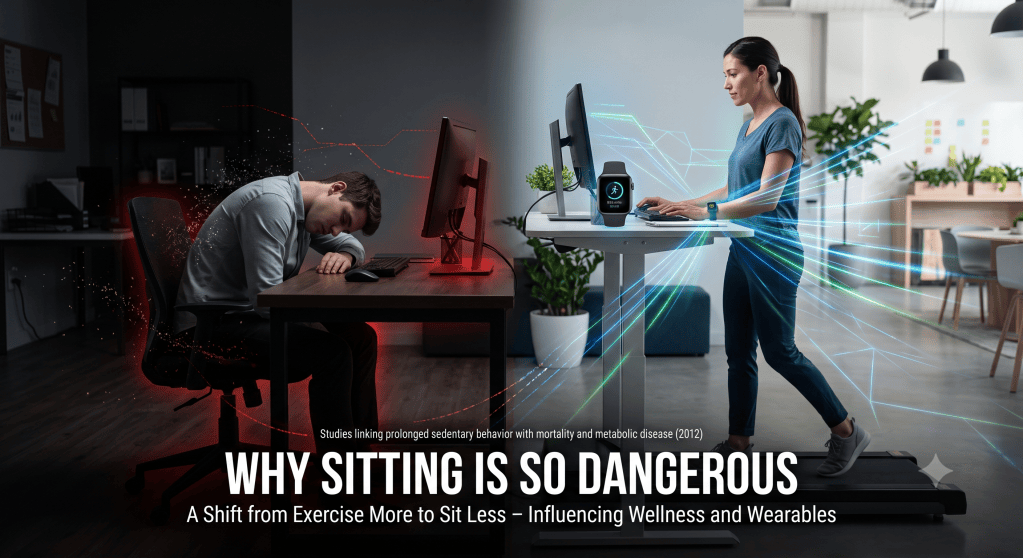
A look at how research on sitting, muscle metabolism, and mortality risk reshaped office culture, wearable tech, and public health advice.
In the early 2010s, a strange kind of health warning started showing up in newspapers, morning talk shows, and office break rooms. It wasn’t about a new virus or a dangerous chemical. It was about chairs. Specifically, it was about how much time people spent sitting in them. The phrase “sitting is the new smoking” began circulating around 2012 and 2013, attributed loosely to physician and researcher James Levine, and it captured something that felt both alarming and slightly absurd. How could an activity as mundane as sitting down carry health risks comparable to a cigarette habit?
The timing mattered. By 2012, the American workforce had spent roughly two decades migrating from factory floors and retail counters to desks and computer screens. Commutes had gotten longer. Television sets had multiplied within homes, then been joined by laptops, then smartphones. Fitness culture was still largely built around the idea that thirty minutes of exercise a few times a week was enough to offset a day spent otherwise still. A wave of new research was starting to suggest that assumption might be wrong, or at least badly incomplete. This article traces that research, the science of what happens to the body during long periods of stillness, and how a scientific finding about muscle physiology eventually reshaped office furniture, wearable technology, and public health messaging.
A Culture Built Around Sitting
To understand why the sitting research landed with such force, it helps to look at how sedentary daily life had already become by the time these studies were published. Office work had shifted from physically active tasks, like filing and standing at counters, toward tasks performed entirely at a keyboard. Suburban development made driving the default way to run errands. Streaming video and later smartphones extended the hours people spent seated in the evening, well past what had once gone to chores or socializing outside the home.
None of this happened by conscious choice. It was a side effect of economic and technological change, yet the cumulative result was a population spending, by some estimates from that period, more than half of their waking hours sitting down. Researchers studying occupational health began asking a question that hadn’t been posed carefully before: what if sitting itself, independent of whether someone exercised regularly, was doing something harmful to the body?
This was a subtly different question from the one public health messaging had been asking for decades. The dominant model framed physical health as a simple equation: move enough during dedicated exercise time, and you counted as active regardless of what you did the rest of the day. The new research suggested that framework missed something, that the body might respond differently to eight hours of stillness punctuated by a single workout than to a day with shorter but more evenly distributed movement.
What Happens to the Body During Long Periods of Stillness
The physiological story behind the sitting research centers on how muscles, particularly the large muscles of the legs, regulate metabolism. When people stand, walk, or otherwise use their leg muscles, those muscles produce an enzyme called lipoprotein lipase, which helps the body break down fats and sugars circulating in the bloodstream. Research from the mid-to-late 2000s, much of it associated with physiologist Marc Hamilton and colleagues, suggested that this enzyme activity dropped sharply during prolonged sitting, in some studies by as much as ninety percent compared to standing or light activity.
This mattered because it pointed to something more specific than the vague notion of “not exercising enough.” It suggested that muscular inactivity itself, the simple absence of muscle contraction over a sustained period, triggered a cascade of metabolic changes. Blood sugar regulation appeared to suffer. The processing of dietary fats slowed. Over time, these changes were theorized to contribute to insulin resistance, a condition in which the body’s cells respond less effectively to insulin, setting the stage for type 2 diabetes.
Importantly, this research suggested something exercise couldn’t fully undo. A person might go for a vigorous forty-five-minute run in the morning and still spend the following nine hours sitting at a desk with barely a break. The metabolic slowdown associated with those nine hours, some researchers argued, operated somewhat independently of the benefits gained from the morning run. This idea became known informally as the “active couch potato” phenomenon, describing someone who met conventional exercise guidelines but still spent the overwhelming majority of their day sedentary.
It’s worth being careful here about what the evidence actually showed versus what it merely suggested. Much of the underlying mechanistic research came from animal studies and small human trials, which are useful for generating hypotheses about biological processes but don’t necessarily prove that the same mechanisms drive disease risk at the population level in exactly the way described. The larger population studies, which we’ll turn to next, provided a different and complementary kind of evidence, one based on statistical associations between sitting time and health outcomes rather than direct measurement of enzyme activity in muscle tissue.
The Population Studies That Changed the Conversation
Around 2009 through 2012, a series of large observational studies began linking self-reported sitting time to mortality risk. One frequently cited study, led by Peter Katzmarzyk and colleagues and published in 2009, followed more than seventeen thousand Canadian adults over roughly twelve years and found that people who reported sitting most of the day had a higher risk of dying during the study period than those who sat less, even after accounting for differences in physical activity levels.
A particularly influential paper came out in 2012 in the Archives of Internal Medicine, led by researcher Anders Grøntved along with Frank Hu, examining the relationship between television viewing time specifically and risk of type 2 diabetes, cardiovascular disease, and death from any cause. The study, a meta-analysis pooling data from multiple long-term studies, found that each additional two hours of daily television viewing was associated with a meaningfully higher risk of these outcomes. Because television viewing serves as a reasonably reliable proxy for prolonged uninterrupted sitting, the study was widely interpreted as further evidence that sedentary time carried its own distinct health risks.
It’s worth pausing on what these kinds of studies can and cannot tell us. Observational research of this type identifies associations, not proof of direct cause and effect. People who sit for many hours a day might differ from those who don’t in other ways that also affect health, some of which researchers can statistically control for and some of which they can’t fully capture. Someone dealing with an undiagnosed illness, for instance, might naturally sit more, which would make sitting look like a cause of poor health when it was actually a symptom of it. Researchers in this field have generally been careful to note this limitation, and reputable summaries of the research describe sitting as “associated with” rather than definitively “causing” these outcomes. Still, the consistency of the pattern across many different studies, using different populations and different measurement methods, gave the findings considerably more weight than any single study could on its own.
By 2015, a widely referenced meta-analysis led by Aviroop Biswas and colleagues, published in the Annals of Internal Medicine, pooled data from dozens of studies and reinforced the general pattern: high amounts of sedentary time were associated with increased risk of death, cardiovascular disease, diabetes, and cancer, though the strength of these associations varied depending on how much overall physical activity a person also got. This nuance is important. The research did not suggest that exercise was pointless. It suggested that exercise and prolonged sitting appeared to operate as somewhat separate risk factors, meaning a physically active person who also sat for very long stretches wasn’t as protected as previously assumed, while an active person who broke up their sitting time appeared to fare better than one who didn’t.
From Laboratory Finding to Cultural Phenomenon
Scientific findings don’t automatically become cultural touchstones. Plenty of well-supported research sits quietly in academic journals without ever reaching a broader audience. The sitting research broke through in part because it arrived alongside a technological and cultural moment that made it feel personally relevant to an enormous number of people.
The early 2010s saw the rise of consumer wearable devices designed to track daily movement. Fitbit, founded in 2007, had by 2012 become a recognizable consumer brand, and competitors were entering the market rapidly. These devices didn’t just count steps; many introduced features specifically nudging users to stand up or move after periods of detected inactivity. This wasn’t a coincidence. Device makers were responding directly to the emerging research, building product features around the specific finding that breaking up sitting time, even briefly, appeared to have measurable metabolic benefits distinct from total daily activity.
Standing desks followed a similar trajectory. Though adjustable-height desks had existed in specialized settings for years, they moved into mainstream office culture during this period, marketed explicitly with references to the mortality and metabolic research. Some employers began offering standing desks as part of broader workplace wellness initiatives, motivated partly by genuine concern for employee health and partly by the financial logic of reducing healthcare costs and absenteeism tied to chronic disease.
This shift illustrates something worth noting about how scientific findings travel through culture. The nuanced version of the sitting research, involving lipoprotein lipase activity, meta-analyses with confidence intervals, and careful hedging about correlation versus causation, doesn’t translate easily into a marketing headline or a five-minute morning show segment. What survived the translation into popular consciousness was a simplified but not entirely inaccurate message: sitting too much, for too long, without breaks, is probably bad for you, and standing up periodically probably helps. That simplified version, while missing considerable nuance, was reasonably faithful to the direction of the evidence even if it flattened the uncertainty involved.
The Psychology of an Invisible Risk
There’s a psychological dimension to why the sitting research resonated so strongly, one worth examining separately from the biology. Unlike smoking, which involves a distinct, effortful, and often socially visible behavior, sitting is the default posture of modern life. It doesn’t feel like a choice in the way lighting a cigarette does. Nobody experiences a craving to sit; they simply remain in the position they were already in, often for reasons entirely disconnected from any decision about health, such as needing to finish a work task or watch a show.
This invisibility made the sitting research psychologically unsettling in a particular way. Public health messaging had long relied on identifying discrete behaviors, smoking, poor diet, lack of exercise, that people could consciously choose to change. Sitting resisted that framework because it wasn’t really a behavior in the same sense. It was closer to a default state, the background condition of an entire way of living and working. Telling someone to “sit less” carried an implicit demand to restructure their entire day, not simply to add or remove a discrete activity.
This may partly explain why the standing desk and activity tracker became such popular solutions. They didn’t ask people to fundamentally rethink how they worked or spent their evenings. They offered a technological patch, a way to interrupt sitting periodically without requiring a wholesale change in daily routine. Whether these patches delivered meaningful long-term health benefits at the population level is a question researchers have continued to study with mixed results; some studies on standing desks specifically found modest improvements in comfort and self-reported wellbeing but less conclusive evidence of significant metabolic change from standing alone, as opposed to actual movement. Standing still, it turns out, is metabolically much closer to sitting still than to walking. The research increasingly pointed toward movement itself, rather than posture, as the more important variable, a distinction that got somewhat lost in the standing desk boom of the following decade.
What the Evidence Actually Supports Today
Looking back from 2026, with more than a decade of additional research to draw on, the picture has become both clearer and more textured than the earlier headlines suggested. Large-scale reviews continue to support an association between high amounts of sedentary time and elevated risk of cardiovascular disease, type 2 diabetes, and all-cause mortality. Later research, including work using accelerometer data rather than self-reported sitting time, has generally reinforced these associations while also refining them. One such study, led by cardiac electrophysiologist Shaan Khurshid and colleagues at Mass General Brigham, tracked nearly ninety thousand adults using wrist-worn activity monitors and found their average daily sedentary time came to roughly nine and a half hours, a figure that underscores just how ordinary the behavior the original research was warning about has remained.
One important refinement involves the concept of a “sweet spot” or threshold, the idea that risk may not increase in a simple straight line with each additional hour of sitting but might rise more sharply beyond a certain daily threshold. The Mass General Brigham study, for instance, found meaningfully higher rates of heart failure and cardiovascular death among participants averaging more than roughly ten and a half hours of sedentary time a day, a pattern that held even among those who also met standard weekly exercise recommendations. Some studies have suggested that even brief interruptions, such as standing or walking for a few minutes every half hour, may meaningfully reduce the metabolic impact of an otherwise sedentary day, lending some support to the “break it up” strategy that wearables were designed to encourage.
Another refinement involves the interaction between sitting and overall physical activity levels. A notable 2016 analysis published in The Lancet, drawing on data from more than a million participants across multiple studies, found that higher levels of physical activity appeared to substantially reduce, though perhaps not fully eliminate, the mortality risk associated with prolonged sitting. This suggests the relationship is not simply additive but interactive. Exercise still matters a great deal, and the most straightforward, well-supported recommendation to emerge from this entire body of research remains fairly simple: move more, in whatever form that takes, and try not to let any single day be dominated by one continuous unbroken stretch of stillness.
It’s worth being honest that this remains an active and evolving area of research. Questions about exact thresholds, about whether standing desks meaningfully reduce disease risk on their own, and about how much of the observed association reflects other underlying factors continue to be studied and debated among researchers in exercise physiology and epidemiology. The core finding, that prolonged sedentary time appears to carry health risks somewhat independent of formal exercise, has held up reasonably well over more than a decade of scrutiny, even as the finer details continue to be refined.
A Broader Shift in How We Think About Health
Beyond the specific findings about metabolism and mortality, the sitting research contributed to a broader and arguably more lasting shift in how public health messaging approaches everyday behavior. Before this research gained traction, health guidance tended to focus heavily on discrete, scheduled activities: a workout, a meal, a doctor’s visit. The sitting research helped popularize a different lens, one attentive to the texture of an entire day, to the countless small choices about posture and movement that occur outside of any formal health-related activity.
This lens has since extended well beyond sitting itself, influencing how researchers and health communicators think about sleep patterns, screen time, and the accumulation of small daily habits more generally. The underlying insight, that health outcomes may be shaped as much by the unremarkable, unconscious patterns of an ordinary day as by deliberate wellness activities, has proven to be one of the more durable ideas to emerge from this period of research.
Looking Forward
More than a decade after the sitting research first captured public attention, its legacy is visible in office furniture, in the buzz of a smartwatch reminding its wearer to stand, and in a general cultural awareness that stillness itself carries a physiological cost. What began as a fairly technical finding about an enzyme in leg muscle tissue evolved into a genuine shift in how millions of people think about their daily routines.
The story of the sitting research also offers a useful case study in how scientific knowledge moves into public life, often unevenly, sometimes oversimplified, but generally trending in a direction supported by the underlying evidence. As remote work, digital entertainment, and screen-based daily life have only deepened in the years since these original studies, the questions raised by that early research have, if anything, grown more relevant rather than less. Future research will likely continue refining exactly how much movement is enough, and in what pattern, but the central lesson that emerged from this chapter of public health science seems unlikely to be reversed: a life spent mostly still carries risks that no single workout can fully erase.
References
Katzmarzyk, P. T., Church, T. S., Craig, C. L., & Bouchard, C. (2009). Sitting time and mortality from all causes, cardiovascular disease, and cancer. Medicine & Science in Sports & Exercise.
Hamilton, M. T., Hamilton, D. G., & Zderic, T. W. (2007). Role of low energy expenditure and sitting in obesity, metabolic syndrome, type 2 diabetes, and cardiovascular disease. Diabetes.
Grøntved, A., & Hu, F. B. (2011). Television viewing and risk of type 2 diabetes, cardiovascular disease, and all-cause mortality: A meta-analysis. JAMA.
Biswas, A., Oh, P. I., Faulkner, G. E., et al. (2015). Sedentary time and its association with risk for disease incidence, mortality, and hospitalization in adults. Annals of Internal Medicine.
Ekelund, U., Steene-Johannessen, J., Brown, W. J., et al. (2016). Does physical activity attenuate, or even eliminate, the detrimental association of sitting time with mortality? A harmonised meta-analysis. The Lancet.
Ajufo, E., Kany, S., Rämö, J. T., Churchill, T. W., Guseh, J. S., Aragam, K. G., Ellinor, P. T., & Khurshid, S. (2025). Accelerometer-measured sedentary behavior and risk of future cardiovascular disease. Journal of the American College of Cardiology, 85(5), 473–486.









