
Originally published in April 2012 and comprehensively updated/edited in June 2026.
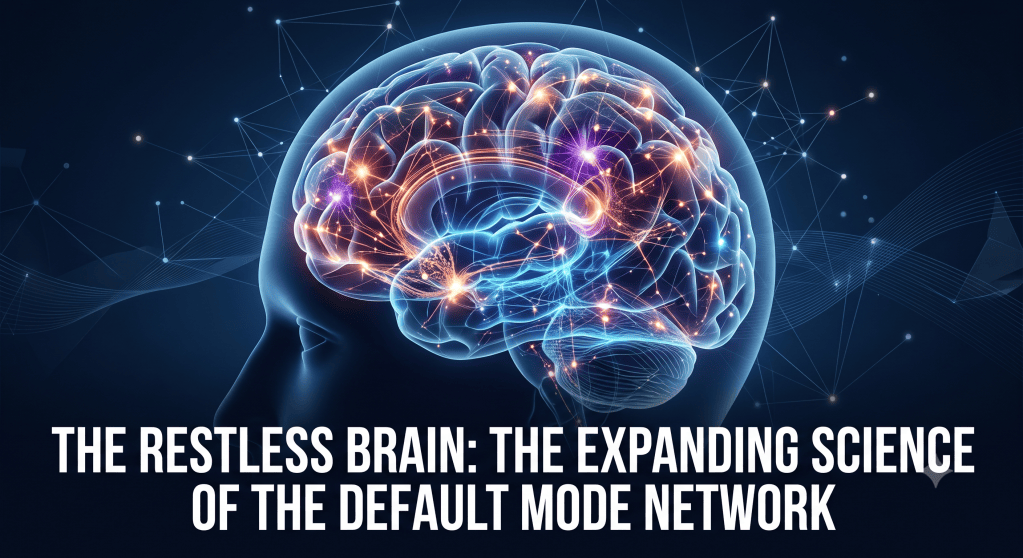
How brain scans revealed the default mode network, proving mind-wandering is an active process, not idle mental downtime.
In the spring of 2012, neuroscience was quietly overturning one of its own oldest assumptions. For decades, brain researchers had operated on a simple and intuitive idea: the brain works when you give it something to do, and it rests when you don’t. A ringing phone, a math problem, a conversation with a friend — these things activated the brain. Staring out a train window, waiting in line, or lying awake before falling asleep were treated as neurological downtime, the mental equivalent of a car idling in a parking lot.
That assumption turned out to be wrong, and the story of how scientists discovered this says as much about the limits of common sense as it does about the brain itself. It began, almost by accident, in brain imaging labs where researchers noticed something strange. When people were told to stop performing a task and simply relax inside a scanner, certain regions of their brain didn’t quiet down. They lit up. A whole network of connected areas became more active during apparent rest than during focused effort. This network eventually earned a name that has since become common currency in both scientific journals and casual conversation: the default mode network, or DMN.
The implications reached far beyond a technical curiosity in brain scans. The discovery suggested that the human mind has a built-in default setting: an internal mode it returns to whenever it isn’t otherwise occupied. That mode isn’t blank. It’s busy. It replays memories, rehearses future conversations, evaluates our sense of self, and threads together a kind of running narrative about who we are and where we stand with other people. Mind-wandering, once dismissed as mental static, began to look like one of the brain’s essential functions rather than a lapse in performance.
This matters for reasons that go well beyond neuroscience labs. In a culture increasingly organized around constant stimulation, productivity, and the elimination of “dead time,” the discovery of the default mode network raised uncomfortable and interesting questions. What happens to a mind that rarely gets to wander? Is boredom actually doing something useful? And if daydreaming is a real, measurable brain process, what does it mean that modern life is engineered to interrupt it at every turn? This article traces the scientific story of the default mode network, from its accidental discovery to its role in one of the more surprising rebrandings in modern brain science: proof that doing nothing is, neurologically speaking, doing quite a lot.
An Accidental Discovery in the Scanner
The default mode network wasn’t something anyone set out to find. It emerged as a kind of statistical nuisance that researchers eventually realized was the real story.
Functional magnetic resonance imaging, or fMRI, works by tracking blood flow in the brain as a rough proxy for neural activity. Through the 1990s, researchers used this technology the way you’d expect: they’d scan a person’s brain while that person performed a task — reading, doing arithmetic, recognizing faces — and then compare that scan to a “resting” baseline scan taken while the person did nothing in particular. The logic was straightforward. Subtract the resting brain from the working brain, and whatever’s left over must be the brain regions responsible for the task.
But researchers kept noticing an odd pattern. Certain brain regions were consistently more active during the supposed resting baseline than during the task itself. At first this looked like noise, an artifact of a flawed experimental design, and many scientists treated it that way. It took a neurologist named Marcus Raichle and his colleagues at Washington University in St. Louis to make the case, in a series of influential papers published in the early 2000s, that this pattern wasn’t noise at all. It was a signal. The brain, they argued, has an organized, energy-hungry baseline mode of operation, and it’s the one we’re in more often than we realize.
By 2012, this idea had matured into a well-established area of research, backed by a growing stack of imaging studies and review papers that mapped out exactly which brain regions belonged to this network and what functions they seemed to support. The default mode network, researchers found, includes a set of interconnected regions: the medial prefrontal cortex, involved in self-referential thought; the posterior cingulate cortex and precuneus, associated with autobiographical memory and a sense of personal continuity; and portions of the parietal lobe linked to imagining other people’s perspectives. These regions don’t work in isolation. They communicate with each other in a coordinated rhythm, switching on together when the mind turns inward and quieting down together when attention turns to the outside world.
Why the Brain Never Really Turns Off
One of the more counterintuitive findings to come out of this research is just how metabolically expensive the resting brain actually is. The human brain, at any given moment, consumes a startling share of the body’s total energy budget, and only a small fraction of that consumption seems tied to responding to the outside world. Raichle and his colleagues estimated that the difference in the brain’s energy use between focused, effortful tasks and apparent rest is surprisingly modest. Most of the brain’s energy budget goes toward maintaining its ongoing, spontaneous activity, the kind that hums along regardless of what’s happening outside.
This finding reframes what we mean by “rest” in the first place. A brain at rest is not powered down. It’s running a different program, one focused on internal rather than external information. Think of it less like a computer going into sleep mode and more like an office where, once customers stop walking through the door, the staff doesn’t stop working. They turn instead to inventory, planning, and paperwork that’s just as demanding as anything they’d do out front.
This reframing helped explain a phenomenon that psychologists had documented for years without quite knowing what to do with it: the sheer amount of time people spend not paying attention to what’s directly in front of them. Estimates from experience-sampling studies, in which participants are prompted at random moments throughout the day to report what they’re thinking about, have suggested that minds wander during a substantial portion of waking hours, often regardless of what task a person is nominally engaged in. For a long time, this looked like evidence of a flawed, easily distracted mind. The default mode network offered a different interpretation: perhaps mind-wandering isn’t a failure of attention so much as attention doing exactly what it’s built to do when nothing more urgent claims it.
The Wandering Mind as an Active Process
Before the default mode network entered the picture, mind-wandering carried a mostly negative reputation in psychology. It was treated as a lapse, a symptom of insufficient willpower or a poorly designed task. Students who daydreamed in class were told to focus. Employees who drifted off during meetings were seen as disengaged. The underlying assumption was that an idle mind was, more or less, an empty one, and that emptiness was best filled with directed effort.
Neuroimaging research began to complicate that story considerably. Studies conducted in the years leading up to and following 2012 found that when people reported mind-wandering during a task, activity in default mode regions tended to increase, and this activity often looked remarkably similar to the patterns seen during deliberate acts of imagination, memory retrieval, and future planning. In other words, the brain wasn’t going quiet during a daydream. It was doing something that, structurally, resembled active cognitive work, just work directed inward rather than outward.
This distinction matters because it reframes daydreaming as a mode of thinking with its own apparent purpose, not simply the absence of thinking. Some researchers began to propose that mind-wandering serves specific psychological functions: rehearsing social interactions before they happen, working through unresolved problems in the background, and stitching together scattered experiences into a coherent personal narrative. A person daydreaming about an upcoming conversation with a coworker isn’t necessarily failing to pay attention to the present. They may be running a kind of low-stakes simulation, testing out how the conversation might go before it actually happens.
It’s worth being careful here about how far the evidence stretches. Much of this research is correlational: certain patterns of brain activity tend to co-occur with certain reported mental states, but correlation doesn’t establish that the default mode network causes creative insight or emotional processing in a direct, mechanical sense. Some of the more ambitious claims linking the network to specific psychological benefits deserve to be treated as promising hypotheses rather than settled conclusions. What does seem well supported, though, is the more modest and still significant claim that mind-wandering represents genuine, structured brain activity rather than a simple absence of engagement.
The Self, Memory, and the Inward-Facing Brain
A recurring theme in default mode network research is its apparent connection to how people think about themselves. The medial prefrontal cortex, one of the network’s key hubs, shows heightened activity not just during idle moments but specifically during tasks that ask people to reflect on their own traits, preferences, and history. Ask someone to judge whether an adjective describes their own personality, and this region tends to respond more strongly than when they’re asked to judge whether the same adjective describes a stranger.
This has led some researchers to describe the default mode network as central to a kind of ongoing internal biography. The brain, left to its own devices, doesn’t drift randomly. It tends to gravitate toward autobiographical material: memories of past events, projections of future ones, and a continuously updated sense of where the self fits into an unfolding personal story. The posterior cingulate cortex and precuneus, other core regions of the network, are similarly implicated in the retrieval of personal memories and the construction of mental scenes, whether remembered or imagined.
There’s a useful metaphor here, though like all metaphors it shouldn’t be taken too literally. If focused, task-directed thinking is like a spotlight aimed at a specific object in a dark room, default mode activity is more like the room’s ambient lighting, always on at some level, illuminating the broader space the person exists in — their relationships, their history, their sense of who they are and where they’re headed. That ambient light doesn’t produce a single, sharp image. It provides context, continuity, and a persistent backdrop against which more focused attention can operate.
This inward orientation also connects the default mode network to social cognition, the mental work of understanding other people’s thoughts, intentions, and feelings. Several studies from around this period found overlap between default mode activity and the brain regions involved in what researchers call “theory of mind,” the capacity to model what another person might be thinking. This overlap suggested a provocative possibility: that the same neural machinery the brain uses to reflect on itself may also be repurposed to imagine the inner lives of others, and that idle, self-directed thought and social imagination may be more closely related than they first appear.
When the Network Misfires
Not all of the interest in the default mode network centered on its ordinary function. A parallel line of research explored what happens when this network behaves in atypical ways, and this work added weight to the idea that the network plays a meaningful role in mental health.
Researchers studying depression, for instance, found evidence that default mode activity in some individuals appeared unusually persistent or poorly regulated, particularly in connection with rumination, the tendency to dwell repeatedly on negative thoughts about oneself. Because the default mode network is so closely tied to self-referential thinking, a network that has difficulty quieting down when it should could plausibly contribute to the kind of repetitive, self-focused negative thought patterns that characterize depressive rumination. Evidence here remains preliminary, and it would be an overreach to say researchers had identified rumination’s neural cause. But the pattern was consistent enough across studies to suggest the default mode network deserved serious attention in mental health research, not just in the study of ordinary cognition.
Similar questions arose in research on attention-deficit conditions, where some studies suggested that the default mode network might fail to properly deactivate when a person shifts into a demanding task, potentially contributing to lapses in sustained attention. Here again, the findings were suggestive rather than conclusive, part of a broader scientific effort to understand attention and its disruptions rather than a finished explanation.
What these lines of research shared was a working assumption: that healthy cognitive functioning depends not just on the ability to focus outward when needed, but on a properly functioning switch between outward focus and inward reflection. A default mode network that engages at the wrong times, or fails to disengage when a task demands full attention, might help explain certain patterns of cognitive and emotional difficulty. This was a meaningful shift in how scientists thought about mental health, moving some of the conversation away from viewing the brain purely in terms of deficits in specific skills and toward viewing it in terms of the coordination between different modes of operation.
A Culture Increasingly Hostile to Idle Minds
The scientific rehabilitation of mind-wandering arrived at a curious moment in cultural history. By the early 2010s, smartphones had become fixtures of daily life, and with them came an enormous expansion of opportunities to fill formerly idle moments. Waiting for a bus, standing in a checkout line, sitting through a lull in conversation — all of these small, previously unstructured pockets of time increasingly became opportunities to check a phone, refresh a feed, or otherwise occupy the mind with something external.
This cultural shift makes the default mode network research feel especially resonant in hindsight. If the resting, inward-facing mind performs meaningful psychological work — organizing memory, rehearsing social scenarios, maintaining a coherent sense of self — then a culture that systematically fills every idle moment with external stimulation may be crowding out something the brain was built to do. This isn’t a claim that ought to be pushed too far or turned into a sweeping indictment of modern technology; the research doesn’t offer strong evidence about the long-term consequences of reduced mind-wandering time, and it would be speculative to draw firm conclusions about smartphones specifically. But the timing of the discovery is worth noting. Just as science was establishing that idle thought serves a function, cultural and technological trends were making idle thought increasingly rare.
There’s a reasonable case that this tension reflects something broader about how societies have historically treated unstructured time. Boredom has often carried a certain stigma, associated with laziness or lack of ambition, and the drive to eliminate it predates smartphones by a long stretch. What’s different now is simply the efficiency with which that stigma can be acted upon. The default mode network gives us a plausible, if still developing, scientific reason to wonder whether that trade-off comes with some cost.
What the Network Reveals About Creativity and Problem-Solving
One of the more compelling threads in this research area involves creativity. Anecdotally, people have long reported that their best ideas arrive not while grinding away at a problem, but during a shower, a walk, or some other unstructured moment when attention has wandered away from the task at hand. The default mode network offers a neurological frame for thinking about why that might happen.
Some researchers have proposed that creative insight depends on a kind of interplay between the default mode network and the brain’s more externally focused attention systems. The idea is that unstructured, associative thought generated during mind-wandering can surface unusual connections between ideas, connections that might not emerge under the narrower, more constrained thinking typical of focused problem-solving. Later, when attention shifts back to a task, some of these loosely generated associations can be evaluated and refined into something useful.
Researchers continue to investigate this hypothesis rather than treat it as an established fact, and they’ve been careful to note that not all mind-wandering leads anywhere productive; plenty of daydreams simply dissipate without producing any usable insight. Still, the general pattern — that stepping away from a problem sometimes helps solve it — has enough empirical and experiential support to be taken seriously, and the default mode network gives that old piece of folk wisdom a plausible biological home.
The Broader Reframing of Attention and Rest
Perhaps the most significant contribution of this body of research isn’t any single finding but the reframing it offers for how we think about attention itself. For much of the twentieth century, cognitive science tended to treat attention as a spotlight to be pointed at external tasks, and anything outside that spotlight was, by default, treated as unimportant or unstudied. The discovery of the default mode network suggested that this framework was incomplete. The brain isn’t simply a tool for processing the external world that occasionally goes quiet. It has an active, structured internal life that runs continuously, surfacing whenever external demands ease up.
This has implications for how we think about everyday concepts like rest, boredom, and distraction. Rest, in this light, isn’t the absence of brain activity, but a shift toward a different kind of activity, one oriented toward memory, self-understanding, and social imagination rather than external tasks. Boredom, rather than representing an empty mental state to be avoided at all costs, might be better understood as a trigger that reliably pushes the brain into this reflective mode. And distraction, at least the internally generated kind that pulls attention away from a task and toward one’s own thoughts, might sometimes represent the brain doing something useful rather than simply failing at the task in front of it.
None of this suggests that focused attention is somehow less important, or that mind-wandering should be indulged without limits. Plenty of tasks genuinely require sustained, external focus, and there’s ample evidence that too much mind-wandering at the wrong moments can undermine performance and safety. The point is more modest: that the human mind seems to be built with two complementary modes rather than one default state and one lapse from it, and that both modes appear to serve real functions.
It’s also worth noting that some researchers have pushed back against how the default mode network gets discussed in popular science writing, arguing that it can be oversimplified into a tidy story of “the daydreaming network” when in reality most cognitive functions emerge from dynamic interactions among several large-scale brain networks rather than any single network acting alone.
What Researchers Have Learned Since 2012
In the years since the default mode network first entered mainstream scientific conversation, the research has grown considerably more nuanced. One major development has been a shift away from studying the network in isolation and toward understanding how it interacts with other large-scale brain networks, particularly the ones responsible for executive control and focused attention. Rather than picturing the brain as switching cleanly between an “on” task-focused mode and an “off” default mode, researchers now generally describe a more fluid relationship, in which the default mode network and executive-control regions coordinate, compete, and occasionally overlap depending on what a person is doing.
The network has also become a significant focus in Alzheimer’s disease research. Imaging studies have found that some of the same regions central to the default mode network, particularly areas involved in memory, tend to show early disruption in people who go on to develop Alzheimer’s, and researchers have explored whether changes in default mode connectivity could eventually serve as an early marker of neurodegenerative decline. This work is still developing, but it has helped position the network as a tool for studying brain health more broadly, not just the psychology of everyday mind-wandering.
Meditation research has been another growth area. Several studies have examined how experienced meditators’ default mode activity differs from that of non-meditators, particularly during practices aimed at reducing self-referential thought. Findings here are mixed and still being refined, but they’ve contributed to a broader interest in whether default mode activity can be intentionally trained or modulated, rather than simply observed.
Finally, the tools available to researchers have changed substantially. Large-scale network neuroscience, aided by bigger datasets, more sophisticated computational modeling, and international brain-mapping projects, has allowed scientists to study the default mode network as one piece of a much larger, interconnected system rather than a standalone feature. This shift reflects a broader trend in the field: the default mode network was an important starting point, but the deeper story turned out to involve how it fits into the brain’s wider organization.
Conclusion: A Quietly Radical Idea
The story of the default mode network is, in some ways, a story about how science sometimes advances through noticing what everyone else had been ignoring. For years, researchers imaging the brain treated the resting state as a null condition, a baseline to be subtracted away so the “real” data could emerge. It took a willingness to take that baseline seriously, to ask why it looked the way it did, to uncover an entire structured network with its own logic and apparent purpose.
The broader significance of this discovery extends well past neuroscience. It offers a scientific vocabulary for something people have long sensed intuitively: that the mind, left alone, doesn’t go empty. It goes somewhere, working through memory, identity, and imagined futures in ways that can feel unproductive from the outside but that may serve real cognitive and emotional functions. This doesn’t mean every moment of daydreaming is secretly valuable, or that boredom should be romanticized. The evidence supports a more measured claim: that idle thought is a genuine, active process worth taking seriously, not a void to be filled reflexively.
As research on the default mode network continued to develop in the years after 2012, it would go on to intersect with new questions about attention in an increasingly digital environment, the neuroscience of rumination and mental health, and the ongoing debate about what constant connectivity does to a mind that may need some unstructured time to do its own quiet work. The resting brain, it turns out, was never really resting. It was simply doing something we had not yet learned to recognize.
References
Buckner, R. L., Andrews-Hanna, J. R., & Schacter, D. L. (2008). The brain’s default network: Anatomy, function, and relevance to disease. Annals of the New York Academy of Sciences.
Christoff, K., Gordon, A. M., Smallwood, J., Smith, R., & Schooler, J. W. (2009). Experience sampling during fMRI reveals default network and executive system contributions to mind wandering. Proceedings of the National Academy of Sciences.
Killingsworth, M. A., & Gilbert, D. T. (2010). A wandering mind is an unhappy mind. Science.
Raichle, M. E., MacLeod, A. M., Snyder, A. Z., Powers, W. J., Gusnard, D. A., & Shulman, G. L. (2001). A default mode of brain function. Proceedings of the National Academy of Sciences.
Raichle, M. E., & Gusnard, D. A. (2002). Appraising the brain’s energy budget. Proceedings of the National Academy of Sciences.
Greicius, M. D., Srivastava, G., Reiss, A. L., & Menon, V. (2004). Default-mode network activity distinguishes Alzheimer’s disease from healthy aging: Evidence from functional MRI. Proceedings of the National Academy of Sciences.
Brewer, J. A., Worhunsky, P. D., Gray, J. R., Tang, Y. Y., Weber, J., & Kober, H. (2011). Meditation experience is associated with differences in default mode network activity and connectivity. Proceedings of the National Academy of Sciences.
Bassett, D. S., & Sporns, O. (2017). Network neuroscience. Nature Neuroscience.
Sheline, Y. I., Barch, D. M., Price, J. L., et al. (2009). The default mode network and self-referential processes in depression. Proceedings of the National Academy of Sciences.
Spreng, R. N., Mar, R. A., & Kim, A. S. N. (2009). The common neural basis of autobiographical memory, prospection, navigation, theory of mind, and the default mode: A quantitative meta-analysis. Journal of Cognitive Neuroscience.









