
Originally published in June 2012 and comprehensively updated/edited in June 2026.
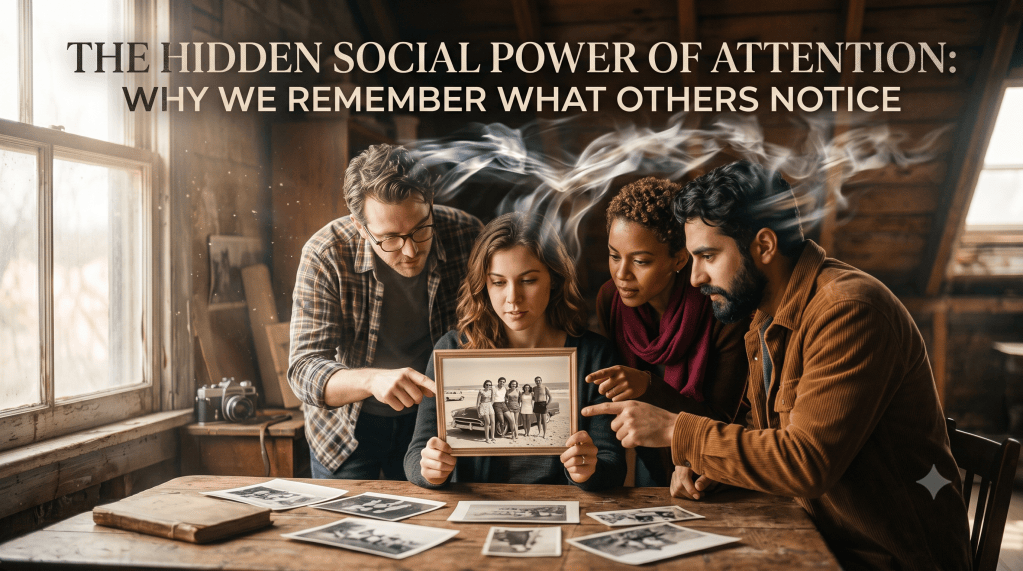
A 2012 psychology study revealed that leading shared attention strengthens memory. Discover what joint attention tells us about connection, cognition, and the digital age.
In the summer of 2012, smartphones were beginning to transform from technological novelty into a permanent layer of everyday life. Facebook had just gone public. The idea that a screen could compete with a human face for someone’s attention was still new enough to feel strange rather than normal. At the same time, a quieter revolution was happening inside university psychology labs, where researchers were using virtual reality headsets — clunky, heavy things by today’s standards — to ask an old question in a new way: what actually happens in the brain when two people share a moment of attention?
That question turned out to matter more than almost anyone predicted. In June 2012, Kwanguk Kim and Peter Mundy published a study exploring this, one that used eye-tracking technology and a computer-generated avatar to test something surprisingly hard to study directly — how the simple act of sharing visual attention with another person changes what we remember. Their findings, and the decade and a half of research that followed, help explain something most of us feel intuitively but rarely examine: shared experiences stick in memory differently than solitary ones, and the way we share them matters.
This matters now more than it did in 2012, not less. We live in a world saturated with information, much of it delivered by screens that mimic attention without ever truly sharing it. Understanding the real psychological architecture of shared attention — what neuroscientists call joint attention — offers a window into why eye contact still carries weight, why some memories from childhood or a good conversation feel unusually vivid, and why the growing substitution of algorithmic engagement for genuine human noticing might be quietly reshaping how we encode the world.
What Is Joint Attention, Really?
Joint attention sounds like a technical term, but it describes something almost every person does dozens of times a day without thinking about it. It is the ability to coordinate your visual attention with someone else’s — to look at what they’re looking at, or to get them to look at what you’re looking at. A parent points at a dog and a toddler follows the gesture with her eyes. A friend glances toward a strange noise across the room and you glance there too. A colleague leans forward and says “look at this,” and for a moment your attention and theirs are locked onto the same object in the world.
Developmental psychologists have studied this behavior in infants for decades, because it emerges early — usually between nine and eighteen months of age — and because it predicts a great deal about how a child’s social and language skills will unfold. Differences in joint attention development are often studied in autism research because they are associated with variations in early communication and social learning. Researchers came to see joint attention as something like a foundation stone: a simple visual behavior that, brick by brick, builds the more abstract capacity to understand that other people have their own minds, their own perspectives, their own internal experience of the world.
For a long time, though, joint attention was treated mostly as a childhood phenomenon — something you grow out of once you already understand that other minds exist. What Kim and Mundy’s 2012 study helped demonstrate is that joint attention continues to influence adult cognition, shaping how information is processed and remembered.
Two Directions of Shared Looking
Researchers who study joint attention distinguish between two related but different skills. The first is called responding to joint attention — following someone else’s gaze or gesture to a shared point of focus. This is the more passive, reactive half of the equation: someone else leads, and you follow. The second is initiating joint attention — using your own gaze or gestures to draw another person’s focus toward something you want them to notice. This is the more active, self-directed half: you lead, and someone else follows.
These sound like mirror images of each other, but researchers had long suspected they weren’t functionally identical. Studies of children showed that initiating and responding to joint attention don’t always develop in lockstep, and they seem to predict different long-term outcomes. Brain imaging research in adults had also hinted that these two modes of shared attention activate somewhat different neural networks. But testing this cleanly in a controlled experiment was difficult, because real human interaction is messy — hard to standardize, hard to repeat exactly the same way across many participants.
The Study That Watched People Watch Each Other
To get around this problem, Kim and Mundy built something clever: a virtual reality environment in which participants wore a head-mounted display and interacted with a computer-generated female avatar whose eyes were tracked and controlled in real time. This let the researchers create two carefully matched conditions that isolated the difference between leading and following shared attention, without the unpredictability of an actual human partner.
In the “responding” condition, participants watched the avatar’s eyes shift toward a picture appearing on her left or right side, and then followed her gaze to look at that same picture themselves — essentially letting the avatar lead. In the “initiating” condition, the roles flipped. Participants chose which side to look at first, and an eye-tracking camera detected their gaze shift and triggered the avatar to follow their lead, turning her eyes toward wherever they had just looked. In both cases, participants were shown images of faces, houses, and abstract patterns, and asked to remember as many as they could. Afterward, they took a memory test, trying to pick out the pictures they’d seen before from a mix of familiar and brand-new images.
This setup let the researchers ask a precise question: does it matter, for memory, whether you were the one initiating shared attention or the one responding to someone else’s?
What They Found: Leading Attention Beats Following It
The results were notable, and they held up across two separate experiments with different groups of college students. Participants showed a clear recognition advantage for images they had encountered while initiating shared attention with the avatar, compared to images they had encountered while simply following her gaze. That’s not a small gap. A second study was run specifically to rule out an obvious alternative explanation — that participants might just be spending more time looking at pictures in one condition than the other, which could explain the memory difference on its own. Once the researchers controlled for viewing time so it was equal in both conditions, the effect held: people still remembered more of what they’d seen while leading shared attention than while following it, though the size of the gap shrank somewhat once viewing time was accounted for.
In plain terms: pictures encoded while a person was actively directing another’s attention toward them were more memorable than the exact same kinds of pictures encoded while that person was simply going along with where someone else was already looking.
Interestingly, this effect wasn’t uniform across every kind of image. It showed up clearly for pictures of houses and abstract patterns, but not for pictures of faces — people were quite good at remembering faces regardless of which condition they’d seen them in. That’s a meaningful wrinkle we’ll come back to.
Why Would Taking the Lead Help Memory?
The honest answer is that researchers don’t yet have a complete explanation, and Kim and Mundy were careful in their discussion to describe several competing possibilities rather than claim they’d solved the puzzle. But the leading theories are worth walking through, because they connect to some well-established ideas in memory research.
The Self-Reference Effect
Decades of psychology research have shown that information gets remembered better when it’s tied to the self in some way — a phenomenon researchers call the self-reference effect. If you’re asked to think about whether a word describes your own personality, you’ll typically remember that word better later than if you’d just been asked whether it was spelled correctly. Anchoring information to your own identity, decisions, and actions seems to activate a richer, more elaborate set of mental associations, which makes the memory easier to retrieve later.
Initiating joint attention may work the same way. When you choose where to look and pull someone else’s focus along with you, the whole experience is more self-directed — it’s your decision, your action, your intention driving the moment. Responding to someone else’s gaze, by contrast, is more reflexive. You’re reacting to a cue rather than generating one. If self-generated experiences get a memory boost the way self-referenced information does, that would help explain why leading shared attention left a stronger trace than following it.
The Brain’s Reward System and Shared Attention
A second possible explanation involves the brain’s reward circuitry. Earlier neuroimaging studies discussed by Kim and Mundy suggested that successfully directing another person’s attention may engage reward-related regions such as the ventral striatum — a brain region closely tied to feelings of reward and motivation. Kim and Mundy did not measure brain activity themselves; they drew on this prior research to propose that initiating shared attention might feel subtly rewarding in a way that responding to someone else’s gaze does not. And there’s a long-established connection between reward-related brain activity and how deeply information gets encoded into memory. If leading a shared moment of attention triggers even a small hit of that reward response, it could help explain why those moments are remembered more vividly.
A third possibility, which the researchers raised more tentatively, is that responding to another person’s gaze cue might simply demand more mental effort and self-control than initiating attention does — and that extra cognitive load could leave fewer resources available for encoding the picture itself into memory. None of these explanations rule out the others; they may all be true to different degrees, working together.
Faces Are Special — And That Complicates the Picture
One of the more interesting wrinkles in the findings is that the memory advantage for initiating shared attention showed up for houses and abstract designs, but not for faces. Across both conditions, people were simply good at remembering faces — better, on average, than they were at remembering buildings or geometric patterns, regardless of who had been leading the shared attention.
This fits with a broader, well-supported finding in cognitive neuroscience: human brains appear to have specialized processing systems for faces, built up over a lifetime of practice recognizing the people around us. Because face recognition already gets a boost from this built-in expertise, there may simply be less room for joint attention to add anything further — a kind of ceiling effect. For less familiar, less specialized categories of images like houses or abstract shapes, the extra depth of processing that comes from actively directing shared attention has more room to make a visible difference.
This distinction matters for how researchers think about conditions like autism spectrum disorder, where difficulties with both joint attention and face processing are common and have often been assumed to be closely linked, even reflections of the same underlying difference. Findings like these suggest the relationship may be more complicated — that the mechanisms behind joint attention’s effect on memory and the mechanisms behind face recognition might be at least partially separate systems, which is itself a useful thing to know for future research and clinical work.
Attention as a Social Architecture
Step back from the specifics of eye-tracking data and avatar experiments, and a larger idea comes into focus. Joint attention isn’t just a milestone babies pass through on the way to bigger cognitive skills. It appears to function, across the entire human lifespan, as a kind of architecture that organizes how information from the world gets processed and stored. Sharing a moment of noticing with another person — especially actively directing that shared moment — seems to deepen the way the brain encodes whatever was being noticed.
This idea has quiet echoes in a lot of ordinary human experience. People often report that memories from meaningful shared experiences — a trip taken with someone close, a conversation where both people were fully present, a moment of pointing something out to a friend and watching their reaction — feel more vivid and more durable than solitary equivalents. Some of that is likely due to emotional significance and repeated retelling. But research like Kim and Mundy’s suggests there may also be a more basic cognitive mechanism at work: the simple structure of sharing attention, particularly leading it, changes how deeply information gets encoded in the first place.
It also helps explain something about why eye contact carries so much social weight across cultures. A shared gaze isn’t just a signal of politeness or engagement — it may be doing real cognitive work, coordinating two nervous systems around a common point of focus in a way that shapes what each person walks away remembering.
What This Means in an Age of Screens and Algorithms
When this research was first published in 2012, virtual reality headsets were laboratory tools, not consumer products, and the idea of spending meaningful daily time interacting with an avatar instead of a real person felt like science fiction. That’s no longer true. Video calls, virtual assistants, AI chat interfaces, and increasingly convincing digital avatars are now part of ordinary life. Meanwhile, a great deal of modern technology is engineered specifically to simulate the feeling of shared attention — a notification that seems to say “look at this,” a feed that appears to know what you’ll want to notice next — without any of the underlying two-way coordination that defines real joint attention.
This raises a genuinely open question that current research is still working through: does simulated or one-directional attention-sharing, of the kind algorithms are built to produce, offer any of the memory or social-cognitive benefits associated with real joint attention between two people? Or does it function more like the passive “responding” condition in Kim and Mundy’s study — a kind of following without any of the self-directed, reward-linked initiating that seemed to matter most? The comparison is metaphorical rather than experimental; algorithms do not participate in joint attention in the human sense, since joint attention requires two minds mutually coordinating around a shared point of focus. Researchers don’t have a definitive answer yet, and it would be overstating the evidence to claim that screen-based attention is straightforwardly worse for memory or social cognition. But the basic finding that leading shared attention differs meaningfully from following it is a useful lens for thinking about a world increasingly built around passive scrolling and algorithmically directed noticing, as opposed to the reciprocal, self-initiated attention-sharing that characterizes face-to-face human connection.
It’s also worth being careful not to overreach in the other direction. This is a body of research built on relatively small samples of college students in laboratory settings, and the specific mechanisms behind the memory effect remain genuinely unsettled, as the original researchers themselves acknowledged. What can be said with more confidence is narrower but still meaningful: the direction of shared attention — who is leading and who is following — is not a trivial detail. It appears to shape, at a measurable level, how deeply the mind holds onto what it has seen.
Where the Research Points Next
In the years since 2012, the tools available to study joint attention have only gotten more sophisticated — better eye-tracking, more naturalistic virtual avatars, and brain-imaging methods capable of capturing activity during live, two-way social interaction rather than static tasks. Researchers have continued building on the questions Kim and Mundy’s paradigm raised: how initiating versus responding to shared attention maps onto distinct brain networks, how these processes unfold differently in populations such as individuals with autism, and how the reward and self-referential systems identified as candidate explanations actually interact during real encoding.
What began as a study of infants following a caregiver’s pointed finger has grown into a broader account of attention as something fundamentally social — not just a spotlight one mind shines on the world alone, but a coordination problem two minds solve together, with measurable consequences for what gets remembered. As digital environments increasingly mediate how humans direct one another’s focus, that older, more basic finding about eye contact and shared noticing may turn out to be one of the more revealing insights from psychological science over the past two decades.
Scientific Reference
Kim, K., & Mundy, P. (2012). Joint attention, social-cognition, and recognition memory in adults. Frontiers in Human Neuroscience, 6, Article 172. https://doi.org/10.3389/fnhum.2012.00172









