
Originally published in November 2012 and comprehensively updated/edited in June 2026.
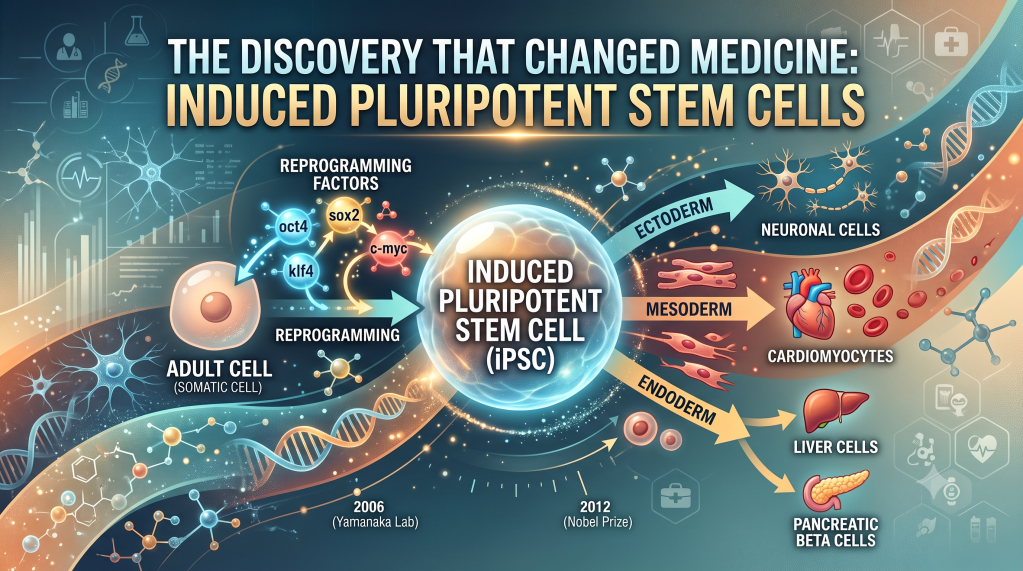
How Shinya Yamanaka’s 2006 discovery of induced pluripotent stem cells (iPSCs) earned a Nobel Prize, transformed regenerative medicine, and changed the future of cellular biology.
In the early 2000s, stem cell research occupied an unusual place in public life. It was simultaneously one of the most promising frontiers in medicine and one of the most politically charged subjects in science. Embryonic stem cells, which are harvested from days-old embryos and can develop into virtually any tissue in the body, held enormous therapeutic potential. But obtaining them required destroying the embryo in the process, and that fact placed the research at the center of a bitter moral and political argument that played out in legislatures, courts, public debates, and religious communities across the world. In the United States, federal funding restrictions imposed in 2001 slowed research programs for years. Scientists spoke of a chilling effect. Patients with degenerative diseases, and the families who cared for them, watched a field full of promise stall under the weight of an ethical dispute that had nothing to do with the biology itself.
Against that backdrop, a discovery announced in 2006 by a Japanese physician-scientist named Shinya Yamanaka did something that few technical breakthroughs ever manage to do. It did not just advance the science. It removed the central practical objection that had constrained one major branch of the field. Yamanaka and his team found a way to take an ordinary adult cell, something as unremarkable as a patch of skin, and coax it backward through its own developmental history until it behaved like an embryonic stem cell again. No egg. No embryo. No destruction of anything most people would consider a potential human life. Just a skin cell, a handful of genetic instructions, and time.
The cells that resulted from this process became known as induced pluripotent stem cells, or iPSCs. In 2012, Yamanaka received the Nobel Prize in Physiology or Medicine for the discovery, sharing the honor with British developmental biologist John Gurdon, whose decades-earlier work on frog cells had first hinted that cellular identity was not a one-way street. This article traces how that idea evolved from a strange laboratory curiosity in the 1960s into one of the defining scientific achievements of the twenty-first century, and it examines what iPSCs have and have not delivered in the years since, now that the initial excitement has given way to a more sober and still remarkable body of clinical progress.
The Old Assumption: Cells Cannot Go Backward
To understand why Yamanaka’s discovery mattered so much, it helps to understand the assumption it overturned. For most of the twentieth century, developmental biologists operated on a simple and intuitively appealing premise. A fertilized egg starts out able to become anything. As it divides, its descendant cells become progressively more specialized, branching down a kind of decision tree until each one settles into a final identity: a neuron, a liver cell, a strand of muscle. Once a cell reached that endpoint, the thinking went, its fate was sealed. The specialization was treated as a one-way door.
Gurdon’s Tadpoles
The first serious crack in that assumption appeared in 1962, when John Gurdon, then a young researcher at Oxford, ran an experiment involving frogs. He took the nucleus from a mature, fully specialized intestinal cell of a tadpole and transplanted it into a frog egg cell whose own nucleus had been removed. If the old assumption were correct, that egg should have done nothing useful, since it now contained genetic instructions from a cell that had already committed to being an intestine. Instead, the egg developed into a normal, swimming tadpole. This demonstrated that the nucleus of a differentiated frog cell retained the complete genetic information required to direct development of an entire organism.
The implication was startling. The intestinal cell’s DNA still contained the complete set of instructions needed to build an entire animal. Specialization, it turned out, did not erase information. It only suppressed it. Gurdon’s discovery shattered the dogma that cellular differentiation could only be a unidirectional process, and it became the conceptual foundation for cloning research in the decades that followed, culminating eventually in projects like Dolly the sheep. But Gurdon’s method depended on physically transplanting a nucleus into an egg cell using extremely delicate laboratory technique. It answered a philosophical question about whether reversal was possible in principle. It did not offer a practical way to reprogram cells for medical use, and for more than forty years, nobody found one.
The Embryonic Stem Cell Era
The next major landmark came in 1998, when researchers led by James Thomson at the University of Wisconsin successfully isolated and cultured human embryonic stem cells for the first time. These cells, taken from early-stage embryos left over from fertility treatments, could be coaxed into becoming almost any cell type in the human body. For the first time, scientists had a renewable laboratory source of pluripotent human cells that could be studied and guided toward specialized cell types, opening the door to research on how damaged organs, lost neurons, or injured tissue might eventually be repaired.
The scientific promise was immense, but so was the controversy. Because deriving these cells required the destruction of an embryo, the technique collided directly with deeply held religious and ethical convictions about the moral status of embryonic life. Research funding became entangled in politics in a way that few areas of basic biology ever experience. Scientists needed an alternative source of pluripotent cells, one that did not require an embryo at all. That need is what set the stage for Yamanaka’s work.
Yamanaka’s Question and the Four Factors
Shinya Yamanaka trained first as an orthopedic surgeon before moving into molecular biology, a background that reportedly shaped his interest in regenerative medicine. Working at Kyoto University, he approached the problem of pluripotency from an unusual angle. Rather than trying to transplant a nucleus the way Gurdon had, he asked a more targeted question: what if pluripotency wasn’t a mysterious, holistic property of the egg cell, but simply the result of a specific set of genes being switched on? If that were true, then activating those same genes inside an ordinary adult cell might be enough to push it backward into a stem-cell-like state, without needing an egg or an embryo at all.
Yamanaka and his graduate student Kazutoshi Takahashi started with a list of two dozen candidate genes known to be especially active in embryonic stem cells. Through a painstaking process of elimination, testing combinations of these genes in mouse skin cells, they eventually narrowed the list down to just four: Oct4, Sox2, Klf4, and c-Myc. These four proteins together are often referred to today as the Yamanaka factors. When the team inserted all four into ordinary mouse fibroblast cells, a type of cell found in connective tissue, something remarkable happened. By introducing four genes together, they could reset fibroblasts into a pluripotent state. The resulting cells displayed the defining property of embryonic stem cells: pluripotency, the ability to generate many different cell types. Although iPSCs are not biologically identical to embryonic stem cells, and can retain traces of their original cell identity that researchers call epigenetic memory, they provided a comparable experimental platform without requiring embryo-derived material.
The team published this result in 2006 in the journal Cell, and it was recognized almost immediately as a major turning point. A year later, in 2007, Yamanaka’s team and a separate group led by Thomson independently confirmed that the same basic approach worked with human cells, not just mouse cells. That second result is what transformed the discovery from an elegant piece of basic science into something with direct relevance to human medicine.
Why “Induced Pluripotent” Is the Right Name
The name given to these cells is worth pausing on because it is unusually precise for a scientific term. “Pluripotent” describes the cell’s capability: it can, in principle, become almost any of the specialized cell types found in the body, much like an embryonic stem cell. “Induced” describes how that state was reached: not through natural embryonic development, but through the deliberate laboratory introduction of specific genes into an already mature cell. Put together, induced pluripotent stem cell describes exactly what the process does, without embellishment or metaphor, which is part of why the term has held up so well in both scientific literature and public communication over the past two decades.
The 2012 Nobel Prize and Its Symbolic Weight
The Nobel Prize in Physiology or Medicine 2012 was awarded jointly to Sir John B. Gurdon and Shinya Yamanaka for the discovery that mature cells can be reprogrammed to become pluripotent. The pairing of the two researchers was itself a small lesson in how science actually progresses. Gurdon’s 1962 frog experiment and Yamanaka’s 2006 gene-based reprogramming were separated by forty-four years, different organisms, different techniques, and entirely different scientific eras, yet the Nobel committee recognized them as two halves of a single continuous insight: that a mature cell’s specialized identity is not permanent, and that under the right conditions, its developmental clock can run in reverse.
There is a detail in the Nobel Committee’s account of the story that captures this connection nicely. Yamanaka was born in 1962, the same year Gurdon reported the arrival of his cloned tadpoles. Whether or not that coincidence carries any deeper meaning, it became a favorite anecdote in press coverage of the award, a small human-interest detail wrapped around a genuinely transformative scientific finding.
The award also mattered for reasons beyond the science itself. By 2012, stem cell research had spent roughly a decade tangled in political and religious controversy, particularly in the United States, where debates over federal funding for embryonic stem cell work had become a fixture of national political discourse. Yamanaka’s technique offered a way to pursue the same fundamental biological goals without the ethical objection that had made the field so contentious. Awarding him science’s highest honor sent a clear signal that this reprogramming approach was not simply a workaround. It was, in the judgment of the Nobel committee, one of the most important biological discoveries of the era, evaluated on its scientific merit rather than its capacity to sidestep controversy.
What iPSCs Made Possible
The practical value of induced pluripotent stem cells falls into roughly three categories, and it is worth being precise about which of these has already been realized and which remains a work in progress, since public discussion of stem cells has historically tended to blur those lines.
Disease Modeling in a Dish
The most immediate and well-established use of iPSCs has been in the study of disease itself, rather than its treatment. Researchers can take a skin or blood sample from a patient with a particular condition, whether that is Parkinson’s disease, certain heart arrhythmias, or a rare genetic disorder, and reprogram those cells into iPSCs. From there, the cells can be coaxed into becoming the specific cell type affected by the disease, such as a dopamine-producing neuron or a heart muscle cell, all grown in a laboratory dish and carrying the patient’s own genetic background. This has given researchers an unprecedented way to watch diseases unfold at the cellular level and to test how individual patients’ cells respond to different drug candidates, long before those drugs ever reach a clinical trial. This application has become mainstream in pharmaceutical research over the past decade and represents the area where iPSCs have had the most consistent, low-controversy impact.
Drug Discovery and Toxicity Testing
Closely related to disease modeling is the use of iPSC-derived cells to screen new drug compounds for safety and effectiveness before they are tested in animals or humans. Because researchers can generate large quantities of specific human cell types, such as heart or liver cells, from iPSCs, pharmaceutical companies can test how a candidate drug affects human tissue directly, rather than relying solely on animal models that do not always translate well to human biology. This has helped identify toxic drug candidates earlier in the development pipeline, potentially saving years of wasted research and reducing risk to human trial participants later on.
Cell Replacement Therapy
The most ambitious and still-developing application is direct cell replacement therapy: growing iPSC-derived cells in a lab and transplanting them into patients to repair or replace damaged tissue. This is the application that captured the public imagination when iPSCs were first announced, and it is also the one that has required by far the most caution, since introducing lab-grown cells into a living human body carries real risks, including the possibility that reprogrammed cells could form tumors if any of them retain properties of their earlier, more primitive state.
Progress here has been real but measured. According to a 2025 review of registered clinical trials involving human pluripotent stem cell-derived products, published in the journal Cell Stem Cell, researchers had identified 115 clinical trials worldwide with regulatory approval as of December 2024, testing 83 distinct hPSC products, with the majority targeting eye disease, conditions of the central nervous system, and cancer. More than 1,200 patients had been dosed with these products by that point, without evidence of generalizable safety concerns. Parkinson’s disease has become one of the most closely watched test cases, with researchers working to generate midbrain dopamine-producing neurons from iPSCs that could potentially replace the very cells that Parkinson’s destroys. Blood and platelet products derived from iPSCs are also being explored as a way to create an “off-the-shelf” supply that does not depend on donor availability, though manufacturing the sheer volume of cells required for something like platelet transfusions has proven to be a significant engineering challenge in its own right.
It is worth being honest about the pace of this work. The excitement that followed Yamanaka’s 2006 and 2007 papers led some observers to predict that iPSC-based cures for major diseases were close at hand. Two decades later, the more accurate picture is one of steady, incremental clinical progress rather than sudden transformation. That is not a failure of the science. Regenerative medicine of this kind requires enormous care, since the therapies involve introducing living, dividing cells into the body rather than a chemical compound that can simply be metabolized and cleared. The caution built into this research reflects the seriousness of the undertaking, not a stall in progress.
The Psychology of a Scientific Breakthrough
There is a less obvious dimension to this story that goes beyond cell biology: the way Yamanaka’s discovery was received by the public and by the scientific community itself illustrates something about how people process moral controversy in science. For years, the embryonic stem cell debate had settled into a familiar and exhausting pattern, one in which supporters of the research argued its therapeutic potential and opponents argued its ethical cost, with little room for a resolution that satisfied both camps. Yamanaka’s technique did not settle the underlying philosophical dispute about the moral status of embryos. Instead, it made the dispute largely irrelevant to the practical pursuit of regenerative medicine, by offering a path to the same biological outcome through a route nearly everyone found acceptable.
This pattern, where a technical innovation dissolves a values conflict rather than resolving it through argument, is not unique to stem cell science, but it is relatively rare, and it is worth noticing when it happens. The discovery also changed the public conversation around stem cell research. By offering an alternative to embryo-derived cells, iPSCs reduced one of the most visible sources of ethical tension surrounding the field, even though the underlying scientific goals of regenerative medicine had not changed at all. Public reactions reflected more than excitement about a new laboratory technique. For many observers, iPSCs also represented a way forward from a moral tension that had made the field feel unsettled.
From 2012 to 2026: A More Grounded Picture
Looking back from the vantage point of 2026, the iPSC story reads less like a single triumphant announcement and more like a long, patient unfolding. The Nobel Prize in 2012 marked recognition of a discovery, not the arrival of a cure. In the years since, the technology has helped drive significant advances in developmental biology, disease modeling, drug discovery, personalized medicine, and regenerative medicine, and in 2014, the first clinical trial using a patient’s own iPSCs opened the door to direct therapeutic applications. Japan, where Yamanaka conducted his original research, has remained a particularly active center for translating the science into approved treatments, supported by a regulatory framework built specifically to accommodate regenerative medicine.
What has emerged is a field that behaves the way most serious biomedical research eventually does: unevenly, with some applications, like disease modeling and drug screening, becoming standard laboratory practice within a few years, and other applications, like large-scale cell replacement therapy, requiring far longer to mature because the stakes of getting it wrong are so much higher. The core scientific insight, that a mature cell’s identity can be reset with a small, defined set of molecular instructions, has held up remarkably well under two decades of scrutiny. What has changed is the field’s collective understanding of how much additional engineering, safety testing, and manufacturing infrastructure stands between a powerful idea and a therapy that can be trusted in a hospital.
Conclusion
The story of induced pluripotent stem cells is, at its core, a story about the limits of assumptions. For most of the twentieth century, biologists treated cellular specialization as a closed door. Gurdon’s tadpoles showed that the door was not entirely closed, and Yamanaka’s four factors showed that it could be reopened deliberately, repeatedly, and without an embryo, using a defined set of genetic instructions delivered through a carefully engineered laboratory process. That discovery did more than open a new branch of biomedical research. It offered a rare example of a scientific advance that reduced a long-standing ethical conflict rather than adding to it, by giving researchers a path toward the same regenerative goals that nearly everyone could accept.
The broader significance of this work extends well past any single disease or therapy. It reframed how biologists think about cellular identity itself, treating it as a maintained state rather than a fixed endpoint, and that reframing has quietly influenced fields far beyond stem cell biology, including cancer research, aging science, and tissue engineering. As gene-editing tools, more precise cell manufacturing methods, and a growing base of clinical trial data continue to mature in parallel with iPSC research, the technology first described in that 2006 Cell paper is likely to remain one of the foundational tools of twenty-first-century medicine, not because it delivered instant miracles, but because it opened a door that biology had spent a century assuming was permanently shut.
Scientific References: Takahashi, K., & Yamanaka, S. (2006). Induction of pluripotent stem cells from mouse embryonic and adult fibroblast cultures by defined factors. Cell, 126(4), 663–676. Kirkeby, A., Main, H., & Carpenter, M. (2025). Pluripotent stem-cell-derived therapies in clinical trial: A 2025 update. Cell Stem Cell, 32(1), 10–37.









