
Originally published in December 2012 and comprehensively updated/edited in June 2026.
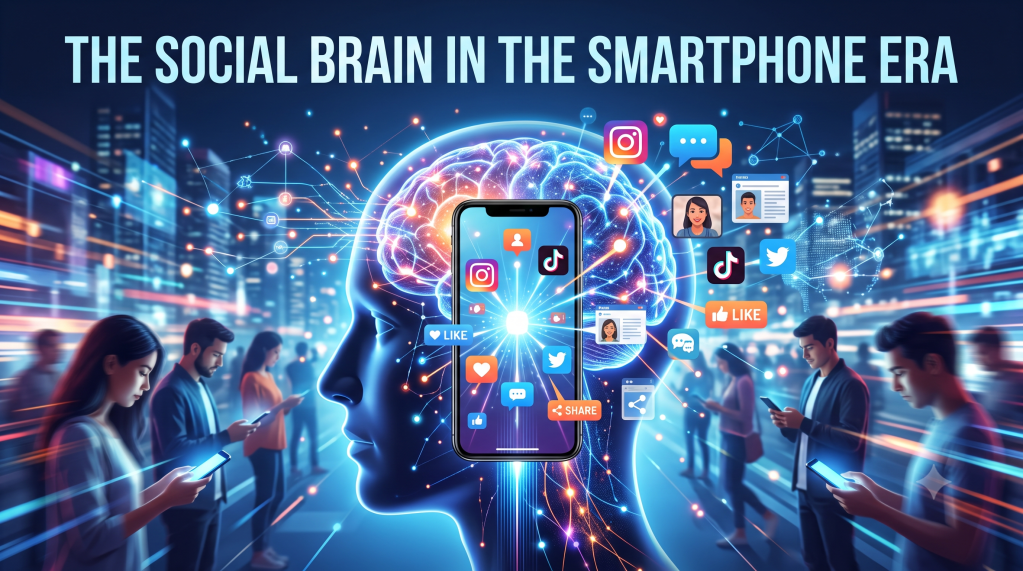
How the 2012 smartphone boom reshaped attention and relationships, and what early research revealed about the brain’s adjustment to constant connectivity.
In the last weeks of 2012, something quiet but historic had already happened in American life. Just a year earlier, only about one in three American adults carried a smartphone. By early 2012, that number had climbed to nearly half, according to survey data released by the Pew Research Center. The device that had begun as a novelty for early adopters was rapidly becoming as ordinary as a set of car keys. People were not just making calls differently. They were checking email at stoplights, texting under restaurant tables, and reaching for a glowing screen during the natural lulls of a conversation — the pause after a joke, the wait for an elevator, the walk from a parking lot to a front door.
This shift did not arrive with a warning label. Nobody sat down and decided that human attention would be reorganized around a rectangle of glass. It happened the way most major behavioral changes happen: gradually, then suddenly, and mostly without anyone noticing the exact moment the old habits gave way to new ones. But researchers in psychology, neuroscience, and sociology were noticing. Around 2012, a wave of studies began asking a question that had barely made sense a decade earlier: what does constant connectivity do to a brain that evolved around rich social interaction, sustained attention, and the slower rhythms of direct human communication?
This piece looks at that moment — the early 2010s tipping point when smartphones stopped being accessories and started being appendages — and at what the science of the time, along with the decade and a half of research that followed, tells us about how continuous digital contact reshaped attention, relationships, and the interior experience of being alone. It is a story about technology, but more precisely, it is a story about the brain meeting a demand it had never faced before: the demand to be reachable, and reaching, without pause.
A Brief History of Being Always On
To understand why 2012 mattered, it helps to see what came before it. Mobile phones had existed for two decades by that point, but for most of their history, they were used the way landlines were used — for discrete, bounded conversations. You called someone, you talked, you hung up. The phone was a tool you picked up and put down.
Two things changed that. The first was the introduction of app-based smartphones in the years following 2007, which turned the phone into a portal for email, social media, games, and news rather than a device built primarily for voice calls. The second, less discussed but arguably more important, was the buildout of affordable mobile data plans and Wi-Fi availability, which meant the portal was open all the time, not just when a person chose to dial a number.
By 2012, this combination had produced something genuinely new in the history of communication technology: a device that was simultaneously a phone, a mailbox, a newspaper, a photo album, a video arcade, and a direct line to nearly everyone a person knew, all small enough to fit in a pocket and check a hundred times a day. Social scientists at the time, including the MIT researcher Sherry Turkle, whose 2011 book Alone Together became a touchstone for this line of inquiry, argued that this convenience carried a psychological cost that had not been fully priced in. Turkle’s central claim was not that technology was inherently harmful, but that it was changing the terms of human closeness — allowing people to feel connected without the vulnerability, patience, and full attention that in-person connection had always required.
The Novelty of Constant Contact
It is worth pausing on how strange this really was from an evolutionary standpoint. Human social behavior developed over hundreds of thousands of years in small groups where communication was immediate, physical, and limited by proximity. You could only talk to the people in front of you. Attention had a natural ceiling because there were only so many conversations a person could have in a day, and only so many faces to track.
The smartphone did not just add a new channel of communication. It removed the natural limits on how many social signals a brain could be asked to process in a given hour. The deeper change was not simply that people communicated more often, but that communication shifted from occasional events into a continuous background condition. A person walking down a street in 2012 might be having a text conversation with a friend, scrolling through a social feed showing dozens of acquaintances’ updates, and half-listening to a companion beside them, all within the same five minutes. The brain’s social systems, shaped by evolution around limited social networks, were suddenly being asked to monitor dozens or hundreds of relationships in a low-grade, continuous way.
What the Science Was Finding in the Early 2010s
The research community’s first serious answers to these questions did not come from smartphone studies specifically, since the technology was still too new to have produced a large body of work. Instead, they came from a broader field already investigating something related: media multitasking.
The Stanford Multitasking Studies
The most influential of these was a 2009 study by Stanford researchers Eyal Ophir, Clifford Nass, and Anthony Wagner, published in the Proceedings of the National Academy of Sciences. The team divided college students into groups based on how often they juggled multiple media streams — texting while watching television, browsing the web while listening to music, and so on — and then tested both groups on basic measures of attention and memory.
The result surprised the researchers themselves. They had expected that people who multitasked heavily would have developed some kind of advantage, perhaps a sharper ability to switch between tasks or filter out distractions. Instead, the heavy multitaskers performed worse on nearly every measure. They were more easily distracted by irrelevant information, slower to switch between mental tasks, and less accurate on basic memory tests. Nass, in interviews at the time, described the heavy multitaskers as unusually susceptible to anything competing for their attention, even when that thing had nothing to do with the task at hand.
This finding mattered because it ran against the popular assumption of the period, which held that younger generations raised on multiple screens were becoming naturally skilled at parallel processing. The Stanford data suggested nearly the opposite: that habitual multitasking was training the brain toward broader, shallower attention rather than toward any genuine ability to do two things well at once. It is important to be precise about what this study did and did not show. It was correlational, comparing people who already differed in their media habits, so it could not prove that multitasking caused the attention differences rather than simply attracting people who already had them. But the pattern was consistent enough across multiple tests that it became a foundational reference point for later research on smartphones specifically.
Early Warnings About Attention Fragmentation
As smartphone ownership climbed through 2012, researchers began extending this line of inquiry to the phone itself. Psychologist Larry Rosen, who had spent years studying technology and behavior, published work around this period describing what he called a growing pattern of “checking habits” — the compulsive, often unconscious urge to glance at a phone every few minutes, driven less by any specific need for information than by a kind of learned restlessness. Rosen’s surveys during this period found that many people, particularly younger adults, reported anxiety when separated from their phones for even short periods. Popular media later gave this behavior the shorthand term nomophobia, short for “no mobile phone phobia.” The concept remains debated and has not been formally recognized as a psychiatric diagnosis. The label was catchy, but the underlying behavioral pattern it described — reflexive checking driven by low-level anxiety rather than deliberate choice — was the more scientifically interesting part.
None of this research, it is worth emphasizing, showed that smartphones were rewiring the brain in any dramatic or irreversible sense. The evidence at the time was behavioral: people were checking their phones more often, multitasking more, and reporting more difficulty concentrating on single tasks for long periods. Whether this reflected lasting changes in neural structure, temporary shifts in habit, or simply a new set of demands on old cognitive systems was, and to some extent still is, an open question that later neuroimaging research would attempt to address with more precision.
The Psychology of the Notification
One of the more interesting threads running through this period concerned not smartphones in general but a very specific feature of them: the notification. A buzz, a chime, a small red badge with a number on it. These signals exploit something psychologists had understood for decades before smartphones existed, a principle sometimes called variable reward.
Why Checking Feels Compulsive
The basic idea, drawn originally from mid-twentieth-century behavioral research on reward schedules, is that unpredictable rewards are more compelling to a brain than predictable ones. A slot machine is a more effective attention hook than a vending machine precisely because you do not know when it will pay off. Every notification carries the same uncertainty. It might be an important message from a boss, a photo from a friend, or nothing more than a promotional alert, and the brain cannot tell which in advance. This uncertainty is what makes checking a phone feel different from checking a mailbox on a fixed schedule. It creates a small, repeating pulse of anticipation, and anticipation itself has been shown in behavioral research to be tied to the brain’s dopamine system, which plays a central role in motivation and the pursuit of reward.
It is worth being careful here, since this is one of the areas where early 2010s commentary sometimes overstated the science. Dopamine is often described in popular writing as a “pleasure chemical” that phones are somehow hijacking, but the more accurate picture from the neuroscience of the period frames dopamine as being more closely tied to wanting and anticipation than to pleasure itself. This is a meaningful distinction. It helps explain why checking a phone can feel urgent and even mildly stressful rather than purely enjoyable, and why people often describe the habit as compulsive rather than pleasurable in the moment.
Fragmented Attention and the Cost of Interruption
A separate but related body of research, much of it summarized by cognitive psychologist Gloria Mark and her collaborators around this period, examined what happens to work and thought when it is repeatedly interrupted. Their studies of office workers found that interruptions created significant recovery costs, with people often taking much longer than expected to return to their previous task and its surrounding train of thought. Applied to smartphone use, this suggested something important: the cost of checking a phone was not just the seconds spent looking at the screen, but the longer period afterward spent regaining lost concentration. A person who checked their phone every ten minutes throughout a workday might never actually reach a state of deep focus at all, cycling instead through a continuous loop of partial attention.
Relationships in the Age of the Glowing Screen
Alongside the attention research, a parallel line of inquiry in the early 2010s looked at what smartphones were doing to face-to-face relationships. This is where Turkle’s work, along with a growing body of sociological research, drew the most public attention.
The Phenomenon of “Phubbing”
Researchers began documenting a behavior that would soon acquire a name: phubbing, a blend of “phone” and “snubbing” coined in 2012 as part of a dictionary campaign in Australia before researchers picked it up to describe the experience of being ignored by someone attending to their phone. Observational studies of the period found this behavior showing up in restaurants, family gatherings, and even therapy waiting rooms, and early survey work suggested that people who experienced frequent phubbing from a partner or friend reported lower relationship satisfaction and greater feelings of exclusion. The underlying mechanism researchers proposed was fairly intuitive: sustained eye contact, attention, and responsive body language are important signals of social bonding shaped by human social evolution, and a phone glancing away mid-sentence interrupts all three at once, even if the interruption lasts only a few seconds.
Turkle’s Argument About Connection Without Vulnerability
Turkle’s broader argument, laid out across her research and public talks during this period, went further than simple distraction. She argued that texting and social media were allowing people to substitute a curated, editable version of connection for the messier, more demanding version that unfolds in real time. A text message can be drafted, revised, and sent at a moment of the sender’s choosing. A face-to-face conversation cannot. Turkle suggested that this control was appealing precisely because real conversation carries genuine risk: the risk of saying the wrong thing, of being misunderstood, of having to sit with an awkward silence. Her concern was that a generation raised with the option to avoid that risk might grow less practiced at tolerating it, and by extension, less comfortable with the depth of relationship that requires tolerating it.
This was, and remains, more of an interpretive argument than a strictly tested hypothesis, and it is important to hold it with appropriate caution. Turkle’s evidence was drawn largely from qualitative interviews rather than controlled experiments, which makes it valuable for generating ideas but less suited to proving causation. Later quantitative research, some of it more mixed in its findings than Turkle’s essays suggested, would go on to complicate parts of this picture, finding that digital communication could supplement rather than replace in-person closeness for many users, particularly when it was used to maintain relationships across distance rather than substitute for relationships nearby.
The Social Brain Meets a New Kind of Crowd
Behind both the attention research and the relationship research sits a deeper question about how the human brain evaluates social information in the first place. Decades of work in social neuroscience, much of it associated with researchers like Robin Dunbar, had already suggested that human social cognition appears to impose constraints on the number of relationships a person can maintain with different levels of intimacy, an idea popularly known as Dunbar’s number, often estimated at around 150. That specific figure has since drawn considerable debate, with later researchers questioning both the statistical methods behind it and whether any single number can capture something as variable as human social capacity.
Smartphones and social media did not raise this ceiling. What they did was flood the space beneath it with far more low-level social information than the brain had ever been asked to process at once. A person in 2012 might see, in the span of a single scrolling session, updates from hundreds of acquaintances, each carrying a small social signal demanding some degree of evaluation: does this matter, does this person matter, should I respond. Multiply that across a day, and the brain was effectively being handed a much larger, much shallower version of the social world it had evolved to navigate in small, deep groups.
Some researchers speculated that this mismatch might explain part of the era’s rising interest in feelings of loneliness despite historically high levels of social contact. The reasoning here should be treated as an emerging hypothesis rather than an established finding: it is plausible that a brain built for a small number of deep bonds experiences a large number of shallow ones as a kind of social noise rather than genuine companionship, but disentangling this effect from other contributors to loneliness during this period, including economic stress and shifting family structures, was and remains a difficult scientific problem.
What This Moment Set in Motion
Looking back from 2026, it is easier to see the early 2010s not as an endpoint but as an opening chapter. The behavioral patterns researchers first documented around 2012 — compulsive checking, fragmented attention, phubbing, the substitution of digital contact for physical presence — did not fade as smartphones became more sophisticated. If anything, later hardware and software developments, including algorithmically tailored feeds and increasingly persuasive notification design, appear to have deepened many of these patterns, giving researchers a much larger and more detailed dataset to study than existed in 2012. Writers like Nicholas Carr had already raised related concerns about attention and deep reading before the smartphone era proper, and later work, including Adam Alter’s writing on persuasive design and Jean Twenge’s research on adolescents and smartphone adoption, extended these questions into new populations and new technologies, though Twenge’s specific claims about causation and generational mental health have themselves been the subject of ongoing scientific debate.
At the same time, the field’s understanding grew more careful. Early claims that smartphones were causing dramatic, fixed changes to the developing brain have generally given way to a more measured picture: one in which digital habits shape attention and social behavior in real but often modifiable ways, and in which individual differences in usage patterns, motivations, and surrounding relationships matter as much as the technology itself. The variable-reward mechanics of the notification, the fragmentation costs documented by researchers like Gloria Mark, and Turkle’s concerns about connection without vulnerability have all held up reasonably well as descriptive accounts of behavior, even as later research has added nuance about when and for whom these effects are strongest.
It is worth stating plainly that this same technology also expanded what social connection could look like. The smartphone made it possible to maintain friendships across long distances, to find communities of shared interest that did not exist locally, and to give people who were isolated by geography, illness, or circumstance access to support networks that simply would not have been available to them before. The story of the social brain in this era is not one of straightforward loss. It is one of trade-offs, in which the same tool that fragmented attention in some contexts restored connection in others.
Conclusion
The years around 2012 marked the moment when a genuinely new question entered scientific conversation: what happens to a social brain that is rarely, if ever, fully offline? The early answers were partial and sometimes overstated in the popular press, but the core observations have proven durable. Constant connectivity changed how attention is allocated across a day, introduced a new category of low-level social monitoring that the brain had not evolved to handle, and altered the texture of ordinary human closeness in ways that researchers are still working to fully map.
What makes this period worth returning to is not that it offered final answers, but that it marked the beginning of a serious, evidence-based effort to understand a technology that had already become inseparable from daily life before anyone fully understood its effects. That effort has continued for well over a decade since, expanding into questions about children’s developing brains, workplace productivity, political polarization, and mental health that the original 2012 researchers could only gesture toward. The smartphone did not simply give people a new tool. It placed the social brain inside a new environment — one where connection became continuous, attention became contested, and adaptation became one of the defining psychological challenges of the modern era.
Scientific References
Pew Research Center. “Nearly Half of American Adults Are Smartphone Owners.” March 2012.
Ophir, E., Nass, C., & Wagner, A. D. “Cognitive Control in Media Multitaskers.” Proceedings of the National Academy of Sciences, 106(37), 2009.
Turkle, S. Alone Together: Why We Expect More from Technology and Less from Each Other. Basic Books, 2011.
Rosen, L. D. iDisorder: Understanding Our Obsession with Technology and Overcoming Its Hold on Us. Palgrave Macmillan, 2012.
Mark, G., Gudith, D., & Klocke, U. “The Cost of Interrupted Work: More Speed and Stress.” Proceedings of the SIGCHI Conference on Human Factors in Computing Systems, 2008.
Dunbar, R. I. M. “Neocortex Size as a Constraint on Group Size in Primates.” Journal of Human Evolution, 22(6), 1992.
Carr, N. The Shallows: What the Internet Is Doing to Our Brains. W. W. Norton & Company, 2010.
Alter, A. Irresistible: The Rise of Addictive Technology and the Business of Keeping Us Hooked. Penguin Press, 2017.
Twenge, J. M. iGen: Why Today’s Super-Connected Kids Are Growing Up Less Rebellious, More Tolerant, Less Happy — and Completely Unprepared for Adulthood. Atria Books, 2017.
Odgers, C. L., & Jensen, M. R. “Adolescent Development and Growing Divides in the Digital Age.” World Psychiatry, 22(3), 2023.









