
Originally published in July 2013 and comprehensively updated/edited in July 2026.
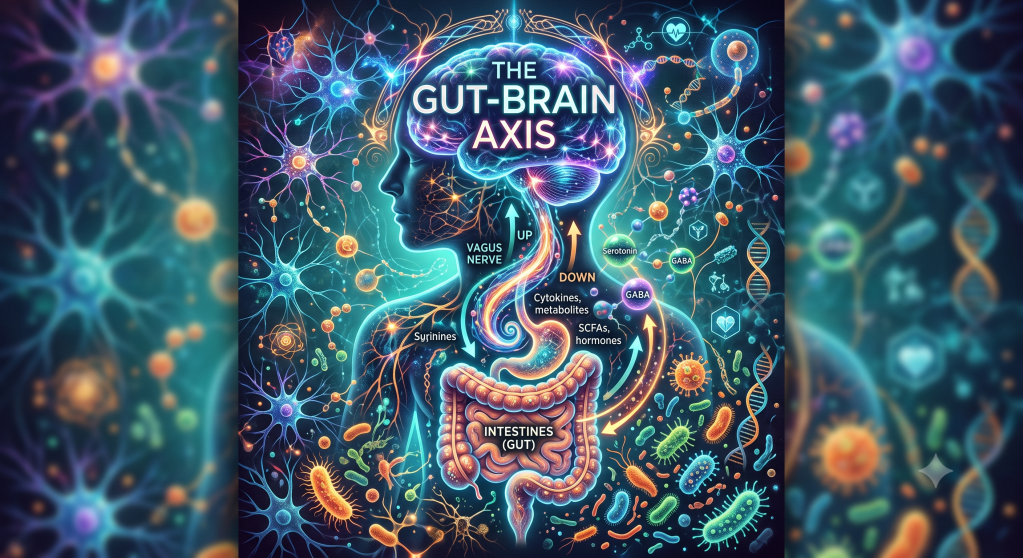
How 2013 studies on mice and yogurt-eating volunteers launched the gut-brain axis, and what a decade of follow-up research has confirmed, revised, or left unresolved.
In the summer of 2013, a quiet shift was underway in how scientists talked about the human body. For most of the twentieth century, the trillions of bacteria living in the human intestine were treated as background noise at best and a source of disease at worst. Doctors worried about the microbes that caused infections. Nobody spent much time wondering what the harmless, everyday bacteria in a person’s gut might be doing to their mood. That assumption was starting to crack. The Human Microbiome Project, a large federal research effort that had spent years cataloging the bacteria living on and inside the human body, had released its major findings the year before, revealing the enormous scale and diversity of the microbial communities living on and inside the human body. Around the same time, a small but growing group of researchers began asking an odd question: could the bacteria in someone’s gut be talking to their brain?
The idea sounded far-fetched to many scientists at the time, and to a lot of ordinary readers it still does. The gut and the brain seem like separate systems, one handling digestion and the other handling thought. But a series of animal experiments, followed by a landmark human study published in 2013, began to suggest that the two systems were in constant conversation, and that the microscopic organisms in the digestive tract might have a hand in shaping anxiety, mood, and even social behavior. This idea became known as the gut-brain axis, and it opened one of the fastest-growing areas of neuroscience research in the years that followed. This piece traces how the idea took shape, what the founding studies actually showed, and how the science has matured since then.
A New Organ Comes Into View
To understand why the gut-brain axis caught on so quickly, it helps to understand what was happening in microbiology more broadly. For most of the history of medicine, bacteria could only be studied by growing them in a lab dish, a method that missed the vast majority of species living in the human gut because most gut bacteria will not grow outside the body. The arrival of cheap genetic sequencing technology in the 2000s changed that. Researchers could now identify bacteria directly from their DNA, without needing to culture them first. This made it possible, for the first time, to get a reasonably complete picture of the roughly one thousand bacterial species that can be found across different human guts.
What researchers found was striking. The gut microbiome, as the collection of these bacteria came to be called, was not a passive tenant. It produced vitamins, broke down fiber the human body could not digest on its own, trained the immune system, and manufactured a surprising range of chemical compounds. Some of those compounds were involved in pathways related to brain signaling, including systems involving serotonin, dopamine, and gamma-aminobutyric acid, usually shortened to GABA. That overlap did not prove the gut was influencing the brain, but it was enough to make a handful of researchers curious about whether there was more to the story.
What Mice Without Bacteria Taught Scientists
The earliest and most persuasive evidence came not from humans but from a peculiar category of laboratory mice known as germ-free mice. These animals are raised in sealed, sterile environments from birth so that no bacteria, viruses, or other microbes ever colonize their bodies. Because researchers can control exactly which bacteria, if any, a germ-free mouse is exposed to, these animals became a useful tool for testing whether gut bacteria affect behavior.
A Japanese research team led by Nobuyuki Sudo had shown as early as 2004 that germ-free mice reacted more strongly to physical stress than normal mice, and that introducing a single bacterial species into their guts early in life could partially reverse that heightened stress response. That early finding did not get much attention outside specialist circles, but it planted a seed. In 2011, two more widely cited studies pushed the idea further. A Swedish team led by Rochellys Diaz Heijtz found that germ-free mice showed different patterns of gene activity in brain regions involved in movement and anxiety, along with more exploratory, less anxious behavior than mice with normal gut bacteria. A separate Canadian study led by Karen-Anne Neufeld reported a similar pattern, with germ-free mice appearing less anxious on standard behavioral tests than mice raised with a typical gut microbiome. Together, these studies suggested that the presence or absence of gut bacteria during early development could shape how the brain wired itself, and how an animal responded to stress later in life.
Perhaps the most widely discussed of these early animal studies came from a McMaster University team led by Javier Bravo, published in 2011. The researchers fed healthy mice a specific probiotic strain, Lactobacillus rhamnosus, and found that the treated mice showed fewer signs of anxiety and depression-like behavior on standard tests, along with changes in GABA receptor activity in several brain regions. When the researchers severed the vagus nerve, a long nerve that runs between the brainstem and the gut, the behavioral effects disappeared entirely. That result pointed to a specific physical pathway: the vagus nerve appeared to be one of the routes through which gut bacteria could influence the brain, rather than the effect being purely chemical or coincidental.
Listening Through the Vagus Nerve
The vagus nerve had been known to anatomists for centuries, but its role as a possible communication line between gut bacteria and brain function was new. The vagus nerve carries an enormous amount of sensory information from the internal organs up to the brainstem, and a majority of its fibers actually run in that direction, from body to brain, rather than the reverse. Gut bacteria do not touch the vagus nerve directly, but they interact with the cells lining the intestinal wall, which are in close contact with vagal nerve endings. Researchers proposed that bacterial byproducts, along with signals from gut hormones and immune cells activated by the microbiome, could influence the messages the vagus nerve sends to the brain.
This was one of at least three plausible communication channels researchers were investigating by the early 2010s. Besides the vagus nerve, gut bacteria were shown to influence the immune system, which produces signaling molecules called cytokines that can affect brain function when they enter circulation. Bacteria also produce short-chain fatty acids and other metabolic byproducts that can cross into the bloodstream and, in some cases, reach the brain. No single pathway fully explained the animal findings, and researchers were careful to describe the gut-brain axis as a network of overlapping signals rather than one clean line of communication.
From Mice to Humans: The Yogurt Study
Animal studies are useful for establishing that something is biologically possible, but they cannot confirm that the same mechanism operates in people. That gap was addressed, at least partially, by a 2013 study from a team at the University of California, Los Angeles led by Kirsten Tillisch and Emeran Mayer, both established figures in gut-brain research. <cite index=”5-1″>The researchers divided 36 healthy women into three groups: one group ate a yogurt containing a mix of several probiotic bacteria twice a day for four weeks, a second group ate a dairy product that looked and tasted the same but had no probiotics, and a third group ate no product at all.</cite> Before and after the four-week period, each participant underwent a brain scan while resting and while performing a task that involved matching pictures of angry or frightened faces.
<cite index=”1-1,6-1″>The women who had consumed the probiotic yogurt showed reduced activity, compared with the other two groups, across a wide network of brain regions involved in processing sensory information and emotion during the face-matching task.</cite> The study did not show that probiotic yogurt made participants happier or less anxious; the women reported no differences in mood or anxiety symptoms across groups. Its significance was narrower and, in some ways, more interesting: it demonstrated that altering gut microbial exposure was associated with measurable changes in brain activity, independent of any change in how participants said they felt. That distinction, between a measurable biological effect and a felt psychological one, became a recurring theme in the research that followed, and it was one of the first pieces of evidence that a dietary change involving gut bacteria could measurably alter brain activity in healthy human adults, not just in mice. Science journalists at the time seized on the finding, and headlines about yogurt changing the brain appeared in outlets around the world. The researchers themselves were considerably more cautious in the original paper, describing the results as an early signal that merited further investigation rather than a demonstrated treatment for anything.
The Autism Question and the Need for Caution
Interest in the gut-brain axis accelerated further after a 2013 study from Caltech researcher Elaine Hsiao and colleagues examined a mouse model relevant to autism spectrum conditions. The mice in this model, exposed to an immune-triggering agent during their mothers’ pregnancies, displayed behaviors that researchers use as rough proxies for some features of autism in humans, including reduced social interaction and repetitive movements. The Hsiao team found that these mice also had gut barrier abnormalities and a different bacterial composition than typical mice, and that treating them with a particular bacterial strain, Bacteroides fragilis, reduced some of the behavioral differences and corrected the gut lining problems.
This study is worth discussing carefully, because it has often been oversimplified in popular coverage into a claim that gut bacteria cause autism, or that probiotics can treat it. Neither claim is supported by the research. The Hsiao study was conducted in a specific mouse model of maternal immune activation, which captures only one proposed contributing pathway among many that researchers associate with autism spectrum conditions in humans, a group of conditions with substantial genetic and developmental complexity. The behavioral measures used in mice are approximations of a few observable traits, not a model of autism as a whole. What the study did establish, credibly, is that gut bacteria composition and behavior were linked within this particular animal model, and that manipulating the microbiome could shift some of those behavioral measures. That is a meaningful finding for understanding biological mechanisms, but it sits several steps removed from any claim about treating autism in people.
How the Story Has Evolved Since 2013
More than a decade on, the gut-brain axis has grown from a niche curiosity into one of the more active areas of biomedical research, and the picture has become both richer and more cautious. The animal evidence from the early 2010s has held up reasonably well and been extended considerably. Researchers have identified additional pathways by which gut bacteria appear to influence brain development, immune signaling, and stress hormone regulation, and the role of the vagus nerve as one communication pathway has continued to receive support from later research.
The human side of the story has advanced more slowly, and the field has become notably more self-critical about it. <cite index=”14-1″>Human trials testing probiotic supplements, generally referred to in this context as psychobiotics, on outcomes such as anxiety, stress, and mood have produced results that vary considerably depending on the bacterial strain, the population studied, and the way outcomes were measured.</cite> <cite index=”11-1″>Researchers reviewing this body of work point to persistent limitations, including short trial durations often lasting only a few weeks to a few months, small and demographically narrow samples, and inconsistent reporting of which specific bacterial strains were used, all of which make it difficult to draw firm conclusions or compare results across studies.</cite> A newer category of interventions, sometimes called postbiotics, uses inactive bacteria or the metabolic byproducts bacteria produce rather than live organisms, on the theory that some of the beneficial signaling does not require living bacteria to reach the gut intact. Evidence for these approaches remains at an early stage as well.
<cite index=”10-1″>Mechanistic research has continued to fill in detail about how gut bacteria and the brain communicate, describing a combination of immune modulation, direct neural signaling through the autonomic nervous system and vagus nerve, and the production of metabolites such as short-chain fatty acids and neurotransmitter-related compounds.</cite> What has not emerged, even after more than a decade of research, is a validated clinical treatment that reliably uses gut bacteria to treat a diagnosed mental health condition in general clinical practice. Regulatory agencies have also struggled to classify and standardize microbiome-based products, which has slowed the translation of promising laboratory findings into approved therapies.
What the Evidence Actually Shows
It is worth being explicit about what a decade and a half of gut-brain research has and has not established, because the topic is prone to overstatement in popular science writing. The animal evidence for a genuine, mechanistically traceable connection between gut bacteria and brain function is fairly strong within the specific models tested. The human evidence for measurable effects of dietary or probiotic interventions on brain activity, as in the Tillisch study, is real but modest, and the evidence for meaningful clinical benefit in diagnosed anxiety or depression remains mixed and preliminary. Correlational studies showing that people with depression or anxiety often have different gut bacteria compositions than people without those conditions are common in the literature, but correlation of this kind cannot establish which direction the influence runs, since mood, diet, stress, and medication use can all independently reshape gut bacteria. Distinguishing a genuine causal pathway from a downstream consequence of illness remains one of the central unresolved challenges in the field.
Why This Idea Resonated Beyond the Lab
Part of what made the gut-brain axis such a durable subject of public fascination was timing. The early 2010s were a period of growing interest in nutrition, wellness, and the idea that everyday choices about food and lifestyle might have outsized effects on mental well-being, a cultural mood that predated the science and arguably shaped how eagerly it was received. A finding suggesting that yogurt could change brain activity fit neatly into an existing appetite for stories connecting the body’s internal ecosystem to psychological experience. The framing of gut bacteria as a kind of hidden organ, sometimes described informally as a second brain, gave the research an intuitive appeal that made it easy to communicate, even when the underlying findings were narrower and more provisional than the popular framing suggested. That gap between careful laboratory findings and enthusiastic public interpretation is a recurring pattern in science communication, and the gut-brain axis became one of its more visible modern examples.
Conclusion
The gut-brain axis began as a set of unusual observations in mice and grew, within a few years, into one of the more actively studied relationships in biology. The core insight has proven durable: the gut and the brain are not separate systems operating in isolation, but are connected through the vagus nerve, the immune system, and a steady traffic of bacterial metabolites that can influence how the brain processes stress and emotion. That much appears well supported by the accumulated evidence. What has proven far harder to establish is how directly, how consistently, and how usefully that connection can be leveraged in human health, and the field has moved from early excitement toward a more measured, evidence-driven phase focused on strain-specific mechanisms and better-designed clinical trials.
Looking forward, the trajectory of gut-brain research mirrors that of many young scientific fields: an initial wave of striking, easily summarized findings, followed by a longer and less dramatic period of refinement and correction. The questions that mattered in 2013—whether gut bacteria could influence mood and behavior—have not been answered with a simple yes or no. Instead, they have evolved into more precise questions about which organisms, which biological pathways, and which individuals may be affected.
Scientific References
Sudo, N., Chida, Y., Aiba, Y., et al. (2004). Postnatal microbial colonization programs the hypothalamic-pituitary-adrenal system for stress response in mice. Journal of Physiology, 558(1), 263–275.
Diaz Heijtz, R., Wang, S., Anuar, F., et al. (2011). Normal gut microbiota modulates brain development and behavior. Proceedings of the National Academy of Sciences, 108(7), 3047–3052.
Neufeld, K. M., Kang, N., Bienenstock, J., & Foster, J. A. (2011). Reduced anxiety-like behavior and central neurochemical change in germ-free mice. Neurogastroenterology & Motility, 23(3), 255–264.
Bravo, J. A., Forsythe, P., Chew, M. V., et al. (2011). Ingestion of Lactobacillus strain regulates emotional behavior and central GABA receptor expression in a mouse via the vagus nerve. Proceedings of the National Academy of Sciences, 108(38), 16050–16055.
Hsiao, E. Y., McBride, S. W., Hsien, S., et al. (2013). Microbiota modulate behavioral and physiological abnormalities associated with neurodevelopmental disorders. Cell, 155(7), 1451–1463.
Tillisch, K., Labus, J., Kilpatrick, L., et al. (2013). Consumption of fermented milk product with probiotic modulates brain activity. Gastroenterology, 144(7), 1394–1401.
Collins, S. M., & Bercik, P. (2013). Gut microbiota: Intestinal bacteria influence brain activity in healthy humans. Nature Reviews Gastroenterology & Hepatology, 10(6), 326–327.
Cryan, J. F., & Dinan, T. G. (2012). Mind-altering microorganisms: The impact of the gut microbiota on brain and behaviour. Nature Reviews Neuroscience, 13(10), 701–712.
Slykerman, R. F., et al. (2025). Precision psychobiotics for gut-brain axis health: Advancing the discovery pipelines to deliver mechanistic pathways and proven health efficacy. Microbial Biotechnology.
Ghahari, S., et al. (2026). Psychobiotics and the microbiota-gut-brain axis: Emerging paradigms in mental health modulation. Experimental Physiology.









