
Originally published in August 2013 and comprehensively updated/edited in July 2026.
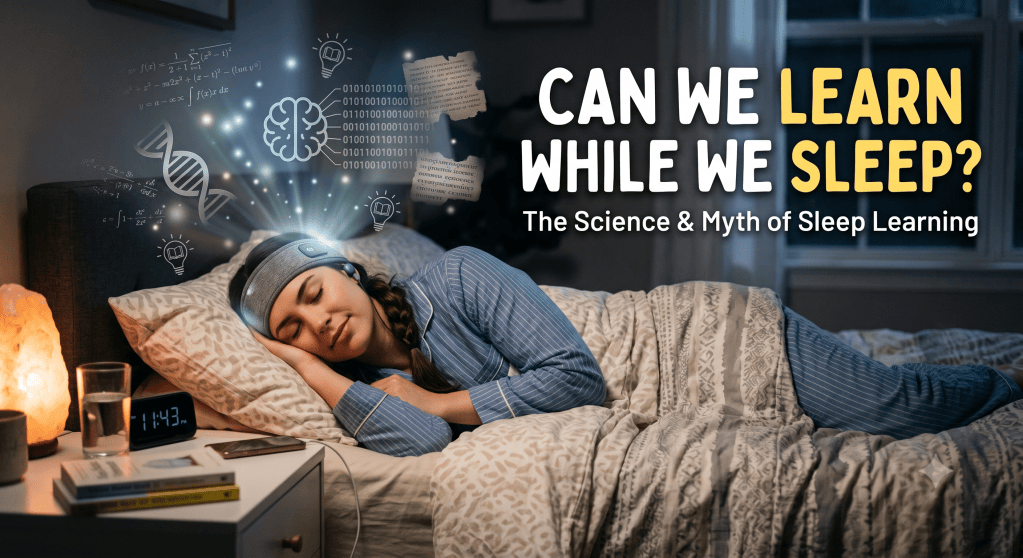
Targeted memory reactivation research shows sleep can selectively strengthen specific memories using sound and scent cues, reshaping what we know about learning.
In the early 2010s, a certain kind of ambition was in the air. Podcasts promised to make people smarter during their commutes. Language apps promised fluency in a matter of weeks. Somewhere in that same cultural moment, an old idea resurfaced with new scientific backing: what if you could learn while you slept? The notion was not new. Recordings promising to teach French or build confidence through a whispering pillow speaker had circulated since at least the 1950s, sold to a public eager for shortcuts. Sleep researchers had mostly dismissed the concept, and for good reason. Early tests found no evidence that a sleeping brain could absorb new vocabulary or facts played through a speaker. But by 2013, a related and more scientifically defensible idea had taken hold in laboratories around the world. It was not about learning something entirely new while unconscious. It was about strengthening what a person had already learned, by nudging the sleeping brain to revisit it.
This technique came to be called targeted memory reactivation, or TMR. It did not promise to teach algebra to a sleeping brain that had never encountered algebra. Instead, it worked with material a person had already studied, using carefully timed sensory cues, usually a sound or a smell, to selectively reawaken specific memories during sleep and make them stick more firmly. The distinction matters enormously, both scientifically and culturally. It separates a phenomenon with real experimental support from decades of pseudoscientific hopefulness about pillow speakers and hypnopedia tapes. Understanding how targeted memory reactivation works, and how it fits into a much older story about what sleep does for the brain, says something interesting about memory, attention, and the limits of what conscious effort can accomplish on its own.
The Old Dream of Sleep-Learning
The fantasy of learning during sleep has a long pedigree. Aldous Huxley’s 1932 novel Brave New World depicted children being conditioned through nighttime whispers, a vision that captured a cultural fascination with shortcuts to knowledge and, more unsettlingly, with the possibility of shaping minds without their consent. In the decades that followed, companies sold sleep-learning kits promising that students could master a foreign language or improve their memory simply by playing a tape while they dozed. The idea appealed to something deeply human: the wish to convert unproductive hours into productive ones, to make the twenty-four-hour day yield more than it naturally gives.
Scientifically, though, the early sleep-learning claims did not hold up. Researchers in the 1950s and 1960s who tested these methods rigorously found that people could not learn new factual information, like foreign vocabulary, from audio played while they were fully asleep. Some of the reported successes turned out to reflect brief moments of wakefulness that participants did not recall, rather than genuine learning during sleep itself. By the late twentieth century, sleep-learning had become something of a punchline in psychology courses, a cautionary tale about mistaking correlation for a real effect.
What eventually revived interest in the underlying question was not renewed enthusiasm for pillow speakers, but a shift in how researchers understood sleep itself. Rather than treating sleep as a passive, brain-off state, a growing body of research beginning in the late twentieth century suggested it was an active period during which the brain reprocesses the day’s experiences. This reframing set the stage for a much more modest, and much more scientifically credible, version of the sleep-learning dream.
Memory Consolidation: What Sleep Actually Does
To understand targeted memory reactivation, it helps to understand what researchers mean when they talk about memory consolidation. When a person learns something new, whether it is a list of vocabulary words, a route through an unfamiliar city, or the fingering for a piano piece, that information is initially stored in a fragile, easily disrupted form. Over time, and especially during sleep, the brain appears to stabilize these memories, weaving them more durably into existing knowledge and, in some cases, extracting general patterns from specific experiences.
A central piece of evidence for this process comes from studies of the hippocampus, a small seahorse-shaped structure deep in the brain that plays an outsized role in forming new memories. Research using rodents in the 1990s found that the pattern of brain cell activity recorded while an animal navigated a maze during the day would reappear, compressed and replayed, in the same brain regions while the animal slept afterward. This replay was not random noise. It closely mirrored the sequence of locations the animal had actually visited, suggesting the sleeping brain was, in some sense, rehearsing the day’s experience.
Human studies using brain imaging and behavioral testing built on this foundation throughout the 2000s and into the 2010s, generally supporting the idea that sleep, and slow-wave sleep in particular, contributes to strengthening newly formed declarative memories, the kind of explicit, fact-based memories a person can consciously describe. Slow-wave sleep, sometimes called deep sleep, is characterized by large, synchronized waves of brain activity and tends to dominate the earlier part of the night. Researchers proposed that during these slow oscillations, the hippocampus effectively communicates with the neocortex, gradually transferring and integrating memories into longer-term storage. This account, often called active systems consolidation, does not suggest sleep is required for all memory to persist. Rather, it suggests sleep offers conditions that are particularly favorable for certain kinds of memory processing, largely because the brain is shielded from the constant stream of new sensory information that competes for attention during waking hours.
If sleep spontaneously replays and strengthens memories from the day, an obvious question follows. Could this replay process be influenced from the outside? Could researchers, in effect, choose which memories the sleeping brain rehearses?
The Birth of Targeted Memory Reactivation
The answer, it turned out, was yes, and the demonstration came through an elegant use of the senses. In 2007, a research team led by Björn Rasch published a study in the journal Science that became a turning point for the field. Participants learned the locations of pairs of picture cards on a grid, a task that depends heavily on the hippocampus, while a rose-like odor was present in the room. Later, during a nap, researchers quietly reintroduced the same odor while participants slept, without waking them. Those exposed to the odor again during slow-wave sleep performed <cite index=”13-1″>better on the memory task afterward, an improvement that did not occur when the same odor was presented during rapid eye movement (REM) sleep or while participants were awake, and did not occur at all for a hand-tapping task that does not rely on the hippocampus.</cite> Brain imaging further showed that <cite index=”13-1″>the odor triggered activity in the hippocampus during slow-wave sleep, mirroring the pattern seen when the memory was first formed.</cite>
Two years later, a team led by Ken Paller and John Rudoy at Northwestern University extended the idea using sound instead of smell. In their study, participants learned the on-screen locations of various objects, each accompanied by a characteristic sound, a meow paired with a cat image, a whistle paired with a kettle, and so on. During a subsequent nap, a subset of these sounds was played back quietly while participants slept. Upon waking, participants were more accurate at recalling the locations of objects whose sounds had been replayed during sleep than objects whose sounds had not been played back. Because sound, unlike a diffuse odor, can be tied to individual, specific memories rather than an entire learning session, this study demonstrated something odor-based cueing could not: the ability to selectively strengthen particular memories, one at a time, while a person slept.
The term “targeted memory reactivation” was coined a few years later by Delphine Oudiette and Ken Paller, in a 2013 review that helped establish the technique as a distinct, structured area of research rather than a scattered set of individual experiments. The formulation is worth stating plainly, because it is easy to conflate with the older, discredited sleep-learning idea. TMR does not teach new information to a sleeping brain. It relies on associations already formed during waking learning, then uses a cue from that learning episode, a smell, a sound, sometimes a light touch, to bias which memories the sleeping brain revisits and strengthens.
How the Technique Actually Works
The basic experimental structure recurs across most TMR studies with only modest variation. First, a person learns some kind of material while awake, such as word pairs, spatial locations, or a sequence of finger movements, and each item or a subset of items is paired with a distinct sensory cue. Later, usually during a nap or overnight sleep monitored with electroencephalography (EEG) to track brain wave patterns, the researchers quietly present some of those same cues again, typically during slow-wave sleep. Because the cues are presented at low volume or intensity, participants generally do not wake up, and many report no conscious awareness that anything happened during the night. When they wake and are tested again, memories associated with the replayed cues tend to be recalled more accurately, or forgotten more slowly, than memories that were never cued during sleep.
Timing turns out to matter a great deal. Slow-wave sleep is characterized by large, slow brain oscillations, and researchers have found that cues delivered during a particular phase of these oscillations produce stronger effects than cues delivered at other moments, or during other sleep stages. This has led to more technically sophisticated versions of the approach, sometimes described as closed-loop TMR, in which a computer system monitors a sleeper’s brain activity in real time and delivers cues precisely timed to specific moments within the ongoing slow oscillation, rather than simply playing sounds at fixed intervals throughout the night. <cite index=”1-1″>This approach has been extended to examine effects across declarative, procedural, and emotional memory domains, alongside more precise investigation of the optimal timing of cues within the brain’s ongoing oscillatory activity.</cite>
The effect sizes reported across these studies are generally modest rather than dramatic. A cued word pair might be recalled with somewhat higher accuracy than an uncued one, a difference of a few percentage points rather than a wholesale transformation of memory performance. This is worth stating clearly, because popular coverage of sleep research has a habit of overselling incremental findings. TMR is supported by a growing body of experimental evidence, but it produces a nudge, not a miracle.
Beyond the Laboratory: Real-World Applications
For much of its early history, TMR research took place under controlled laboratory conditions, with word pairs and picture grids chosen for their experimental tractability rather than their real-world relevance. Over the past decade, researchers have increasingly asked whether the technique holds up outside that controlled environment, and whether it might be useful for something people actually care about, like learning a second language.
Several studies have examined whether TMR can strengthen vocabulary learning specifically. In one line of work, researchers had participants learn foreign-language word pairs and then cued a subset of those words with associated sounds during subsequent sleep, finding improved recall for the cued vocabulary relative to uncued items. More recent research has pushed this out of the sleep laboratory entirely. One study used a wearable device that could detect a participant’s sleep stage at home and deliver auditory cues at the appropriate moment, without any technician present, and found that cued pseudowords were translated more accurately the following morning than uncued items, with the size of the improvement tracking a brain-wave signature, known as sleep spindle activity, that has separately been linked to successful memory consolidation. Other researchers have tested TMR in more unusual real-world settings still, including a classroom-adjacent study in which odor cues associated with a history lesson were used at home during students’ normal sleep, with encouraging effects on later recall of the lesson content.
The technique has also been explored well beyond academic learning. One particularly striking line of research, led by Anat Arzi and colleagues at the Weizmann Institute of Science, examined whether TMR-like conditioning could influence a behavior with obvious public health relevance: cigarette smoking. In this study, researchers paired the smell of cigarettes with a foul, aversive odor while nicotine-dependent participants slept, aiming to build an unpleasant association with smoking outside of conscious awareness. <cite index=”20-1″>Participants who received this pairing during non-REM and REM sleep subsequently reduced the number of cigarettes they smoked in the following week, an effect that did not appear when the same odor pairing was delivered during wakefulness.</cite> The result generated considerable interest, in part because it suggested that sleep-based cueing might do more than sharpen recall of a word list. However, this finding should be viewed as a demonstration of possibility rather than a proven therapeutic approach, drawn from a single study with a modest sample and a one-week follow-up window. It hinted at the possibility of subtly reshaping emotional associations and, by extension, behavior, without requiring the conscious effort and willpower that habit change normally demands. Researchers have since discussed similar approaches as potentially relevant to other conditions involving unwanted associations, including certain anxiety-related and compulsive behaviors, though this remains an early and comparatively underdeveloped area relative to the vocabulary and spatial memory research.
What the Evidence Does Not Show
It is worth being precise about the limits of this research, because the gap between what TMR studies demonstrate and what a casual reader might assume they demonstrate is significant. TMR has not been shown to create new memories from nothing. Every documented effect depends on prior waking learning; the sleeping brain is being nudged to rehearse something it already partially knows, not taught something for the first time. This distinction is what separates TMR from the pillow-speaker fantasies of the twentieth century, and it is a distinction that gets lost with some regularity in headlines promising that sleep can replace studying.
The size of the benefit also matters. Most published effects are statistically reliable but modest in magnitude, and they tend to emerge most clearly for the kind of hippocampus-dependent declarative memory used in laboratory word-pair and location tasks. Evidence for procedural learning, the kind involved in physical skills, is more mixed, with some studies finding benefits and others finding none, depending on the type of task and how it is cued. There is also ongoing scientific debate about individual variability: not everyone shows the same degree of benefit from cueing, and researchers do not yet have a full account of why some people’s memories respond robustly to TMR while others show little change. Sample sizes in this line of research have often been small by the standards of clinical trials, which means that some specific findings await replication in larger and more diverse groups before they can be considered firmly established.
Finally, most of what has been studied involves fairly narrow, discrete pieces of information: word pairs, object locations, short melodies. Whether TMR meaningfully assists with the kind of complex, integrated understanding required for something like mastering a new professional skill or reasoning through an unfamiliar problem is a much less settled question, and one that current research has only begun to probe.
Why This Research Matters Beyond the Sleep Lab
Part of what makes targeted memory reactivation interesting is not simply the narrow technical finding, but what it implies about the architecture of memory more broadly. The fact that a smell or sound encountered days or weeks earlier can still, quite specifically, steer which memories get strengthened during sleep suggests that memory consolidation is not a single, undifferentiated process happening uniformly across everything a person has recently experienced. It appears to be selective, and that selectivity can be influenced from outside the sleeper’s conscious control.
This has a certain resonance with a broader shift that has taken place in memory science over the past two decades: the recognition that consolidation is not simply a matter of a fragile memory becoming a durable one through the passive fixing of neural connections. It looks more like an ongoing, editable process, one in which memories can be strengthened, reorganized, or in some cases weakened, well after the original learning experience. TMR research has become one of the more direct experimental windows into that process, because researchers can intervene at a very specific moment, during a very specific sleep stage, and observe a measurable downstream effect on what a person remembers the next morning.
There is also a more human dimension to why this line of research continues to draw attention. People spend roughly a third of their lives asleep, and the idea that this time is not simply lost to productivity, but may in fact be doing quiet, selective work on behalf of the things a person cared about while awake, offers a different way of thinking about rest. It reframes sleep not as an obstacle to a productive life, but as a genuinely active participant in it, one with its own logic about what gets kept and what fades.
The Ethics of Editing Sleep
The fact that memories can be strengthened, reorganized, or in some cases weakened by a cue delivered while a person is unconscious raises questions that go beyond the laboratory. If a sound or a smell can nudge which memories the sleeping brain rehearses, the obvious next question is who gets to choose the cue, and for what purpose.
In a research setting, this is straightforward. A participant consents to the study, chooses to wear the device or sleep in the lab, and knows in advance what is being tested. Outside that setting, the picture gets murkier. Consumer sleep-tracking devices already attempt to estimate sleep stages outside the laboratory, and the same closed-loop technology used to time TMR cues in the lab is not far removed from what ships in some commercial sleep trackers and white-noise machines today. It is not difficult to imagine a future in which a device marketed for better rest also quietly plays cues tied to a study app, a habit tracker, or, more troublingly, a product a company would like a sleeper to associate with something pleasant. Advertising has always looked for the edges of conscious attention; a technique that works specifically because the recipient is not awake to notice or resist it would represent a meaningful escalation of that pursuit, and one that existing advertising regulations were not written to address.
There are more clearly beneficial directions as well, which is part of what makes the ethical picture genuinely mixed rather than simply cautionary. The same mechanism that can strengthen a helpful memory or a wanted association, as in the smoking-cessation work described above, could in principle be used to soften the emotional intensity of a traumatic memory, an idea some researchers have begun to explore in the context of anxiety and fear-related learning. That possibility is appealing precisely because current treatments for conditions like post-traumatic stress disorder can be difficult and distressing to undergo while awake. But it invites the same question from the opposite direction: if a memory’s emotional weight can be adjusted without the rememberer’s active participation or awareness, who decides which memories are the right ones to change, and on whose authority. These are not questions current science is equipped to answer, and the technology remains far too limited and unreliable today to make them urgent. But the underlying dynamic, that consciousness may not be a strict precondition for influencing what the brain retains and how it feels about it, is worth sitting with before the technology, rather than after.
Looking Forward
The 2013 origins of this research sat at an interesting cultural moment, one increasingly preoccupied with optimizing every hour of the day, including the hours previously considered unproductive by definition. In the years since, that preoccupation has, if anything, intensified, with consumer sleep-tracking devices and apps promising ever more granular insight into a night’s rest. Targeted memory reactivation research has followed a parallel trajectory: from a phenomenon documented under carefully controlled laboratory conditions, cueing a nap with a rose-like odor, to a technique now being tested with wearable EEG devices in people’s own bedrooms.
What has not changed is the underlying scientific caution that should accompany any of these findings. TMR remains a research tool with genuine experimental support for specific, narrow forms of memory, not a shortcut around the effortful work of learning. Where this line of inquiry goes next likely depends on questions that remain open today: how durable these effects are over weeks and months rather than the following morning, how much individual variability in brain physiology shapes who benefits, and whether more complex, real-world learning, rather than word pairs and picture grids, can be meaningfully assisted by a well-timed sound in the dark. Sleep researchers are also increasingly interested in whether the reverse process, using sleep cues to weaken or reframe unwanted memories, might eventually offer a complementary tool for certain mental health conditions, an application that remains considerably earlier in its scientific development than the memory-strengthening work described here.
For now, the more modest and better-supported conclusion stands on its own as a fairly remarkable finding: the sleeping brain is not a blank, inert stretch of downtime between one day’s demands and the next. It is doing something, and under the right experimental conditions, that something can be gently, selectively guided.
Scientific Reference
Rasch, B., Büchel, C., Gais, S., & Born, J. (2007). Odor cues during slow-wave sleep prompt declarative memory consolidation. Science, 315(5817), 1426–1429.
Rudoy, J. D., Voss, J. L., Westerberg, C. E., & Paller, K. A. (2009). Strengthening individual memories by reactivating them during sleep. Science, 326(5956), 1079.
Oudiette, D., & Paller, K. A. (2013). Upgrading the sleeping brain with targeted memory reactivation. Trends in Cognitive Sciences, 17(3), 142–149.
Wilson, M. A., & McNaughton, B. L. (1994). Reactivation of hippocampal ensemble memories during sleep. Science, 265(5172), 676–679.
Arzi, A., Holtzman, Y., Samnon, P., Eshel, N., Harel, E., & Sobel, N. (2014). Olfactory aversive conditioning during sleep reduces cigarette-smoking behavior. Journal of Neuroscience, 34(46), 15382–15393.
Hu, X., Cheng, L. Y., Chiu, M. H., & Paller, K. A. (2020). Promoting memory consolidation during sleep: A meta-analysis of targeted memory reactivation. Psychological Bulletin, 146(3), 218–244.
Schreiner, T., & Rasch, B. (2015). Boosting vocabulary learning by verbal cueing during sleep. Cerebral Cortex, 25(11), 4169–4179.
Rasch, B., & Born, J. (2013). About sleep’s role in memory. Physiological Reviews, 93(2), 681–766









