
Originally published in April 2014 and comprehensively updated/edited in July 2026.
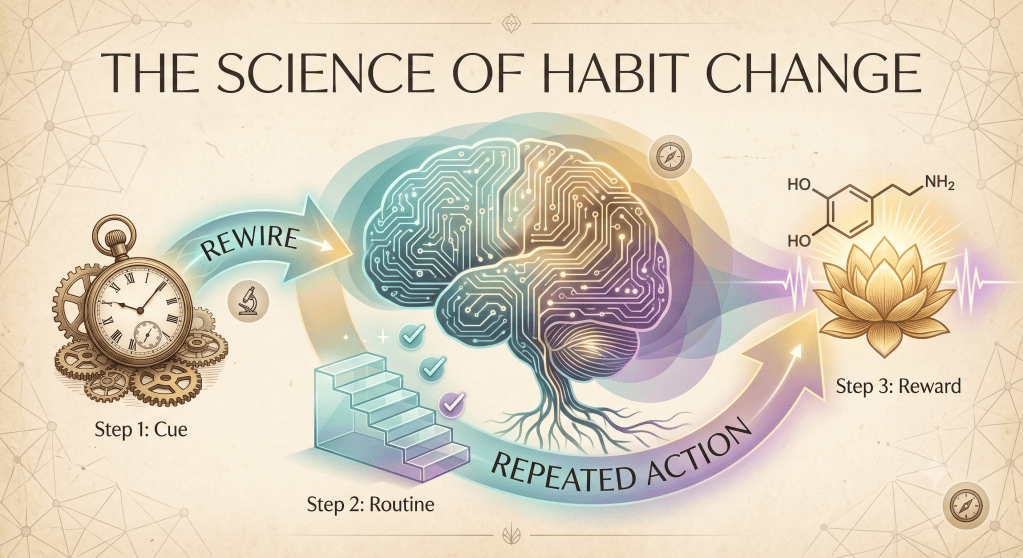
How reinforcement learning and basal ganglia circuitry explain why habits become automatic — and what the science says about changing them.
There is a particular kind of frustration that comes from knowing exactly what you should do and doing something else anyway. You know you should go for a run, but you find yourself on the couch. You know you should stop checking your phone during dinner, but your hand is already reaching for it before you’ve decided to reach at all. For most of the twentieth century, this gap between intention and action was treated as a matter of character. People who changed their behavior successfully were disciplined. People who didn’t were weak-willed. It was a tidy moral story, and it was also, as it turned out, largely wrong.
By the early 2010s, that story was starting to come apart. A wave of research from neuroscience, cognitive psychology, and behavioral economics was converging on a different explanation: habits are not primarily a test of willpower. They are a learning system, built into the architecture of the brain, that operates according to identifiable rules. Once those rules were mapped, habit change stopped looking like a battle of moral fortitude and started looking like something closer to engineering. You could not simply decide your way out of a habit any more than you could decide your way out of a reflex. But you could understand the mechanism well enough to work with it, or against it, deliberately.
That shift mattered beyond the world of self-help. It reframed public health campaigns, corporate wellness programs, addiction treatment, and educational design. It also arrived at a cultural moment when habits themselves were becoming more consequential. The rise of smartphones, algorithmically tuned notifications, and always-available digital services meant that more of daily life than ever was being shaped by environmental cues engineered specifically to trigger automatic responses. Understanding how habits form was no longer just a matter of personal improvement. It was becoming necessary just to understand the forces acting on your own attention.
This article traces that story: how scientists identified the neural circuitry underlying habitual behavior, what reinforcement learning theory revealed about why certain actions become automatic, and what all of this means, in practical terms, for anyone trying to build a new habit or break an old one.
A Brain Built for Efficiency, Not Willpower
To understand why habits are so persistent, it helps to start with a basic fact about the brain: conscious, deliberate thought is expensive. It requires sustained attention, working memory, and energy, and the brain has a limited supply of all three. If every action, from brushing your teeth to merging onto a highway, required the same level of conscious deliberation as, say, deciding whether to change careers, daily life would be exhausting to the point of being unworkable.
The brain’s solution to this problem is to offload frequently repeated behaviors to a more automatic system, freeing up conscious attention for things that actually require it. This is not a metaphor. It corresponds to an identifiable shift in which brain structures are doing the work.
The Basal Ganglia and the Habit Loop
Much of what scientists now understand about the neural basis of habit comes from decades of research into a cluster of structures deep in the brain called the basal ganglia, and in particular a region within it called the striatum. Ann Graybiel, a neuroscientist at MIT’s McGovern Institute for Brain Research, has spent much of her career studying this circuitry, and her lab’s findings have become foundational to the field. Graybiel and her colleagues have <cite index=”4-1″>shown that the ability to acquire habits depends on the basal ganglia, deep forebrain structures that are interconnected with the frontal cortex through a series of loop circuits</cite>. In simpler terms, there is a physical pathway that runs from the parts of the brain responsible for conscious thought and sensory processing down into deeper structures associated with automatic action, and back again.
What happens along that pathway as a behavior becomes habitual is genuinely interesting. Early in learning, when a behavior is new, neurons throughout this circuit fire more or less continuously as the brain works out what to do, step by step. But as a behavior is repeated and becomes routine, something changes. Graybiel’s research has identified <cite index=”2-1″>a “chunking” pattern of neuronal activity that emerges when a habit is formed, in which neurons activate when a habitual task is initiated, go quiet during the task itself, and then reactivate once the task is complete</cite>. The brain, in effect, stops tracking the individual steps of the behavior and instead treats the whole sequence as a single unit, bookended by a start signal and an end signal. This is part of why habitual actions can feel like they happen “on their own.” From the brain’s point of view, they largely do. The moment-to-moment decision-making has been compressed out of the loop.
This chunking process explains a familiar experience: driving a very routine route and arriving with little memory of the actual drive, or realizing partway through brushing your teeth that you were thinking about something else entirely. The behavior didn’t require your attention because the brain had already packaged it into an efficient, low-oversight routine.
Graybiel has also emphasized that this circuitry is not limited to physical movement. Her research points to habits of thought and emotion as well as habits of action, all routed through overlapping basal ganglia circuits. <cite index=”5-1″>”Many everyday movements become habitual through repetition, but we also develop habits of thought and emotion,” she has said, noting that if cognitive and emotional habits share this circuitry, it would help explain why damage to these brain structures can produce not just movement disorders but repetitive, intrusive thoughts and emotions.</cite> This is one reason the habit framework has proven useful well beyond questions of diet and exercise. Rumination, anxious thought spirals, and compulsive checking behaviors all show some of the same automatic, cue-triggered structure as more mundane physical habits.
Why Reward Comes First
None of this circuitry would organize itself around a behavior unless something told the brain that the behavior was worth repeating. That signal, it turns out, comes primarily from a single neurotransmitter: dopamine.
Dopamine’s role in habit formation is often misunderstood, partly because of how the word gets used casually, as shorthand for pleasure or a “dopamine hit.” The actual neuroscience is more precise, and more interesting. The foundational work here comes from Wolfram Schultz, a neurophysiologist who, working with primates in the 1990s, discovered that dopamine neurons don’t simply fire in response to a reward itself. <cite index=”14-1″>Schultz was recording from individual dopamine neurons in a monkey’s brain, giving the monkey a reward and watching how the neurons responded.</cite> What he found upended the simple idea that dopamine equals pleasure.
As the animal learned to anticipate a reward, based on a cue that reliably preceded it, the dopamine signal shifted in time. <cite index=”14-1″>The dopamine burst no longer fired when the reward arrived. Instead, it fired earlier, at the moment the predictive cue appeared. And when the reward showed up exactly as expected, the dopamine neurons barely responded at all.</cite> Dopamine, in other words, was not tracking reward. It was tracking the gap between what was expected and what actually happened, a quantity researchers call reward prediction error. <cite index=”11-1″>Reward prediction errors are the differences between received and predicted rewards, and they are central to how organisms learn about rewards, driving them to seek more.</cite> Dopamine neurons are activated when an outcome is better than expected, stay at baseline when an outcome matches expectations exactly, and dip below baseline when an outcome is worse than expected.
This finding turned out to connect directly to a body of theory from computer science known as reinforcement learning, a family of algorithms in which an artificial system learns by comparing its predictions to actual outcomes and adjusting future behavior based on the size and direction of the error. <cite index=”17-1″>The mathematician Peter Dayan recognized that Schultz’s dopamine data matched almost exactly what reinforcement learning theory predicted a reward-prediction-error signal should look like, and the fit was compelling enough that Dayan, Schultz, and psychiatrist Ray Dolan later received a major prize for their work connecting the two fields.</cite> The upshot is that the brain appears to run something functionally similar to the trial-and-error algorithms behind modern machine learning. Each time an outcome lands better, worse, or exactly as expected, a dopamine signal nudges the perceived value of that action up or down, shaping whether you’re likely to repeat it next time.
This is the mechanism that turns a one-off behavior into a habit. It is not that the behavior feels good in the moment, necessarily. It is that the behavior consistently produces an outcome that meets or exceeds what the brain predicted, which reinforces the association between the situation, the action, and the outcome, and gradually shifts control of that action from deliberate decision-making circuitry into the more automatic basal ganglia loop.
The Cue-Routine-Reward Framework, and Its Limits
The popular version of this science, widely circulated in the years after Charles Duhigg’s 2012 book The Power of Habit, describes a three-part “habit loop”: a cue triggers a routine, the routine produces a reward, and repetition strengthens the association between cue and routine until the behavior runs automatically. This framework is a reasonable simplification of the underlying neuroscience, and it remains useful as a way of thinking about how to structure a new habit or interrupt an old one. But it is worth being precise about what it leaves out.
The cue-routine-reward model implies a fairly clean, mechanical loop. Actual habit formation is messier and more context-dependent. Wendy Wood, a social psychologist who has spent over three decades studying habitual behavior, has argued that context, more than reward alone, is the critical variable. Her research has produced one of the most frequently cited figures in the field: <cite index=”19-1″>roughly 43 percent of everyday actions are carried out habitually, while the person’s attention is engaged elsewhere.</cite> Crucially, Wood’s work emphasizes that habits are cued not just by discrete triggers but by stable environmental context: the same physical location, the same time of day, the same sequence of surrounding actions. <cite index=”21-1″>When a behavior is performed repeatedly in a stable context, the brain learns to automate it, and a large share of daily behavior ends up shaped by that kind of context-driven automation rather than by conscious choice.</cite>
This has a somewhat humbling implication for how people usually think about self-control. Wood’s research on students transferring to new universities and similar disruptions found that people who successfully change their behavior are not necessarily people with unusual willpower. <cite index=”22-1″>They tend to be people who are good at recognizing how much situations shape behavior and who choose contexts that make the desired action easier to repeat, reducing the day-to-day friction and temptation they have to fight against.</cite> In other words, a lot of what looks like impressive self-discipline from the outside is actually well-designed environment from the inside. This reframes habit change as a problem of environmental design as much as a psychological one: change the context, and the behavior it reliably produces tends to change with it.
How Long Habit Formation Actually Takes
One of the most persistent myths in popular psychology is the claim that it takes 21 days to form a new habit. That number has no basis in habit research at all. It traces back to a 1960 book by a plastic surgeon, Maxwell Maltz, who observed that patients seemed to take roughly three weeks to psychologically adjust to a change in their appearance after surgery. Over decades of retelling, that observation about adjusting to a new face was gradually mistranslated into a general rule about habit formation, losing its original context along the way.
The actual empirical answer comes from a 2010 study led by Phillippa Lally and colleagues at University College London, published in the European Journal of Social Psychology. <cite index=”34-1″>Lally’s team asked 96 volunteers to choose an eating, drinking, or activity behavior to perform daily, in the same context, over twelve weeks, and had them report each day both whether they carried out the behavior and how automatic it felt.</cite> The results complicate the tidy 21-day story considerably. <cite index=”34-1″>The time it took participants to reach 95 percent of their eventual, plateaued level of automaticity ranged from 18 to 254 days, reflecting substantial variation from person to person and from behavior to behavior.</cite> The frequently cited “66 days” figure is the median of that range, not a fixed timeline that applies to everyone. Simple behaviors performed in stable, low-friction contexts, such as drinking a glass of water after a meal, tend to become automatic much faster than complex behaviors that require more effortful planning, such as a structured exercise routine.
This matters practically, because it suggests that people who abandon a new habit after three or four weeks, concluding that it “isn’t working,” may simply be quitting partway through a process that was always going to take longer. It also offers some genuine reassurance: the Lally data indicates that occasionally missing a day did not meaningfully disrupt the overall trajectory toward automaticity. Habit formation, in other words, is forgiving of imperfection in a way that popular narratives about discipline rarely acknowledge.
Breaking a Habit Is Not the Reverse of Building One
A common intuition is that if habits are built through repetition and reward, they should be dismantled the same way, in reverse: remove the reward, and the behavior should fade. This intuition captures part of the picture but misses something important, which is that the neural pathways underlying an established habit do not appear to simply erase once the behavior stops.
Graybiel’s research on the basal ganglia has produced findings relevant to addiction and compulsive behavior that bear on this question directly. Her lab’s work suggests that <cite index=”9-1″>as an animal is rewarded for learning a new behavior, physiological changes occur in the neurons of the basal ganglia, and because reward is such a powerful learning driver, it accounts for a great deal of the learning process.</cite> Once those changes are in place, they appear to function less like a light switch that can simply be flipped off and more like a well-worn path that remains available even after a person stops using it regularly. This helps explain a familiar and frustrating pattern: a person who has successfully quit smoking, or stopped biting their nails, or broken a habit of checking their phone compulsively, can find the old behavior resurfacing under stress, fatigue, or a return to the original triggering context, sometimes years later. The old circuit was not deleted. It was suppressed, or overridden by a competing, newer habit, and it can become dominant again when conditions favor it.
This has led researchers, including Graybiel, to focus less on the idea of erasing habits and more on the idea of building competing ones. <cite index=”9-1″>Graybiel has pointed to evidence that certain sensory or contextual interventions may interrupt destructive, compulsive loops tied to dysfunction in this brain circuitry, and has expressed interest in finding simple interventions that could counter something like a craving.</cite> The practical version of this insight, echoed across the field, is that effective habit change usually works by inserting a new routine into an existing cue, rather than by trying to eliminate the cue or willing the old routine out of existence through effort alone. If a particular time of day, location, or emotional state reliably triggers an unwanted behavior, the more durable fix tends to be substituting a different response to that same trigger, rather than trying to simply resist the urge each time it arises.
Habits of Thought and Emotion
The habit framework has also extended into territory that was, for a long time, treated as separate from behavioral habits altogether: patterns of thinking and emotional reactivity. If the same basal ganglia circuitry that automates a physical routine also automates recurring thought patterns, as Graybiel’s research suggests, then a tendency toward catastrophic thinking under stress, or a reflexive defensive reaction to certain kinds of feedback, may operate on very similar principles to a habit of biting your nails or snacking at your desk. It is triggered by a recognizable cue, it runs largely below conscious awareness, and it has been reinforced over time by some kind of internal reward, whether that reward is the temporary relief of anxiety, a sense of being right, or simply the reduction of uncertainty that comes from a familiar mental script.
This extension of habit theory into cognitive and emotional territory remains an active area of research rather than a settled conclusion, and researchers are generally careful to note that thought patterns are more difficult to measure directly than observable physical behaviors. But the overlap has meaningfully influenced clinical approaches to anxiety, rumination, and some compulsive behaviors, many of which now incorporate habit-reversal techniques originally developed for physical tics and behavioral compulsions.
Why the Digital Environment Changed the Stakes
The scientific picture described above was largely in place by the early 2010s. What has changed substantially since then is the environment in which this circuitry operates. Smartphones, social media platforms, and streaming services are, among other things, enormously effective at generating exactly the conditions under which habits form: a consistent cue (a notification, a specific time of day, a moment of boredom), a low-effort routine (opening an app), and a variable, unpredictable reward (new content, social validation, novel information). Variable rewards are, per reinforcement learning theory, particularly potent, because unpredictability produces larger and more frequent reward-prediction-error signals than a reward that arrives reliably every time.
This is not a coincidence. Much of the design language of consumer technology over the past decade and a half has drawn, explicitly or implicitly, on behavioral science research into habit formation and reward variability. It has applied that research to product design at a scale that individual habit researchers in the 2000s were not necessarily anticipating. The consequence is that many people now find themselves fighting cue-driven, dopamine-reinforced habitual behaviors that were deliberately built by teams of designers rather than formed accidentally through daily life, which is a meaningfully different problem than the one habit researchers were originally describing. Recognizing this distinction matters for anyone trying to apply the science of habit change to their own relationship with technology: the cues in question are often built specifically to be difficult to ignore, which makes environmental redesign, removing or dampening the cue itself, disproportionately more effective than relying on willpower to resist the routine once the cue has already fired.
What the Science Actually Recommends
Pulling together several decades of research, a few practical conclusions hold up reasonably well across the literature, with appropriate caution about how confidently each can be stated.
The first is that context matters more than motivation for sustaining a habit over time. Wood’s research consistently finds that stable, repeated contexts are what drive automaticity, which means that changing your environment, your routes, your routines, the objects placed in your line of sight, tends to be a more reliable lever than relying on renewed determination each day.
The second is that new habits are more easily attached to an existing routine than built from nothing. Because the basal ganglia loop organizes around a triggering cue, inserting a new behavior immediately after an already-automatic one (a habit sometimes called “stacking”) gives the new behavior a ready-made cue to attach to, rather than requiring the brain to build an entirely new triggering association from scratch.
The third is that timelines should be set with real data in mind rather than folklore. The Lally research indicates that meaningful automaticity, for many behaviors, takes closer to two to three months than three weeks, and that occasional lapses do not appear to derail the underlying trajectory in a lasting way, which argues for patience over self-recrimination when progress feels slow.
The fourth is that eliminating an old habit is generally harder, and less permanent, than building a competing one. Because established neural pathways appear to persist rather than disappear, the more durable strategy in the research is substitution: identifying the cue that triggers an unwanted routine and deliberately attaching a different, incompatible routine to that same cue, rather than attempting to extinguish the urge through sheer resistance.
None of this amounts to a formula that guarantees success, and researchers in this field are generally careful to note how much individual variation exists, in brain chemistry, in life circumstances, in the complexity of the target behavior itself. Correlational findings about which strategies tend to work should not be mistaken for a promise about what will work for any particular person. But the overall shift the research represents is genuine: habit change moved, over the course of roughly a decade and a half, from being framed primarily as a test of moral character to being understood as a learnable interaction with a specific, well-characterized piece of neural machinery.
Looking Forward
What began as basic research into the basal ganglia of laboratory animals in the 1990s has become one of the more practically influential areas of neuroscience, touching public health policy, addiction treatment, workplace design, and the architecture of the apps most people carry in their pockets. That trajectory seems likely to continue. Researchers are increasingly interested in individual variability in habit formation, why some people’s basal ganglia circuitry seems to automate behavior faster than others, and in more precise interventions for the compulsive end of the habit spectrum, where this same reward-learning machinery becomes implicated in addiction and obsessive-compulsive disorders.
There is also a broader cultural reckoning still unfolding, as more people become aware that their daily behavior is shaped, in measurable and mechanistic ways, by systems designed to exploit exactly the reward-prediction circuitry described above. Understanding the neuroscience of habit does not by itself neutralize that influence, but it does change the terms of the conversation. The science of habit ultimately reframed behavior not as a question of moral character, but as the predictable output of an ancient learning system continuously shaped by cues, context, and experience.
Scientific References
Graybiel, A. M. (2008). Habits, rituals and the evaluative brain. Annual Review of Neuroscience, 31, 359–387.
Graybiel, A. M., & Grafton, S. T. (2015). The striatum: Where skills and habits meet. Cold Spring Harbor Perspectives in Biology, 7(8).
Martiros, N., Burgess, A. A., & Graybiel, A. M. (2018). Inversely active striatal projection neurons and interneurons selectively delimit useful behavioral sequences. Current Biology, 28(4), 560–573.
Schultz, W., Dayan, P., & Montague, P. R. (1997). A neural substrate of prediction and reward. Science, 275(5306), 1593–1599.
Schultz, W. (2016). Dopamine reward prediction error coding. Dialogues in Clinical Neuroscience, 18(1), 23–32.
Wood, W., & Neal, D. T. (2007). A new look at habits and the habit-goal interface. Psychological Review, 114(4), 843–863.
Wood, W., & Rünger, D. (2016). Psychology of habit. Annual Review of Psychology, 67, 289–314.
Lally, P., van Jaarsveld, C. H. M., Potts, H. W. W., & Wardle, J. (2010). How are habits formed: Modelling habit formation in the real world. European Journal of Social Psychology, 40(6), 998–1009.
Gardner, B., Lally, P., & Wardle, J. (2012). Making health habitual: The psychology of habit-formation and general practice. British Journal of General Practice, 62(605), 664–666.
Duhigg, C. (2012). The Power of Habit: Why We Do What We Do in Life and Business. Random House.









