
Originally published in June 2014 and comprehensively updated and edited in July 2026.
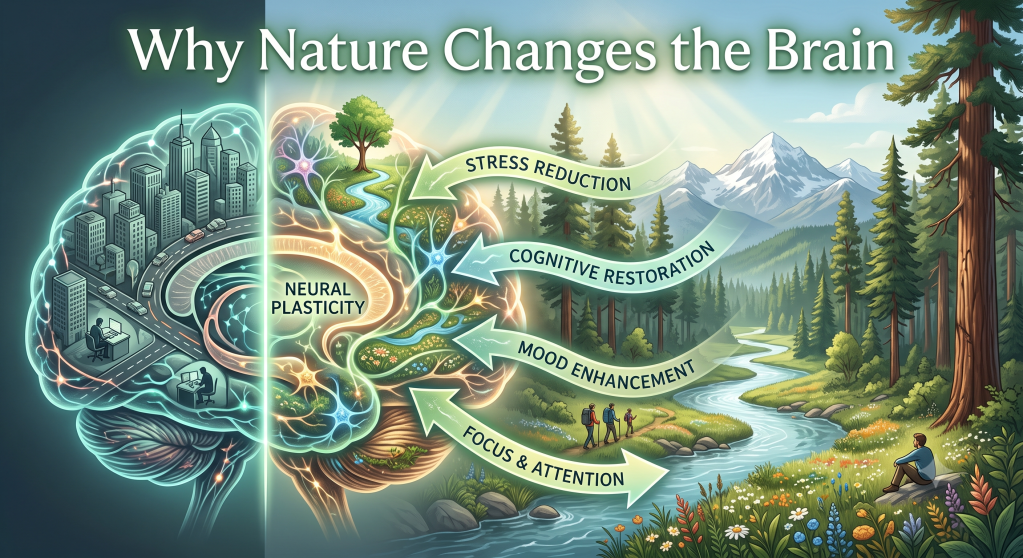
Why nature changes the brain: what decades of psychology and neuroscience research reveal about attention restoration, stress recovery, and time spent outdoors.
In the early 2010s, a quiet shift was taking place in how people related to the outdoors. Smartphones had gone from novelty to necessity in the space of a few years, and for the first time in history, a large share of the world’s population carried a device in their pocket capable of delivering an almost limitless stream of information, entertainment, and social feedback. Offices filled with open floor plans and fluorescent lighting. Commutes lengthened. Screen time, for both adults and children, climbed steadily upward, while time spent outdoors quietly declined. Researchers who studied human behavior began to notice a pattern worth investigating: people were reporting more stress, more difficulty concentrating, and more emotional exhaustion, even as material comforts and digital conveniences multiplied.
Against that backdrop, a body of research that had been building for decades started to receive fresh attention. Environmental psychologists, neuroscientists, and public health researchers were asking a deceptively simple question: what happens to the brain when a person steps outside? The answer, it turned out, was not simple at all. It touched on attention, memory, mood regulation, stress hormones, and even the structure of certain brain circuits. Researchers have examined these questions across children, adults, and older populations, in settings ranging from hospital rooms to classrooms to city parks. This article surveys what that research has shown, from the foundational studies of the 1980s through the more recent work of the 2020s, and explains why so many scientists now treat time in nature as a genuine, measurable contributor to cognitive and emotional health rather than a pleasant but unprovable folk belief.
It is worth being clear about the boundaries of that claim from the outset. Most of the research in this field is correlational, meaning it shows a relationship between nature exposure and wellbeing without always proving that one directly causes the other. But a meaningful number of studies are controlled experiments, in which researchers assign people to spend time in natural or urban settings and then measure the difference. Those experiments give scientists a much stronger basis for saying that nature itself, not just the kind of person who seeks it out, produces real effects on the brain and body.
A Discipline Takes Root: The Origins of Nature Research in Psychology
The formal scientific study of how natural environments affect the mind is younger than many people assume. While writers, philosophers, and physicians had long suspected that green spaces were good for the body and spirit, it took until the second half of the twentieth century for researchers to test that idea with any rigor.
The Hospital Window Study That Changed the Field
One of the earliest and most influential studies came from Roger Ulrich, an environmental psychologist who in 1984 published a paper in the journal Science examining recovery outcomes among patients who had undergone gallbladder surgery at a Pennsylvania hospital. Ulrich compared two groups of patients who were matched closely on factors like age, sex, weight, and smoking status. The only meaningful difference between the two groups was the view from their hospital room window. One group looked out onto a small stand of trees. The other looked at a plain brick wall.
The results were striking for such a modest intervention. Patients with the tree view left the hospital roughly three-quarters of a day sooner on average, required fewer strong pain medications, and received fewer negative remarks in nurses’ notes about their emotional state during recovery. Nothing about their treatment had changed except what they could see from their bed. Ulrich’s study helped establish what later became known as evidence-based design in healthcare architecture, and it remains one of the most frequently cited pieces of research connecting the visual experience of nature to measurable physical outcomes.
From Anecdote to Theory
Ulrich’s early work also fed into a broader theoretical framework he developed, sometimes called stress recovery theory, which proposed that natural scenes trigger a fast, largely automatic reduction in physiological stress. Around the same period, a husband-and-wife team of psychologists, Rachel and Stephen Kaplan, were developing a related but distinct idea that would come to dominate the field for the next several decades: attention restoration theory.
Attention Restoration Theory: How Nature Refills a Depleted Mind
The Kaplans’ central insight was that human attention comes in at least two varieties, and understanding the difference is key to understanding why nature feels so mentally refreshing.
Two Kinds of Attention
The first kind is what psychologists call directed or voluntary attention. This is the effortful, deliberate focus a person uses to write a report, drive through traffic, or answer emails while ignoring the ping of a dozen other notifications. Directed attention is powerful, but maintaining it over long periods requires effort and can become increasingly difficult as cognitive demands accumulate. When it grows fatigued, people tend to grow irritable, distractible, and prone to errors.
The second kind is involuntary attention, sometimes described as fascination. This is the attention that gets captured effortlessly, without any conscious struggle, by things that are inherently interesting: the movement of clouds, the sound of a stream, the pattern of light through leaves. Because this kind of attention requires no deliberate effort, it does not add to the cognitive load that builds up during directed attention. The Kaplans proposed that natural environments are unusually rich in this softly fascinating stimulation, which allows the brain’s directed attention system to rest and recover while a person is still awake, alert, and engaged with the world around them.
Testing the Theory
The Kaplans’ original studies compared people who walked through an arboretum with people who walked through an urban area, finding that the arboretum walkers showed better concentration and cognitive performance afterward. That basic design has since been repeated many times with variations. A frequently cited study led by cognitive psychologist Marc Berman found that a walk in a natural setting improved performance on a demanding memory and attention task more than a comparable walk through a city, even when participants disliked the weather during their nature walk. That detail matters, because it suggests the benefit was not simply a matter of people being in a better mood.
More recent reviews have added nuance to the theory rather than overturning it. A 2016 systematic review in the journal Environmental Health found reasonably consistent evidence that nature exposure improves attention and working memory, but noted that studies vary widely in how they define “nature,” how long exposure lasts, and how outcomes are measured, which makes it harder to state precise, universal numbers. Later meta-analyses have generally reinforced that selective attention, working memory, and cognitive flexibility show some of the most consistent improvements after time in natural settings, while cautioning that effect sizes differ depending on study design. In other words, the broad pattern is well supported, even if scientists are still refining the details of exactly how much nature, of what kind, produces how much benefit.
The Stress Response: What Nature Does to the Body Under Pressure
Attention is only part of the story. A separate but related line of research has focused on the body’s physiological stress response, and here the evidence is arguably even more robust.
Cortisol and the Nervous System
When a person experiences stress, the body releases cortisol, a hormone that helps mobilize energy for a fight-or-flight response but that, when chronically elevated, is linked to problems ranging from disrupted sleep to impaired immune function. Multiple studies have found that time spent in green or natural settings is associated with measurable drops in cortisol levels, along with reductions in heart rate and blood pressure, compared with time spent in urban settings. Some research suggests that even relatively brief exposure, in the range of twenty to thirty minutes, can produce a meaningful reduction in stress hormone levels, though the exact dose-response relationship is still an active area of study.
This lines up with the concept of shinrin-yoku, or forest bathing, a practice that originated in Japan in the 1980s as a public health initiative and has since become the subject of formal scientific investigation. Researchers studying forest bathing have repeatedly documented reductions in stress hormones and shifts toward parasympathetic nervous system activity, although many studies remain relatively small and researchers continue refining estimates of effect size and mechanism.
Rumination and the Brain’s Self-Focused Circuitry
Perhaps the most striking neuroscience finding in this field came from a 2015 study led by Gregory Bratman and colleagues at Stanford, published in the Proceedings of the National Academy of Sciences. The researchers were interested in rumination, the tendency to get stuck in repetitive, negative thought patterns about oneself, which is a well-established risk factor for depression and other mental health conditions. They had healthy volunteers take a ninety-minute walk, either through a natural, oak-woodland setting or along a busy, traffic-heavy urban street, and used brain imaging to examine activity in a region called the subgenual prefrontal cortex both before and after the walk.
The nature walkers reported lower levels of rumination afterward and showed reduced activity in the subgenual prefrontal cortex, a region that in earlier research had been linked to self-focused, withdrawn patterns of thinking associated with both depressed and healthy individuals. The urban walkers showed no such change on either measure. Because participants were randomly assigned to one walk or the other rather than simply choosing their own routine, the study offers stronger evidence than a purely observational design that the natural environment itself, not just the kind of person who prefers it, was responsible for the shift. The researchers were careful to frame their findings as identifying one plausible pathway connecting nature exposure to mental health, rather than claiming to have found the definitive explanation for why urban living is associated with higher rates of certain psychiatric conditions.
How Much Nature Is Enough? The Search for a Dose
As the science matured, researchers began asking a more practical question. If nature is beneficial, how much of it does a person actually need?
The 120-Minute Threshold
A large-scale study published in 2019 in Scientific Reports by Mathew White and colleagues at the University of Exeter offered one of the clearest attempts to answer that question. Drawing on survey data from nearly twenty thousand people in England, the researchers examined the relationship between the amount of time participants had spent in natural environments during the previous week and their self-reported health and wellbeing. They found that people who spent at least two hours a week in nature were substantially more likely to report good health and high wellbeing than those who spent no time in nature at all, with benefits appearing to level off somewhere between roughly three and five hours a week. Notably, it did not seem to matter whether that two hours came from a single long outing or was accumulated across several shorter visits over the week.
The study’s authors were careful to describe this as an association derived from survey data rather than a controlled experiment, and they explicitly called for more longitudinal and experimental research to establish firmer guidelines, drawing a comparison to the way public health authorities eventually developed weekly recommendations for physical activity. Even so, the 120-minute figure has become a widely cited reference point in public health conversations about nature, in part because it offers something concrete and achievable, roughly seventeen minutes a day, rather than an abstract call to “spend more time outside.”
Not All Nature Experience Is Identical
Later research has continued to probe which forms of nature exposure matter most. Some studies distinguish between passive exposure, such as viewing nature through a window or in a photograph, and active engagement, such as walking or exercising outdoors, generally finding that active engagement produces more durable benefits, though passive exposure is not without measurable effect. Work using virtual and simulated nature scenes has found that even digital nature imagery can produce some attention-related benefits, though typically smaller than those seen with real-world immersion, suggesting that physical presence in a natural setting adds something that a screen cannot fully replicate. Emerging research also suggests that biodiverse environments, those with a greater variety of plant and animal life, may produce larger psychological benefits than less varied green spaces, though this remains an active area of investigation. This growing body of nuanced findings suggests attention restoration and stress recovery may operate as complementary processes rather than competing explanations, each capturing part of what happens when the brain encounters a natural environment.
Nature in Everyday Life: From Hospital Windows to Classroom Design
The scientific findings on nature and cognition have increasingly shaped decisions well outside the research lab.
Healthcare and Architecture
Ulrich’s early hospital study helped launch a design philosophy that now influences how many hospitals are built, with architects incorporating gardens, courtyards, and window views specifically because of the documented links between natural views and patient outcomes. While later attempts to replicate the exact hospital-stay findings in different patient populations have produced more mixed results, the broader principle, that access to natural views and green space can reduce patient stress and pain perception, has held up well enough to become a standard consideration in hospital design guidelines.
Schools and Learning Environments
A similar pattern has emerged in education research. Reviews examining both passive nature exposure, such as classrooms with views of greenery, and active outdoor learning have generally found associations with improved attention, working memory, and in some cases academic performance in areas like reading and mathematics, along with greater classroom engagement. Researchers note that active outdoor engagement tends to produce longer-lasting benefits than passive exposure alone, which has informed a modest but real shift toward outdoor and nature-based learning programs in some school systems.
Urban Planning
City planners have also drawn on this research to justify investment in parks, street trees, and green corridors, framing them not merely as aesthetic amenities but as public health infrastructure. Given that more than half the world’s population now lives in urban areas, with that share projected to keep climbing, researchers including Bratman and his collaborators have argued that preserving accessible natural spaces within cities may be an important, underused resource for supporting mental health at a population level.
What the Evidence Does Not Yet Show
Responsible science communication requires being honest about the limits of what is known. Nature research faces some genuine methodological challenges. Studies define “nature” inconsistently, ranging from a city park to old-growth forest, which makes it difficult to compare findings across the field. Many of the strongest experimental studies involve relatively small samples of healthy adult volunteers, which raises open questions about how well the findings generalize to children, older adults, or people with diagnosed mental health conditions. And while the correlational research linking nature exposure to broad measures of wellbeing is extensive, researchers are still working to disentangle how much of the effect comes from the natural setting itself versus related factors like physical activity, social interaction, or simply time away from work obligations.
None of this undermines the core findings so much as it appropriately tempers them. The controlled experiments, including the arboretum studies pioneered by the Kaplans, Berman’s memory and attention research, and Bratman’s brain imaging work on rumination, provide real evidence that natural environments produce measurable psychological and neural effects beyond what would be expected from mood alone. But scientists in this field, like those in most areas of psychology and neuroscience, continue to describe their conclusions in terms of associations and plausible mechanisms rather than settled, universal laws.
Conclusion: A Quietly Radical Idea
What began as scattered observations about hospital patients and arboretum walks has grown into a substantial, if still evolving, body of research connecting the natural world to the inner workings of the human mind. The findings converge on a consistent picture: sustained attention is a limited resource that natural environments seem to help replenish, physiological stress responses appear to ease measurably in green settings, and even brain regions tied to negative, self-focused thinking show detectable changes after time spent outdoors. None of this suggests that nature is a cure-all, and researchers are careful to avoid overstating what the evidence can support. But taken together, it represents a meaningful shift from viewing time outdoors as a pleasant luxury to treating it as a legitimate, evidence-backed component of cognitive and emotional health.
The broader significance of this research extends beyond any single finding. As more of daily life moves indoors and onto screens, and as urbanization continues to reshape where and how people live, the question of how to preserve meaningful contact with the natural world is likely to remain a live one for public health researchers, city planners, and ordinary people alike. The science built over the past several decades does not settle every detail, but it offers a reasonably solid foundation for a simple, testable idea: that the brain did not evolve in an office building, and it still responds, in measurable ways, when it gets a chance to leave one.
Scientific References
Bratman, G. N., Hamilton, J. P., Hahn, K. S., Daily, G. C., & Gross, J. J. (2015). Nature experience reduces rumination and subgenual prefrontal cortex activation. Proceedings of the National Academy of Sciences, 112(28), 8567–8572.
Berman, M. G., Jonides, J., & Kaplan, S. (2008). The cognitive benefits of interacting with nature. Psychological Science, 19(12), 1207–1212.
Kaplan, S. (1995). The restorative benefits of nature: Toward an integrative framework. Journal of Environmental Psychology, 15(3), 169–182.
Ohly, H., White, M. P., Wheeler, B. W., Bethel, A., Ukoumunne, O. C., Nikolaou, V., & Garside, R. (2016). Attention Restoration Theory: A systematic review of the attention restoration potential of exposure to natural environments. Journal of Toxicology and Environmental Health, Part B, 19(7), 305–343.
Ulrich, R. S. (1984). View through a window may influence recovery from surgery. Science, 224(4647), 420–421.
White, M. P., Alcock, I., Grellier, J., Wheeler, B. W., Hartig, T., Warber, S. L., Bone, A., Depledge, M. H., & Fleming, L. E. (2019). Spending at least 120 minutes a week in nature is associated with good health and wellbeing. Scientific Reports, 9(1), 7730.









