
Originally published in July 2014 and comprehensively updated/edited in July 2026.
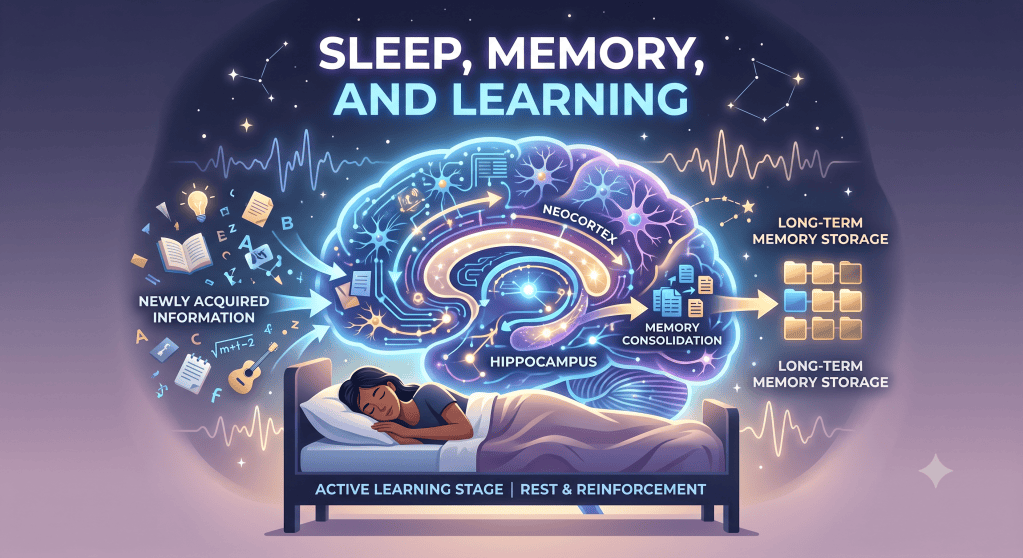
How sleep actively consolidates new memories: the neuroscience of hippocampal replay, sleep stages, and key studies proving sleep is essential for learning.
In 2014, sleep had an image problem. A generation of professionals wore their exhaustion like a badge of honor, and college students swapped stories about all-nighters the way earlier generations swapped stories about summer jobs. Fitbits had just started showing up on wrists in large numbers, and one of the first things people did with them was watch little bar graphs of their own sleep, often for the first time in their lives. The data was frequently unflattering. A cultural moment was forming in which people were beginning, almost against their will, to notice how little they slept and to wonder what it was costing them.
At the same time, a quieter and more consequential shift was happening inside neuroscience labs. For decades, sleep had been treated as a period of neurological downtime: the brain idling, waiting for morning. But a growing body of research was demonstrating something far more interesting. Sleep, it turned out, was not the absence of mental activity. It was a distinct and active phase of learning, one in which the brain returned to the day’s experiences, sorted through them, and decided what to keep.
This idea reframed a basic assumption most people carried without examining it: that learning happens while you’re awake, full stop, and sleep is simply downtime that follows. The research suggested instead that acquiring information is only half the job. The brain still has to consolidate it, and that second half of the process depends heavily on what happens after the lights go out. This article traces how scientists arrived at that conclusion, what they’ve learned about the mechanics of memory consolidation during sleep, and how the picture has sharpened in the years since.
A Culture Built on Borrowed Time
To understand why the sleep-memory research landed the way it did in the early 2010s, it helps to remember the environment it landed in. Smartphones had made the workday elastic. Email followed people home, then to bed, then, for many, into bed. Energy drinks marketed themselves directly at students and night-shift workers. “I’ll sleep when I’m dead” was a genuine, unironic slogan on t-shirts.
Underneath the bravado was a real psychological pattern: people had come to think of sleep as optional in a way that waking effort was not. If you wanted to learn a new skill, study for an exam, or master a new role at work, the intuitive strategy was to spend more waking hours on it. Sleep felt like something you could trade away, a soft cost rather than a hard requirement.
Sleep researchers had been quietly building a counterargument for years. Their case was not moralistic — it wasn’t about virtue or self-discipline — it was mechanistic. They were showing, experiment by experiment, that the brain performs specific, measurable work during sleep that cannot be performed any other way. This distinction matters. The claim was never that sleep is pleasant or restorative in some vague sense. The claim was that sleep is when certain kinds of learning actually finish happening.
An Old Idea Resurfaces
The notion that sleep helps memory is not new. In 1924, psychologists John Jenkins and Karl Dallenbach ran a simple experiment: people memorized lists of nonsense syllables, then either slept or stayed awake for a set interval before being tested. The sleepers remembered more. Their explanation at the time was almost entirely negative — they proposed that sleep protected memories mainly by preventing new experiences from interfering with old ones, not because sleep was doing anything constructive on its own.
That interpretation held for decades, largely because researchers lacked the tools to look inside a sleeping brain and see what, if anything, was actually happening there. The rise of modern sleep labs, EEG recording, and eventually functional imaging changed that. Robert Stickgold, a psychiatry researcher at Harvard Medical School, became one of the central figures in reviving and updating the old idea. His lab trained volunteers on tasks like complex finger-tapping sequences, then compared performance after a night of sleep versus a night of sleep deprivation. The sleep-deprived group’s skills eroded noticeably, sometimes for days afterward, even though nothing else about their training had changed. Something about sleep itself was doing protective, constructive work — not just running interference against forgetting, but actively strengthening what had been learned.
What Happens in the Brain While You Sleep
The modern explanation for these effects goes by the name active systems consolidation theory, developed largely through the work of Jan Born, Susanne Diekelmann, and their collaborators in Germany. The theory proposes something close to a nightly filing operation. During the day, new experiences are captured quickly by the hippocampus, a seahorse-shaped structure deep in the brain that’s especially good at fast, flexible encoding but not built for permanent, long-term storage. Think of it as short-term scratch space. During sleep, particularly during the deep, slow-wave stages early in the night, the hippocampus replays fragments of the day’s activity, and those replayed patterns are gradually transferred and woven into the neocortex, the brain’s outer layer, where long-term, stable memory appears to live.
The Hippocampus Replays the Day
Some of the most striking early evidence for this replay process came from animal research. In 1994, neuroscientists Matthew Wilson and Bruce McNaughton recorded from large groups of “place cells” in the hippocampus of rats — neurons that fire when an animal is in a specific location in its environment. They found that cells which had fired together while a rat explored a maze were significantly more likely to fire together again during the rat’s subsequent sleep, compared to sleep before the exploration happened. In effect, the rats’ brains were replaying the maze while they slept.
This finding has been replicated and extended many times since, and researchers now describe brief, high-frequency bursts of hippocampal activity called sharp-wave ripples as one of the physical signatures of this replay process. When scientists have selectively disrupted these ripples during sleep in animal studies, memory performance suffers afterward, which is about as close as this kind of research gets to demonstrating that the replay isn’t just a side effect of consolidation, but a mechanism that helps cause it.
Slow Waves, Spindles, and the Consolidation Window
Human sleep researchers have identified a related set of signatures using EEG. Slow oscillations — large, synchronized waves of neural activity that sweep across the cortex during deep sleep — appear to coordinate with hippocampal replay and with bursts of activity called sleep spindles, brief pulses that show up in the same deep sleep stages. The current working model treats this as a kind of coordinated conversation between the hippocampus and the cortex: the hippocampus offers up a compressed version of a recent memory, the cortex listens and gradually builds its own, more durable version, and the timing of this exchange is set by these large-scale brain rhythms. It’s a genuinely elegant piece of biology, though it’s worth being honest that much of the fine detail — exactly how a spindle helps “lock in” a specific memory at the level of individual synapses — is still an active area of investigation rather than settled fact.
Different Sleep Stages, Different Jobs
One of the field’s more durable findings is that sleep is not a single, uniform state where consolidation either happens or doesn’t. Sleep cycles through distinct stages across a night, and different stages appear to specialize in different kinds of memory work.
Slow-wave sleep, concentrated in the first half of the night, has been linked most consistently to declarative memory — the kind of fact-based, “what happened” memory involved in remembering a conversation, a vocabulary word, or a historical date. Rapid eye movement (REM) sleep, which becomes more prominent later in the night, has instead been associated in various studies with procedural and emotional memory, and with more flexible, associative kinds of thinking. Matthew Walker and Robert Stickgold’s influential 2004 review laid out much of this early evidence, showing that improvements on motor skill tasks correlated with the combined amount of slow-wave and REM sleep a person got, and that skipping the first night of sleep after learning a new motor sequence could block performance gains that would otherwise have appeared automatically.
It’s worth noting that the REM side of this story is less settled than the slow-wave side. Some studies have found REM sleep plays a distinct, independent role in memory; others have found that depriving people of REM sleep specifically doesn’t meaningfully impair declarative memory. Researchers generally agree that NREM and REM sleep contribute differently to consolidation, but there isn’t full consensus yet on exactly what REM’s contribution actually is.
Sleep Doesn’t Just Save Memories — It Reorganizes Them
Perhaps the most conceptually interesting line of research goes beyond simple retention and asks whether sleep can help people find patterns and solve problems they couldn’t solve while awake. In a widely cited 2004 study, Ullrich Wagner, Jan Born, and colleagues gave participants a number-based puzzle that could be solved the slow way, step by step, or quickly, if the solver noticed a hidden shortcut buried in the structure of the task. People who slept between their first and second practice sessions were substantially more likely to discover the hidden shortcut than people who stayed awake for an equivalent stretch of time, even during the day.
The implication is that sleep doesn’t just preserve memories in their original form. It appears to reorganize them, extracting general rules or patterns from a set of specific experiences. This lines up with something many people report anecdotally — waking up with a solution to a problem they went to bed frustrated by — though it’s worth being careful here. Later replication attempts on this specific number-puzzle paradigm have produced mixed results, and some researchers have found the insight-boosting effect only in certain age groups or under certain conditions. The general phenomenon of sleep supporting the extraction of hidden patterns and regularities is fairly well supported across many different experimental paradigms; the particular finding of a dramatic, one-night insight leap is a more fragile result that hasn’t always held up on retesting.
Proving the Connection: Targeted Memory Reactivation
Correlational evidence — people who sleep more or better remember more — is useful, but it can’t fully rule out other explanations. One of the more elegant experimental approaches to establishing a causal link is called targeted memory reactivation, and it works by exploiting the brain’s associative wiring.
In a landmark 2007 study, Björn Rasch, Jan Born, and colleagues had participants learn the locations of objects on a screen while a rose scent was piped into the room. That same evening, during slow-wave sleep, researchers quietly reintroduced the rose scent to some participants while they slept, without waking them. Those participants remembered the object locations significantly better the next day than participants who didn’t get the odor cue during sleep, and imaging showed the odor cue specifically activated the hippocampus during those exposures. Because the scent had no effect when it was presented during REM sleep, during wakefulness, or if it hadn’t been paired with the learning task in the first place, the design allowed researchers to argue for something closer to cause and effect: reactivating a specific memory trace during the right sleep stage measurably strengthened it.
This approach has since been extended well beyond the laboratory. More recent studies have applied the same logic to actual classrooms, using odor cues to help school-age students consolidate vocabulary and even a full history lesson, with the reactivation happening later at home during a normal night’s sleep. Not every attempt to replicate targeted memory reactivation has succeeded, and some studies have found the effect doesn’t generalize as broadly as researchers initially hoped — for instance, some recent work has struggled to show that cueing one memory selectively benefits it over other, uncued memories learned in the same context. That mixed record is a healthy sign for the field rather than a problem with it; it means researchers are now testing the boundaries and limits of an effect, rather than simply confirming it exists.
A Decade of Debate
It would be misleading to present sleep-dependent memory consolidation as a settled matter with no dissent. Some researchers, notably Robert Vertes and Jerome Siegel, have argued for years that the evidence for an active, constructive role of sleep in memory is less conclusive than proponents suggest, and that some of the effects attributed to sleep could reflect factors like time of day, stress hormones, or simple interference from waking activity rather than sleep itself doing something unique. Stickgold, among others, has acknowledged that these are legitimate questions a maturing field needs to keep answering rather than dismissing.
That back-and-forth has been genuinely productive. It’s pushed researchers toward more tightly controlled designs — like the odor-cueing studies — specifically because those designs can distinguish an active sleep effect from a passive “time without interference” effect. The debate hasn’t been resolved in the sense of one side simply winning; it’s been resolved in the more useful sense that the field now has considerably better tools for answering the original question.
What This Means for Students, Workers, and Everyone Pulling All-Nighters
None of this research translates into a simple slogan, and it’s worth resisting the urge to compress it into one. But a few implications are reasonably well supported. Cramming new material the night before a test and then skipping sleep to keep studying appears to work against the very process that would otherwise help lock that material in. A full night of sleep after learning something new — whether it’s a language, a piece of music, or a physical skill — seems to matter more for retention than an equivalent stretch of additional waking practice. And the timing of sleep relative to learning may matter almost as much as the total amount of sleep a person gets, since the consolidation window appears to open specifically in the sleep that follows a learning episode, not sleep in general.
This is a meaningfully different way of thinking about study habits and skill acquisition than the “more hours awake equals more progress” model that dominated a great deal of self-improvement and productivity culture in the early 2010s. It doesn’t argue against effort. It argues that effort has two phases, and only one of them happens with your eyes open.
From 2014 to 2026: How the Picture Has Sharpened
In the years since this piece was first written, the core model of active systems consolidation has held up well, while the surrounding evidence has become considerably richer and more nuanced. Targeted memory reactivation, once mostly a laboratory curiosity involving rose-scented pillows, has been tested in real schools and, more recently, with automated devices designed to deliver sleep cues without requiring a researcher in the room. That shift from tightly controlled labs to messier real-world settings is exactly the kind of test a finding needs to survive if it’s going to matter for actual students and workers, and the effect has largely — though not universally — held up.
At the same time, the field has grown more comfortable acknowledging its own uncertainties. The precise role of REM sleep remains genuinely contested rather than settled. Some specific, headline-grabbing findings — including aspects of the original insight research — have had a bumpier road through replication than they did through initial media coverage. And researchers have increasingly connected memory consolidation to other things happening in the sleeping brain, including the discovery in the early 2010s of the glymphatic system, a network that appears to help clear metabolic waste from brain tissue more efficiently during sleep — a separate physiological process that reinforces the broader view that sleep is an active biological state rather than merely a period of rest.
Conclusion
The core insight that emerged from this research, and that has only been reinforced by the past decade of study, is a genuine reframing of what sleep is for. It is not empty time bolted onto the end of a productive day. It is the second half of learning — the stage where the hippocampus and the neocortex conduct an overnight negotiation about which recent experiences deserve to become permanent, and where scattered facts sometimes get quietly reorganized into rules and patterns a waking mind hadn’t yet noticed.
The broader significance goes beyond students and their exam scores. As workplaces, schools, and health systems continue to grapple with chronic sleep deprivation as a widespread condition rather than an individual failing, the sleep-memory research offers a concrete, mechanistic reason to take it seriously: skipping sleep isn’t just unpleasant, it appears to interrupt a biological process with no other opportunity to run. Looking forward, the open questions — how REM sleep contributes, how reliably memories can be externally cued, how this system changes with age and disease — are likely to keep this a productive area of neuroscience for years to come, and the answers may eventually reshape everything from how schools structure their days to how we think about rest as part of skilled work rather than a break from it.
Scientific References
Jenkins, J. G., & Dallenbach, K. M. (1924). Obliviscence during sleep and waking. American Journal of Psychology, 35(4), 605–612.
Wilson, M. A., & McNaughton, B. L. (1994). Reactivation of hippocampal ensemble memories during sleep. Science, 265(5172), 676–679.
Stickgold, R., Whidbee, D., Schirmer, B., Patel, V., & Hobson, J. A. (2000). Visual discrimination task improvement: A multi-step process occurring during sleep. Journal of Cognitive Neuroscience, 12(2), 246–254.
Walker, M. P., Brakefield, T., Hobson, J. A., & Stickgold, R. (2003). Dissociable stages of human memory consolidation and reconsolidation. Nature, 425(6958), 616–620.
Wagner, U., Gais, S., Haider, H., Verleger, R., & Born, J. (2004). Sleep inspires insight. Nature, 427(6972), 352–355.
Walker, M. P., & Stickgold, R. (2004). Sleep-dependent learning and memory consolidation. Neuron, 44(1), 121–133.
Stickgold, R. (2005). Sleep-dependent memory consolidation. Nature, 437(7063), 1272–1278.
Rasch, B., Büchel, C., Gais, S., & Born, J. (2007). Odor cues during slow-wave sleep prompt declarative memory consolidation. Science, 315(5817), 1426–1429.
Diekelmann, S., & Born, J. (2010). The memory function of sleep. Nature Reviews Neuroscience, 11(2), 114–126.
Rasch, B., & Born, J. (2013). About sleep’s role in memory. Physiological Reviews, 93(2), 681–766.
Iliff, J. J., et al. (2013). A paravascular pathway facilitates CSF flow through the brain parenchyma and the clearance of interstitial solutes, including amyloid β. Science Translational Medicine, 4(147).
Neumann, F., Oberhauser, V., & Kornmeier, J. (2020). How odor cues help to optimize learning during sleep in a real-life-setting. Scientific Reports, 10, 1227.
Bueno-Lopez, A., et al. (2022). Odor cueing during sleep improves consolidation of a history lesson in a school setting. Scientific Reports, 12, 10493.









