
Originally published in January of 2015 and comprehensively updated in June 2026.
On the Rise of Curate Identity
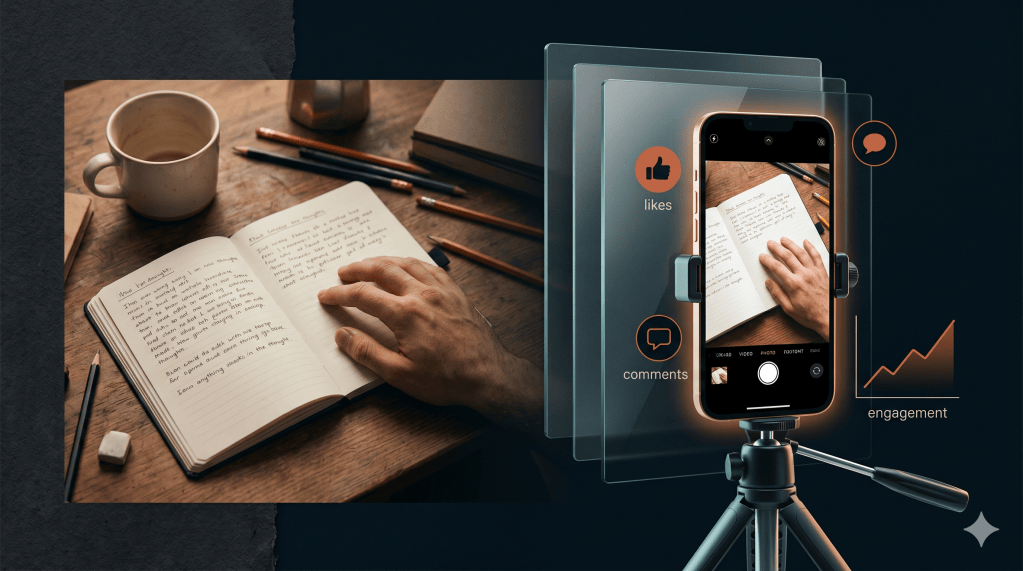
There is a particular kind of exhaustion that comes not from doing too much, but from performing too much. Sometime in the early 2010s, millions of people quietly took on a second job — one with no salary, no set hours, and no clear job description. The work involved managing their public image across multiple digital platforms, crafting the visual story of their lives, and maintaining a consistent personal brand legible to hundreds or thousands of loosely connected followers.
Nobody assigned this work. Most people didn’t even realize they were doing it. It simply became, over the course of a few short years, a feature of modern life.
The rise of curated identity — the deliberate construction and management of a public self through digital media — is one of the defining social phenomena of the early 21st century. It didn’t emerge from nowhere. It grew from a specific set of technological, economic, and psychological conditions that converged in the years following the mass adoption of smartphones and social media platforms. Understanding why it happened, what it did to people, and how its consequences continue to unfold requires pulling together threads from sociology, psychology, neuroscience, and cultural history.
This is an attempt to do that.
A Stage That Never Closes
Sociologist Erving Goffman published The Presentation of Self in Everyday Life in 1959, and its central argument has aged remarkably well. Goffman proposed that social life is essentially theatrical — that people are constantly managing impressions, playing roles, and adjusting their behavior depending on who is watching. He distinguished between “front stage” behavior, the polished performance we put on for others, and “backstage” behavior, the unguarded moments when we drop the act.
For most of human history, the front stage had natural limits. You performed for the people physically present around you. When you went home, you went backstage. The audience was finite, the performance was temporary, and there were clear transitions between public and private.
Digital social media created something Goffman couldn’t have imagined: a front stage that never closes, that follows you everywhere, and that preserves every performance indefinitely.
Platforms like Facebook, Instagram, Twitter, and later TikTok and Snapchat collapsed those boundaries in ways that are still difficult to fully appreciate. The backstage began to shrink. And with it, the psychological breathing room that backstage had always provided. This wasn’t an accident of design. It was, in large part, the design.
Engineering Engagement
To understand why curated identity took hold so completely, it helps to understand the incentive structures of the platforms that hosted it.
Social media companies built their businesses on a straightforward premise: the more time users spent on the platform, the more advertising revenue the company could generate. Maximizing “engagement” — the industry term for clicks, likes, shares, comments, and time spent — became the central engineering challenge. The tools these companies deployed were drawn from behavioral psychology, and they worked with uncomfortable efficiency.
Variable reward schedules, first described by psychologist B.F. Skinner in the mid-20th century, are among the most potent tools for shaping behavior. Unlike predictable rewards, which become routine and lose motivational power, variable rewards — where the timing and size of the payoff are unpredictable — produce persistent, compulsive behavior. Slot machines use the same principle. So does the “pull to refresh” gesture on a social media feed.
When a person posts a photo and waits to see how many likes it receives, they are participating in a variable reward system. The response might be enormous or minimal, immediate or delayed. The uncertainty itself drives engagement. Neuroscientist Wolfram Schultz’s research on dopamine neurons helped clarify the underlying mechanism: the brain’s reward circuitry responds most powerfully not to the reward itself, but to the anticipation of an uncertain reward. The notification ping became, for many users, a reliable trigger for a small but real neurochemical response.
None of this required users to understand the mechanism. The behavior simply emerged, reinforced by millions of small rewards and social interactions. People learned, mostly without realizing it, that certain kinds of posts generated more engagement than others. They began, again mostly without realizing it, to optimize. The red notification badge — designed to trigger the same instinctive attention response as a flashing warning light — was not an accident of interface design. Neither was the infinite scroll, which removed the natural stopping points that paginated feeds once provided. Each element was engineered to keep the loop running.
The Grammar of the Curated Self
What did optimization look like in practice? It looked like a photograph taken, deleted, and retaken fifteen times until the lighting was right. A caption agonized over for longer than the event it described. The careful exclusion of anything messy, ambiguous, or unflattering — illness, failure, conflict, boredom, grief. By the early 2010s, a recognizable visual grammar had emerged: natural light, aspirational aesthetics, travel, fitness, artisanal food, and carefully arranged domestic spaces. Authenticity was valued, but only a very specific kind — the kind that had been carefully constructed to appear unconstructed.
This was not simple vanity, though vanity was certainly present. Research by social psychologist Leon Festinger had established as early as 1954 that humans engage in constant social comparison, using others as reference points to evaluate their own standing and worth. Social media didn’t invent social comparison; it industrialized it. The average user was now exposed to the highlight reels of hundreds of acquaintances simultaneously — career success, physical appearance, romantic relationships, parenting, travel — all at once, all the time.
The consequences were measurable. A widely cited 2018 study in the Journal of Social and Clinical Psychology (Hunt et al.) found that limiting social media use to 30 minutes per day produced significant reductions in loneliness and depression after just three weeks. The causal relationship was never perfectly clean — people with preexisting mental health challenges tended to use social media more heavily, too — but the bidirectional dynamic was difficult to dismiss.
Identity in Adolescence: A Perfect Storm
The timing of social media’s mass adoption was particularly consequential for one group: teenagers.
Adolescence has always been the period when identity formation is most intense. Developmental psychologist Erik Erikson described identity versus role confusion as the central conflict of adolescence — the work of figuring out who you are, what you value, and how you want to present yourself to the world. It’s inherently experimental work. It involves trying on different identities, making social mistakes, and revising your self-concept in response to feedback.
That process requires a certain amount of privacy. It requires the ability to fail without an audience, to be embarrassing without the embarrassment being permanent. The internet weakened those protections at precisely the moment they were most needed.
For the generation that came of age with smartphones in their pockets — sometimes called Generation Z, born roughly 1997 onward — the experimental self of adolescence was also a public self. Every social misstep was potentially documented. Every evolving identity was subject to immediate peer feedback. The pressure to maintain a coherent, attractive public persona intersected with the developmental task of figuring out who you actually were.
Psychologist Jean Twenge, who has studied generational trends in mental health for decades, documented a significant upturn in adolescent anxiety, depression, and loneliness that she traced, with substantial evidence, to the period following the widespread adoption of smartphones around 2012. Her 2017 book iGen drew considerable attention — and considerable methodological debate — for its argument that screen time and social media were primary drivers. The debate over causation versus correlation continued well into the 2020s, but the basic empirical finding — that adolescent mental health worsened substantially during this period — was difficult to contest.
The Paradox of Performed Authenticity
As the 2010s progressed, a countermovement emerged. Users saturated by polished aesthetics began demanding something different. “Authenticity” became the most coveted quality in a personal brand. Influencers who showed their struggles, their imperfect homes, their unfiltered faces, built enormous audiences on the promise of realness.
But there was a paradox embedded in this shift. Performed authenticity is still a performance. A carefully crafted reveal of vulnerability is still carefully crafted. When “showing the messy parts” becomes a social media strategy, the messy parts become content, subject to the same optimization pressures as everything else. The backstage gets lit, filmed, and posted.
Sociologist David Riesman had anticipated something like this in The Lonely Crowd as far back as 1950, describing a cultural shift from “inner-directedness” — identity anchored in internalized values — toward “other-directedness,” where the self was continually recalibrated against the perceived expectations of peers. The authenticity wave didn’t reverse that shift. It produced a second layer of curation nested inside the first: a performance of not performing, a brand built around the rejection of branding. The self remained curated. Only the aesthetic changed.
The Body as Content
The aestheticization of the body — its transformation into visual content to be produced, consumed, and evaluated — accelerated dramatically with the rise of image-centric platforms. Instagram, launched in 2010, made photographs the primary unit of social communication. The front-facing camera combined with editing tools and filters enabled a kind of continuous self-documentation that had no real predecessor.
Research consistently found elevated rates of body dissatisfaction among heavy users, particularly those who followed accounts centered on appearance and fitness. A 2020 meta-analysis in Body Image journal, drawing on over 30 studies, found significant associations between social media use and body image concerns across demographic groups — most pronounced where content invited direct social comparison.
The emergence of augmented reality filters added a further dimension. Users could see a digitally idealized version of their own face in real time, creating an immediate gap between actual appearance and filtered appearance. By the late 2010s, cosmetic surgeons were documenting a new clinical pattern: patients arriving with filtered selfies as procedural references. A 2018 paper in JAMA Facial Plastic Surgery by Ramanadhan et al. named the phenomenon “Snapchat dysmorphia” — though by then it extended well beyond any single platform.
What Gets Lost
Amidst the sociological and psychological analysis, it is worth pausing to consider something more difficult to measure: what curated identity costs in terms of interiority.
The philosopher Charles Taylor, in The Ethics of Authenticity, argued that the modern era’s emphasis on self-expression was not inherently shallow — that the aspiration to live in accordance with one’s own genuine values was meaningful and important. The problem, Taylor suggested, arose when self-expression became untethered from any horizon of significance — when the self became an end in itself rather than a site from which to engage with things that matter beyond the self.
Curated identity, at its most complete, is self-expression detached from exactly that horizon. It is the self presented to be admired, not the self engaged in the work of living. The distinction matters not because admiration is bad, but because a life organized primarily around its own presentation is, by definition, oriented outward rather than inward. The question “who am I really?” gets crowded out by the more pressing question “how am I appearing?”
Psychologists who study self-concept and identity coherence have a term for the internal experience of having a stable, continuous sense of who you are across different contexts: narrative identity. Developed by Dan McAdams and others, the concept proposes that psychological wellbeing depends partly on the ability to construct a coherent life story — a through-line that connects past, present, and imagined future. Social media platforms, with their fragmented, moment-to-moment structure and their incentives toward performance over reflection, are not well designed for that kind of narrative work. They reward the curated moment, not the examined life.
After the Peak: Where Identity Went Next
By the late 2010s, the cultural conversation had begun to turn. The vocabulary of “personal branding,” once aspirational, started to feel crass in casual contexts. Platform fatigue set in for significant portions of the user population. A wave of books, documentaries, and journalistic investigations exposed the mechanisms of algorithmic manipulation. Former engineers and executives at major social media companies gave public interviews expressing regret — among them early Facebook president Sean Parker, who told Axios in 2017 that the platform had been explicitly designed to consume as much of users’ time and attention as possible, and former Google design ethicist Tristan Harris, whose concerns eventually became the subject of the 2020 documentary The Social Dilemma.
The backlash produced real behavioral changes for some users — deliberate social media fasts, migration to smaller and more private platforms, renewed interest in analog social life — but it did not fundamentally alter the underlying dynamics. The platforms remained dominant. The incentive structures remained largely unchanged. New platforms, particularly TikTok, found new and more sophisticated ways to deploy the same basic attention-capture mechanisms. Curated identity didn’t fade. It evolved.
What changed, gradually, was the sophistication of cultural awareness around it. By the 2020s, the grammar of curation was widely understood, even by people who continued to practice it. Terms like “main character syndrome” and “posting a look” entered casual vocabulary as self-aware commentary on the performance of self. A generation raised entirely within social media developed its own ironic distance from the very platforms it used daily.
Whether this irony represented a genuine shift in the relationship between selfhood and digital performance, or simply a more sophisticated layer of curation — an awareness performed as content — remained an open question.
What the Mirror Changed
The rise of curated identity was not merely a story about technology or vanity. It was a story about what happens when the social and commercial pressures of a new medium reshape the most intimate aspects of human experience — how we see ourselves, how we compare ourselves to others, and how we construct a sense of who we are over time.
The psychological costs were real and documented, if unevenly distributed. The benefits were also real: connection, community, self-expression, and the discovery of people who shared marginal identities that would have remained invisible in purely local social worlds. For many, social media offered the first audience that genuinely understood them. That is not a small thing.
But the deeper question the era raises is not about policy or platform design, though both matter. It is about what happens to identity when its primary medium becomes observation. For most of human history, the self emerged largely through living — through action, failure, revision, and the slow accumulation of experience that didn’t require an audience. Goffman’s insight was that performance was always part of social life. What he couldn’t have anticipated was a world in which the performance never paused.
The question “who am I really?” has always been difficult. What curated identity did was quietly replace it with a different question — “how am I appearing?” — and make the substitution feel natural. The front stage moved into the pocket. The backstage shrank. And the psychological work of becoming a person, which has always required some shelter from observation, got harder to do in the open.
That may prove to be the most lasting consequence of this period — not the anxiety studies or the filter trends or the influencer economy, but the subtle rewiring of the relationship between selfhood and being seen. Identity has always been partly social. What changed was the ratio.









