
Originally published in January 2015 and comprehensively updated June 2026
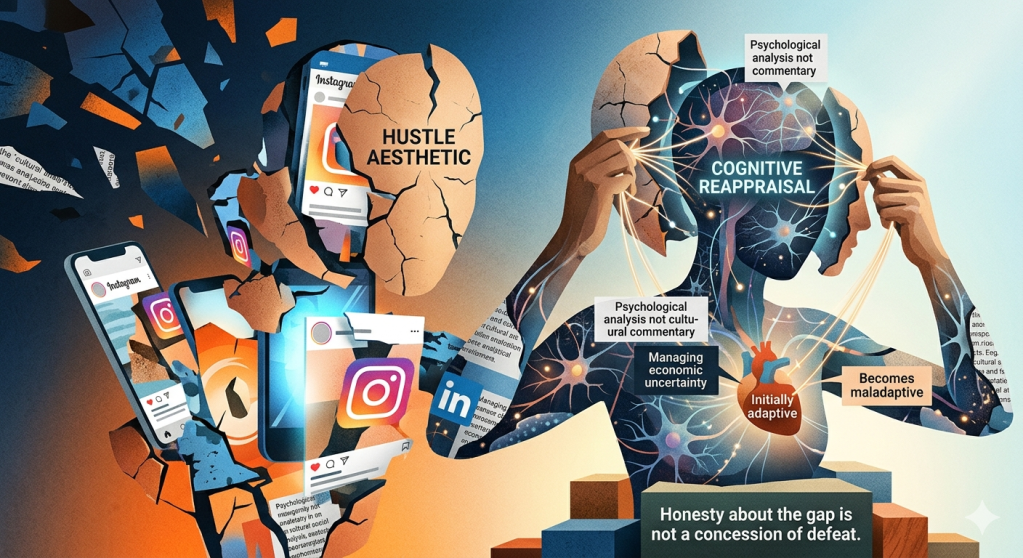
On performing success before achieving stability
There is a specific kind of pressure that settles over people in their twenties and thirties — a pressure not just to succeed, but to appear to be succeeding. It is distinct from ambition, which is at least oriented toward an actual goal. This pressure is more immediate and more theatrical. It asks not what you are building, but how you look while you are building it.
In the early 2010s, that pressure found a medium perfectly suited to amplify it. Social media platforms made the performance of professional aspiration visible, constant, and searchable. A LinkedIn update, an Instagram post from a work trip, a casual reference to a project or a client — these became the vocabulary of a new kind of social signaling, one organized almost entirely around the appearance of upward momentum. The term that would eventually crystallize the phenomenon — “performing success” — hadn’t fully entered common use yet, but the behavior it described was already widespread and accelerating.
This essay examines what drove that behavior, what it cost the people who practiced it, and what it reveals about the particular anxieties of a generation that came of age during a period of profound economic instability. The story involves psychology, economics, platform design, and the remarkably durable human tendency to manage what others think of us — especially when we are uncertain about what to think of ourselves.
The Economic Ground Beneath the Performance
To understand why performing success before achieving stability became such a defining behavior of the 2010s, it helps to understand the economic context in which it emerged.
The 2008 financial crisis did not merely damage the economy. It disrupted the implicit contract that had governed the relationship between work and identity for the previous half-century. That contract held, roughly, that a combination of educational credentials, consistent effort, and loyalty to an employer would produce a reasonably predictable outcome: stable employment, incremental advancement, and a standard of living that improved over time. The crisis didn’t just suspend that contract temporarily. For many people — particularly those who graduated between 2008 and 2014 — it voided it entirely.
The labor market that emerged from the crisis was characterized by credential inflation, contract and gig work in place of full-time employment, stagnant wages relative to housing and healthcare costs, and a general sense that the pathways that had worked for previous generations were no longer reliable. Research consistently found that workers who entered the labor market during recessions faced persistent wage penalties that followed them for years, sometimes decades. A landmark 2012 study by economists Philip Oreopoulos, Till von Wachter, and Andrew Heisz, using Canadian earnings data, found that graduates who entered the labor market during downturns earned significantly less than those who didn’t — and that the gap closed only slowly over time.
This was the ground on which performing success took root. When actual stability is scarce and uncertain, the performance of stability — and of the upward mobility that was supposed to lead to it — becomes an understandable response. It was partly strategic: in a competitive labor market, signaling momentum could attract opportunities. The graduate who had been freelancing sporadically announced a “consulting practice.” The laid-off manager described the gap on their résumé as a period of “independent advisory work.” Neither description was exactly false. Neither was exactly the whole picture. But it was also psychological, and more complicated than pure calculation.
The Psychology of Self-Presentation Under Pressure
Social psychologists have long studied the conditions under which people manage their public image most aggressively. The answer, consistently, is when they feel their social standing is threatened or uncertain. This tendency has a name — impression management — and it intensifies when the stakes feel high and the outcomes feel unpredictable.
Sociologist Erving Goffman, whose work on social performance remains foundational, described impression management as a universal feature of human interaction. Everyone does it, always. But the degree of effort people invest in controlling their public image varies significantly with perceived threat. When people feel secure in their standing, they manage impressions with a relatively light hand. When they feel insecure — when they sense that others may be evaluating them, that their status is in question, that they may be falling short of some important standard — the effort intensifies.
The early 2010s produced exactly those conditions for a large cohort of educated young adults. They had done what they were supposed to do — attended college, accumulated credentials, networked, applied — and found the expected rewards either absent or delayed. The gap between what they had been told to expect and what they were actually experiencing was real, significant, and socially awkward in a culture that still attached strong moral and social weight to professional achievement.
When actual success is uncertain, performing success becomes a way of managing not just how others see you, but how you see yourself.
This points toward a dimension of the behavior that is often missed when performing success is characterized simply as deception or vanity. The performance was frequently directed inward as much as outward. Psychologists studying self-concept maintenance have found that people actively use social feedback — the reactions of others to their self-presentations — to regulate their own sense of competence and worth. Presenting yourself as successful, and having that presentation accepted, can temporarily stabilize a self-image that feels threatened. The performance and the performed thing become, for a time, difficult to disentangle.
What the Platform Made Possible
The infrastructure for performing success before achieving stability had always existed in rudimentary form — the well-tailored interview suit, the carefully composed business card, the name-drop in conversation. What changed in the early 2010s was the scale, permanence, and social reach of the available tools.
LinkedIn, founded in 2003, transformed from a resume-hosting service into a full social network over the course of the early 2010s. By 2012, it had crossed 200 million users and was functioning as something qualitatively different from a job board: it was a continuous stage for professional self-presentation, where every promotion, project, certification, and career transition could be broadcast to a professional network simultaneously. The platform’s architecture rewarded activity and connection. It created strong incentives to present an active, progressing professional narrative — and significant social awkwardness for those whose narratives had stalled.
Instagram, which reached mainstream adoption around 2012, offered a different but complementary stage. Where LinkedIn governed the explicit professional narrative, Instagram governed the lifestyle signals that surrounded it: the work trips, the co-working spaces, the business lunches, the laptops photographed in airports. The aesthetics of hustle culture — which would become a fully named and discussed phenomenon by the mid-2010s — were incubated largely on Instagram, where the visual grammar of productivity and momentum became a recognizable genre.
Together, these platforms created something new: a continuous, public, semi-permanent record of professional identity that existed alongside the actual, private experience of work and economic life. Managing that record — deciding what to post, what to omit, how to frame setbacks, how to signal momentum even during periods of stagnation — became a form of labor in its own right, largely invisible and almost entirely uncompensated.
The Hustle Aesthetic and Its Contradictions
By the mid-2010s, hustle culture had become a coherent aesthetic and ideological system. Its core premise was that relentless work and visible ambition were virtues, that rest was suspect, and that the entrepreneurial self — always building, always optimizing, always moving — was the aspirational model for the era. Gary Vaynerchuk’s social media presence, books like The 4-Hour Workweek, and an entire ecosystem of productivity influencers all contributed to a cultural atmosphere in which performing success was not just socially advantageous but actively valorized.
What made hustle culture psychologically effective — and psychologically costly — was that it offered a reframe for precarity that felt empowering rather than diminishing. The person working three gig jobs and sleeping poorly was not struggling; they were grinding. The distinction mattered less as a description of the situation than as a mechanism for managing how that situation felt. Psychologists who study cognitive reappraisal — the mental process of reinterpreting a stressful situation to alter its emotional impact — have found that reframing genuinely does reduce distress in the short term. Hustle culture was, among other things, a collective cognitive reappraisal strategy, distributed through social media at scale.
The problem with reappraisal, applied this way, is that it can suppress the signal without addressing its source. Distress about economic precarity is informative. It points toward a real condition that may warrant a real response — a different strategy, a different market, a different set of expectations. When the reappraisal succeeds in numbing that signal — when grinding feels genuinely preferable to acknowledging difficulty — the information it carried gets lost. Hustle culture didn’t just make performing success feel virtuous. It made the honest assessment of its costs feel like weakness.
Impostor Syndrome, Amplified
In 1978, psychologists Pauline Clance and Suzanne Imes published a paper describing a phenomenon they observed among high-achieving women: a persistent internal experience of intellectual fraudulence, a fear that despite external evidence of competence, they were somehow fooling the people around them and would eventually be exposed. They called it the impostor phenomenon. Over the following decades it was studied more broadly and found to be remarkably common across genders, professions, and demographic groups.
Performing success before achieving stability is, in a meaningful sense, a behavioral expression of impostor syndrome operating in an environment that rewards performance. The person who presents a polished professional narrative while privately experiencing uncertainty or inadequacy is not simply being dishonest. They are managing a gap between their public self-presentation and their private self-assessment — the same gap that Clance and Imes described, now expressed through the tools of digital social media.
The social media context, however, added a dimension that impostor syndrome researchers had not fully anticipated: the possibility of an audience that was itself performing. When everyone’s public professional narrative is polished and curated, the average person’s private experience of uncertainty comes to feel anomalous — a personal failing rather than a universal human condition. Research by social psychologist Shai Davidai and Thomas Gilovich has examined what they call the “headwinds/tailwinds asymmetry” — the tendency to be more aware of the obstacles in one’s own path than in others’. Social media exacerbated this asymmetry by making others’ tailwinds highly visible while their headwinds remained largely private.
The result was a kind of collective performance of confidence that made everyone more anxious. Each person, seeing polished presentations from their peers, felt more inadequate. The person scrolling LinkedIn at midnight, watching former classmates announce promotions and funding rounds, had no way of knowing how many of those announcements were their own version of the same performance. And each person, feeling more inadequate, worked harder to polish their own presentation. The cycle was self-reinforcing, and it operated largely below the level of conscious awareness.
The Financial Architecture of Aspiration
Performing success is not only a psychological and social phenomenon. It also has a financial dimension that deserves direct attention.
The signals associated with professional success and upward mobility are not free to produce. The right wardrobe, the right neighborhood, the right devices, the right social experiences — the material markers that communicate “I am doing well” require money, often money that people in their twenties and early thirties during the 2010s did not reliably have. The graduate buying a tailored blazer on a credit card for a networking event they couldn’t quite afford to attend. The junior professional photographing a work lunch at a restaurant that represented, quietly, half a week’s discretionary budget. The result, for a significant portion of this cohort, was the use of consumer credit and personal debt to fund a lifestyle that signaled a financial stability they had not yet achieved.
This wasn’t entirely new behavior — consumer culture has long encouraged spending as a form of identity expression. But the social media environment raised the stakes by making lifestyle visibility continuous and comparative. A 2016 analysis by economists Marianne Bertrand and Adair Morse found evidence that rising income inequality increased consumption among lower-income households, as people spent more in response to the visible consumption of wealthier peers — what the researchers described as “trickle-down consumption.” The mechanism was social comparison, the same mechanism Festinger had identified in the 1950s, now operating through Instagram feeds and LinkedIn status updates rather than neighborhood observation.
For younger adults in particular, the financial cost of performing success intersected with already strained household finances — student debt, high urban housing costs, stagnant entry-level wages — to create a precarious arithmetic. The performance required money. The money wasn’t there. Credit filled the gap. And the resulting debt made actual stability harder to achieve, even as the performance of stability continued.
What Performing Success Does to the Self
Beyond the financial costs, there are psychological ones that are harder to quantify but no less real.
Psychologists who study self-concept and identity stability have found that the coherence of a person’s self-narrative — the degree to which their internal sense of who they are aligns with how they present themselves to others — is meaningfully related to psychological wellbeing. When the gap between private experience and public presentation becomes large and persistent, it generates a specific kind of cognitive and emotional strain. Maintaining a performance that feels disconnected from reality requires ongoing effort. It produces vigilance: a monitoring of conversations, contexts, and social media records for signs that the gap has been noticed.
Psychologist Mark Leary’s work on sociometer theory offers a useful framework here. Leary proposed that self-esteem functions less like a fixed trait and more like a gauge — a real-time monitor of one’s perceived social acceptance and standing. When the gauge reads high, people feel confident and engage more openly. When it reads low, they experience anxiety and are motivated to repair their social standing. Performing success, in this framework, is a sociometer management strategy: a way of keeping the gauge reading acceptable by controlling the information that social evaluators receive.
The problem is that sociometer management through performance is unstable. It depends entirely on the performance being sustained and believed. It produces no real improvement in the underlying situation it is designed to conceal. And it tends to foreclose the honest conversations — with employers, mentors, financial advisors, or simply close friends — that might lead to actual improvement. The performance becomes its own obstacle.
The Generation That Watched It Happen
Performing success before achieving stability is most often associated with millennials — but the behavior was never exclusive to any single cohort. Older workers who experienced mid-career disruption — layoffs, industry contractions, the erosion of previously stable professional identities — found themselves using the same tools for similar purposes. The senior executive maintaining an active LinkedIn presence during unemployment, carefully framing the gap as a “transition” or a period of “advisory work,” was performing the same basic function as the recent graduate presenting a single freelance project as a thriving independent business. The infrastructure was democratic in that sense. It served anyone whose reality needed a better-looking proxy.
What was generationally specific was the formative timing. The performing-success years coincided with the period when professional identity is most actively being constructed — when the question of who you are as a worker is still genuinely open. Having that construction take place primarily on optimized public platforms meant that many people’s professional self-concepts were shaped as much by the performance as by the underlying experience.
When the Performance Becomes Legible
By the late 2010s, the grammar of performed success was sufficiently well understood that a significant counterculture had formed around rejecting it. Personal essays about financial precarity — writers and journalists publishing detailed accounts of debt, underpayment, and the gap between professional image and bank account — became a recognizable genre. Anne Helen Petersen’s viral 2019 BuzzFeed essay on millennial burnout articulated for a large audience the specific exhaustion that comes from performing competence and momentum without the material conditions that would make that performance feel warranted.
The counter-performance that emerged — the deliberately unpolished post, the public acknowledgment of rejection, the “real talk” thread about financial stress — had genuine value. It disrupted the uniformity of the success narrative. But it also, fairly quickly, became subject to the same optimization pressures as the original. Strategically disclosed vulnerability, timed correctly and formatted for maximum relatability, could generate more engagement than a conventional success post. The authenticity of failure became, for some practitioners, simply a more effective variant of the same strategy.
This isn’t cynicism about the people involved — most weren’t being deliberately calculated. It’s an observation about the structure of the platforms themselves. Any signal that generates social reward will eventually be performed, regardless of its original content. The machinery doesn’t distinguish between success and the honest acknowledgment of its absence. Both get fed through the same engine.
The Gap Between Image and Ground
Pilots have a term — “spatial disorientation” — for the condition in which the instruments in the cockpit and the body’s physical sensations give contradictory information about the aircraft’s position. The senses say one thing; the instruments say another. The danger is trusting the wrong signal.
Performing success before achieving stability creates a version of this problem. The social media instruments read: momentum, growth, forward motion. The private experience may read: stagnation, uncertainty, financial stress. When the two diverge significantly and persistently, the question of which signal to trust — which to act on, which to share, which to use as the basis for decisions — becomes genuinely difficult.
One of the more counterintuitive findings from research on decision-making under uncertainty is that access to social information doesn’t necessarily improve individual decisions — it can actually make them worse, by introducing conformity pressures that override independent judgment. When a person in economic difficulty sees their peers apparently thriving, the rational response might be to reassess their own strategy. The socially conditioned response is often to work harder to match the performance, regardless of whether the underlying conditions support it.
This is the deepest cost of performing success before achieving stability: not the financial strain or the social exhaustion, though both are real, but the way it distorts the feedback loops that people need to make accurate decisions about their own lives. When the map consistently misrepresents the territory, navigation becomes treacherous.
A More Honest Accounting
The phenomenon described in this essay did not end with the 2010s. If anything, the platforms that hosted it became more sophisticated, the pressures that drove it more entrenched, and the gap between performed and actual economic stability more pronounced for more people. The COVID-19 pandemic produced a brief period of widespread acknowledged precarity — it’s hard to perform success during a global emergency — but the underlying conditions returned and in some respects intensified as the economy restabilized unevenly.
What did shift, gradually and incompletely, was the cultural permission to speak honestly about the gap. The normalization of discussing mental health, financial stress, career uncertainty, and the distance between aspiration and reality — driven partly by public figures willing to be candid, partly by the sheer saturation of polished performance creating its own fatigue — made honesty slightly less socially costly than it had been in 2012 or 2015.
That shift matters, because the alternative to performing success is not the absence of aspiration. It is aspiration grounded in an honest accounting of where you actually are. And those are very different things. The person who understands their real financial position can make better decisions than the person spending energy maintaining the appearance of a position they haven’t reached. The person who acknowledges career uncertainty can seek mentorship, change direction, or ask for help in ways that the person performing confidence simply cannot. Honesty about the gap is not a concession of defeat. It is the precondition for closing it.
The real cost of performing success before achieving stability was never the LinkedIn post or the Instagram aesthetic, taken individually. It was cumulative and structural. It was what happened when the performance ran long enough to begin replacing the internal work — the honest self-assessment, the recalibration, the willingness to say things are not going as planned — that genuine progress actually requires. When success becomes a costume worn long enough, it can start to feel like the only thing standing between you and the acknowledgment of failure. At that point the performance is no longer managing how others see you. It is managing how you see yourself. And that is a much harder habit to break.
The pressure that created this behavior was real, and the economic conditions that drove it were not of anyone’s individual making. But the cost was borne individually, quietly, and largely in private — which is, in a certain irony, exactly where the performance was never allowed to be.









