
Originally published in March 2015 and comprehensively updated June 2026
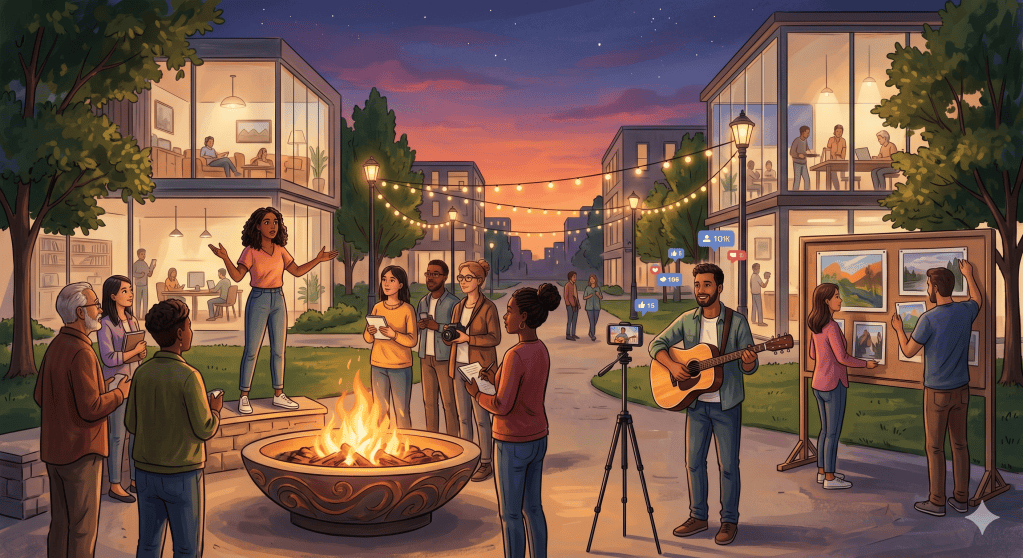
On privacy, self-disclosure, and the slow erosion of the private self
There was a moment, sometime around 2009 or 2010, when a significant portion of the population made a decision that would have seemed strange to any previous generation: they began narrating their lives out loud, in public, to people they mostly didn’t know very well. They posted what they ate, where they traveled, how they felt about Monday mornings and Friday afternoons. They shared photographs of their children, their living rooms, their faces on bad days and good ones. Not under duress. Not for money, in most cases. Voluntarily, enthusiastically, and with a growing sense that failing to do so meant missing something important.
This shift toward public living is one of the most significant behavioral changes of the early 21st century, and it happened so quickly, and with so little explicit deliberation, that most people who participated in it never quite examined why. The question of why humans started living publicly — why privacy began to feel not like a right to be protected but like a wall to be dismantled — is not a simple one. It touches on the psychology of self-disclosure, the sociology of visibility and status, the economics of the attention industry, and the deep evolutionary architecture of a species that has always been intensely social and intensely concerned with how it appears to others.
This essay examines that shift: where it came from, what drove it, what it displaced, and what the consequences of a more public human life turn out to be.
Privacy Was Never the Default
The first thing to understand about the turn toward public living is that it did not represent a corruption of some natural human preference for privacy. Privacy, as a widespread social norm, is historically recent and geographically uneven. For most of human history, and still in many parts of the world, life was conducted in conditions of enforced proximity — shared dwellings, communal work, village-scale social environments in which genuine solitude was rare and sustained privacy was a luxury of the wealthy.
The notion of the private individual — a person with an inner life that was their own business, a home that was their castle, a right to move through the world without surveillance or documentation — emerged gradually in Western culture from roughly the 17th century onward, accelerating through the 18th and 19th centuries alongside urbanization, rising living standards, and the development of the legal and philosophical frameworks that codified privacy as a value. Legal scholars Samuel Warren and Louis Brandeis articulated the “right to be let alone” in their influential 1890 Harvard Law Review article, a document often cited as the foundation of modern privacy law. Their concern, notably, was triggered by a new technology of the time: the portable camera, which was making it possible for journalists to photograph people without their consent.
The 20th century brought privacy norms to their peak in Western consumer societies. The single-family home with its fenced yard and separate bedroom for each child; the private automobile; the unlisted telephone number; the sealed envelope — these were the material artifacts of a culture that had come to regard the separation of public and private life as a fundamental social good. The private self was where you rested, recovered, and were allowed to be incomplete.
What social media did was not invent public living. It offered it back to a culture that had spent a century building walls around itself, and discovered, unexpectedly, that many people were ready to tear them down.
The Social Brain and the Need to Be Known
To understand why the invitation was accepted so readily, it helps to start with the biology that predates the privacy norms by several hundred thousand years.
Humans are, by evolutionary heritage, intensely social animals whose survival depended on membership in groups and whose psychological wellbeing is closely tied to social connection and recognition. Neuroscientist Matthew Lieberman, summarizing decades of social neuroscience research in his 2013 book Social: Why Our Brains Are Wired to Connect, argued that the human brain’s social circuitry is not secondary to its other functions but foundational — that being known, recognized, and understood by others is a primary human motivation, not a superficial one.
The need to be seen is not vanity. It is, in the language of psychologist Abraham Maslow’s hierarchy of needs, a genuine psychological requirement — located in the middle of his pyramid between basic safety needs and the higher-order needs for self-actualization. More recent research by Roy Baumeister and Mark Leary, published in their influential 1995 paper “The Need to Belong,” proposed that the desire for interpersonal connection is a fundamental human motivation with deep evolutionary roots, and that its frustration produces reliable psychological harm. Loneliness, social exclusion, and invisibility are not merely unpleasant. They are threatening, at a level the nervous system registers as physical danger.
Social media platforms arrived at a moment when the social conditions of modern Western life — geographic mobility, urban anonymity, declining participation in traditional community institutions like religious congregations and civic organizations — had left many people with attenuated social networks and a deficit of the kind of ambient social connection that sustained earlier, denser communities. They offered something that addressed that deficit directly: a continuous, low-friction environment for being seen, acknowledged, and responded to. The dopamine prediction loops and variable reward schedules that behavioral scientists later documented as features of platform design were built on top of a genuine underlying human need. The engineering was effective in part because what it exploited was real.
Self-Disclosure as a Psychological Drive
Beyond the general need for social connection, there is a more specific psychological mechanism worth examining: the human drive toward self-disclosure.
Psychologists James Pennebaker and Sandra Beall demonstrated in a landmark 1986 study that writing about personally significant emotional experiences produced measurable health benefits, including improved immune function and reduced physician visits in the months following the disclosure. Subsequent research has consistently supported the finding that self-expression — talking or writing about one’s experiences and internal states — has genuine psychological and physiological benefits, particularly when the disclosure is received and acknowledged by others.
Diana Tamir and Jason Mitchell at Harvard extended this line of research in a 2012 paper that attracted widespread attention for its finding that self-disclosure activates the same brain regions associated with reward as food and money. Their participants, given the choice between answering questions about themselves or about factual topics like geography, consistently chose self-disclosure — and would forgo financial rewards to do so. The researchers estimated that humans devote between 30 and 40 percent of their speech to talking about themselves. Self-disclosure, in other words, is not merely a social habit. It is a motivated behavior driven by its own reward signal.
Social media did not create the human appetite for self-disclosure. It created the largest, most responsive audience for it that had ever existed.
The implications for understanding public living are significant. The person who posts about their morning run, their difficult conversation, their child’s first steps, or their opinion about the news is not simply seeking attention in the pejorative sense. They are doing something that human psychology is deeply wired to find rewarding: expressing the self to others and receiving acknowledgment in return. The platforms understood this — whether through explicit research or simply through observing what users did — and designed their reward architectures accordingly.
The Collapse of Context and the New Visibility
One of the most important structural changes that accompanied the turn toward public living was what social media researcher danah boyd described as “context collapse” — the flattening of multiple distinct social audiences into a single undifferentiated one.
In ordinary offline social life, people naturally adjust their self-presentation to context. What you say to close friends differs from what you say to colleagues, which differs from what you say to acquaintances or strangers. This contextual shifting is not dishonesty; it is the normal management of appropriate social disclosure across different relationship types. A single Facebook post in 2010, by contrast, might be simultaneously visible to college roommates, work colleagues, distant relatives, high school acquaintances, and near-strangers. Consider the teenager who posts a joke intended for three friends. A teacher sees it. A parent hears about it. An employer, years later, finds it in a search. None of those audiences was the intended one. All of them received the disclosure anyway. Context collapse made that kind of mismatch not an accident but a structural feature of the medium.
Some users responded by self-censoring, defaulting to content safe for the most conservative segment of their composite audience. Others responded by performing — adopting a public persona calibrated for general appeal rather than authentic communication with any specific relationship. Still others treated collapsed context as an opportunity, constructing a public self addressed not to any particular audience but simply to “the public.” That last response — the emergence of the ordinary person as their own broadcasting network — was something genuinely new. For most of human history, public address was an institutional function. Social media democratized broadcast, and millions of people discovered, sometimes to their own surprise, that they wanted to use it.
Celebrity as Template
The cultural template for public living — the model of what it looked like and why someone might want it — was already available before social media provided the infrastructure to pursue it. It was celebrity.
The 20th century had made celebrity one of the most visible and aspirational social conditions in Western culture. Celebrities were not just famous; they were publicly known in a specific and intimate way. Their faces, their voices, their relationships, their homes and habits were documented, discussed, and consumed by audiences who felt, through the parasocial bonds that media creates, a sense of personal connection to people they had never met. Celebrity, at scale, modeled a version of being known that felt qualitatively different from the recognition available in ordinary social life — larger, more intense, more permanent.
What social media offered, at first tentatively and then unmistakably, was a scaled-down version of that experience. Not millions of followers, necessarily — but an audience. Recognition that extended beyond the people you encountered face-to-face. Comments from strangers who had found your words or images and chosen to respond. The small but real experience of being publicly known, in a way that the pre-digital world had reserved for a tiny fraction of the population.
Psychologist Chris Rojek, in his work on celebrity culture, identified what he called “celetoids” — people who achieve brief, contingent celebrity through chance encounters with media attention — as a growing category in the late 20th century. Social media accelerated this phenomenon and gave it infrastructure. The person who went viral for a tweet, a video, a photograph, or a public statement was experiencing something that celebrity culture had made culturally legible: the sudden expansion of one’s known audience from dozens to millions. The experience was disorienting when it happened unexpectedly, and increasingly something people sought deliberately.
What Privacy Protected — and What Was Lost
To understand what the turn toward public living cost, it helps to be specific about what privacy actually provides. Philosopher Helen Nissenbaum argued that privacy is not primarily about concealment but about appropriateness — about information flowing in ways that match the norms of the context in which it was originally shared. Medical information flows appropriately to other treating physicians; it does not flow appropriately to employers. Personal struggles shared with close friends belong in that relationship; they do not belong on a composite feed visible to everyone you’ve ever met. Psychologist Irwin Altman, who studied privacy as a regulatory process, described it as the selective control of access to the self — a dynamic boundary that individuals adjust constantly based on context and relationship. What privacy protects, in both frameworks, is the ability to be a different kind of person in different social contexts: to have half-formed opinions, experimental positions, and honest admissions of confusion that are appropriate between intimates and potentially costly in public.
What social media altered was the control. The membrane became leaky in ways that were difficult to manage and frequently impossible to reverse. A post made at 23 remains searchable at 43. An opinion expressed carelessly in 2012 can resurface in 2026. The emotional disclosure that felt right at midnight, addressed to a particular imagined audience, exists permanently in a context-free archive accessible to anyone. The irreversibility of public living is one of its least-examined costs — and one of the most significant differences from pre-digital life, where words spoken in public dissolved into memory and faded.
The Attention Economy’s Role
It would be incomplete to discuss why humans started living publicly without acknowledging the degree to which they were encouraged, incentivized, and structurally nudged to do so by platforms with strong financial interests in their doing exactly that.
The business model of social media is built on user-generated content and the attention it attracts. Every post, photograph, check-in, and status update is content that the platform uses to hold the attention of other users and sell that attention to advertisers. The more users shared, the more valuable the platform became, the more advertising revenue it generated. The platforms were therefore highly motivated to reduce the friction of sharing, to reward sharing with social feedback, and to create norms in which not sharing felt like an unusual choice rather than a default one.
Facebook’s real-name policy, introduced and enforced throughout the early 2010s, was one such structural choice. By requiring users to post under their actual identities rather than pseudonyms, it tied public behavior on the platform to reputational stakes in the real world — which, paradoxically, made some disclosures riskier while also making the platform feel more like a genuine extension of real social life rather than an anonymous performance. Twitter’s early norm of using real names accomplished something similar. The platforms were constructing a version of public life that was continuous with, not separate from, the offline social world — which made the information shared on them consequential in ways that earlier, more anonymous internet communities had not been.
Meanwhile, the social rewards of sharing — likes, comments, followers, retweets — created positive feedback loops that reinforced public self-disclosure. The person who shared and was responded to was more likely to share again. The person who shared nothing received nothing. Over time, consistent sharing built an audience; having an audience created an incentive to continue; and what had started as occasional self-expression gradually became, for many users, something closer to a practice — a regular act of public self-presentation maintained partly by habit, partly by the social expectations of the audience that had accumulated around it.
The Generation That Never Had a Private Adolescence
For most of the population that adopted social media in adulthood, the shift toward public living was a change they made — a behavioral adjustment to a new technology, made with at least nominal awareness of what was being exchanged. For the generation that came of age after roughly 2010, no such adjustment was required. They simply arrived in a world in which public living was already the norm.
The psychological consequences of this difference are still being worked out in the research literature, but some patterns have become clear. Adolescence is, developmentally, a period of identity experimentation — of trying on different versions of the self, making social mistakes, revising beliefs and presentations in response to feedback. That process has always benefited from a degree of audience limitation: the embarrassing phase, the poorly considered opinion, the social misstep that is witnessed by a small enough group that it can be genuinely left behind.
For adolescents whose social lives were conducted substantially on Instagram, Snapchat, TikTok, and their predecessors, that audience limitation was structurally unavailable. Every version of themselves they tried on was documented, potentially permanent, and visible to a social network that included peers, acquaintances, and in many cases, much larger audiences. The experimental self of adolescence became a public self, subject to immediate peer feedback and potentially lasting consequences, at exactly the developmental moment when experimentation requires the most protection from those pressures.
Whether this represents a fundamental change in how identity develops, or an adaptation that adolescents prove more capable of managing than older observers feared, remains genuinely uncertain. What is not uncertain is that the conditions under which adolescent identity formation now occurs are structurally different from those that preceded them — and that no previous generation has developed in those conditions, which means predictions about the long-term consequences are necessarily speculative.
Public Living and the Question of Authenticity
Running through the entire history of the turn toward public living is a recurring tension: the gap between the authentic private self and the curated public one.
Sociologist Erving Goffman described this tension long before social media existed, framing social life as theatrical performance in which people manage the impressions they make on different audiences in different contexts. The “front stage” behavior performed for others was always, in Goffman’s model, distinct from the “backstage” behavior of private life. Social media did not invent that distinction, but it significantly altered the ratio: more of life moved onto the front stage, the backstage shrank, and the performance became continuous rather than context-dependent.
The demand for authenticity that emerged as a cultural counter-movement in the mid-to-late 2010s was, in part, a response to the exhaustion of sustained performance. Audiences developed a fluency for detecting curated self-presentation and began rewarding what appeared to be genuine disclosure over polished image management. Influencers who showed vulnerability, failure, and the unglamorous parts of their lives built followings on the credibility that apparent authenticity conveyed.
But as discussed elsewhere in this series, performed authenticity is still a performance. The disclosure of vulnerability, timed and framed for maximum audience impact, is a sophisticated form of impression management, not an escape from it. The tension between the public and private self that drove humans toward public living in the first place does not resolve simply because the performance adopts a more candid aesthetic. It persists — more complex, better disguised, and increasingly difficult to locate.
What Living Publicly Has Become
By the mid-2020s, the question of why humans started living publicly had been partly superseded by a different question: what does it mean to live publicly now that it has become the default condition, rather than a choice?
For younger generations, the distinction between public and private life that the previous century had naturalized is less intuitive and less meaningful than it was for their parents. The expectation of documentation — that significant moments will be photographed, that opinions will be expressed online, that one’s life will have a digital record — is woven into the texture of social experience in ways that make the pre-social-media norm feel distant rather than natural. Privacy, once the default that publicity interrupted, has become the exception that requires active cultivation.
This is neither straightforwardly good nor straightforwardly bad. Public living has created genuine communities of people who found each other across geographic and social barriers that would have kept them isolated in earlier eras. It has given voice to experiences and perspectives that mainstream media would never have amplified. It has made certain kinds of accountability possible that opacity previously prevented. And it has cost something real: the psychological shelter of the unobserved life, the freedom to be in process without an audience, the ability to leave the past behind in ways that a searchable, permanent public record does not easily permit.
What the turn toward public living revealed, ultimately, is that privacy and publicity are not opposites but complements — that the self requires both the social recognition that public expression provides and the protected interior space that privacy makes possible. The culture that emerged from the social media era optimized heavily for the former and underinvested in the latter. The question it left open is whether a society can remain psychologically healthy when visibility becomes the default condition of human life and privacy becomes something you have to build yourself, against the grain of every system designed to dismantle it.









