
Originally published in February 2015 and comprehensively updated June 2026.
Social media as behavioral conditioning — and why it worked so well
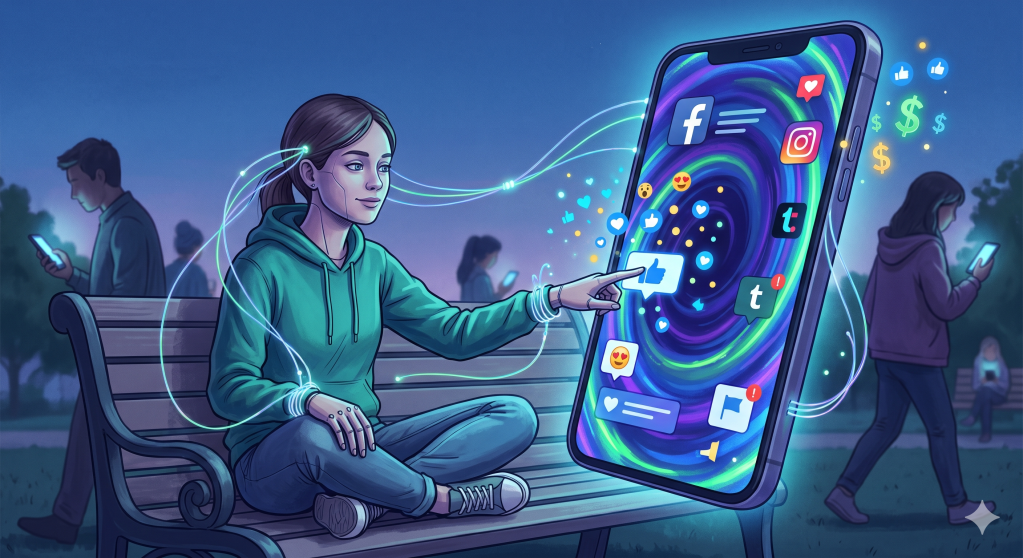
Maya unlocks her phone to check a text and twenty minutes later cannot remember why she picked it up. She puts it down. She picks it up again. She is not bored, not waiting for anything specific, not expecting news. She is simply doing what the phone, by design, makes easiest to do: return. That experience is so common that most people have stopped noticing it as anything remarkable. It is worth noticing.
This is not a conspiracy. It is engineering. Social media platforms are among the most sophisticated behavioral conditioning systems ever built, and they were constructed deliberately, by people who understood exactly what they were doing. The science behind them predates the internet by decades. What changed in the early 2010s was the scale at which that science could be applied — and the degree to which it became woven into the texture of everyday life before most people understood what was happening.
Understanding social media as behavioral conditioning doesn’t require cynicism about technology or nostalgia for a pre-digital past. It requires taking seriously a straightforward question: when a system is designed to change what you do, and it works, what has it changed — and at what cost? This essay examines the psychological mechanisms behind that influence, how they were deployed, what the research shows about their effects, and why the answers matter more now than they did when these platforms first arrived.
The Science That Came First
To understand how social media conditions behavior, it helps to start not with a smartphone but with a mid-20th-century laboratory and a psychologist named B.F. Skinner.
Skinner’s work on operant conditioning — the process by which behavior is shaped by its consequences — established principles that have proven remarkably durable across decades of subsequent research. His core finding was straightforward: behaviors that produce rewards tend to be repeated, while behaviors that produce punishment or no response tend to diminish. This was not a surprising idea. What Skinner contributed was a precise map of how different patterns of reward delivery produced different patterns of behavior.
The most important of his findings, for the purposes of understanding social media, concerned what he called variable ratio reinforcement. In a variable ratio schedule, rewards are delivered not after a fixed number of actions but after an unpredictable number. Sometimes the reward comes quickly; sometimes it takes many attempts; sometimes it doesn’t come at all. Skinner found that this schedule produced behavior that was both more persistent and more resistant to extinction than behavior reinforced on any other schedule. Subjects in a variable ratio schedule would continue performing the target behavior far longer after rewards stopped than subjects whose rewards had been predictable. The uncertainty, counterintuitively, made the behavior stronger.
Skinner’s most famous demonstration involved pigeons pecking levers for food. But the same principles were later documented in humans across a wide range of contexts, from gambling to video game design to financial trading. Variable ratio reinforcement is the mechanism behind why it is difficult to stop pulling the lever on a slot machine, why some video games become genuinely compulsive despite the player wanting to stop, and — as would become clear by the early 2010s — why a person might unlock their phone to check for notifications dozens of times a day without quite intending to.
How the Design Became the Behavior
The architects of modern social media platforms did not simply stumble onto these principles. Many of them studied them deliberately. Aza Raskin, the designer credited with inventing infinite scroll — the feature that replaced pagination with an endlessly loading feed — later estimated that the feature was responsible for approximately 200,000 additional hours of social media use per day across the platforms that adopted it. He described it as having been designed without full consideration of its psychological effects, and said publicly that he regretted it.
Raskin’s candor was relatively unusual. More common was the engineering culture described by former Google design ethicist Tristan Harris, who testified before Congress and gave widely circulated talks arguing that major tech platforms had been optimized for engagement at the expense of user wellbeing — and that this optimization had drawn explicitly on behavioral science. The red notification badge, Harris pointed out, was designed to exploit the same attentional hijacking mechanism as a warning light. The pull-to-refresh gesture replicated the physical motion of a slot machine lever. These were not accidents of interface design. They were the product of deliberate choices made by people who understood what the science predicted.
The Dopamine Question
Popular discussions of social media and the brain often invoke dopamine as an explanation for why these platforms feel compelling. The framing — “dopamine hit,” “dopamine rush” — is not entirely wrong, but it is imprecise in ways that matter.
Dopamine is a neurotransmitter involved in the brain’s reward and motivation systems, but its function is more complex than simply producing pleasure. Neuroscientist Wolfram Schultz’s landmark research in the 1990s demonstrated that dopamine neurons fire not primarily in response to reward itself, but in response to reward prediction — specifically, to cues that predict reward and to the gap between expected and actual outcomes. When a reward arrives unexpectedly, dopamine activity spikes. When an expected reward fails to arrive, it drops. The system is exquisitely tuned to uncertainty.
This means that social media notifications, likes, comments, and follower counts are not simply pleasures. They are prediction signals that activate a system evolved to guide behavior toward uncertain rewards. Maya, scrolling back to a photo she posted an hour ago to see if anyone has responded, is not merely seeking validation. Her brain is running a prediction loop — anticipating a potential reward, monitoring for its arrival, recalibrating based on whether it appeared. The compulsive quality of the behavior reflects the underlying neuroscience, not a character flaw. And crucially, dopamine does not force behavior — it alters the perceived significance of cues and rewards, making certain actions feel more worth pursuing than others. The platforms did not invent that sensitivity. They found it and built an engine that runs on it continuously.
From Individual Behavior to Social Norms
Behavioral conditioning, in the classical sense, operates on individuals. What made social media’s conditioning effects distinctive was their scale and their social dimension. These platforms did not simply change how individual users behaved; they changed the norms and expectations that governed social behavior more broadly.
Sociologists describe this kind of norm shift through the concept of pluralistic ignorance — a situation in which most members of a group privately hold one view but publicly behave as though they hold another, because each person assumes their private view is unusual. Social media created the conditions for a specific kind of pluralistic ignorance around compulsive use. Most users, privately, felt that they were spending more time on their phones than was good for them. Most users, publicly, continued to use their phones in ways that reinforced the norm of constant connectivity. Because each person’s private misgivings were invisible to others, the norm persisted even as the discomfort underlying it was widespread.
The conditioning also operated through social comparison, a mechanism first systematically described by psychologist Leon Festinger in 1954. Festinger observed that humans use others as reference points to evaluate their own opinions, abilities, and circumstances — and that this comparison process is largely automatic and largely unavoidable. Social media platforms concentrated social comparison stimuli at a density that had no precedent in human experience. The result was not merely that people compared themselves more often, but that the reference group against which they compared themselves shifted from the local and familiar to the curated and global.
A person in 1990 compared themselves, primarily, to people they knew personally: neighbors, colleagues, friends. A person in 2015 compared themselves to an algorithmically selected feed of people whose public presentations had been optimized for maximum attractiveness and engagement. The comparison inputs changed. The comparison mechanism, being automatic, kept running.
Attention as the Raw Material
The business model that drove all of this was not, fundamentally, about social connection. It was about attention.
The economist Herbert Simon observed as early as 1971 that in an information-rich world, the scarce resource is not information but the attention required to process it. Social media platforms understood this before most people did. Their product, in the economic sense, was not the platform itself — it was the time and attention of their users, sold to advertisers. Every design decision that extended the average session, increased the frequency of returns, or reduced the friction of disengagement was a decision that increased the value of the product. User wellbeing was not the optimization target. Attention was.
This created an incentive structure with a specific and predictable character. Features that were good for users but reduced engagement would be deprioritized. Features that were bad for users but increased engagement would be developed and deployed. The variable reward mechanisms, the infinite scroll, the algorithmic feed that surfaced emotionally activating content — these were not oversights. They were products of a system selecting for engagement above everything else.
Internal research at major platforms, portions of which became public through whistleblower disclosures and congressional testimony in the early 2020s, confirmed what behavioral scientists had been arguing from the outside for years. Facebook’s own researchers documented that the platform’s recommendation algorithms amplified emotionally polarizing content because it generated more engagement. Instagram’s internal studies found that the platform had measurable negative effects on body image among a significant portion of female teen users. These findings were known internally before they became public. The platforms continued operating as designed.
What the Research Actually Shows
The scientific literature on social media and behavioral outcomes is large, contested in its details, and frequently misrepresented in both directions — by advocates who overstate the harms and by platform defenders who dismiss the evidence entirely. A fair reading of the research as of the mid-2020s supports a more nuanced picture.
On the question of compulsive use, the evidence is relatively clear. Studies using experience sampling methods — where participants report their mood and behavior at random intervals throughout the day — consistently find that social media use is associated with reduced wellbeing in the moment, even when users report enjoying it or choosing to continue. A 2018 experimental study by Allcott et al. at Stanford, which paid participants to deactivate Facebook for four weeks, found that deactivation significantly increased wellbeing, reduced political polarization, and led participants to report, at the end of the study, that they had used Facebook more than they should have. The subjective experience of choice did not match the behavioral reality.
On mental health outcomes, the picture is more complicated. Large correlational studies have found associations between heavy social media use and elevated rates of anxiety, depression, and loneliness, particularly among adolescents. But the causal direction is difficult to establish, since people experiencing mental health difficulties also tend to use social media more heavily. More carefully designed studies — including longitudinal analyses and experiments involving reduced use — tend to find smaller effects than the most alarming correlational findings suggest, while still supporting the conclusion that heavy use, particularly passive consumption rather than active communication, is associated with worse outcomes for a meaningful subset of users.
The honest summary is that social media as behavioral conditioning has demonstrable effects on behavior, attention, and mood, with effects on longer-term mental health that are real but smaller and more variable than either the most alarming headlines or the platform dismissals suggest. The variation matters: heavy passive use appears to be considerably more harmful than active social use, and effects are stronger for adolescents than adults, for people with preexisting vulnerabilities than for those without them, and for platforms organized around social comparison rather than communication.
The Attention Economy and the Self
Beyond the measurable effects on mental health, social media as behavioral conditioning raises a deeper question about the relationship between designed behavioral systems and human autonomy.
Philosopher Harry Frankfurt, in his influential work on freedom of the will, drew a distinction between first-order desires — wanting to do something — and second-order desires — wanting to want, or not want, to do something. A person who wants to check their phone but also wishes they didn’t want to check their phone has a conflict between first and second-order desires. Frankfurt argued that genuine autonomy involves acting in accordance with one’s second-order desires — being able to align what you do with what, on reflection, you actually want.
Behavioral conditioning systems, at their most effective, operate precisely at the level of first-order desire. They make you want things — in this case, to check, to scroll, to post, to return — without engaging the reflective layer. Maya, reaching for her phone for the third time in an hour without consciously deciding to, is not acting autonomously in Frankfurt’s sense. She is acting on a conditioned first-order desire that her second-order self — the one who said, before bed last night, that she was going to use her phone less — may not endorse at all.
This is not unique to social media. Advertising, gambling, and various other designed systems have always sought to influence behavior by targeting first-order desires. What makes social media distinctive is the intimacy and continuity of the access. The phone is in the pocket, the pocket is on the body, the body is in almost every context of daily life. The conditioning system has a reach that earlier attention industries could not have imagined.
When the Conditioning Became Visible
The public reckoning arrived around 2017 and 2018. Former Facebook president Sean Parker admitted the platform had been designed to consume users’ time and attention by “exploiting a vulnerability in human psychology.” Justin Rosenstein, who built the Like button, called it a “bright bling” engineered to trigger dopamine responses — and restricted his own access to social media. Aza Raskin, inventor of infinite scroll, estimated the feature generated roughly 200,000 additional hours of daily consumption across the platforms that adopted it and said he regretted not thinking harder about what he was building. The 2020 documentary The Social Dilemma brought these admissions to a mainstream audience, and the core argument — that behavioral science had been deliberately applied to manufacture compulsive use — was not seriously disputed by anyone with direct knowledge of how the platforms worked. What followed was a wave of screen time dashboards and nudge features that were meaningful as signals and limited as solutions, navigating against the grain of systems that remained structurally optimized for the opposite.
The Conditioning Continues
By the mid-2020s, the behavioral conditioning mechanisms first developed in the early social media era had not retreated — they had been refined. Short-form video platforms deployed recommendation algorithms capable of building a precise model of each user’s engagement patterns and serving content calibrated to maintain attention with a granularity their predecessors could not have achieved. The same principles — variable reward, social comparison, continuous low-level social monitoring — now operated at higher fidelity and in a more immersive format.
Meanwhile, the population most exposed to these systems had shifted. A generation for whom Instagram and TikTok were not novelties adopted in adulthood but simply the environment of adolescence was reaching early adulthood with patterns of attention, self-presentation, and social comparison formed by behavioral conditioning systems from childhood. The long-term consequences of that exposure remain incompletely understood. The research is ongoing, and the most important outcomes may not be fully visible for years.
What Awareness Changes
Understanding that social media functions as behavioral conditioning doesn’t make the behavior stop. Knowing that the slot machine uses variable ratio reinforcement does not make it less compelling to pull the lever. Behavioral conditioning operates at a level that cognitive awareness only partially reaches. This is part of what makes the engineering so effective: it targets systems that predate and operate independently of the rational, deliberative mind.
But awareness is not useless. Research on what psychologists call “choice architecture” — the design of environments that make certain choices more or less likely — suggests that even modest structural changes can significantly alter behavior. Turning off notifications reduces the cue that triggers the checking behavior. Removing apps from the home screen increases the friction of access in ways that matter at the margins. Using platforms at a desk rather than carrying them in a pocket changes the behavioral context enough to reduce compulsive use. None of these changes are dramatic. All of them work by modifying the conditioning environment rather than simply willing the behavior to change.
The broader implication is that the question of social media and behavior is not primarily a question about individual willpower or self-discipline. It is a question about the design of systems — about who builds them, what they are optimized for, and whether the people most affected by their design have any meaningful input into it. Individual awareness matters. Structural design matters more.
The tools that shaped behavior so effectively during this period were not neutral. They were built with intention, refined continuously by what the data said worked, and deployed into the most intimate contexts of daily life. The defining technology of the social media era may not be the smartphone or the algorithm in any narrow sense. It may be something more fundamental: the transformation of human attention into a continuously optimized behavioral target — a resource to be harvested, shaped, and sold, largely without the knowledge of the people whose attention it was. Understanding that is not the end of the problem. But it is the only honest place to begin thinking about it.









