
Originally published in April of 2015 and comprehensively updated June 2026
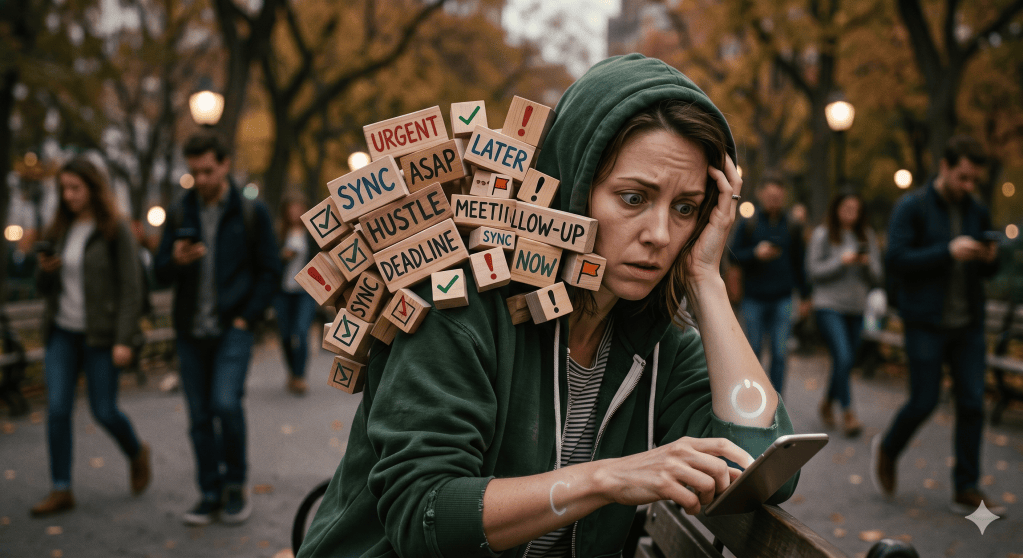
Busyness used to be something that happened to people. Today, for a great many of us, it’s something we are.
Somewhere along the line, being busy stopped being a circumstance and became an identity — something worn like a badge, narrated to others, and defended even when it’s doing damage. You know the type, because most of us have been the type at some point: the person who answers “How are you?” with a list of everything they’re juggling, delivered in a tone that’s equal parts complaint and pride. The calendar packed to the edges. The inbox that never empties. The quiet pride of someone who hasn’t had a genuinely slow Sunday in months.
And like most identities we absorb from the culture around us, most people adopted this one without quite realizing they had.
This is worth examining carefully. Not because being productive is bad, or because ambition is something to be suspicious of — but because there is a meaningful difference between a full life and an addictively busy one. Understanding that difference, and how we got here, requires looking at the psychological machinery behind busyness, the cultural forces that elevated it, and what the science has started to tell us about what all this relentless motion is actually doing to the human mind.
How Busyness Became a Virtue
The Cultural Roots of Busy
For most of recorded history, leisure was the privilege of the powerful. Ancient Greek philosophers distinguished between skholē — the free time necessary for thought and civic life — and ascholia, the state of being preoccupied with labor. The Romans had similar distinctions. Leisure wasn’t laziness; it was the condition that made wisdom possible.
That orientation shifted dramatically with the Protestant Reformation of the 16th century and the rise of what sociologist Max Weber famously called the “Protestant work ethic.” The idea that hard work was morally virtuous — that idleness was sin and industriousness a sign of divine favor — became deeply embedded in Western, and particularly American, culture. You weren’t just working to survive. You were working to prove something about your character.
The Industrial Revolution amplified this. When factory clocks replaced the rhythms of agricultural life, time itself became something to be managed, accounted for, and never wasted. The phrase “time is money” — popularized by Benjamin Franklin in 1748 — captures exactly this transformation. Time stopped being a human experience and became a resource to be spent wisely or squandered foolishly.
By the 20th century, especially in the United States, the cultural equation was firmly established: busy people were serious people. Productive people. Important people. And being seen as important became its own reward.
The 2000s and the Acceleration of Everything
When the original version of this essay was written in 2015, the busyness phenomenon had reached a kind of cultural fever pitch. But to understand why, it helps to trace the decade or so that preceded it.
The early 2000s brought a perfect storm of pressures. Globalization meant that competition for jobs was no longer local or even national. The 2008 financial crisis — the worst economic collapse since the Great Depression — left millions of workers scrambling. In that climate, putting in more hours, taking on more projects, and signaling your indispensability became genuine survival strategies. Being busy wasn’t just a preference; for many, it felt necessary.
At the same time, smartphones were completing their colonization of daily life. The iPhone launched in 2007. By 2015, roughly two-thirds of Americans owned one. Email, which had already eroded the boundary between work and home, was now accessible at dinner, in bed, on vacation, and in the middle of the night. The concept of being “off the clock” became increasingly theoretical.
Productivity culture entered the mainstream. Books with titles about getting more done in less time became bestsellers. “Life hacking” — the idea that your daily routines were inefficiencies waiting to be optimized — became a genre unto itself. Even personal relationships got swept into the optimization framework: networking, self-improvement, and “investing in yourself” became the vocabulary of people talking about their social lives.
The result was a culture that didn’t just tolerate busyness — it celebrated and rewarded it.
The Psychology of Perpetual Motion
Why Busy Feels Good
Here is the uncomfortable truth at the center of all this: busyness feels good, at least for a while. And that feeling has a neurological basis.
Before going further, it’s worth addressing the word “addiction” directly. Busyness is not a clinical addiction for most people — it doesn’t carry the physiological dependency of substance use disorders, and conflating the two would overstate the case. But it frequently exhibits several addiction-like characteristics: behavioral reinforcement, identity attachment, escalating commitment, and something that resembles withdrawal when the activity stops. People who clear their calendars for a vacation often describe the first few days as agitated and uncomfortable rather than relaxing. That pattern — the inability to disengage even when disengagement is the goal — is worth examining on its own terms, whatever we decide to call it.
When we accomplish tasks — crossing items off a to-do list, responding to emails, finishing a project — the brain releases dopamine, the neurotransmitter associated with reward and motivation. This is the same basic mechanism behind gambling, social media scrolling, and other behaviors that can become compulsive. Completing tasks triggers a small but real chemical reward. The brain notices this pattern. It wants more of it.
This is why people who describe themselves as hopelessly busy often can’t stop even when they claim they want to. The activity itself has become reinforcing. The stimulation of a packed schedule — the sense of motion, of being needed, of things always happening — provides a constant low-level stimulation that many people come to associate with purpose, relevance, and momentum.
Research by behavioral scientist Christopher Hsee at the University of Chicago found something revealing: people prefer being busy over being idle, even when the busy work serves no meaningful purpose. In a series of experiments published in Psychological Science, participants who were kept busy — even artificially — reported feeling happier than those left with nothing to do. Idleness, it turns out, is genuinely uncomfortable for most people. Not because they’re achieving anything, but because stillness itself has become threatening.
The Anxiety Connection
Busyness and anxiety have a complicated relationship. For many people, staying perpetually occupied is a way of avoiding thoughts they don’t want to have. There’s a reason therapists frequently encounter patients who describe keeping their schedules maxed out as a coping mechanism. A full calendar leaves no room for sitting alone with difficult feelings, unresolved grief, or the low-grade existential questions — Am I living the way I want to? Does any of this matter? — that tend to surface in quiet moments.
Psychologists sometimes refer to this as “activity-based avoidance.” The busyness isn’t incidental; it’s functional. It’s doing a job. And like most avoidance strategies, it works in the short term and compounds the problem in the long term, because the things being avoided don’t go away — they just wait.
This is distinct from a genuine love of work or the natural satisfaction of productivity. The distinction matters. Meaningful engagement with work is associated with psychological wellbeing. Compulsive busyness — staying in motion because stopping feels dangerous — is associated with burnout, anxiety disorders, and a peculiar kind of emptiness that often arrives when the schedule finally clears.
The Identity Trap
Somewhere in the last twenty years, many people stopped having busy lives and became busy people. The distinction is subtle but important.
When busyness becomes identity — when “I’m so slammed right now” becomes a defining feature of who you are, something you say about yourself the way you’d describe your personality or your values — it creates a trap. Because identities resist being dismantled. If your sense of self is built around being someone who has a lot going on, then slowing down isn’t relief. It’s a threat to who you think you are.
Sociologist Arlie Hochschild, in her research on work-family dynamics, found that some workers — particularly in professional environments — actually preferred being at the office to being at home, not because work was more enjoyable but because the workplace offered a clearer structure of identity and competence. Home required navigating emotional complexity, relationship demands, and ambiguity. Work offered the reassurance of productivity metrics and clearly defined roles.
The busyness addiction, in this light, is partly about the comfort of having a role to play and things to do. Unstructured time is psychologically demanding because it requires you to answer the question: Who am I when I’m not doing anything?
What the Neuroscience Actually Says
The Brain on Overload
The human brain is not designed for the cognitive load that modern busyness imposes. This isn’t a romantic notion about simpler times — it’s fairly straightforward neuroscience.
The prefrontal cortex, which manages decision-making, impulse control, and complex reasoning, operates on limited resources. When it is taxed by an unrelenting stream of tasks, notifications, decisions, and context-switching, its performance degrades. Researchers call this “decision fatigue.” The more decisions you make, the worse your decision-making becomes. This applies to trivial choices and important ones alike.
Neuroscientist Daniel Levitin, in his book The Organized Mind, describes the cognitive toll of constant connectivity. Every notification, he argues, carries a small attentional cost — not just the time it takes to respond, but the residual distraction that follows. Studies have measured the time it takes for a person to return to full concentration after an interruption at somewhere between 15 and 23 minutes. In an environment where interruptions can occur dozens of times per hour, sustained deep thought becomes almost structurally impossible.
Consider what this looks like in practice. A manager answers a Slack message while reviewing a proposal. She glances at email between back-to-back meetings. The afternoon is spent switching between a budget spreadsheet, a document someone needs feedback on, and a thread that keeps pinging. By day’s end, she’s exhausted — not because the work was particularly difficult, but because her attention was fractured and reassembled dozens of times. She hasn’t done deep work. She’s done dozens of shallow tasks and paid the neurological toll of each transition. The busyness was real. The productivity, less so.
This matters because it means perpetual busyness doesn’t just affect how we feel — it actively undermines the quality of the thinking we’re supposedly so busy doing.
The Default Mode Network and the Value of Idleness
One of the more striking findings in modern neuroscience is what happens in the brain when you’re doing nothing in particular.
For a long time, neuroscientists assumed that brain activity quieted during periods of rest. What they discovered instead was that certain regions of the brain — collectively called the default mode network — become more active during unstructured downtime. This network, which involves the medial prefrontal cortex, the posterior cingulate cortex, and other regions, is associated with self-referential thinking, creativity, memory consolidation, and what researchers describe as “mental simulation” — the imaginative work of thinking about the past, the future, and hypothetical scenarios.
In other words, the brain doesn’t rest when you rest. It does a different kind of work — work that may be essential for creativity, problem-solving, and psychological integration. When we fill every moment with tasks, notifications, and scheduled activity, we crowd out the idle time that the default mode network needs to function. There is a reasonable argument, supported by neuroimaging research, that the relentless busyness of modern life is directly interfering with the cognitive processes that produce our best thinking.
This may help explain why so many people report having their best ideas in the shower, on walks, or in other moments of low-demand activity. It’s not coincidence — those are the moments when the default mode network finally gets some space.
Social Media and the Performance of Busy
Busyness as a Signal
In 2017, sociologist Silvia Bellezza of Columbia Business School published research demonstrating something that felt intuitively obvious once stated: in the United States, busyness had become a status symbol — and the effect was specifically American.
Bellezza and her colleagues found that, unlike in Italy (where leisure and dolce far niente remained aspirational), American respondents associated busyness and long working hours with high social status, competence, and importance. The paper, published in the Journal of Consumer Research, suggested that in a cultural environment where time is perceived as scarce and valuable, being busy signals that you are a person whose time is in demand. It’s a proxy for being wanted, necessary, and successful.
This finding reframes the busyness conversation in an important way. It’s not only that people are busy — it’s that they are incentivized to appear busy, and to narrate their busyness to others. Social media provided the perfect stage for exactly this kind of performance.
Instagram, Twitter, LinkedIn, and later platforms created environments where people curated their lives for an audience. And in that curation, busyness became a genre: the 6 a.m. workout post, the airport lounge photo, the screenshot of back-to-back meeting blocks, the late-night “just shipped something” announcement. These weren’t simply moments of sharing. They were broadcasts of industriousness — signals that sent the message: I am a person who is doing things.
The line between being busy and performing busyness became increasingly blurry. And the performance, over time, exerted pressure on the experience. People began organizing their actual schedules around what they could display, rather than what they actually wanted or needed to do.
The Costs Nobody Talks About
The Physical Toll
Chronic busyness — particularly the kind driven by stress and inadequate recovery — carries measurable physiological costs.
The stress response, mediated by cortisol and adrenaline, is designed for short-term activation. When it operates continuously, as it does in people who describe themselves as perpetually overwhelmed, it begins to create problems. Chronically elevated cortisol has been associated with impaired immune function, disrupted sleep, weight gain, cardiovascular strain, and suppressed cognitive function. The phrase “burning the candle at both ends” is, physiologically speaking, a reasonably accurate description.
Sleep is particularly significant here. Research from the National Sleep Foundation and numerous academic studies has repeatedly demonstrated that sleep deprivation — one of the most common consequences of overcommitted schedules — impairs virtually every dimension of cognitive and physical performance. Yet the busyness culture has historically treated sleep as a negotiable line item, something to be optimized and minimized. The phrase “I’ll sleep when I’m dead” expresses, quite literally, the cultural attitude.
The Relationship Cost
Perhaps the most quietly significant cost of chronic busyness is what it does to relationships. Not the dramatic, visible ruptures — the missed milestones, the canceled plans — but the subtler erosion that happens when people are physically present but mentally elsewhere.
Quality of attention matters in relationships, and attention is finite. When it’s continuously divided among tasks, devices, and obligations, the people in our lives — children, partners, friends — receive a fraction of it. Research on “technoference” — the interference of technology in interpersonal interactions — has found that the mere presence of a smartphone on a table reduces the quality of conversation and the sense of connection between people talking.
Busyness creates a kind of ambient distraction that can persist even when the schedule isn’t actively full. When your mind is trained to always be processing the next task, the next commitment, the next obligation, being present in a conversation becomes genuinely difficult. The busyness isn’t just a schedule problem. It becomes a neurological habit.
Where Things Stand in 2026
A Decade of Reconsideration
Since the original version of this essay, the conversation around busyness has shifted in notable ways. The COVID-19 pandemic, beginning in 2020, functioned as a kind of forced experiment in how people spend their time. With commutes eliminated and the performative scaffolding of office culture suspended, many people found themselves confronting their actual relationship with productivity and rest — sometimes with surprise at what they found. The “Great Resignation” that followed suggested that significant numbers of people had grown quietly ambivalent about the busyness framework they’d adopted, and that the pandemic had simply created enough space to notice it.
The growth of mindfulness practices, four-day workweek experiments underway in numerous countries, and the research on burnout that finally entered mainstream awareness all point to a cultural moment of reckoning with chronic overcommitment. The busyness identity is not gone. But its dominance is being contested in ways it wasn’t a decade ago.
Perhaps the more consequential pressure, though, is coming from outside the culture entirely. For centuries, productivity and busyness were treated as roughly synonymous — if you were working, you were producing, and if you were producing, you were busy. Artificial intelligence is beginning to pull those two things apart. As AI tools absorb growing portions of routine cognitive labor — drafting, organizing, summarizing, scheduling — the hours once filled by that work don’t automatically fill with something more meaningful. They simply empty. That raises a question the busyness culture was never designed to answer: what forms of human activity remain worth pursuing when busyness is no longer required? The essay’s central argument — that many people use busyness to avoid confronting who they are without it — becomes considerably more urgent when the busyness itself starts to disappear.
The Structural Versus the Personal
It would be incomplete to discuss the addiction to being busy without acknowledging that not all busyness is psychological or cultural in origin. For many people, particularly those navigating economic precarity, working multiple jobs, or managing caregiving responsibilities alongside employment, the fullness of their lives is not a performance or an identity — it is a necessity. Any honest analysis has to hold both realities at once: that there is a genuinely compulsive, culturally constructed version of busyness that functions like an addiction, and that there is also busyness born of economic circumstance that has nothing to do with status-seeking or avoidance.
The distinction matters because the solutions are different. The person addicted to busyness needs to examine their relationship with stillness, identity, and anxiety. The person who is structurally overextended needs systemic change — in wages, in work norms, in caregiving infrastructure — that no amount of mindfulness practice can substitute for.
Conclusion: What We’re Actually Choosing
The addiction to being busy is, at its core, a story about what we use to define ourselves, what we use to avoid ourselves, and what we’ve been culturally trained to perform for others.
It is not a new story. The pressure to demonstrate industry and productivity has deep roots in Western culture. But the technological infrastructure of the last two decades — always-on connectivity, social media audiences, digital productivity tools — created conditions in which the addiction could accelerate and generalize in ways that previous generations simply didn’t have to contend with.
What the research suggests, taken together, is something fairly sobering: that the busyness many people pursue with such dedication is undermining the very things it’s supposedly building toward. Chronic overcommitment degrades decision-making, erodes creativity, strains relationships, and carries real physiological costs. The brain, when given no room to wander, loses some of its best capabilities.
None of this means that work is bad, or that ambition is a pathology, or that people should feel guilty for having full lives. Those would be the wrong conclusions. The more useful observation is narrower: there is a difference between choosing to be engaged and being unable to disengage. One is a quality of living. The other is something closer to a compulsion — shaped by culture, reinforced by neurology, and worth examining honestly.
A useful diagnostic may be simpler than it sounds: how does stillness feel? Not the enforced stillness of illness or crisis, but a genuinely open afternoon — no agenda, no obligations, nothing that needs doing. For many people, that prospect produces something closer to anxiety than relief. If an empty afternoon feels threatening rather than restorative, the issue may not be a lack of things to do. It may be a dependence on activity itself — on the noise, the motion, the reassurance of the occupied mind. Recognizing that dependence is not the same as curing it, but it’s a more honest starting point than assuming the busyness is simply what life requires.
The question isn’t whether to be productive. It’s whether the busyness is in service of something, or whether the something has become the busyness itself.
That’s a question worth sitting still long enough to actually think about.









