
Originally published in May of 2015 and comprehensively updated and edited in June 2026.
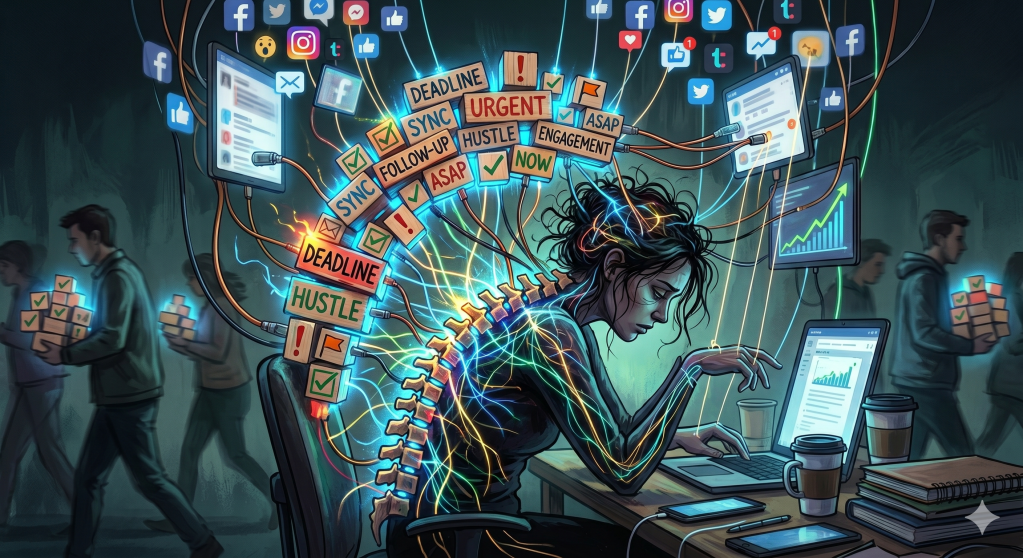
There was a period, roughly spanning the mid-2010s through the early 2020s, when a particular philosophy took hold in the culture with unusual force. It went by several names — hustle culture, the grind, the #riseandgrind mentality — but the core idea was consistent: maximum effort, minimum rest, and an almost religious suspicion of anyone who wasn’t pushing themselves to their limit. Sleep was for the weak. Vacations were for people without ambition. The goal wasn’t just success — it was a specific, visible, performative version of striving that needed to be constantly demonstrated.
At the time, it felt like a motivational movement. In retrospect, it looks more like a mass experiment in chronic stress.
What hustle culture was selling, underneath the productivity rhetoric, was a relationship with the nervous system — a way of living in a state of near-constant activation, where the body and brain rarely get the signal that it’s safe to stand down. This isn’t metaphorical. The physiology is real. And understanding what prolonged activation of the stress response actually does to the human body helps explain why so many dedicated practitioners of hustle culture eventually hit a wall that no amount of motivation could get them past.
This essay examines how hustle culture emerged, what it demanded of people’s bodies and brains, what the science tells us about those demands, and what the long aftermath of that period has started to reveal.
The Anatomy of Hustle Culture
Where It Came From
Hustle culture didn’t arrive fully formed. It was assembled from pieces that had been accumulating in American culture for decades — the Protestant work ethic, the self-made mythology, the Silicon Valley ethos of “move fast and break things” — and was then dramatically amplified by social media.
The late 2000s and early 2010s were fertile ground. The 2008 financial crisis had shaken the conventional career contract: the idea that loyalty, credentials, and steady effort would produce stability. In the rubble of that collapse, a counter-narrative emerged, promoted heavily in entrepreneurial and tech circles, that the solution was to work harder, build your own thing, and refuse to depend on institutions that could fail you. Entrepreneurial influencers, startup founders, and productivity gurus built massive audiences around the idea that relentless effort and constant optimization were the path to freedom. The specific prescriptions varied — some emphasized output and visibility, others efficiency and leverage — but the underlying assumption was consistent: the amount of effort you were willing to apply was the primary variable determining your outcome.
Instagram arrived in 2010. By 2015, it had become the primary stage on which hustle culture performed itself. The 5 a.m. alarm photo. The home office at midnight. The airport terminal selfie tagged with some variation of “always moving.” These weren’t just personal moments — they were declarations of identity, broadcast to audiences that rewarded them with likes and followers. Being visibly productive became its own form of social currency.
What made hustle culture distinct from earlier work-hard narratives was the addition of this performative layer. Previous generations may have worked long hours, but they didn’t typically document and broadcast those hours in real time to curated audiences. The social media dimension transformed grinding from a private practice into a competitive public sport.
Who It Targeted
Hustle culture found its most receptive audience among young adults — particularly millennials navigating a labor market that was simultaneously more competitive and less stable than the one their parents had encountered. Rising housing costs, stagnant wages relative to the cost of living, and the explosion of precarious gig work meant that for many young people, working multiple jobs or side hustles wasn’t an aspiration but a practical necessity.
Hustle culture was, in part, a psychological response to precarity — a way of reframing economic anxiety as personal agency. If you couldn’t count on the system, you could at least count on yourself to outwork it. The framing was empowering, which is why it spread. But it also carried a subtle cruelty: it located the solution to structural problems entirely within the individual, suggesting that insufficient hustle, rather than wages or housing policy or student debt, was why people were struggling.
This framing had real consequences for how people related to their own exhaustion. If the system rewarded those who pushed hardest, then feeling tired wasn’t a signal to rest — it was a personal failure to push through. The nervous system’s distress signals got reinterpreted as weakness.
Consider a composite portrait that would have been unremarkable in 2016: a twenty-six-year-old working a full-time job in marketing while building a side business on evenings and weekends, sleeping five or six hours because that’s what the schedule allowed, consuming productivity content during her commute, and measuring her worth largely by output metrics. She wasn’t unusual. She was, by hustle culture’s standards, doing it right. The alarm systems her body was running — the persistent fatigue, the hair-trigger irritability, the difficulty winding down at night — weren’t legible to her as warning signs. They were, in the framework she’d absorbed, just the cost of wanting something.
The Stress Response and What It’s For
A System Built for Emergencies
To understand what hustle culture was doing to people physiologically, it helps to understand what the stress response is actually designed to do.
The human stress response — sometimes called the fight-or-flight response — is one of the oldest and most sophisticated survival mechanisms in the animal kingdom. When the brain perceives a threat, the hypothalamus signals the adrenal glands to release adrenaline and cortisol. Adrenaline accelerates the heart rate, increases blood pressure, and shunts blood toward the muscles. Cortisol raises blood sugar, suppresses non-essential functions like digestion and immune activity, and sharpens certain kinds of focused attention. The body, in short, goes on high alert.
This system is extraordinarily effective for what it evolved to handle: acute, physical, time-limited threats. A predator. A physical confrontation. A sudden emergency that requires peak performance and fast action. When the threat passes, the parasympathetic nervous system takes over — the branch sometimes described as “rest and digest” — and the body begins recovering. Heart rate slows. Cortisol levels drop. Digestion resumes. The system resets.
The problem is that this ancient machinery is now being activated by things it was never designed for: a difficult email, a looming deadline, a performance metric, a social media comparison, a financial worry. These aren’t acute threats that resolve quickly. They’re chronic, low-to-medium-grade stressors that can keep the stress response activated for hours, days, or continuously for months. The system that was built for sprints is being asked to run a marathon. It was not designed for that.
The Cortisol Problem
Cortisol is useful in short bursts and destructive in sustained doses. This is one of the better-established findings in stress physiology, and it has direct implications for anyone who spent years operating in hustle culture’s preferred state of chronic urgency.
Chronically elevated cortisol suppresses immune function, making the body more vulnerable to illness and slower to recover from it. It disrupts sleep architecture — particularly the deep, restorative sleep stages — which creates a feedback loop, since inadequate sleep further elevates stress hormones the following day. It impairs memory consolidation, specifically the transfer of information from short-term to long-term storage that occurs during sleep. Over time, sustained high cortisol is associated with structural changes in the hippocampus, the brain region central to memory and spatial navigation. It promotes the accumulation of visceral fat, which is independently associated with cardiovascular and metabolic risk. And it degrades the prefrontal cortex’s capacity for complex reasoning, impulse control, and long-range planning — precisely the cognitive functions most needed for the ambitious goals hustle culture was nominally in service of.
There is a painful irony here that took many people years to recognize: the high-activation state that hustle culture celebrated as optimal performance was, when sustained, actively undermining the cognitive performance it claimed to produce.
The Nervous System on the Grind
Chronic Activation and the Allostatic Load
Physiologists use the term “allostatic load” to describe the cumulative wear and tear on the body from sustained stress — the total biological cost of repeatedly activating and imperfectly recovering from the stress response. It’s a more precise concept than simply “stress,” because it captures the compounding nature of the damage: each episode of incomplete recovery adds to the load, and the body’s systems gradually lose their ability to maintain equilibrium.
Think of it less like a muscle being trained and more like a machine being run without maintenance. Individual demanding workdays are recoverable. Weeks of them, strung together without genuine rest, begin to degrade the system in measurable ways. Years of them — the timeline many serious practitioners of hustle culture were working on — can produce changes that aren’t quickly reversible.
Research on allostatic load, developed substantially by neuroscientist Bruce McEwen at Rockefeller University, has linked high cumulative stress exposure to accelerated biological aging, cardiovascular disease, metabolic dysfunction, and cognitive decline. These aren’t abstract risks — they’re outcomes that show up in measurable biomarkers: blood pressure, inflammatory markers, hormonal profiles, telomere length. The body keeps score in ways that don’t show up in a LinkedIn profile.
Sleep as the Missing Variable
If there is one variable that hustle culture got most catastrophically wrong, it is sleep.
The cultural messaging was consistent: sleep less, do more. Four or five hours was presented not just as survivable but as an advantage — evidence of superior drive and discipline. Entrepreneurs bragged about their abbreviated sleep schedules the way athletes boast about training volume. The implicit message was that time spent sleeping was time not spent building.
Sleep science tells a very different story. Matthew Walker, a neuroscientist at UC Berkeley and author of Why We Sleep, has described insufficient sleep as one of the most pervasive and consequential public health problems of the modern era — and one that is dramatically underappreciated because its effects accumulate gradually and are often attributed to other causes.
The mechanisms matter here. During sleep, the brain does not simply pause. The glymphatic system — a network of channels that clears metabolic waste from brain tissue — is primarily active during sleep, flushing out toxins including the proteins associated with neurodegenerative disease. Memory consolidation, emotional regulation, immune function, hormonal balance, and cellular repair all depend significantly on sleep quantity and quality. Even a single night of inadequate sleep produces measurable impairment in attention, working memory, and emotional reactivity. Chronic sleep deprivation produces deficits that accumulate over time and that people are often unable to accurately self-assess — a particularly dangerous feature, since the sleep-deprived brain tends to underestimate how impaired it is.
The hustle culture directive to sleep less was, in physiological terms, a directive to impair cognitive function, destabilize emotional regulation, and accelerate wear on virtually every organ system in the body. It was productivity advice that undermined productivity — and a great deal more besides.
The Nervous System Doesn’t Negotiate
One of the more significant misconceptions embedded in hustle culture was the idea that willpower and mindset could override the body’s physiological responses. That if you simply wanted it badly enough, stayed disciplined enough, thought positively enough, you could run on less sleep, absorb more stress, and keep performing at a high level indefinitely.
The nervous system doesn’t work that way.
The autonomic nervous system — the branch that governs the stress response, heart rate, digestion, and dozens of other involuntary functions — operates largely below the threshold of conscious control. You can choose how you respond to a stressor behaviorally, but you cannot choose not to have a cortisol response to a threatening situation. You can decide to stay at your desk at midnight, but you cannot decide that your glymphatic system will adequately clear waste products from your brain on five hours of sleep. You can believe that you’re performing at full capacity on inadequate rest, but your prefrontal cortex will be measurably impaired regardless of your beliefs about it.
This gap — between what people believed they were capable of through sheer will and what their nervous systems were actually doing — is where hustle culture quietly produced its most significant damage.
The Burnout Reckoning
When the System Fails
Burnout is not simply extreme tiredness. The World Health Organization formally recognized burnout as an occupational phenomenon in 2019, characterizing it by three dimensions: feelings of exhaustion or depletion, increasing mental distance or cynicism toward work, and reduced professional efficacy. It is the system announcing, through its failures, that the demands placed on it have exceeded what it can sustain.
What the research on burnout — much of it developed by psychologists Christina Maslach and Michael Leiter over several decades — makes clear is that burnout is not primarily a personal failure of resilience. It develops from a mismatch between what a job or environment demands and what the individual has available to give: in time, energy, autonomy, recognition, fairness, or community. Hustle culture was, almost by design, an engine for producing those mismatches. It maximized demands and treated recovery as a weakness.
The timing of the pandemic is relevant here. When COVID-19 arrived in 2020 and disrupted work structures globally, it hit a workforce that was, in many sectors, already operating at or near the edge of sustainable capacity. The pandemic didn’t create burnout — it accelerated and exposed it. The mass departure from jobs and the re-evaluation of work priorities that followed reflected something that had been building for years in the culture’s nervous systems.
The Particular Toll on Young Workers
The generation that came of age professionally during peak hustle culture — roughly those who entered the workforce between 2010 and 2020 — is now old enough to be reckoning with what that period cost them. Surveys and qualitative research consistently show elevated rates of burnout, anxiety, and what psychologists sometimes call “existential exhaustion” — a depletion that goes beyond tiredness to something closer to a loss of meaning — among younger workers who embraced the hustle framework most fully.
There’s something particularly disorienting about burning out on a belief system, not just a job. Many people who invested years in hustle culture did so because they genuinely believed in its promises. The cognitive dissonance of arriving at burnout — having done everything the ideology prescribed and still finding themselves depleted and unfulfilled — produced a kind of identity crisis that ordinary job fatigue doesn’t.
This might be called ideological burnout, and it operates differently from the kind that develops simply from overwork. When a person burns out from a demanding job, they can preserve a sense of self separate from the job — they were always more than the work, even if the work was too much. But hustle culture didn’t just ask for time and energy. It asked for identity. It asked people to organize their sense of self-worth around productivity metrics, to treat their capacity for output as the measure of their value, and to view rest as a form of moral failure. When the system collapsed anyway — when the grinding produced exhaustion without the promised payoff, or produced success that felt strangely hollow — people weren’t just tired. They had lost the framework through which they had been interpreting their own lives. That’s a different and harder kind of recovery.
The popularity of the “quiet quitting” discourse of 2022 — the idea of doing your job without performing extra commitment — was partly a symptom of this reckoning. It was less a trend than a name applied to a posture many people had already quietly adopted after years of giving more than was sustainable.
What Recovery Actually Requires
The Science of Genuine Rest
Recovery from chronic stress is not simply a matter of stopping the stressor. The nervous system, once trained to maintain high activation, doesn’t automatically return to baseline when the pressure eases. This is one of the more counterintuitive aspects of burnout recovery: people expect that rest will feel immediately restorative, and are sometimes alarmed when it doesn’t.
The parasympathetic nervous system — the “rest and digest” branch that counterbalances the stress response — can be deliberately activated through specific practices. Deep, slow breathing is among the most direct methods, because respiratory patterns have a direct physiological connection to the autonomic nervous system through the vagus nerve. Slower exhalations, in particular, activate the parasympathetic branch and measurably lower heart rate and cortisol. This is not folk wisdom — it’s well-documented in the physiology of heart rate variability, a standard measure of autonomic nervous system balance.
Physical exercise presents a more nuanced picture. Moderate aerobic activity has strong evidence behind it as a stress buffer — it metabolizes stress hormones, improves sleep quality, and promotes neurogenesis in the hippocampus. But high-intensity exercise, particularly when used as a productivity strategy rather than genuine recreation, can add to allostatic load rather than reduce it. The distinction matters: exercise as a form of self-care produces different outcomes than exercise as another item on the optimization checklist.
Social connection, time in nature, genuine leisure — activities pursued for their own sake rather than for any return — all activate the parasympathetic system and contribute to recovery. What they share is the absence of productive urgency: the nervous system’s signal, finally, that no output is required.
Relearning What the Body Is Saying
Perhaps the deepest legacy of hustle culture’s relationship with the nervous system is the disruption it caused to people’s ability to read their own physiological signals accurately.
When people spend years interpreting fatigue as weakness, anxiety as fuel, and the desire for rest as laziness, they become increasingly disconnected from what their bodies are actually communicating. The body’s distress signals — the disrupted sleep, the chronic tension, the low-grade irritability, the difficulty concentrating — get overridden by ideology rather than attended to as information.
Reconnecting with those signals is not a trivial task. For people who spent years in high-activation states, stillness can initially feel like a problem to solve rather than a state to inhabit. The quieting of the nervous system, rather than feeling like relief, can first manifest as restlessness, anxiety, or a disorienting sense of purposelessness. Recovery, in this sense, is not just physiological — it involves relearning how to interpret the body’s communications after years of systematic suppression.
What makes this particularly difficult is that the high-activation state becomes familiar — and the brain tends to treat the familiar as safe. The chronic stress of hustle culture, sustained long enough, stops feeling like stress and starts feeling like normal. People describe it as “just how I function” or “how I’ve always been.” The baseline shifts. And when rest and recovery eventually lower that activation level, the new state can feel foreign and even threatening, because the nervous system has recalibrated to treat urgency as its default setting. This isn’t a character flaw or a failure of will. It’s a predictable consequence of how the nervous system adapts to its environment over time. Recovery, in this light, isn’t about getting back to a previous baseline — for many people, that baseline was already compromised before they recognized it. It’s about building a new one, slowly, by giving the nervous system enough consistent safety signals that it can actually learn to stand down.
Where Hustle Culture Stands in 2026
A Philosophy Under Revision
The hustle culture that dominated the cultural conversation a decade ago is quieter now — not gone, but significantly chastened. The influencers who built brands around the grind have largely diversified their messaging. The most extreme advocates have either burned out publicly or quietly shifted their framing. The research on burnout, chronic stress, and sleep deprivation that was already well-established in 2015 has since accumulated further and entered mainstream awareness in ways it hadn’t before.
Several forces contributed to the shift. The pandemic, as noted, forced a confrontation with what the relentless pace had cost. Prominent figures in tech and entrepreneurship began talking openly about their own burnout experiences, normalizing a conversation that hustle culture had previously made almost unspeakable. The four-day workweek research — including large-scale trials in Iceland, the UK, and elsewhere — produced findings suggesting that productivity didn’t reliably suffer from reduced hours and that worker wellbeing improved significantly. These weren’t marginal findings. They challenged the foundational assumption that more hours equals more output.
The science of recovery has also gained cultural traction that it previously lacked. Sleep is discussed with considerably more seriousness than it was in 2015. The concept of “nervous system regulation” — while sometimes reduced to wellness-culture buzzwords — reflects a genuine and growing awareness that the body’s stress response has a biology, and that biology has limits.
The Structural Problem That Remains
There is an important caveat to the narrative of hustle culture’s decline, and it’s the same one that complicates the busyness discussion more broadly: for many people, the conditions that made hustle culture feel necessary haven’t substantially changed.
The economic precarity that drove young workers toward a philosophy of relentless effort has not been resolved. Housing costs have continued rising faster than wages in most major cities. Gig work remains a significant portion of the labor market. Student debt continues to shape the financial lives of a generation. The structural pressures that hustle culture offered to address — however inadequately — remain.
This means that any cultural reckoning with hustle culture’s costs has to grapple honestly with the fact that some version of working hard, often across multiple jobs, is not a choice for significant portions of the workforce. The critique of hustle culture as a damaging ideology applies most cleanly to people for whom it was genuinely optional — the entrepreneurially aspirational, the already-credentialed, the economically comfortable who chose intensity over balance. For those who were simply trying to make ends meet, the critique offers less practical leverage.
The distinction is worth holding onto. The nervous system damage from chronic overwork is real regardless of whether the overwork was chosen or imposed. But the solutions look different depending on which situation you’re in.
Conclusion: What the Body Knew
Hustle culture, at its peak, operated as though the body were a tool to be deployed rather than a system to be sustained. It treated the stress response as a resource to be maximized rather than a mechanism to be used sparingly. It rebranded physiological distress signals as evidence of insufficient commitment. And for a significant period, it convinced a remarkable number of people that this was not just acceptable but admirable.
What the science of stress physiology, sleep research, and burnout psychology collectively suggest is that the body was right all along. The fatigue was real. The need for rest was real. The signals being overridden were accurate. The nervous system wasn’t failing the people running on hustle culture’s protocols — it was doing exactly what it was designed to do, which is to communicate when the demands placed on it are unsustainable.
The more enduring question that hustle culture raises isn’t really about productivity or ambition. Those aren’t the problem. The problem is what happens when a cultural movement convinces people to treat the body’s honest communications as obstacles rather than information — when the goal becomes suppressing the signal rather than addressing what the signal is pointing to.
Recovery, for many people who spent years in that framework, has meant something more than taking a vacation or sleeping in. It has meant rebuilding a relationship with the body’s intelligence that hustle culture spent years systematically dismantling. That’s a longer project than any productivity hack can fix — and it requires a kind of patience that hustle culture, almost by definition, had no framework for.
The nervous system, it turns out, was never the obstacle. It was the whole point.









