
Originally published in October 2015 and comprehensively updated/edited in June 2026.
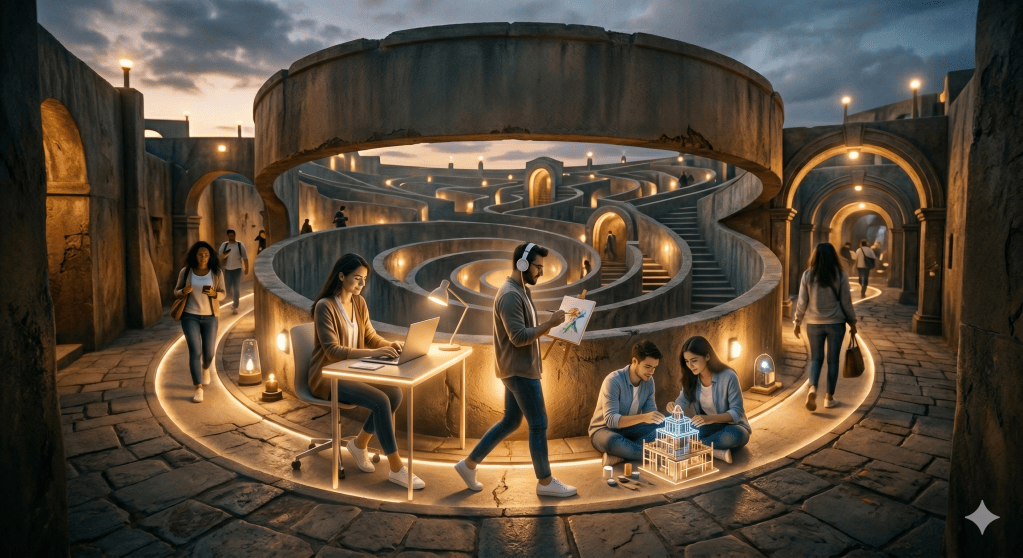
Why does stillness feel so uncomfortable? Explore the psychology, neuroscience, and social forces behind our need for constant activity — and what the discomfort of quiet might reveal.
There’s a particular kind of exhaustion that doesn’t come from doing too much — it comes from stopping. Most of us have felt it: the strange unease that settles in during a quiet afternoon, the restless scrolling that fills a five-minute wait, the guilt that creeps in during a Saturday with no plans. We live in a culture that has made busyness into a virtue and stillness into something that needs to be justified.
This wasn’t always the case, or at least not to this degree. Something shifted in the decades surrounding the turn of the twenty-first century — an acceleration in the pace of daily life that changed not just how we spend our time, but how we feel about spending it. By 2015, the condition had a name in popular culture: FOMO, the Fear of Missing Out. But the psychological roots ran much deeper than a Twitter-age acronym could capture. And by 2026, what once felt like a cultural moment has calcified into a basic condition of modern life.
Understanding why constant activity feels so psychologically comforting — and why its absence feels threatening — requires looking at forces that span neuroscience, sociology, technology, and the long arc of how modern economies came to define human worth. What emerges from that examination is something that might be called motion sickness of the mind: a condition in which stillness itself has become the thing we can’t tolerate, not because we have so much to do, but because we’ve lost the capacity to be anywhere other than in motion.
The Busy Signal: How Busyness Became a Status Symbol
For most of recorded history, leisure was the mark of privilege. The aristocrat didn’t work. The philosopher had time to think. Physical labor was associated with the lower classes, and the ability to rest — to simply be — was something you demonstrated to show you had arrived. That system of meaning began to erode with the Industrial Revolution and collapsed almost entirely under the pressure of twentieth-century consumer capitalism.
By the mid-twentieth century, being productive had become morally loaded. The Protestant work ethic, as sociologist Max Weber famously analyzed, had severed itself from its theological roots and become a free-floating cultural value: work was good, idleness was suspect, and the industrious person was the virtuous person. But it was the late twentieth and early twenty-first centuries that completed the transformation. Busyness didn’t just become acceptable — it became aspirational.
Sociologist Silvia Bellezza and her colleagues at Columbia Business School documented this shift in a 2017 paper that became widely cited for good reason. Across a series of studies, they found that in the United States, people who signaled they were busy and in demand were perceived as having higher social status than people who signaled they had leisure time. This was the opposite of findings from Italy, where leisure still carried the connotation of wealth and social standing. The American pattern, Bellezza’s team argued, reflected a belief that being in demand signals rare and valuable human capital — that a busy person is a person the world needs.
This matters because status signals are deeply motivating. When we adopt behaviors that earn social approval, we’re not just performing for others — we internalize those values. The person who brags about their packed schedule may initially be performing busyness, but over time, the performance and the psychology become indistinguishable.
The Texture of Modern Time
Something else happened alongside this status shift: technology erased the natural boundaries that used to structure time. Before smartphones, before the internet, before round-the-clock connectivity, there were whole categories of waiting — for the bus, for a letter, for the news at six o’clock — that imposed pauses on daily life. Those pauses, annoying as they might have felt, were also gaps in which the mind could wander, rest, and reset.
The smartphone didn’t just give us access to information. It gave us access to a permanent supply of stimulation — social media, news, messages, games, podcasts, shopping — available in any moment of potential stillness. And we took the offer. Extensively. Research from the early 2020s estimated that Americans checked their phones somewhere between 50 and 100 times per day, with total daily screen time often exceeding four or five hours. The average person, it turned out, would rather do almost anything than sit with their own thoughts.
That last sentence isn’t an exaggeration. In a now-famous 2014 study published in Science, psychologist Timothy Wilson and his colleagues at the University of Virginia asked participants to sit quietly in a room for six to fifteen minutes, alone with their thoughts, with nothing to look at or interact with. Many found the experience deeply unpleasant. In a series of follow-up experiments, a significant portion of participants — including a majority of men — chose to administer mild electric shocks to themselves rather than simply sit with their thoughts. People actively preferred discomfort over mental quiet.
What the Brain Does When It’s Busy (and When It’s Not)
To understand why constant activity feels comforting at a psychological level, it helps to understand what the brain is actually doing when we’re busy versus when we’re not.
For much of the twentieth century, neuroscientists assumed that the brain at rest was essentially idling — a car engine running at low RPM between tasks. That assumption turned out to be wrong. When researchers began using functional MRI technology in the late 1990s and early 2000s, they discovered something unexpected: the brain doesn’t quiet down when a person stops doing a directed task. Instead, a different network activates.
This network — which neuroscientist Marcus Raichle named the Default Mode Network, or DMN, in a 2001 paper — is particularly active when the brain isn’t focused on the external world. It lights up during daydreaming, mind-wandering, thinking about other people, imagining the future, and reflecting on the self. The DMN is also implicated in creativity, narrative thinking, and the integration of memories and emotions. Far from being idle, the resting brain is doing some of its most sophisticated work.
Here’s the complication. The DMN doesn’t always produce pleasant experiences. When it turns inward, it often turns critical. Research on mind-wandering has consistently found that people are less happy when their minds are wandering than when they’re focused on what they’re doing — even if what they’re doing isn’t especially enjoyable. This was the central finding of a landmark 2010 study by Matthew Killingsworth and Daniel Gilbert, who collected nearly a quarter-million data points from people throughout their days using a smartphone app and found that a wandering mind was a statistically unhappy mind.
The DMN, when left to its own devices, tends toward rumination — replaying past events, worrying about future ones, generating self-critical narratives. For many people, keeping busy isn’t just about productivity or status. It’s a way of keeping that internal critic quiet. Activity, in this sense, is motion sickness of the mind made operational: the movement itself becomes the cure for the discomfort that stopping creates.
Think of the person who can’t take a bath without a podcast, can’t eat lunch without scrolling, can’t sit in a waiting room without immediately producing their phone. It isn’t that silence is painful in any objective sense. It’s that silence has become unfamiliar enough to feel threatening — and unfamiliarity reads, in the brain, as danger. We’ve trained ourselves to need the motion.
Dopamine, Novelty, and the Pull of the Feed
Alongside the default mode network, another piece of the brain’s machinery helps explain the pull of constant stimulation: the dopaminergic reward system.
Dopamine is often described as the “pleasure chemical,” but that’s a simplification neuroscientist Kent Berridge has spent his career correcting. Dopamine isn’t really about pleasure — it’s about anticipation. It drives the seeking, the wanting, the leaning-forward feeling that precedes a reward. The actual pleasure of getting what you sought runs through a different system entirely. This is why you can scroll a feed for forty-five minutes and put the phone down feeling vaguely hollow: the wanting kept activating, but the liking never quite arrived.
The scroll of a social media timeline exploits this mechanism almost perfectly. You don’t know when the next interesting post, funny video, or piece of news will appear, so you keep going. Behavioral psychologists call this a variable ratio reinforcement schedule — the same mechanism behind slot machines. Unpredictability is the point. And the people who designed the platforms understood exactly what they were building. In a 2017 interview, former Facebook president Sean Parker said the Like button was designed to give users a dopamine hit that would keep them coming back. The systems weren’t accidents. They were engineered, and they worked more effectively than perhaps even their designers expected.
By 2015, the average American adult was spending close to eleven hours per day interacting with screens of various kinds. By the early 2020s, that number had climbed further. The cognitive load of that level of stimulation — the constant influx of new information, social signals, and emotional content — is genuinely significant. The brain is not designed to process information at that rate indefinitely. But the wanting system keeps activating regardless.
FOMO and the Social Dimension of Restlessness
The psychological comfort of constant activity isn’t purely an internal affair. Much of its power comes from the social signals that busyness and engagement send — and from the social anxiety that accompanies the alternative.
The acronym FOMO — Fear of Missing Out — existed in various forms before social media, but it was social media that gave it teeth. Earlier generations could miss a party and remain blissfully unaware of what they’d missed. By 2015, you could watch it unfold in real time on Instagram. Every curated post of someone else’s adventure, gathering, or achievement became a data point suggesting that life was richer elsewhere.
What makes FOMO more than trivial envy is that it activates something deeper. Social psychologists have established that humans don’t merely prefer belonging — we’re wired for it in a way that makes exclusion genuinely painful. Feeling left out or left behind registers in neural systems that overlap substantially with physical pain. FOMO, understood in this light, isn’t a shallow anxiety about missing fun. It’s a threat signal about social standing, and the brain takes threat signals seriously regardless of whether the threat is real.
And because social comparison is continuous on social media — not just occasional, as in pre-digital life — the anxiety is continuous too. You’re never fully caught up. There’s always another story, event, or experience you haven’t seen. The response is often to intensify engagement, to post more, to check more, to stay more continuously present to the social stream. The activity itself becomes protective.
Identity and the Productivity Trap
There’s a deeper layer beneath the FOMO dynamic, one that connects to questions of identity. For many people — particularly those in professional-class occupations in wealthy countries — what you do has become almost synonymous with who you are. Career isn’t just a source of income; it’s a source of self-definition, social identity, and existential meaning.
When that’s the case, stopping work isn’t just stopping work. It’s temporarily ceasing to be the person you understand yourself to be. This is what researcher Brené Brown’s work on vulnerability and worthiness touches on: the conflation of productivity with personal worth. When we define ourselves by what we produce or accomplish, any gap in production feels like a gap in the self.
This helps explain a phenomenon well-documented in retirement literature: the significant psychological difficulty many high-achieving people experience when they retire, even when they retire voluntarily and into financial comfort. The cessation of productive activity can feel like a loss of identity. Depression and anxiety rates spike in the early months of retirement for a substantial portion of people, before most find ways to reorganize their sense of self around new activities and roles.
It also helps explain the compulsive quality that work takes on for many knowledge workers in particular. The laptop comes to the dinner table. The phone comes to bed. Vacations are half-worked. These aren’t just failures of discipline — they’re responses to a genuine psychological discomfort that arises when a core source of self-definition is taken away.
The Curious Case of Chosen Versus Imposed Busyness
Not all busyness is psychologically equivalent. One of the more interesting distinctions in the research on this is between busyness that is chosen — purposeful, self-directed, meaningful — and busyness that is performed or compulsive.
Experiments on what researchers call “idleness aversion” have found that people consistently prefer being busy to being idle, but that the preference is driven less by the intrinsic rewards of activity than by the need to justify it. Given even a thin reason to be busy, people report being happier than if they’re simply sitting still. This suggests that motion sickness of the mind isn’t really about loving activity — it’s about needing permission to stop. We invent reasons to keep going because the alternative, stillness without justification, creates a friction the psyche struggles to tolerate.
There is, of course, a kind of busyness that genuinely nourishes rather than just distracts. Psychologist Mihaly Csikszentmihalyi spent decades studying what he called “flow” — the state of complete absorption in a task that’s difficult enough to require full engagement. People in flow aren’t avoiding anything. They’ve found something worth their attention. The distinction matters because it points to what gets lost in the era of the constant partial attention: not activity itself, but the quality of engagement that makes activity feel meaningful rather than merely perpetual.
The Long Shadow: What Constant Activity May Be Costing
None of this is to say that the psychology of constant activity is without consequence. The same researchers and clinicians who have mapped out why it feels comforting have also documented what it appears to cost.
Attention is the most obvious casualty. The capacity for sustained, focused attention — the ability to sit with a difficult problem, a long book, or a complex conversation without reaching for distraction — appears to be genuinely affected by habits of constant stimulation. This isn’t simply about willpower; it reflects how the brain’s attentional systems adapt to the demands placed on them. A brain trained on rapid, varied, low-effort stimulation will find deep, sustained focus increasingly uncomfortable and unfamiliar.
The researcher Cal Newport, in his 2016 book Deep Work, argued that the capacity for deep, focused concentration is both increasingly rare and increasingly economically valuable in a knowledge economy. The irony is that the tools and habits that signal busyness and engagement — the constant checking, the multitasking, the always-on availability — may be actively undermining the kind of cognitive work that creates the most value.
Emotional processing is another area of concern. The DMN, for all its tendency toward rumination, also plays a critical role in emotional integration. When we suppress its activity through constant stimulation, we may be interfering with the brain’s natural processes for working through emotional experiences. Research on grief, stress, and psychological resilience consistently emphasizes the importance of allowing the mind time to process difficult experiences — something that’s hard to do when every available moment is filled with distraction.
Sleep has taken its own hit. The stimulation of screens in the hours before bed suppresses melatonin production and keeps the brain in a state of heightened alertness. The result, documented extensively in sleep research, is a population sleeping less and sleeping worse than previous generations — and experiencing the downstream effects in mood, cognitive performance, and physical health.
Living in the Acceleration
By 2026, the dynamics that were coming into focus in 2015 have only intensified. Short-form video has compressed the unit of stimulation to seconds, training attentional systems toward brevity and speed. The expectations around pacing have changed so fundamentally that content requiring more than a few minutes of sustained attention now feels, to many people, effortful in a way that would have seemed strange to earlier generations.
Artificial intelligence has added a layer to this that is worth examining closely, because it doesn’t fit the usual narrative. AI is often framed as a source of new anxiety — new tools to learn, new skills that might become obsolete, new cognitive demands on already-overstimulated minds. That’s partially true. But the more interesting possibility is almost the reverse. As AI handles more of the execution work — drafting, summarizing, searching, organizing — a certain kind of cognitive space opens up. And for people who have spent years filling every available moment with activity, that space may feel more uncomfortable, not less.
Motion sickness of the mind doesn’t get cured by having less to do. If anything, the removal of tasks that kept the hands busy may leave the internal discomfort more exposed. The question of what to do with unstructured psychological space — space that isn’t filled by a deadline or a deliverable — is one that automation raises but cannot answer. Machines can handle execution. They cannot handle the experience of being a person with time to think.
There are countermovements, of course. Mindfulness practice has entered the mainstream, available in apps, endorsed by corporations, prescribed by therapists. Analog hobbies have seen genuine revival. Whether these represent a real reckoning with motion sickness of the mind, or simply a new set of activities to perform and optimize, is an open question. There’s a certain irony in checking your mindfulness app thirty times a day.
What the Discomfort of Stillness Is Trying to Tell Us
Understanding the psychological comfort of constant activity ultimately points toward a question that’s both personal and cultural: what are we avoiding when we refuse to be still?
For some, the answer is straightforward anxiety — the vague, free-floating worry that surfaces when there’s nothing to do. For others, it’s grief or emotional residue that hasn’t been processed. For many, it’s the deeper confrontation with questions about purpose and whether the life being lived is the one actually wanted. Activity, in this reading, is less about the activities themselves than about the ongoing project of not having to ask certain questions. Motion sickness of the mind is, at bottom, a flight from interiority.
What makes this condition genuinely difficult is that it’s partly rational. The DMN does ruminate. Stillness does surface things people would rather not feel. The discomfort of stopping isn’t imaginary. But the brain also does its most integrative work in those quiet moments — connecting experiences, consolidating memory, working through what’s unresolved. The choice to keep moving indefinitely doesn’t eliminate what’s unfinished; it just defers the encounter.
None of that points to a clean prescription. Humans are active, meaning-seeking creatures, and engagement with the world is a legitimate source of wellbeing. The question isn’t whether to be busy — it’s whether the busyness is chosen or compelled, whether it’s moving toward something or simply moving to avoid stopping.
That distinction is harder to maintain as the pace of external stimulation increases. The notifications keep arriving. The feeds keep refreshing. And somewhere in the quiet moments we can’t quite stop filling, the default mode network keeps doing its patient, unappreciated work — integrating the day’s experiences, processing what went unsaid, and quietly generating the kinds of thoughts that only arrive when the motion finally stops.









