
Originally published in September 2015 and comprehensively updated and edited in June 2026.
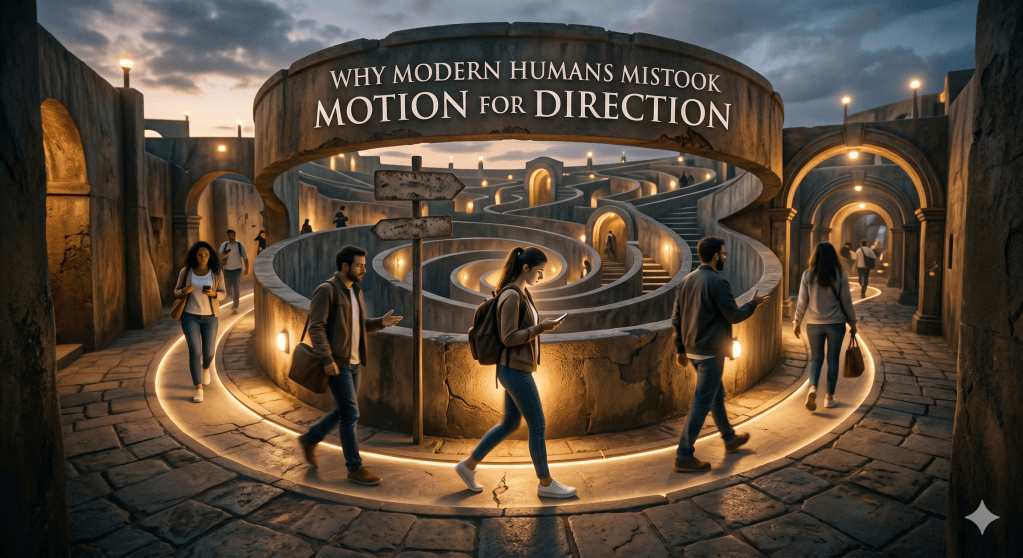
Why do people stay busy without making real progress? Explore the psychology, neuroscience, and cultural forces behind mistaking motion for direction in modern life.
Picture a Sunday evening in 2016. Someone sits down to review their week. By any reasonable measure, it was productive: dozens of emails answered, three meetings attended, a project delivered, a report filed, two networking lunches completed. The calendar was full. The to-do list shrank. And yet, sitting there, they feel a quiet unease they cannot quite name — a sense that something important did not happen, even though they cannot say what it was or when they last had time to figure it out.
That unease has a name. It is what happens when people mistake motion for direction. Not laziness. Not failure. Just the strange experience of moving fast and going nowhere in particular — of being genuinely productive while losing sight of what any of it is ultimately for. By the mid-2010s, this had become something like a defining condition of educated, connected, ambitious life in the developed world. And a decade later, rather than resolving itself, it has deepened.
The phrase “mistaking motion for direction” describes the experience. The process producing it might be called Achievement Drift: the gradual adoption of goals that were never consciously chosen — absorbed from institutions, employers, and social comparison until the life a person is living has quietly become someone else’s idea of success. Productivity became its own reward. Busyness became a status signal. The tools designed to help people accomplish more began, paradoxically, to make it harder to think about what actually mattered. The result was a strange cultural moment: an era of extraordinary capability and chronic purposelessness existing side by side, often within the same person on the same afternoon.
Understanding how this happened requires looking at several converging forces — the smartphone revolution and what it did to attention, the psychological research on goals and motivation, the sociology of status in an achievement-obsessed culture, and the neuroscience of how the human brain responds to stimulation and reward. None of these forces operated in isolation. Together, they created the conditions in which a person could be genuinely productive for years and still feel, at some fundamental level, like they were running in place.
The Speed Trap: How Technology Rewired the Experience of Time
The Smartphone as Acceleration Engine
When Apple released the first iPhone in 2007, the dominant cultural narrative around it was one of liberation. Here was a device that put the internet in your pocket, collapsed the distance between people, and let you accomplish things anywhere. The productivity gains seemed real and significant. Email on the go. Maps that actually worked. News in real time.
What took longer to become visible was what the device was doing to the experience of time itself.
By 2012 or 2013, smartphone penetration in the United States had crossed fifty percent. By 2015, it was closer to seventy. The average American was unlocking their phone somewhere between eighty and one hundred and fifty times a day — a figure that seemed startling when researchers first reported it, and that has only climbed since. The device had become the primary mediating layer between a person and their experience of the world.
The psychological consequence of constant connectivity is not simply distraction, though distraction is part of it. The deeper effect is a compression of time horizons. When information arrives continuously and demands immediate response — a notification, a message, a headline — the nervous system adapts to operating in shorter and shorter cycles. The present moment shrinks. Planning horizons contract. What feels urgent crowds out what is important.
Research from the field of temporal motivation theory, developed by psychologist Piers Steel and others, describes how motivation is powerfully affected by temporal distance. Goals that are far away feel abstract; goals that are immediate feel concrete and compelling. When technology floods daily life with immediate demands, it effectively makes everything feel urgent and nothing feel important in any lasting sense. The person responding to the hundredth notification of the day is not thinking about what they want their life to look like in five years. They are just responding.
Busyness as a Social Currency
Alongside the technological shift came a cultural one. Busyness — the sheer quantity of activities, commitments, and engagements — became something people competed over. Sociologist Jonathan Gershuny at the University of Oxford has documented what he calls “busyness as a badge of honor”: the pattern, most visible in professional and educated circles, of treating a packed schedule as evidence of importance and social worth.
This represents an interesting historical inversion. For much of human history, and well into the twentieth century, leisure was the mark of high status. The wealthy had time; the poor were busy. By the early twenty-first century, particularly in the United States, that relationship had largely reversed. The most economically successful people tended also to be the most time-pressured, and they wore that time pressure as a kind of credential.
The consequences for how people thought about their own lives were significant. When busyness itself is the signal of a life well-lived, there is no natural incentive to slow down and ask whether the things keeping you busy are actually worth doing. Motion becomes indistinguishable from direction because motion is what gets socially rewarded. The person who works sixty hours a week, volunteers on weekends, and can never find a free Tuesday is not perceived as confused. They are perceived as successful.
The Psychology of Goals: What Research Reveals About Direction
The Difference Between Doing and Becoming
One of the more useful distinctions in psychological research on motivation is the difference between performance goals and learning goals — a framework developed by psychologist Carol Dweck that has become foundational to how researchers think about achievement and long-term development.
Performance goals are about demonstrating competence: getting the grade, hitting the metric, winning the comparison. Learning goals are about developing competence: getting better at something because the capability itself matters. These are not mutually exclusive, but they operate differently in the human motivational system, and they tend to produce different outcomes under pressure.
The person caught in the motion-without-direction trap is, characteristically, heavily oriented toward performance goals. They are optimizing for visible outputs — checking things off lists, meeting deadlines, accumulating credentials — rather than toward any coherent internal sense of what they are trying to become or build. The activity is real. The output is real. But the connective tissue between activity and purpose has gone missing.
This matters psychologically because research consistently shows that people experience their work as more meaningful when they can perceive a clear line between what they are doing and a goal that genuinely matters to them. When that line is absent — when the tasks are just tasks — motivation becomes brittle. It depends on external pressure rather than internal pull. The person keeps moving because stopping feels worse, not because continuing feels purposeful.
The Planning Fallacy and the Busyness Spiral
Psychologists Daniel Kahneman and Amos Tversky identified what they called the planning fallacy: the consistent human tendency to underestimate how long tasks will take and to overestimate how much can be accomplished in a given period. The planning fallacy feeds the motion trap directly. People take on more than they can realistically do, commitments accumulate, and the schedule fills in ways that make reflection nearly impossible — while the resulting overload feels like bad luck rather than a predictable outcome of how they said yes to things.
There is also something worth noting about the relationship between busyness and anxiety. Research in clinical psychology has documented that activity can function as an avoidance strategy — a way of not sitting with uncertain questions or the kind of open-ended reflection that asks what any of this is actually for. The person who cannot tolerate stillness may not love their work so much as fear the silence that appears when it stops.
The Neuroscience of Stimulation: Why the Brain Prefers Noise
The human brain did not evolve for the information environment of the twenty-first century. It evolved in an environment that was relatively sparse in stimulation, where novel signals were worth attending to because they might indicate food, danger, or social opportunity. The neural architecture built for that world — centered significantly on dopamine systems in the midbrain — is now operating in a condition of radical informational abundance.
Dopamine is often described as the “pleasure chemical,” but neuroscientist Kent Berridge at the University of Michigan has argued for a more precise distinction: the difference between wanting and liking. Dopamine is more closely tied to wanting — the anticipatory drive toward something — than to the actual satisfaction of having it. This means the reward system can be powerfully activated by the prospect of reward without the reward itself being particularly fulfilling when it arrives. It helps explain one of the signature experiences of modern life: compulsively refreshing a feed while finding the contents largely empty. The wanting system is fully engaged. The liking system is barely touched. Technology platforms have been extraordinarily effective at exploiting this gap — notification systems, infinite scrolls, variable reward schedules are all optimized for the wanting system. They are designed, in other words, for motion. Not for direction.
What makes this especially consequential is what happens on the other side of the equation. Neuroscience has identified a network of brain regions — the default mode network — that activates during rest and unfocused mind-wandering. Far from being idle, this network is deeply involved in self-reflection, perspective-taking, imagining the future, and processing the meaning of experiences. It is, in short, where a person figures out who they are and what they want. When attention is perpetually claimed by external demands, the default mode network gets crowded out. Chronic busyness does not merely waste time that could have been spent thinking. It undermines the neural conditions in which thinking of that kind becomes possible at all.
The Cultural Architecture of Purposelessness
Achievement Drift and the Missing Question
Achievement Drift becomes possible because the systems surrounding modern life are extraordinarily effective at supplying goals. The education systems and professional cultures of the early twenty-first century were extraordinarily effective at preparing people to pursue goals and remarkably poor at helping them choose which goals were worth pursuing. The entire apparatus of academic success — grades, test scores, college rankings, internships, résumés — provided continuous feedback on performance without much occasion to ask what the performance was in service of.
This was not an accident and it was not the product of any particular ideology. It was the natural outgrowth of institutions designed to sort and credential large numbers of people efficiently. The question “how are you doing?” had clear, measurable answers. The question “what do you actually want?” was harder to grade and easier to defer.
By the time the products of this system entered professional life, many of them had spent fifteen or twenty years in high-performance mode without ever having been seriously asked — or having seriously asked themselves — what they wanted their lives to be about. They were excellent at motion. They had very little practice with direction.
The Comparison Economy
Social media did not create the human tendency to compare oneself to others — that is ancient — but it did give that tendency an unprecedented infrastructure. For the first time in history, people had continuous access to carefully curated highlights from the lives of hundreds or thousands of acquaintances, colleagues, and strangers. The result was a comparison environment radically more intense than anything the human social psychology evolved to handle.
Research on social comparison theory, building on work originally done by psychologist Leon Festinger in the 1950s, suggests that people evaluate their own lives largely in relation to reference groups — the people they compare themselves to. When the reference group was your neighborhood or your workplace, it was bounded and manageable. When the reference group became everyone you had ever met plus every aspirational figure the algorithm decided to show you, the comparison pressure became effectively limitless.
This created a particular kind of directionless striving. People were not primarily asking what they genuinely wanted. They were asking what success looked like — and the answer kept shifting based on whoever had posted something impressive most recently. Goals became mimetic: adopted because others seemed to want them, not because they reflected any authentic internal orientation. And mimetic goals, by definition, point in as many directions as there are people to imitate. They are not a compass. They are noise.
Finding a Way Through: What Actually Helps
The Evidence on Purposeful Living
Research on well-being and life satisfaction points with remarkable consistency toward a small number of factors. Psychologist Martin Seligman’s work on flourishing identifies meaning — having a sense of purpose larger than oneself — as one of the central components of a good life. Viktor Frankl, writing from experience that was about as far from theoretical as it gets, arrived at similar conclusions decades earlier.
What this research does not do, unfortunately, is tell people how to find meaning. It confirms that meaning matters, and it identifies some of the conditions under which people experience more of it, but the content of a meaningful life is irreducibly personal. This is why generic productivity advice tends to be only marginally helpful to someone suffering from the motion-without-direction problem. The issue is not how they are managing their time. It is that they have not done the harder work of figuring out what their time is for.
The practices that seem to support that harder work have some consistent features. They tend to involve some form of regular reflection — journaling, therapy, meditation, or simply the practice of setting aside time to think without agenda. They tend to involve deliberate reduction of input: less information, fewer commitments, more space. And they tend to involve honest engagement with values — not the values a person thinks they should have, but the ones that actually show up in their behavior when they pay close attention.
The Structural vs. the Personal
It would be incomplete, and a little unfair, to frame the motion-without-direction problem as purely a personal failing — a matter of individuals not having thought carefully enough about what they want. The conditions producing the problem are structural as well as psychological.
Labor markets that reward long hours. Technology platforms designed to maximize engagement. Social systems that assign status based on visible activity. Educational pipelines that delay or avoid the question of purpose. These are not features of individual psychology. They are features of the environments people move through, and they push in a consistent direction — toward more activity, more striving, more doing — regardless of whether any of it is connected to anything that genuinely matters to the person doing it.
Recognizing the structural dimension does not eliminate personal agency, but it does put it in context. Someone trying to slow down and ask harder questions about direction is, in some sense, swimming against a powerful current. That does not make it impossible. But it helps explain why so many intelligent, reflective people have found themselves years deep into a life that felt busy but not purposeful, accomplished but not satisfying.
Looking Ahead: What the Pattern Left Behind
The decade roughly spanning 2015 to 2025 saw growing popular awareness of the problem this essay has been tracing. Books on attention, purpose, and the dangers of busyness became bestsellers. The concept of a “attention economy” — the idea that platforms compete for human attention as a scarce resource and extract value from it — moved from academic discussion into mainstream conversation. Meditation apps attracted tens of millions of users. The irony of using a smartphone to meditate on the harms of smartphone use was not lost on commentators, but the impulse behind the behavior was genuine.
There were also more structural responses. Growing research attention to the relationship between technology design and well-being led to regulatory discussions in Europe and elsewhere about how platforms should be allowed to operate. The COVID-19 pandemic, whatever else it did, forced a large-scale involuntary pause that prompted many people to reconsider how they had been spending their time and what they had been chasing. Some research suggested the pause had meaningful effects on how people thought about work and meaning — though the durability of those effects is still being assessed.
By 2026, the picture is mixed. The forces that produced the motion-without-direction problem have not gone away. In some respects, the rise of large-scale artificial intelligence tools has made the underlying challenge significantly sharper — and in a way that gets to the heart of what this essay has been arguing.
AI has made execution faster and cheaper than at any point in human history. A single person with access to the right tools can now produce in an afternoon what once required a team working for weeks: drafted documents, analyzed data, generated code, researched questions, designed materials. The capability gap between what people can do and what they could previously do has never been wider. What has not expanded — what AI cannot supply — is the answer to the prior question: what should I be doing this for? Direction is becoming more valuable precisely because motion is becoming cheaper.
This is Achievement Drift accelerated. When execution becomes easy, the scarcity that remains is not skill or effort or time. It is clarity about direction. Someone with powerful AI tools and a vague sense of purpose can now produce a very large amount of work that points in no particular direction extremely efficiently. The volume of motion increases. The underlying problem deepens. If the old trap was not having time to think about what mattered, the new version is not needing to think about it because the doing can happen so fast that reflection feels optional right up until it becomes urgent.
There is, potentially, a constructive flip side. If AI genuinely handles more of the execution layer of knowledge work, it could — in principle — create space for the kind of reflection and direction-setting that has always mattered but rarely had room to breathe. Whether that space gets used that way, or simply gets filled with more accelerated doing, is one of the more consequential open questions of the current moment.
The question that animates this essay is an old one. It predates smartphones, social media, achievement culture, and artificial intelligence. The Stoics asked it. Thoreau asked it. Countless people asking themselves, at the end of an exhausting day, what was any of that for — they have been asking it too.
What is new is the scale of the capability surrounding the question, and the sophistication of the forces that make answering it feel less necessary than it actually is. Achievement Drift does not announce itself. It accumulates quietly, one reasonable decision at a time, until the distance between where a person is and where they would have chosen to go becomes visible only in retrospect.
Getting quiet enough to hear one’s own answer — and then having the persistence to organize a life around it rather than around whatever the culture happens to be applauding this season — may be the most genuinely productive thing a person can do. It does not look like motion. It rarely generates a notification. But it is, in the truest sense, direction.









