
Originally published in October 2016 and comprehensively updated/edited in June 2026.
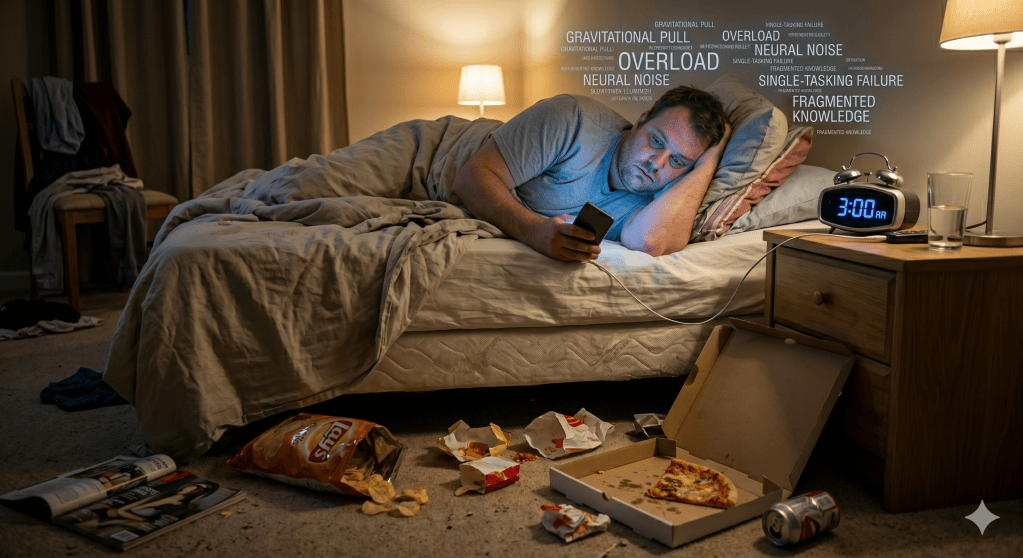
How the ancient human brain became habituated to continuous digital stimulation — exploring the neuroscience, psychology, and social forces behind modern attention and anxiety.
Something shifted in human behavior around 2012 and 2013. It was hard to name at the time, and most people were too busy experiencing it to notice it was happening at all. Attention spans shortened. Silence became uncomfortable. Waiting — for a webpage to load, for a friend to text back, for a line to move — started to feel genuinely unbearable in a way it hadn’t before. People began checking their phones not because they expected anything in particular, but because not checking felt worse than checking.
This wasn’t a moral failing or a generational weakness. It was the predictable outcome of a profound mismatch: the ancient human brain, shaped by millions of years of evolution for a very different kind of environment, suddenly immersed in a world engineered to exploit its deepest reward circuits. The story of how that happened — and what it did to the way we think, feel, and relate to one another — is one of the defining stories of modern life.
This is an attempt to tell that story clearly.
The Brain Was Not Built for This
To understand why humans developed such a powerful dependence on continuous stimulation, you first need to understand what the brain was actually built for.
Our brains evolved in conditions of scarcity and uncertainty. For the vast majority of human history, information was rare and consequential. A rustle in the grass might mean a predator. A change in the sky might mean rain. An unfamiliar face in the tribe required immediate evaluation. We developed an extremely efficient system for detecting novelty, because in the ancestral environment, new things mattered. They could mean food, danger, opportunity, or threat.
At the center of this system is dopamine — a neurotransmitter that most people associate with pleasure, but which more precisely governs anticipation, motivation, and the drive to seek. Neuroscientist Jaak Panksepp, who spent decades mapping the emotional systems of the brain, called this the SEEKING system. It’s the neural engine that pushes animals — including humans — to explore, investigate, and pursue. Critically, dopamine surges not primarily when a reward is received, but when a reward is anticipated or when something unexpected happens. The uncertainty itself is the trigger.
This is why checking a phone produces a distinct psychological pull that doesn’t disappear after checking. The behavior is driven not by the reward you received last time, but by the possibility of a reward this time. In behavioral science, this is called a variable ratio reinforcement schedule — the same mechanism that makes slot machines so difficult to walk away from. Unlike fixed rewards (which lose their motivating power quickly), variable rewards maintain their pull precisely because you can never be sure when the next one is coming.
Social media platforms, news feeds, email inboxes, and messaging apps are all — whether by design or by accident — extraordinarily effective variable ratio reward machines. Every refresh might bring something interesting, something validating, something funny, or nothing at all. The uncertainty keeps the SEEKING system running.
A World Designed to Capture Attention
The mid-2010s represented a remarkable concentration of several forces that, taken together, created an environment of near-constant stimulation unlike anything humans had previously experienced.
Smartphones had achieved mass adoption. In the United States, smartphone ownership crossed 50 percent of adults around 2012 and continued climbing sharply. By 2016, most Americans — and hundreds of millions of people globally — carried a device in their pocket that was connected to the internet, loaded with social apps, and capable of producing a stimulation-delivering notification at any moment of the day or night.
Simultaneously, the business models underlying the dominant platforms of that era had converged on a single metric: engagement. Facebook, Twitter, YouTube, and their competitors were not selling products in any traditional sense. They were selling attention to advertisers, which meant their financial incentives were perfectly aligned with maximizing the amount of time users spent on their platforms. Every design decision — the infinite scroll, the notification badge, the like button, the autoplay video — was tested and optimized for its effect on user behavior. Features that kept people scrolling were kept. Features that didn’t were changed.
This was not accidental, and it was not hidden. Former insiders at several major platforms have since described internal cultures where engineers competed to design the most engaging features, with little systematic discussion of what “engaging” might be doing to users over time. Tristan Harris, a former design ethicist at Google, described the smartphone era as a “race to the bottom of the brain stem” — a competition to capture attention by appealing to the most primitive and reactive parts of human psychology.
The result was an environment that had been optimized for stimulation in ways that no human environment had ever been before.
What Constant Stimulation Does to the Mind
The effects of living inside a high-stimulation environment are not straightforward, and it’s worth being careful about overstating what the science does and doesn’t show. What the research does suggest, though, is meaningful.
The Attention Economy and Its Costs
Sustained attention — the ability to focus on a single thing for an extended period — appears to be a resource that can be depleted and that requires practice to maintain. Psychologist Mihaly Csikszentmihalyi spent decades studying what he called “flow” states: periods of deep, focused engagement in a task, characterized by high performance, time distortion, and intrinsic satisfaction. One consistent finding across his research was that flow requires uninterrupted attention. Frequent interruption, even brief interruption, breaks the state and makes re-entry difficult.
Research by Gloria Mark at the University of California, Irvine found that after an interruption, it takes an average of about 23 minutes to return to the original task at the same level of focus. In a world of constant notifications, this means that deep attention becomes structurally difficult to sustain. The interruptions are built into the environment.
A separate body of research has examined what happens to the mind during moments that are not filled with stimulation — what neuroscientists call the default mode network. This brain system activates during rest, mind-wandering, and daydreaming. It appears to be involved in self-reflection, memory consolidation, creative thinking, and the formation of long-term narrative identity. Some researchers, including Mary Helen Immordino-Yang at USC, have argued that the default mode network may be essential for developing the kind of deep emotional and moral thinking that allows humans to understand themselves and others.
If that’s right, then a culture that relentlessly fills every quiet moment with stimulation may be doing something consequential to human cognition — not through any single dramatic event, but through a gradual erosion of the mental conditions that certain kinds of thinking require.
Anxiety, Restlessness, and the Discomfort of Nothing
A notable feature of this habituation to continuous stimulation is what happens when the stimulation is removed. For many people, the experience of sitting quietly without a phone, without background noise, without some form of input, produces not relaxation but a low-grade agitation — a pull toward something, anything, that functions as content.
A striking 2014 study published in Science found that a majority of participants preferred to administer mild electric shocks to themselves rather than sit quietly with their thoughts for 15 minutes. The researchers, led by Timothy Wilson at the University of Virginia, described the result as evidence that the human mind resists unoccupied time, and that negative stimulation is often experienced as preferable to no stimulation.
This finding raised more questions than it answered, but it pointed toward something real in everyday experience. The discomfort of idleness — of being unstimulated — appears to have intensified significantly as smartphone use became normalized. Whether the technology caused this change or simply made an existing tendency more visible is genuinely difficult to determine. But the correlation between the spread of smartphone culture and widespread reports of increased anxiety, restlessness, and difficulty being present is hard to ignore.
Social Stimulation and the Approval Circuit
Among the most powerful drivers of this compulsive relationship with digital platforms was the social dimension. Humans are, at the most fundamental level, social animals. The need for acceptance, belonging, and status within a group is not superficial or vain — it’s wired deeply into the primate brain, because for most of human evolutionary history, social rejection carried life-or-death consequences. Being cast out of the group meant vulnerability, resource loss, and reduced reproductive success. We evolved to treat social approval and social rejection with the same urgency we treated physical threats.
Social media tapped directly into this circuitry.
The introduction of the “like” button — first by FriendFeed in 2007, then famously by Facebook in 2009 — transformed social platforms into real-time feedback systems for social approval. Posting something and waiting to see how many likes it received activated the same anticipatory dopamine mechanisms that drive other forms of compulsive seeking behavior. Receiving likes produced a brief reward. Receiving no likes produced something closer to the social rejection response — a disproportionate feeling of discomfort given the actual stakes.
Research in social neuroscience has shown that social pain — rejection, exclusion, public embarrassment — activates some of the same brain regions as physical pain. The impact of a humiliating comment on a social media post is not merely “psychological” in some abstract sense; it registers in the brain through circuitry that evolved to process genuine threat. This is part of why social media interactions can feel so emotionally intense relative to their apparent significance. The nervous system is not assessing them in terms of their real-world consequences; it’s assessing them through emotional systems that predate language.
The consequence of embedding this circuitry into an app that people checked dozens of times per day was a persistent low-level monitoring of social standing — a kind of background anxiety about status and acceptance that had no natural off switch.
The Body in the Loop
The effects of high-stimulation culture were not confined to the mind. The body is deeply involved.
Chronic stress — the kind produced by sustained anxiety, constant vigilance, and relentless information load — activates the body’s stress response systems in ways that accumulate over time. Cortisol, the primary stress hormone, is designed for short-term threat response. It sharpens attention, accelerates the heart, suppresses digestion and immune function, and mobilizes energy reserves — all useful adaptations for a brief emergency. But when cortisol remains chronically elevated because the nervous system is treating an endless news feed or social media notification stream as a persistent threat, the physical costs mount: disrupted sleep, compromised immune function, increased inflammation, heightened cardiovascular risk.
Sleep, in particular, became a casualty of the stimulation economy. Blue light emitted by smartphone screens suppresses melatonin production and signals wakefulness to the brain. But beyond the physiological effects of the light itself, the behavioral habits surrounding phone use — checking social media in bed, reading news before sleeping, keeping a device on the nightstand — created patterns that kept the nervous system alert during hours that evolution designated for rest. Research consistently showed a correlation between high smartphone use and sleep disruption, particularly among adolescents, though the causal mechanisms were often difficult to isolate.
The Youngest Minds
No group experienced the shift more intensely than adolescents, and no aspect of the culture of continuous stimulation became more widely debated than its effects on young people.
The timing was significant. Adolescence is a developmentally sensitive period during which the prefrontal cortex — the brain region governing impulse control, long-term planning, and emotional regulation — is still actively maturing. It’s also a period of intense social sensitivity, during which the peer approval system operates at high intensity even under ordinary circumstances. Putting high-powered social feedback technology in the hands of teenagers during this particular window of development proved to be an experiment with results that took years to fully materialize.
Psychologist Jean Twenge, who has tracked generational psychological data for decades, documented a sharp upturn in reported anxiety, depression, and loneliness among American adolescents that correlated closely in time with the rise of smartphone use and social media adoption. The increases were particularly pronounced among girls, consistent with research suggesting that girls’ social lives are more embedded in relational networks that translate more directly to social media dynamics. Twenge was careful to note that correlation is not causation, and the research has remained genuinely contested among scientists. But the signal was consistent enough to warrant serious attention.
The debate crystallized into a broader question that extended beyond teenagers: what does it do to human development — at any age — to replace periods of boredom, daydreaming, and unstructured time with a device that fills every gap with input?
What Boredom Was For
In the pre-smartphone era, boredom was an ordinary feature of life. Waiting rooms, commutes, standing in lines, lying in bed before sleep — these were times when the mind had no external input and was left to its own devices. Cognitive science has increasingly suggested that these moments were not wasted time. They were doing something.
Boredom, researchers have found, correlates with increased creativity. When the mind is not occupied with external demands, it tends to wander into associative, imaginative territory — connecting ideas that have no obvious connection, revisiting memories, working through unresolved problems in the background. The insight that arrives in the shower is not a cliché; it reflects a genuine cognitive phenomenon. The mind works differently when unoccupied than when tasked, and some of what it does in that mode is generative in ways that directed, goal-focused thinking cannot replicate.
By filling every moment of potential boredom with stimulation, the smartphone era effectively removed this cognitive resource from daily life. It was replaced with something that felt better in the moment — more engaging, more connected, more entertaining — but that did not perform the same function.
This trade-off was made by hundreds of millions of people without any real awareness that a trade-off was being made.
Adaptation, Resilience, and the Limits of the Alarm
It would be incomplete — and inaccurate — to tell this story without acknowledging what it leaves out.
Humans are adaptive. The brain is plastic in ways that researchers are still mapping, capable of adjusting to new environments in both directions — becoming more reactive under certain conditions, developing new forms of resilience under others. There is real evidence that heavy media consumers developed strategies for managing information overload: selective attention, curated feeds, deliberate disconnection. The alarm that swept through psychology research and popular culture in the 2010s was not wrong, but it was also not the full picture.
Digital technology also extended genuine human connection, provided access to communities that would otherwise never exist, enabled creative collaboration across distances, and gave millions of people — particularly those isolated by geography, disability, or social marginalization — a connection to the broader human world that they would not have had otherwise. These are real goods. They don’t erase the costs, but they belong in any honest account.
And the science, where it was most careful, consistently resisted the most alarming conclusions. The effects of screen time, social media use, and information overload on mental health and cognition were real but typically modest in controlled studies — significant at the population level, but not deterministic for individuals. Many heavy users of social media reported high levels of social connection and wellbeing. Many people who rarely touched a smartphone reported anxiety and depression for reasons entirely unrelated to technology. The picture was complicated, as pictures of human behavior usually are.
Looking Forward From Here
The broad outlines of this story were clear enough by 2016 that thoughtful observers were beginning to describe them. What wasn’t yet clear — and what the decade following would slowly reveal — was what humans and societies would do about it.
A backlash emerged. It was slower and quieter than the original wave, but real. “Digital wellness” entered the cultural vocabulary. Phone-free spaces, intentional offline time, and attention management became subjects of serious discussion in schools, workplaces, and therapy offices. Several countries moved toward legislative approaches to limit social media use by minors. Researchers studying attention and cognition found growing audiences for findings that had previously interested only specialists.
The deeper question — whether the attention economy and its underlying business model would bend to the weight of evidence and public concern, or whether the incentive structures that created the problem were simply too powerful to change without structural intervention — remained genuinely unresolved.
It’s worth being precise about what this story is actually claiming, because the claim is easy to misread. Humans have always sought stimulation. Curiosity, discovery, social connection, learning — these are not pathologies. The brain’s SEEKING system exists for good reasons and produces real goods. The problem was never stimulation itself. The problem was a historically unprecedented concentration and delivery mechanism: continuous, externally supplied, algorithmically optimized stimulation, available at any moment, designed by systems with no interest in whether you felt better or worse afterward.
What the evidence from this period ultimately reveals is not a failure of individual willpower or a defect in human character. It reveals a mismatch — between ancient human biology and an environment that was built, at extraordinary speed and scale, to exploit that biology for commercial ends. Understanding that mismatch clearly is the first step toward navigating it wisely.
The human brain wants novelty, connection, and the anticipation of reward. It always has. For most of history, the world didn’t have the technology to deliver all three, continuously, at the tap of a finger. Now it does. What humans do with that fact will shape not just individual wellbeing, but the texture of collective life for generations to come.









