
Originally published in October 2016 and comprehensively updated/edited in June 2026.
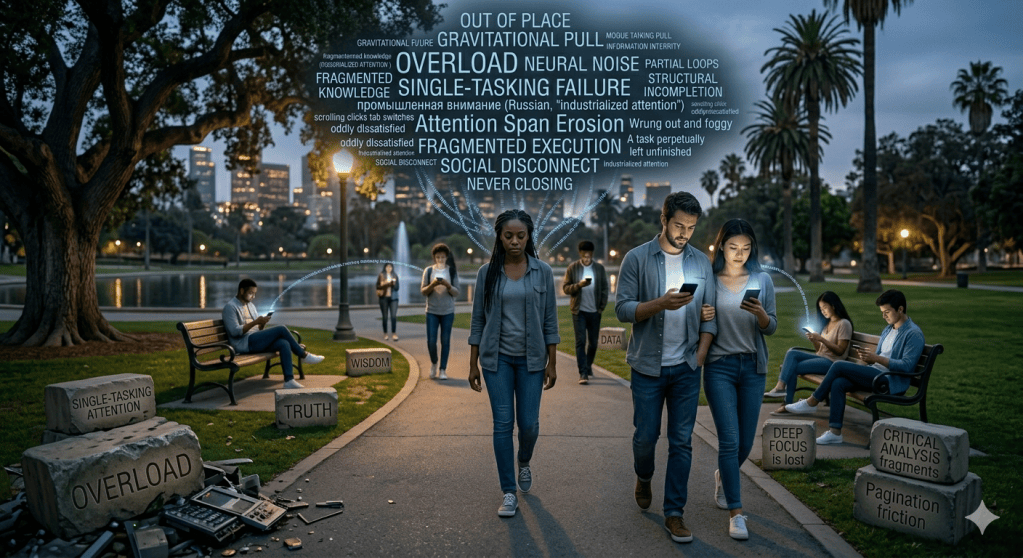
Why solitude started feeling threatening in the digital age — exploring the psychology, neuroscience, and cultural forces behind our discomfort with being alone.
There was a specific kind of discomfort that became widespread in the early 2010s, though it took years for people to name it clearly. It wasn’t loneliness exactly — many of the people who experienced it were surrounded by others, or at least perpetually connected to them. It was something closer to an inability to be alone. Not just a preference for company, which humans have always had, but something sharper: a low-grade anxiety that arrived the moment a person was left with no input, no distraction, no one to reach out to. The quiet room. The commute without headphones. The dinner table when the phone was put away.
Solitude had started feeling threatening.
Think about what a grocery store line looked like in 2006. People stared at the tabloid covers, glanced around, let their minds drift. Maybe they ran through a mental to-do list, or noticed the person ahead of them, or simply waited. A decade later, the phone was out before the cart had even stopped moving — not because anything urgent had arrived, but because two minutes of unoccupied stillness had become genuinely uncomfortable.
This shift was subtle enough that it could be dismissed as personal quirk — some people just prefer company, always have. But the pattern was too widespread, too consistent across demographics and cultures, to be explained by individual temperament alone. Something in the broader environment had changed, and that change had altered the way millions of people related to their own minds when left alone with them.
This essay explores what happened, why it happened when it did, and what the science of solitude reveals about a condition that most people never recognized they were losing.
What Solitude Actually Is
Before asking why solitude started to feel threatening, it’s worth being clear about what solitude actually means — because it is routinely confused with loneliness, and the two are almost opposites.
Loneliness is the pain of unwanted isolation. It arises from a perceived gap between the social connection a person has and the social connection they want. It’s a signal, much like hunger, that something is missing. Loneliness tends to be accompanied by rumination, a sense of rejection or exclusion, and a yearning for contact.
Solitude is something else entirely. Psychologists define it as time spent alone that is voluntary and that involves the experience of being with oneself rather than simply being without others. It carries no inherent negative valence. Across a wide range of psychological research, chosen solitude has been associated with self-reflection, emotional regulation, creative thinking, and a kind of psychological restoration that social interaction — even pleasurable social interaction — doesn’t provide.
Ester Buchholz, a psychoanalyst who wrote extensively about what she called the “need for alonetime,” argued that solitude was not merely the absence of connection but an active psychological state with its own developmental function. Like attachment and sociality, she believed the capacity for productive solitude was a fundamental feature of healthy human psychology — one that required cultivation and, crucially, practice.
The distinction matters because the cultural moment of the mid-2010s didn’t make people lonelier in the clinical sense. By most measures, people were more connected than they had ever been — more messages sent, more relationships maintained, more social contact by volume. What eroded was something different: the capacity to be comfortably alone. The ability to sit with one’s own thoughts without reaching for the phone, turning on the television, or manufacturing some form of external input.
That capacity, researchers were beginning to realize, was not trivial. Its loss carried consequences that showed up in mental health data, in measures of creativity and self-knowledge, and in the texture of daily life in ways that were difficult to quantify but easy to recognize.
The Historical Context: Solitude Was Never Easy
It would be a mistake to romanticize the past. Solitude has never been uniformly comfortable, and the idea that previous generations were better at sitting quietly with their thoughts probably owes more to nostalgia than evidence.
Blaise Pascal, writing in the seventeenth century, observed that “all of humanity’s problems stem from man’s inability to sit quietly in a room alone.” The remark has become so frequently quoted that it risks sounding glib, but it points to something Pascal took seriously: the human tendency to seek diversion from one’s own inner life, and the restlessness that emerges when diversion is unavailable. Pascal was diagnosing a condition that predated smartphones by several centuries.
What changed in the 2010s was not the fundamental human discomfort with an unoccupied mind. What changed was the availability of relief. For most of human history, the means of escaping one’s own thoughts required some effort: seeking out company, picking up a book, going to a tavern, finding work to do. Boredom and solitude were often simply imposed by circumstance, because the alternatives required action or resource.
The smartphone collapsed that effort to nearly zero. By 2012 or 2013, the means of escape — social media, streaming video, messaging, endless news — were available instantaneously, carried in a pocket, active at any hour. The cost of avoiding solitude dropped so sharply that avoidance became the default behavior rather than the exception. This wasn’t a choice most people made consciously. It was the path of least resistance, and the path had been engineered to be as smooth as possible.
The result was a widespread atrophying of a capacity that had previously been maintained simply because circumstances demanded it.
What the Research Found
The psychology of solitude became a more active research area in the 2010s, partly because researchers noticed the same cultural shift that everyone else was experiencing, and partly because decades of study on attention, emotion regulation, and creativity were converging on findings that pointed in the same direction.
The Restorative Function
One of the most influential frameworks for understanding solitude came not from clinical psychology but from environmental psychology. Rachel and Stephen Kaplan developed what they called Attention Restoration Theory in the 1980s and 1990s, originally to explain why time in natural environments seemed to reduce mental fatigue. Their core insight was that certain kinds of attention — the directed, effortful attention required for tasks, decisions, and social interaction — deplete over time and require recovery periods to restore.
The mental state associated with restorative recovery, in their framework, involves what they called “soft fascination” — a gentle, wandering engagement with one’s surroundings that doesn’t demand directed attention. Quiet natural environments provided this. So did certain kinds of solitude.
This framework wasn’t directly about solitude, but its implications were clear: if directed attention depletes and requires recovery, and if the smartphone environment turned recovery periods into additional bouts of directed attention — processing social feeds, responding to messages, following news — then the population was systematically preventing the cognitive restoration that had previously occurred in idle moments. The waiting room, once a mild tedium that allowed mental recovery, had become another arena of engagement.
Solitude and Emotional Processing
A separate body of research explored the relationship between solitude and emotion regulation — the ability to manage one’s own emotional states. This is a more nuanced area, because solitude’s effects on emotion vary significantly depending on the person and the circumstances.
Psychologist Reed Larson, who studied the experience of adolescents in solitude using experience sampling methods — essentially, paging people at random intervals and asking how they felt — found something counterintuitive. Adolescents who spent moderate amounts of time alone during the week reported better emotional wellbeing at the end of the week than those who spent very little time alone, despite reporting lower moods in the moment of solitude itself. The finding suggested that solitude functioned something like emotional processing: uncomfortable while it was happening, but producing better outcomes than avoidance.
The analogy to physical exercise is imperfect but useful. The discomfort of solitude, particularly for someone unaccustomed to it, may be part of its function rather than evidence of its harm. Sitting with one’s thoughts — including uncomfortable ones — appears to be part of how those thoughts get processed and integrated rather than suppressed.
If that’s right, then the widespread practice of immediately filling moments of solitude with stimulation may have been doing something to emotional processing that was difficult to see in the short term. The emotions weren’t resolved; they were deferred.
The Mind-Wandering Research
Around the same time, neuroscience was building a richer picture of what the brain does during rest and mind-wandering — the default mode network research mentioned earlier in this series. These findings were directly relevant to solitude.
Matthew Killingsworth and Daniel Gilbert published a widely discussed 2010 paper in Science using an iPhone app to sample people’s thoughts and moods throughout the day. Their headline finding — that people’s minds were wandering roughly 47 percent of the time, and that they were less happy when their minds wandered — generated considerable attention. But the paper’s relationship to solitude was more complex than the headlines suggested. Mind-wandering associated with negative emotion was different in character from the constructive introspection associated with voluntary solitude. The distinction between an unoccupied mind that ruminated and one that engaged in productive self-reflection was a real one, even if the research didn’t always capture it cleanly.
What the default mode network research made clear was that an unoccupied mind is not an inactive one. The brain in quiet, unfocused states is doing something — consolidating memories, working through unresolved problems, constructing a narrative sense of self, imagining future possibilities. Disrupting these processes by immediately filling every idle moment with external input doesn’t eliminate them; it just prevents them from completing.
Why the Quiet Room Became Uncomfortable
Understanding the psychological mechanisms doesn’t fully explain why solitude specifically started to feel threatening — why the experience acquired an anxious quality for many people, rather than simply becoming less practiced.
Part of the answer is neurological. The same reward circuitry described in the stimulation essay applies here: a mind conditioned by regular doses of social feedback and variable-ratio stimulation comes to experience the absence of those inputs as a kind of deprivation. The quiet room isn’t just boring; it registers as wrong, as a state to be corrected. The agitation that many people report when their phones are unavailable is not simply impatience. It has the quality of withdrawal — a nervous system that has been calibrated to a particular baseline of input, now running below it.
But there’s a second, perhaps deeper layer. Solitude requires confronting one’s own thoughts, and the mid-2010s produced a cultural environment in which the contents of the unoccupied mind were, for many people, not particularly pleasant to encounter. Anxiety about status, productivity, social comparison, and an increasingly turbulent news environment meant that the thoughts waiting in the quiet room were often ones that people had strong incentives to avoid.
Social comparison, in particular, had been systematically intensified by platform design. Looking at a social feed populated by curated highlights of other people’s lives — their travel, relationships, professional achievements, and social gatherings — reliably produces upward social comparison, the tendency to evaluate oneself against those who appear to be doing better. Research consistently finds that upward social comparison is associated with lower mood and reduced self-esteem. By 2015 or 2016, this was the ambient condition of social media use for hundreds of millions of people.
When the phone went down and the feed disappeared, what remained was the residue of all those comparisons — the half-formed anxieties, the sense of inadequacy, the unresolved questions about whether one’s life measured up. The quiet room made those thoughts audible. So the phone went back up.
Solitude, Identity, and the Self
There is a dimension of this story that goes beyond mood and cognitive function into something more fundamental: the relationship between solitude and the sense of self.
Developmental psychologists have long observed that the capacity for solitude is linked to what the British pediatrician and psychoanalyst Donald Winnicott called the ability to be “alone in the presence of another” — a state first achieved in infancy, when a child can play independently while a trusted caregiver is nearby. This internal sense of security — the felt knowledge that one is not abandoned even in aloneness — develops through early attachment relationships and forms part of the psychological foundation for comfortable solitude in adulthood. Adults who lack this foundation tend to experience solitude as threatening in a way that goes beyond boredom or discomfort; it carries a faint echo of abandonment, of non-existence.
The smartphone era didn’t change early childhood development in any direct way. But it created an environment in which the capacity for comfortable solitude — even if it had been adequately developed — could go unpracticed for years. And capacities that go unpracticed tend to weaken, whatever their origins.
Solitude Was Not Equally Lost
The texture of this shift varied considerably by circumstance, personality, and life situation. Introverts, who tend to find social interaction more draining and solitude more restoring, often reported the smartphone era as a genuinely mixed experience. The pressure toward constant connectivity conflicted with a genuine need for time alone, but the ability to maintain social relationships with lower energy expenditure — texting rather than calling, following rather than attending — offered real advantages. The smartphone could be a tax on introversion or a relief from it, depending on how it was used.
People with demanding social or professional lives sometimes found that the erosion of solitude accelerated an existing depletion. The executive who once had a quiet commute, the parent who had brief pockets of stillness after the children slept, the student who once stared out a window between classes — these micro-recoveries, individually minor but collectively significant, were increasingly colonized by the phone. And the discourse about solitude and digital wellness that emerged from this period was largely shaped by educated, relatively affluent voices; the prescriptions that followed — meditation retreats, digital detoxes, intentional phone-free time — were easier to implement for some than for others.
What Was Lost in the Quiet
Beyond mood, cognition, and emotional processing, there is something harder to measure that solitude provides: the experience of one’s own inner life as a real and inhabitable place.
This may sound abstract, but it has concrete implications. Creative work of almost any kind requires extended periods of solitude — not because creativity is solitary by nature, but because the early stages of a creative process involve a kind of internal exploration that is disrupted by social demands. The writer staring at a blank page, the scientist turning a problem over in her mind, the musician working through a melody in her head — these are all forms of productive solitude, and they require a tolerance for the discomfort of open-ended, undirected mental activity.
If that tolerance is eroded by years of immediately filling every uncomfortable moment with external input, the effect on creative capacity is not dramatic and sudden — it’s gradual and largely invisible, a slight lowering of the threshold at which the mind gives up and reaches for a distraction. The great insight or the solution to the persistent problem requires staying with the discomfort long enough for the mind to work through it. That staying power, like any other form of tolerance, can be reduced by disuse.
There’s also the matter of self-knowledge. Knowing who you are — what you actually value, what genuinely brings you satisfaction, what you believe when you haven’t been recently influenced by someone else’s opinion — requires extended acquaintance with your own thoughts. Philosophers and contemplative traditions across cultures have recognized this for millennia. More recently, psychological research on what is called “self-concept clarity” — the degree to which a person has a clear, stable, and consistent sense of their own identity — has found it associated with better mental health, more stable relationships, and greater emotional resilience.
A person who has spent years carefully avoiding their own unoccupied mind may find, when circumstances eventually force solitude upon them — illness, loss, the quiet that arrives uninvited in middle age — that the inner life they encounter feels strange and unfamiliar, because so little time has been spent in it.
The Recovery of Solitude
There’s a quiet countermovement worth noting, because the story doesn’t end only in loss.
By the late 2010s and into the 2020s, the same cultural moment that produced anxiety about constant connectivity also produced a renewed interest in practices that had been associated with solitude for centuries: meditation, long-form reading, walking without a destination or a podcast. These were not new inventions; they were old technologies for inhabiting one’s own mind, rediscovered by people who had noticed what they were losing. Research on mindfulness expanded rapidly during this period, with studies linking regular practice to reduced anxiety, improved attention, and greater emotional regulation — the capacity, in essence, to sit with one’s inner experience without immediately escaping it.
The reports of readers struggling to concentrate on books they had previously enjoyed, finding their attention fragmenting after a few pages, became a cultural conversation in themselves. And the response — deliberate phone-free time, a return to physical books that couldn’t be interrupted by notifications — represented a form of practiced recovery. None of it reversed the broader shift. But it demonstrated that the capacity for solitude, once eroded, was not permanently lost. It was more like a muscle than a bone — diminished by disuse, but responsive to exercise.
Why It Still Matters
The significance of what happened to solitude in the 2010s is not simply that people became more anxious about being alone. It’s that a specific psychological capacity — one connected to self-knowledge, emotional processing, creativity, and the recovery of attention — was systematically disrupted at population scale, in a very short period of time, largely without anyone deciding that this was a good idea.
No one chose to make solitude feel threatening. It happened as a byproduct of millions of individual decisions to check a phone, each one reasonable in isolation, accumulating into a pattern that reshaped the relationship between people and their own inner lives. This is one of the defining features of the technological moment the 2010s represented: consequences that were real and significant, produced not by any single choice or intention, but by the aggregate effect of an environment optimized for engagement at the expense of almost everything else.
The question that emerged from this period — and that remains unresolved — is whether the recovery of comfortable solitude requires deliberate effort in a way that its original development did not. For most of human history, solitude arrived whether you wanted it or not. Now, for most people in wealthy, connected societies, it must be chosen and defended. That represents a genuine change in the human condition, small enough to go unnoticed and large enough, perhaps, to matter quite a lot.









